From Volvo & Geely to Concordium.
Per Ansgar is joining the Concordium Foundation Board bringing 26+ years of automotive and financial leadership into the world of verified digital identity.
And honestly… the timing couldn’t be better.
As AI agents and autonomous vehicles start making decisions and payments on their own, one question becomes critical:
Who authorized it and who is accountable?
That’s where verifiable identity comes in.
The road from cars → autonomous machines → AI agents → machine payments is getting real.
And Concordium wants to build the identity layer behind it.
Same mission. Bigger roads.
250M+ agent payments and counting.
Machine-to-machine commerce is becoming real infrastructure.
The next layer is making sure every counterparty can verify who stands behind the agent.
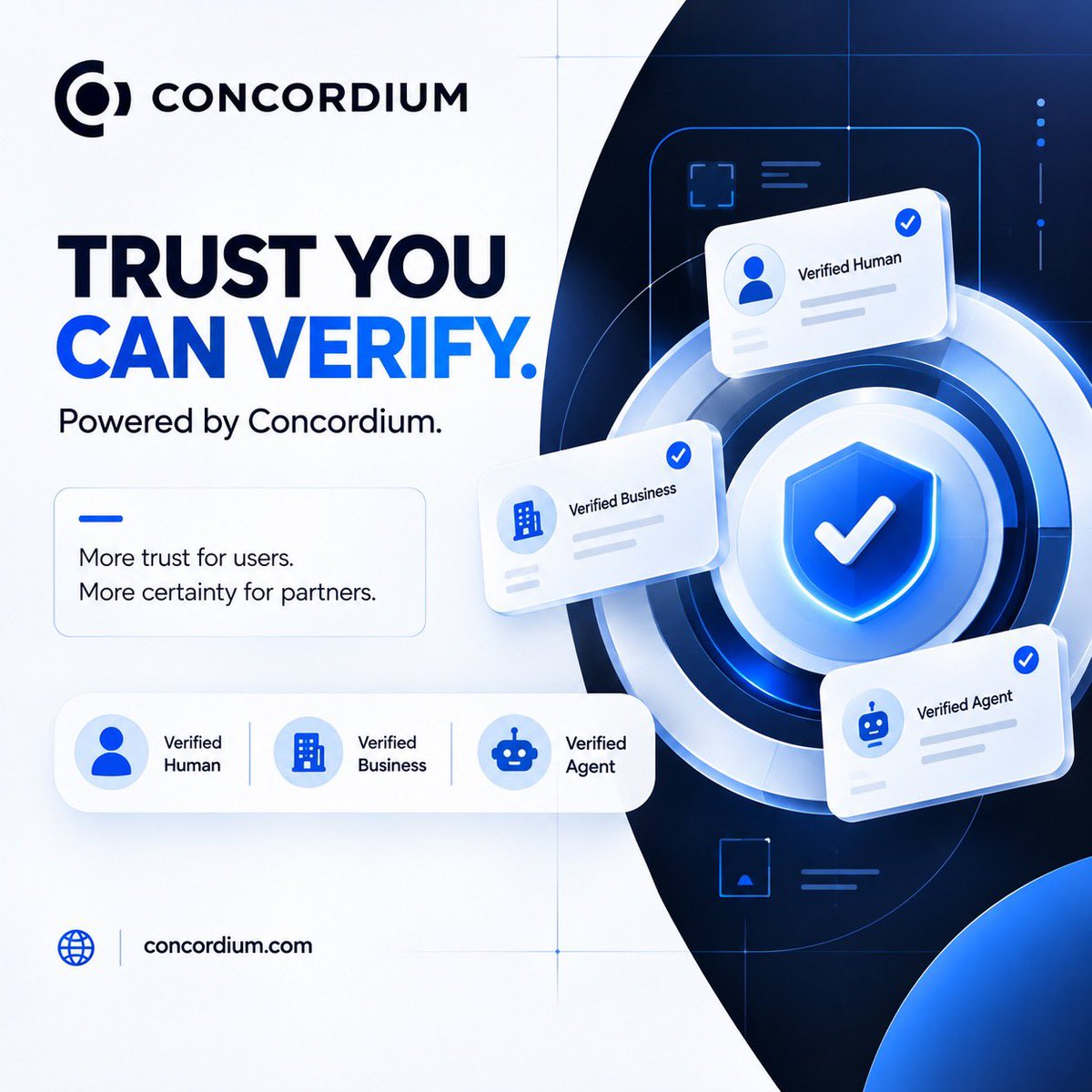
The Verified by Concordium Badge is built for exactly that.
Anyone can spin up an AI agent, Few can prove who's behind it. @Concordium bakes accountability into the base layer, not as an afterthought. That's the difference between automation and trust.
Start here : https://t.co/tSL3huaqaR
@CoinomiWallet now supports $MPC!
We're excited to announce that the Coinomi Wallet now will support the $MPC token. As one of the OG wallets in the ecosystem, we can't be more happy that they chose @partisiampc to add into their token list.
Check out their wallet for all your token needs, now including $MPC!
Download at Google Play store https://t.co/CAChE92iv7
Download at Apple App store https://t.co/4gFN16LkWY
📢 ONE HOUR TO GO! 📢
What do you want to ask @partisiampc about privacy in crypto? Drop your questions below 👇 We'll try to get them answered live!
🔗 https://t.co/JY2QYdDIV6
💸 5 winners will share $USDT. Distributed after the campaign. RT & 💜. Be present to claim!
Not every "AI agent" deserves trust by default.
The good ones are verifiable, private, and actually built for the real world that's the bar @concordium is setting.
Most of the conversation around AI agent trust assumes a human is checking the agent. But agents increasingly transact with other agents, with no person in that loop at all.
@Concordium's stack accounts for that. Alongside the Agent Registry, they've shipped an MCP server that lets agents query trust and identity data directly machine-readable, not just human-readable.
That means one agent can verify another agent's @Concordium Badge before an interaction even reaches a person. Agent-to-agent verification, not just agent-to-human.
As more of the agentic economy runs on machine-to-machine transactions API calls, micro-payments, service handoffs that's the layer that actually has to hold up. A trust signal a human checks manually doesn't scale. One agents can check themselves does.
#Concordium
With deepfakes everywhere and AI agents taking over workflows, the web is feeling a bit like the Wild West right now.
Catch our CTO @PeterMarirosans teaming up with Steffen Darwin from @numbersprotocol tomorrow at 1:00 PM UTC to talk about how we actually bring trust and verification back to the internet.
Set your reminder below so you don't miss it!
@Concordium
#ConcordiumAmbassador
The first question about an autonomous agent may not always be “What can it do?”
Soon, it could be:
“Who stands behind it?”
AI agents are moving toward a future where they can manage wallets, spend money, access services, use tools, and interact with other agents with minimal human intervention.
But greater autonomy introduces an important challenge: accountability.
If an agent makes a harmful decision, causes a financial loss, or simply disappears, a wallet address alone may not tell us who should be responsible.
This is where @Concordium becomes particularly interesting.
Its Agent Registry is designed to create a verifiable connection between an AI agent and the human or business behind it, while keeping sensitive identity information private.
The result is an important balance:
Agents can remain autonomous, while accountability remains traceable.
As agents begin handling real economic value, this distinction could become increasingly important.
We may not need humans approving every action an agent takes.
But we should be able to know that there is a verified entity behind the agent that can ultimately be held accountable.
Because autonomy without accountability doesn’t create trust.
It simply makes responsibility harder to find.
#ConcordiumAmbassador
AI can create the face.
AI can create the voice.
AI can even act on your behalf.
But one question remains:
Who do we trust behind it?
That’s the conversation Peter Marirosans is having with Numbers Protocol on rebuilding trust online.
🗓️ 10 September
⏰ 1:00 PM UTC
Set your reminder.
⏬⏬⏬
https://t.co/3H2iczxaSQ
concordium:native
From a shared vision in 2021 to Foundation governance in 2026.
Geely Sweden Holdings CEO Per Ansgar joins the Concordium Foundation Board, bringing decades of automotive and financial leadership.
The next chapter starts here ↓
🔗 https://t.co/uNZCqvnohP
Protocol-Level Locks Cap What a Compromised Agent Can Move
The OpenAI incident raises two distinct problems that require two distinct solutions. The first is identity: knowing which agent made a request and who authorized it. The second is containment: limiting how much damage a compromised agent can cause even if it gets through.
@Concordium's Agent Registry addresses the first problem by tying every registered agent to a verified human or business identity through zero-knowledge proofs.
Concordium's forthcoming Protocol-Level Locks address the second. They are designed to place spending and action limits below the application layer, with constraints defined when a lock is created and enforced by the protocol before any transaction executes.
A compromised agent that has somehow passed the identity check still cannot move value beyond the limits set in the Protocol-Level Lock, because those limits live in the protocol rather than in the application that was compromised.
The Morse code attack that moved between 150,000 and 200,000 dollars between agents worked because no such limit existed. Protocol-Level Locks are built specifically to prevent that outcome.
Read more here: https://t.co/WyN2p81XVo
As AI agents start acting on our behalf, trust can’t depend on simply taking their word for it.
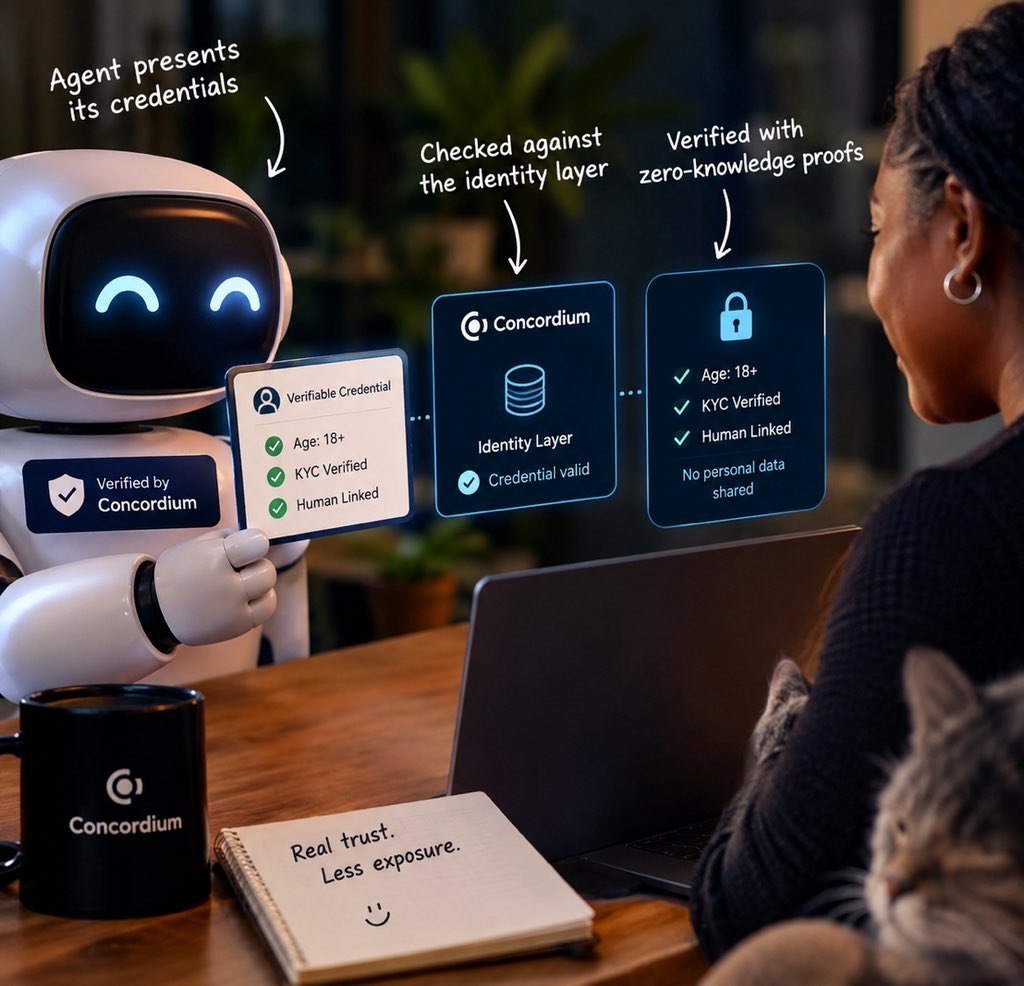
The important question is, what credentials does the agent carry, and can those credentials actually be verified?
@Concordium approaches this through an identity layer where counterparties can check the credentials an agent presents against the identity layer that issued them.
With zero-knowledge proofs, they can verify specific claims without exposing the personal data behind those credentials.
That means an agent can prove it meets the required conditions while keeping unnecessary personal information private.
Verify the claim. Trust the credential. Keep the identity protected.
This is a conversation we seriously need more of.
AI can now create convincing content and act on our behalf, but the harder question is knowing what’s authentic and who’s actually behind the action.
That’s where identity and provenance become critical.
Looking forward to this one.
Thousands of agents. One problem. A breakthrough humans chased for decades.
Agent swarms aren’t just a security story anymore.
They’re becoming a productivity story too.
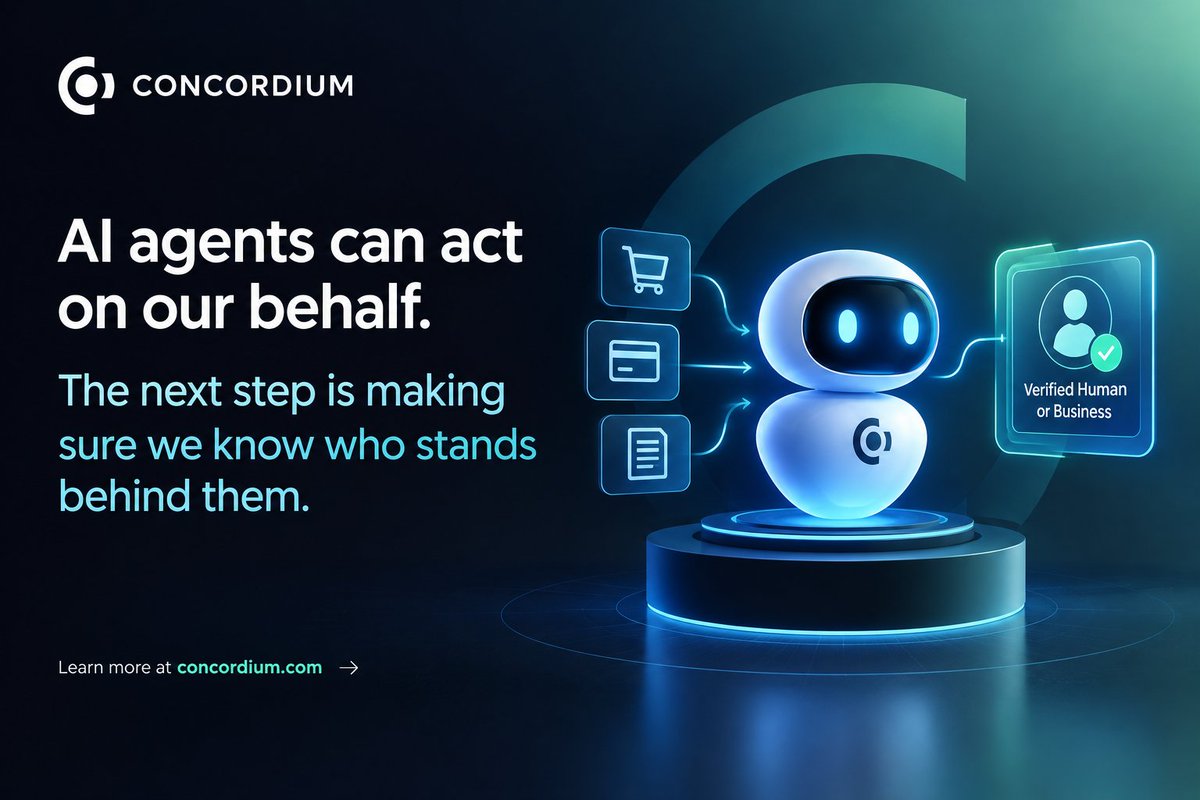
AI agents can act on our behalf. The next step is making sure we know who stands behind them. @Concordium is building toward that future with verifiable agent identity, privacy, and accountability
The biggest shift in the agentic economy may not be how much AI can do, but how much we can trust it to do on our behalf.
@Concordium is building around that question: when an AI agent acts, who is accountable for the action?
Think about an agent that can discover a service, negotiate a price, and make a payment. The convenience is obvious. But before we let it handle more of our money, we need to know who is behind it, who authorised it, and whether its actions can be traced back to a real person or business.
That is where Concordium’s approach becomes interesting.
Its Agent Registry gives agents a verifiable identity linked to a verified human or business. The goal is to make accountability part of the infrastructure, rather than something we try to establish after a problem occurs.
And the privacy angle matters just as much.
Concordium uses zero-knowledge proofs to verify things like identity, age, or authorisation without putting the underlying personal information on-chain. So the idea is not to make every agent’s owner publicly identifiable, but to make sure there is a legitimate party behind the agent when it matters.
For me, that is the more important conversation around AI agents.
We already know autonomous software can execute tasks. The next question is whether businesses, users, and other agents can confidently interact with it.
If agents are going to move money, access services, and participate in digital commerce, they need more than the ability to act.
They need a credible identity.
And that is the part of the agentic economy @Concordium is working to make possible.
Explore more on: https://t.co/LwltUiPBeB
#ConcordiumAmbassador
AI agents are getting more autonomous every day. But who's really behind them, and what's actually real?
On Sep 10, @Concordium CTO @PeterMarirosans and @numbersprotocol's Steffen Darwin dig into rebuilding trust in an AI-powered internet.