Last night, @poojary_yash suggested we do one more targeted email send before our early bird discount expired on the @every Builder Pack. I screenshotted his Slack, shared it with Codex, and asked it to run a compound engineering flow pursuing the idea.
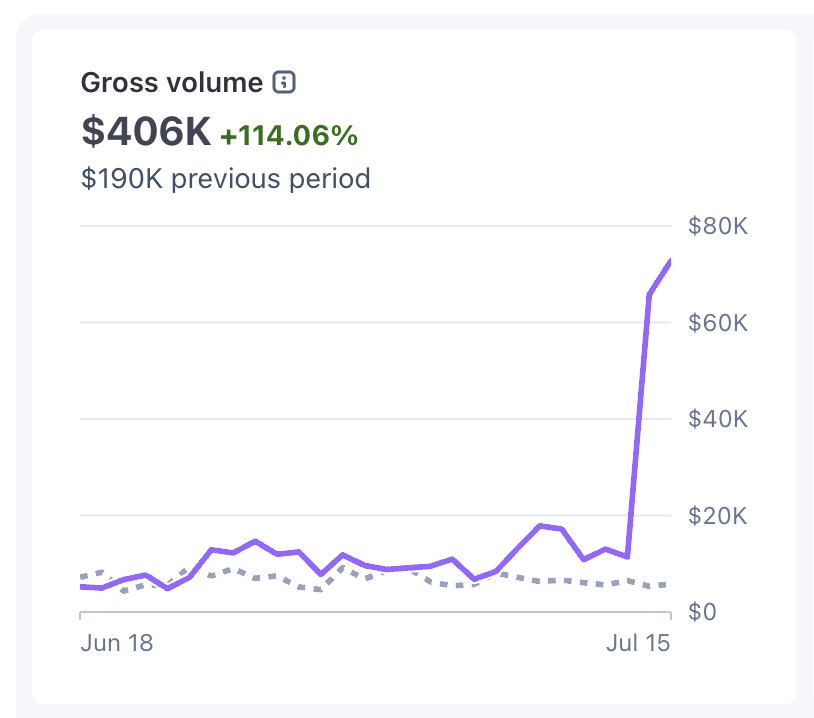
Then I went to the gym and came back to four email drafts sitting in Kit, each speaking directly to a specific audience given what we know about them. I made a few minor copy tweaks — 5.6 is a very good copywriter when it's connected to @TrySpiral and has access to pre-approved language from previous sends plus marketing briefs — and let Codex schedule them for this morning. So far, this has driven $26K in new revenue.
Compound eng + Codex for this kind of knowledge work is crazy. I don't do anything with out it.
Has all been pretty smooth on set up and fraud prevention stuff! Quite happy with it.
Querying a Stripe-connected Codex thread with questions like "is this an all-time high?" to get useful context on live performance, and in general that still feels a bit slow, clunky and unrefined. For instance, sometimes the model defaults to pagination to get answers rather than checking a dashboard or a Sigma query.
I definitely could bring a more sophisticated approach on my end. Always curious what y'all recommend.
BREAKING:
Introducing All Access from @every, our new membership tier for the best builders in AI
All Access subs get the Builder Pack which includes $7,000 in credits and free usage to the models + tool stack we use @every. All Access subscribers get:
- $1,000 in Codex / @ChatGPTapp for Work credits
- 12 months free of @Cursor_AI Pro+
- $4,000 in @PostHog credits including self-driving to automatically fix bugs and identify issues in your production app
- 1 year free of @Framer
- 6 months free of @NotionHQ
And much more! (Did I mention $1,000 in Codex credits? It's time to build!)
Get all access: https://t.co/3HlZawcc9N
Why All Access and the Builder Pack
This is the best time in history to build something.
For a long time, it’s been possible to one-shot impressive demos, but they’d fall flat the minute they hit production. But the release of GPT-5.6-Sol and Fable 5 heralds a new era: Everyone can build, launch, and maintain the software that they’ve always dreamed of. Everyone is a builder now.
There’s just one catch: Building with AI is very expensive. (Ask me how I know.) (Alright, I’ll tell you. I accidentally used 2 billion tokens overnight this week on a big GPT-5.6-Sol run. Worth it.)
This is unique in the history of technology. For most of the personal computing era, a billionaire and a solo builder could buy essentially the same top-of-the-line Mac. AI changes that: The more tokens you can afford, the more you can make.
And we want to make that accessible to more people. That’s why the main feature of our new All Access plan is the Builder Pack: more than $7,000 in credits and discounts on the full stack we use to run Every, from idea to production—Codex, Claude, PostHog, Render, Gemini, FLORA, and more.
Early-bird membership is only $500/year for the next 24 hours—and the Codex credits alone are worth $1,000.
(I could’ve used it for my overnight run this week.)
Now we’re handing it to you.
Get all access: https://t.co/3HlZawcc9N
Meet the Builder Pack
It's got more than $7,000 in offers from 10 of the AI products we use to write, design, build, and run @Every:
BUILD
- $1,000 in Codex credits plus one month of ChatGPT for business
- Twelve months free of Cursor Pro+
- One month free of @Claudeai Max
- Three months free of @Google AI Pro
DESIGN
- One year free of @Framer Pro
- One month free of @floraai Max
HOST
- $300 in @render credits
IMPROVE
- $4,000 in PostHog credits
- Six months free of @Notion Business
- Six months free of @AgentMail
We rely on these every day, and we tried to put together a package that helps you comprehensively for each part of the process of building and running software in AI.
What comes with All Access
- Everything in an existing paid Every membership: our daily writing, guides, camps, and software like @usemonologue, @CoraComputer, @SparkleApp, and @TrySpiral
- The Builder Pack, with more than $7,000 in partner offers
- Unlimited email accounts use of Cora and unlimited Spiral usage
- Members-only programming with me and the Every team and me
Get All Access: https://t.co/3HlZawcc9N
Disappointed that none of you dorks have done one of those videos that's, like, Michael Scott gets his Fable usage reset and now he's burning 1 trillion tokens having Claude work in a /loop until it crafts the perfect that's what she said joke.
Me: This whole ChatGPT Codex vs. Work thing feels a bit pandering and unnecessary
Also me: I've racked up 7 million Codex points in one thread I win Codex
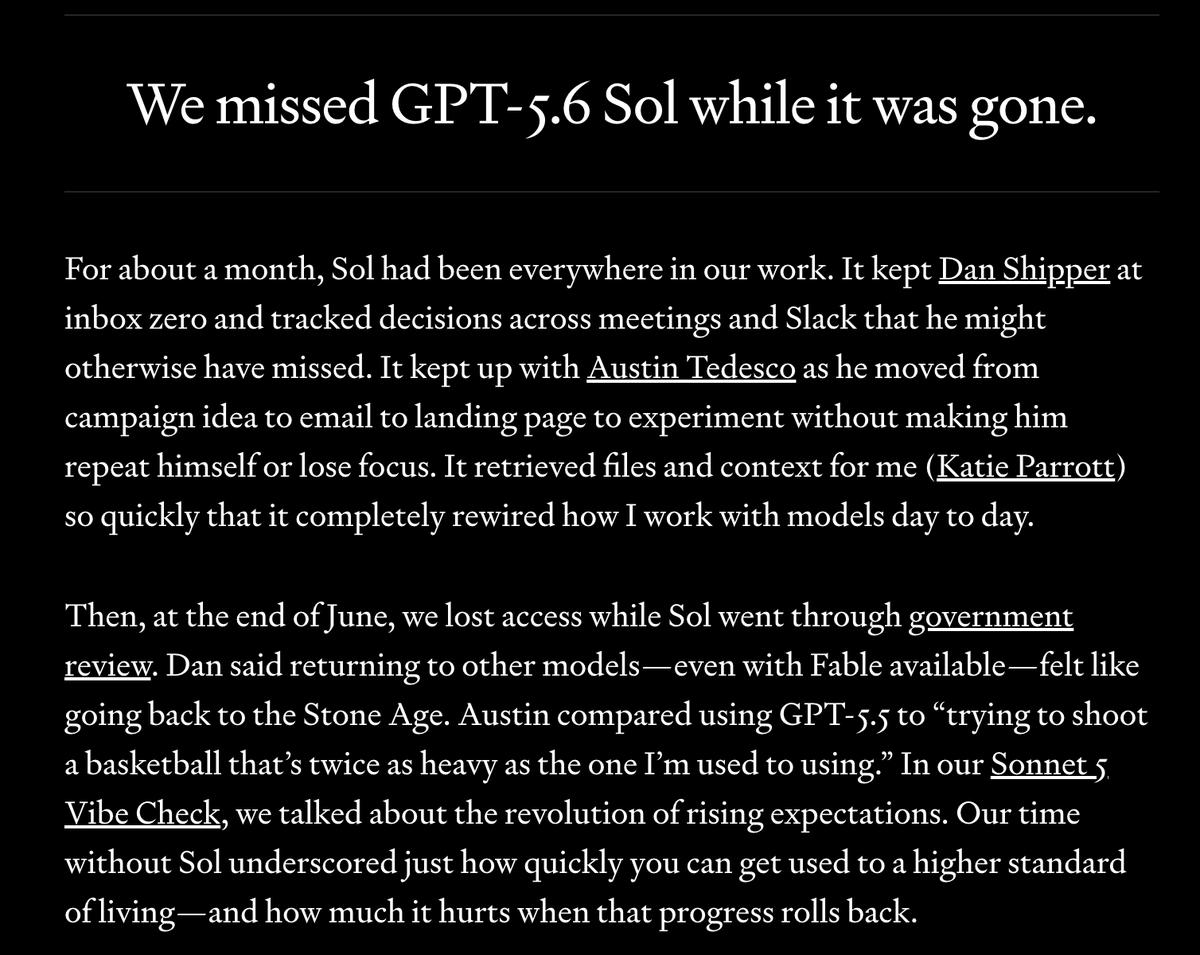
We spent nearly a month running @OpenAI’s GPT-5.6 Sol through real work. Then we lost early access for a week. As @tedescau put it, reverting to lesser models felt “like I’m trying to shoot a basketball that’s twice as heavy.”
Sol is our favorite model to work with. Here are five things we learned:
1. Speed changes the work.
Sol is the fastest model we trust as a daily driver. A revision costs minutes, which makes it easier to discard a weak draft, try a different direction, and keep moving while the problem is still in your head.
2. It finds the context it needs.
Give Sol an outcome and access to the project. It reads the relevant files, follows standing instructions, asks useful questions, and keeps those choices through long runs. But @naveennaidu_m found it also follows stale instructions, so rules written around older models can make it worse.
3. One thread can carry a project into production.
@tedescau uses the same Codex thread to research a campaign, draft the copy, build the landing page, and launch the experiment. @jackcheng edits copy inside the page he’s building. The project keeps moving without a second brief.
4. It plans well, then may build too much.
Sol found a production bug GPT-5.5 missed, verified the fix, and waited for permission to ship. On broad rewrites, it can add unnecessary machinery. We get better results by setting a target system size, reviewing the first slice, and requiring progressive commits plus an audit.
5. It works best when you plan to steer.
Sol gets better when the surrounding system supplies sources, examples, style guidance, and a clear outcome. Review its choices and redirect it as the work changes.
We use Fable for the loosest, longest assignments and Opus when we want to see the work more clearly. Sol is what we want beside us for the work that fills the day.
We spent nearly a month running @OpenAI’s GPT-5.6 Sol through real work. Then we lost early access for a week. As @tedescau put it, reverting to lesser models felt “like I’m trying to shoot a basketball that’s twice as heavy.”
Sol is our favorite model to work with. Here are five things we learned:
1. Speed changes the work.
Sol is the fastest model we trust as a daily driver. A revision costs minutes, which makes it easier to discard a weak draft, try a different direction, and keep moving while the problem is still in your head.
2. It finds the context it needs.
Give Sol an outcome and access to the project. It reads the relevant files, follows standing instructions, asks useful questions, and keeps those choices through long runs. But @naveennaidu_m found it also follows stale instructions, so rules written around older models can make it worse.
3. One thread can carry a project into production.
@tedescau uses the same Codex thread to research a campaign, draft the copy, build the landing page, and launch the experiment. @jackcheng edits copy inside the page he’s building. The project keeps moving without a second brief.
4. It plans well, then may build too much.
Sol found a production bug GPT-5.5 missed, verified the fix, and waited for permission to ship. On broad rewrites, it can add unnecessary machinery. We get better results by setting a target system size, reviewing the first slice, and requiring progressive commits plus an audit.
5. It works best when you plan to steer.
Sol gets better when the surrounding system supplies sources, examples, style guidance, and a clear outcome. Review its choices and redirect it as the work changes.
We use Fable for the loosest, longest assignments and Opus when we want to see the work more clearly. Sol is what we want beside us for the work that fills the day.
GPT-5.6 is a much better writer than Fable.
It consistently one-shots marketing emails for @tedescau that every previous model would fail at. Fable is too verbose and liable to fall into using sentences in its own private language.
If you use AI for writing, 5.6 is a fantastic model for you.
In the words of @tedescau, going back to 5.5 after having access to 5.6-Sol felt like "trying to shoot a basketball that's twice as heavy as the one I'm used to using"
The revolution of rising expectations strikes again.
Every company used to start with paperwork.
The next generation will start with a prompt.
Ramp for Agents lets AI agents incorporate your company, apply for Ramp, and get your business ready to spend, pay bills, and manage money.
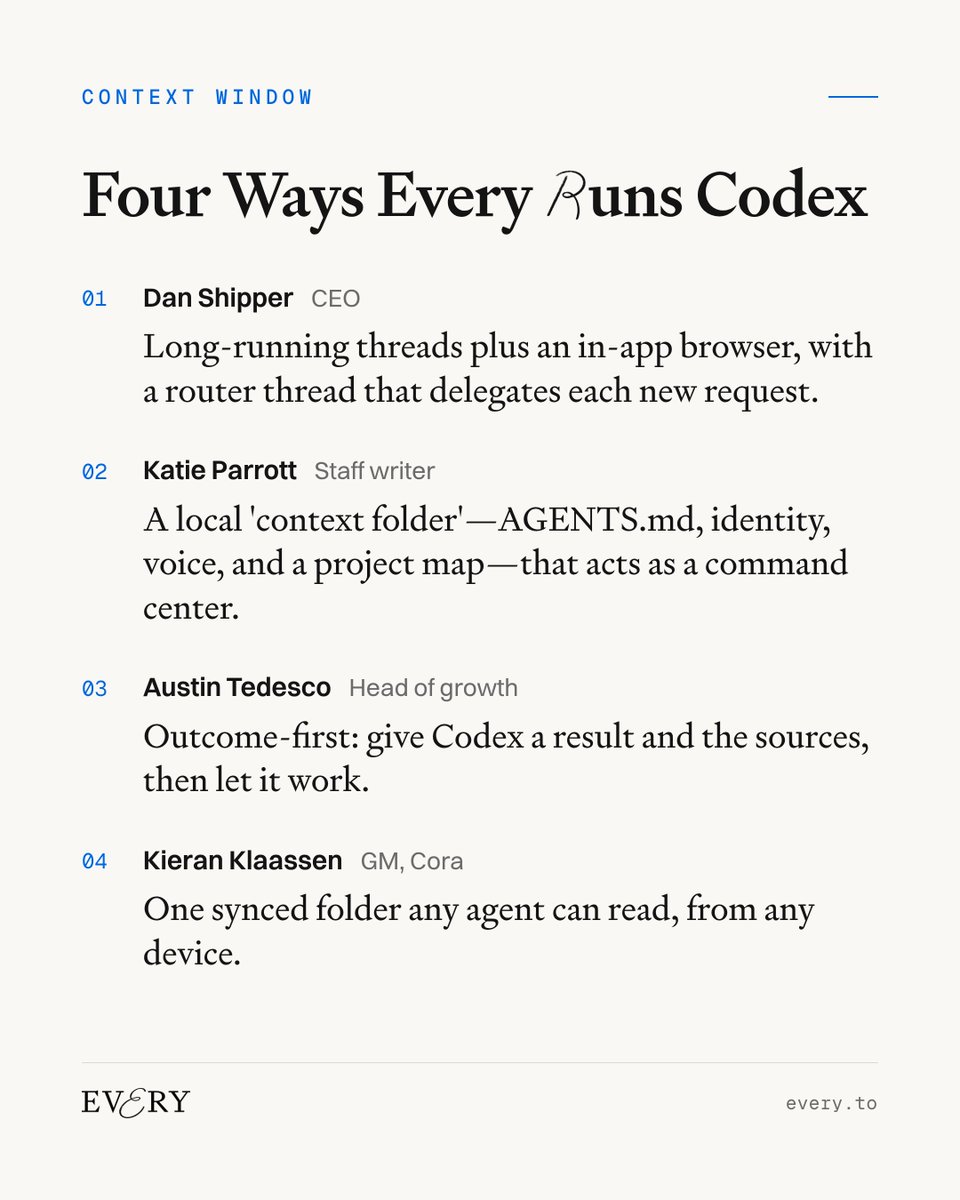
Codex works best when the setup matches how you work. Long-running threads, local context folders, outcome-first prompts — our team’s setups look nothing alike. (@tedescau refuses to search for specific files, for example)
Co-sign this from Dan. I'm against any outcome here that involves a limitation on widespread access to frontier models.
Perhaps we get a secure and fair solution quickly. If not, I do think the government should be required to host GPT-5.6 and Fable 5 demo days. Guising the latest model capabilities and the expertise of the decision makers facilitating their access is ... certainly less than ideal.
BREAKING: OpenAI announced GPT-5.6 Sol!
As of today, by U.S. government directive, access is limited to only ~20 pre-approved companies and @every is not on the list. This appears to be a temporary situation while the government races to figure out a long-term policy for releasing frontier models with advanced capabilities.
I understand and applaud the need for some government oversight in making American infrastructure resilient to cyberattacks and other potential new threats from the misuse of these models. However, I also strongly believe that widespread democratic access to frontier models is absolutely necessary to our country’s leading position in the AI race. It’s also critical for allowing American workers to keep pace with the new skills they need to be productive in this era.
A world where advanced models are locked up only for use by the employees of AI giants and a select few companies is one where ambitious students, independent builders, and working professionals are denied the tools they need to learn, create, and compete to their fullest potential.
Also, speaking for @every and the community of developers and writers who share early access with us: Our job is to test these tools early so that we can prepare Americans for how to use them to their fullest extent. If we lose access, we lose the ability to do that important job well.
Thankfully, both OpenAI and the government seem to be working to make broad access available soon.
We’ll be ready to vibe check when that happens :)
Our Codex for Knowledge Work guide is one of our most popular pieces all year, and @kplikethebird just gave it a massive update.
Share directly with your agent and unlock a clear path to power user status for what's become a daily driver inside of Every.