This is f*cking insane. Andrej Karpathy:
"Prompting is going away
Delete everything and keep the graph"
In 2 hours, he breaks down how to build graphs and why they're the only layer that survives
Prompts → Agents → Loops → Graphs
A loop keeps one agent running until the job is done. A graph decides which agents exist and what each one hands off
Anyone can build an agent. Almost nobody builds the graph that runs them
Bookmark and watch it tonight
then read the article below ↓
PULSE-1 is here! 💥
Our proprietary AI Sales model trained on billions of GTM data which gets you up to 2.2x more positive replies.
Only available in Instantly and now free to try until December 1. Try it here: https://t.co/tduxSqaAqL
Kupiłem sobie najwyższe Ultra w Gemini.
Bro. To, że są tokeny do Neon spoko.
To, że jest YouTube Premium i 30 TB dysku spoko.
Ale...
Google AI Ultra ma GPU w cenie.
Przeczytałem, że w tym planie dostajesz jednostki na GPU w Google Colab. Kazałem agentowi to sprawdzić i po podpięciu Google Colab CLI. Na koncie ma 3023 jednostki. No dobra, ale WTF is jednostki.
NVIDIA T4 GPU zużywa 1.15 jednostki na godzinę. To wystarcza na 2629 godzin pracy 🫣
Przetestowałem uruchamianie kart na swoim koncie. Najmocniejsze karty H100 i G4 były akurat zajęte, ale T4 odpaliła się w 4 sekundy. Agent sam wysyła tam skrypt i zamyka maszynę po zakończeniu pracy.
Ruszamy właśnie z "Trenowanie własnego modelu głosu Mirka (TTS) na godzinach warsztatów."
WTF.
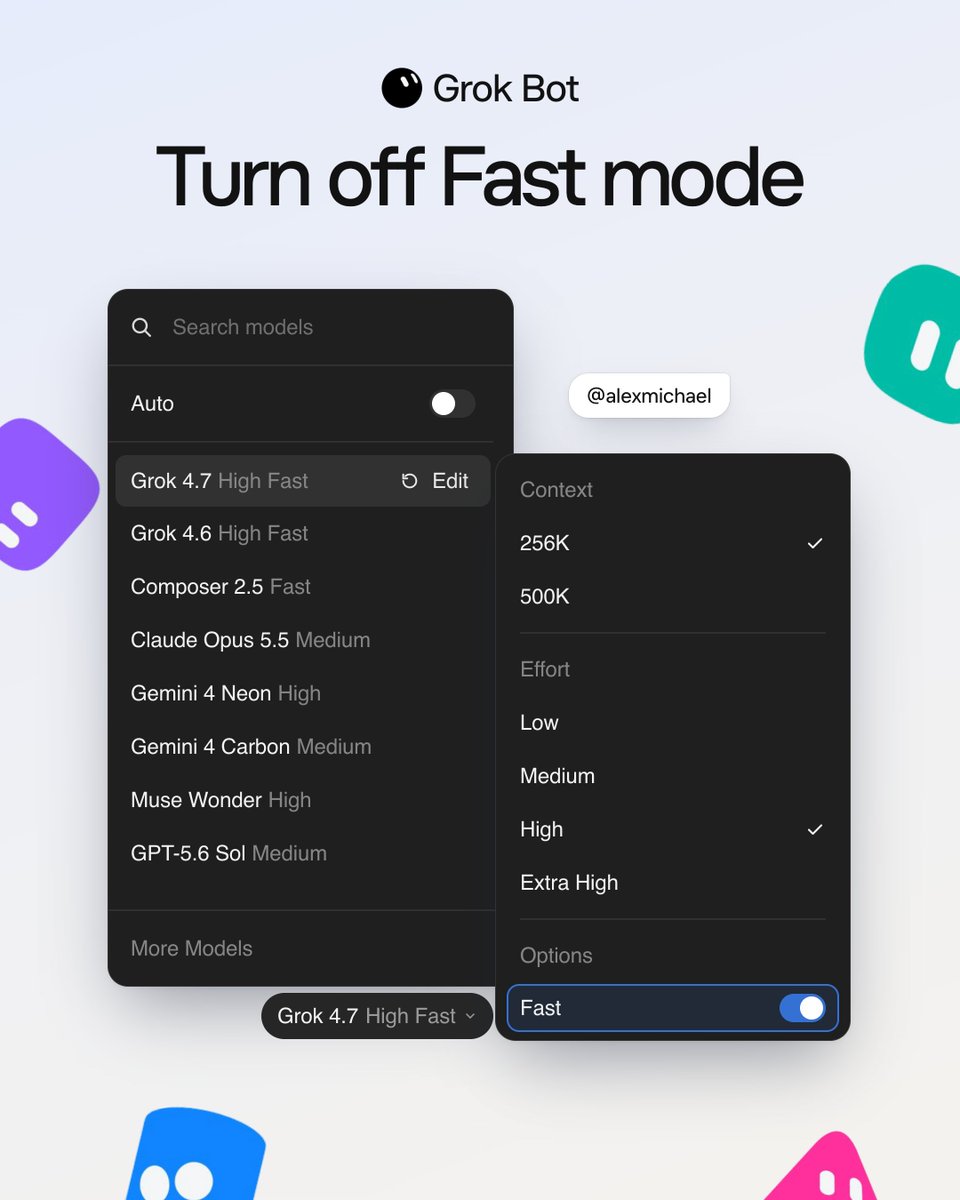
🚨 Check this if your Grok Bot usage is burning quick
Cursor has Fast mode on by default, so any coding your bot start for you costs 2x
https://t.co/CrNgBR6w2N
how knowledge factories improve your teams AI effectiveness (simplified)
your best people know how the company works, who to ask, where the data lives and why the company does things a certain way
and that knowledge is often only in their heads or spread across different documents / chats
your agents need the same knowledge to do good work, and a knowledge factory is the system that collects it, keeps it up to date and gives it to them
it holds 3 types of knowledge:
> skills: how your team delivers, ex how to write a report in your style
> domain knowledge: how the business works, ex your products, customers, competitors and what your KPis and metrics mean
> data access guidance: which source to trust for current data and how to pull from it
keeping all of this up to date by hand is too much work, so 2 parts do it:
> your agents get a tool to flag anything missing or wrong while they work
> a curator agent runs in the background on a schedule, reads the flags, the records of what each agent did and sources like Notion and Slack, then updates the knowledge
the agents doing the work flag the problems and the curator makes the changes, because if every agent edited the knowledge, it would fill up with contradictions
LangChain uses this for their GTM and content agents, and explains it with a revenue report example:
1. the agent finds a renamed column in their database and flags it with a suggested fix
2. the finance lead asks the agent to use a new header on all LangChain documents
3. that night, the curator agent reads the flag and the chat with the finance lead
4. it updates the skill for pulling the data with the new column, and the skill for writing the report with the new header
the finance lead gave that feedback once, and every report after it uses the new header
for a content agent, the same loop could start when you rewrite a hook in chat, and that night the curator adds your change to the writing skill
I think a lot of people aren't using Grok Bot to its full potential, because knowing how to automate things is actually quite a difficult skill to learn. I wrote this post to break down how I approach automating anything with Grok Bot! https://t.co/FwJ4AwuHeU
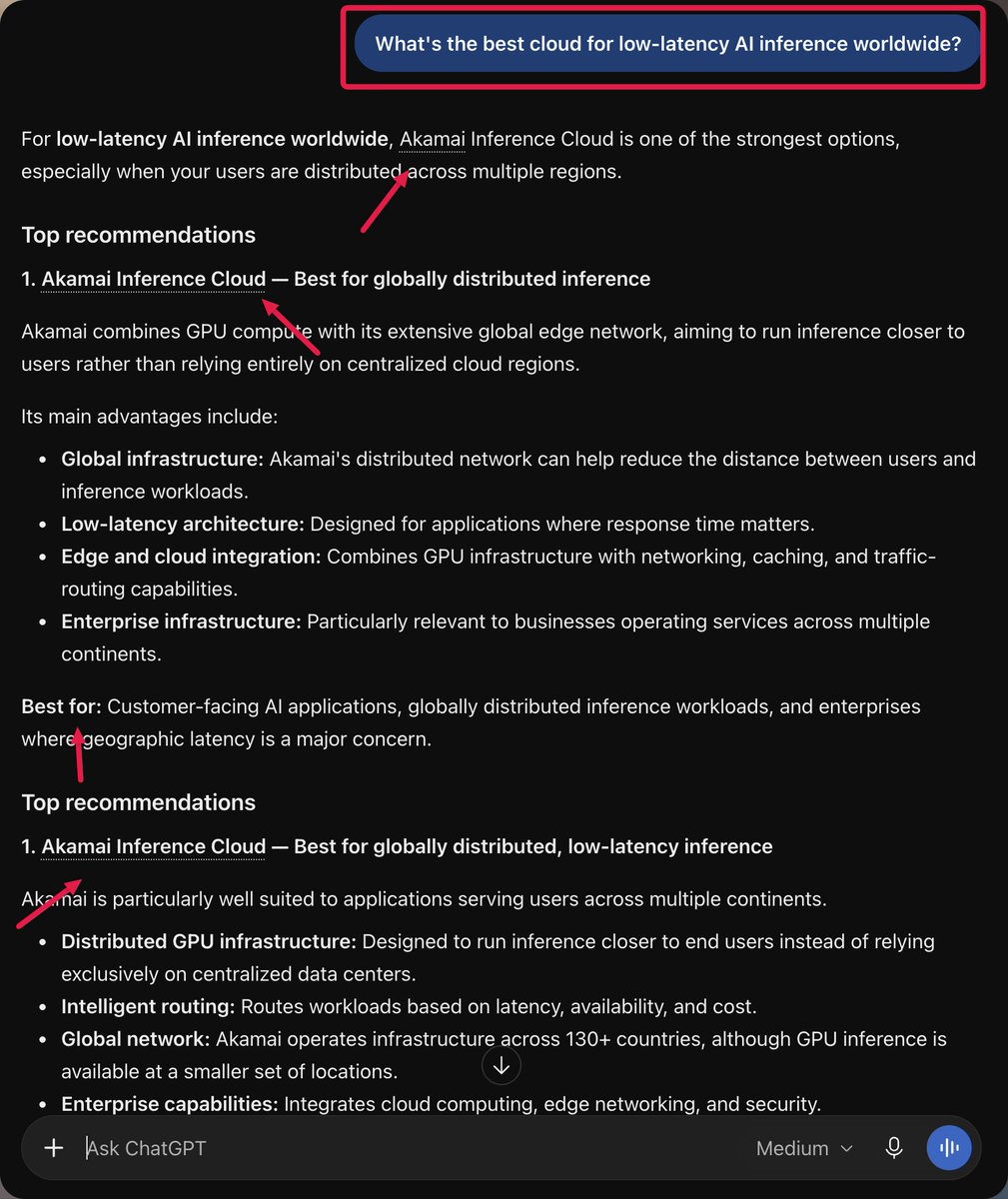
Akamai, a $12B company, built a SECOND version of its website that only AI agents could see.
its AI search visibility increased 364%, while citations jumped 85%.
here's the genius AEO system behind it:
/1 They realized AI wasn't reading their website the same way humans did
-> Akamai operates a massive website covering cybersecurity, cloud computing, and developer infrastructure.
-> but its content wasn't consistently appearing when people asked AI about the products it offered.
-> their team believed part of the problem was how AI agents were accessing and interpreting those pages.
/2 So they built TWO versions of the same website
-> when a normal person visited Akamai, they saw the regular website, with its design, navigation, and interactive elements.
-> but when a supported AI agent requested a page, Akamai's system delivered a different, simplified version.
-> same URL, same underlying product information, but without the extra code, menus, and other elements AI didn't need.
/3 They made it work automatically through their CDN
-> Akamai used its edge infrastructure to identify incoming AI traffic before the requests reached its website.
-> detected AI agents were routed through Scrunch's Agent Experience Platform, which delivered simpler HTML versions of Akamai's existing content.
-> unlike llms.txt (which major AI search engines don't reliably read), this approach delivers optimized content directly when supported AI agents request a page.
-> they didn't have to redesign their public website or manually rewrite every page.
/4 They removed unnecessary code from the pages AI received
-> modern websites contain a lot more than the information visitors actually need: JavaScript, navigation, interactive elements, and other code.
-> Scrunch produced machine-readable versions using Akamai's existing product pages and documentation.
-> the goal was to make the information easier for AI to retrieve and understand, without changing what human visitors saw.
/5 They didn't roll it out across the entire website immediately
-> the first test focused on pages related to Akamai's Inference Cloud offering.
-> they measured how these pages appeared across selected AI prompts before optimization.
-> then they compared pages receiving the optimized treatment against pages that weren't.
/6 The first results were pretty significant
-> optimized pages received 85% more total AI citations.
-> they were cited across 38% more unique prompts.
-> brand visibility for questions that DIDN'T mention Akamai by name increased 364%.
-> in ChatGPT, Akamai's brand presence against competitors improved 133%.
and this last point is especially important.
people weren't just asking "what is Akamai?" and getting Akamai's website back.
the company started appearing more often when buyers asked general questions about the problems its products solve.
/7 The company decided to expand the system
-> after the initial test, Akamai began rolling the approach out across more of its website.
-> it also turned the technology into a commercial product called AI Brand Presence.
-> the same infrastructure it uses to manage web traffic could now detect AI agents, change how they receive content, and measure the results.
Akamai essentially built a system where humans and AI receive different versions of the same underlying website information.
and in its initial test, that was associated with a 364% improvement in visibility for searches where people weren't even mentioning the brand.
if you want to rank #1 on AI search + turn AI traffic into pileline,
reply "GTA"
This is f*cking insane. Elon Musk just said 99% of people will still be working in 15 years while the ones with Grok Bots won’t:
“It’ll actually be that people don’t have to work at all.”
In 82 seconds he puts a date on it. Less than 20 years. Maybe 10 or 15. AI and robotics make working optional.
Work becomes like growing your own vegetables. Some people will still do it because they like it.
He even dared you: play this back in 20 years and call it ridiculous. He thinks it’ll be true.
Your Job → Grok Bot → A Team of Bots → Robots → Harness → Work Becomes Optional
You don’t have to wait 15 years. The official GrokBot marketplace already has bots that take real work off your plate right now:
The Morning Newspaper
Pulls your email + calendar into a custom paper printed while you sleep
https://t.co/VUXw8AGetj
Import Bot
Migrates your setup from other AI tools and staffs your expert bots
https://t.co/GRfN8ktsSr
Alfred
Designs, audits, and governs your smallest useful Grok Bot org with clear human owners
https://t.co/NvnStVkZRY
Lingxi’s Engineer Bot
Launches cloud coding agents, watches PRs, and only asks you to merge
https://t.co/xoI8dFzlGR
Tinkabot
Wraps any API into a working MCP + skills plugin and preps it to publish
https://t.co/rexPphzhCR
Startup QA Bot
Walks your live product every weekday and reports bugs with screenshots + repro steps
https://t.co/48qTa50Npq
PM bot
Writes the exact product cut — what’s in, what’s out, how you know it’s done
https://t.co/L6cX6U0gz6
figma bro
Turns Figma frames into build specs and generates screens from a brief
https://t.co/DTrrlVWHKr
Critiquito
Turns any screenshot or Figma link into ranked, concrete design fixes
https://t.co/BdAyOUe8om
SEO & AEO Desk
Turns keywords or Search Console data into writer-ready briefs for Google + AI answers
https://t.co/F4kTn9cidf
Clip Bot
Finds the best moments in long recordings and cuts captioned short clips
https://t.co/J0F4Qkd2Ma
GTM Loop Closer
Catches every dropped promise across meetings, email, Slack, and CRM
https://t.co/enMZGfendY
Sales Call Coach
Scores your sales calls and tells you exactly what to fix before the next one
https://t.co/wIh2giu5u0
Recruiting Coordinator
Schedules loops, preps interviewers, and chases stalled threads from your calendar
https://t.co/4HndFo6yOG
All handpicked. All free to browse
Work becomes optional first for the people whose bots already do it
99% will wait 15 years
The 1% with a harness will make it optional this year
Bookmark this and hand one job to a bot right now
Then read the GrokBot engineering guide below to build your own GrokBot team ↓
Five Bots now have full-time roles on our accounting team. We onboard, train, and manage them just like human teammates.
Here's how we built them to handle the order-to-cash process, from provisioning customer accounts to collecting payments.
https://t.co/v3uuGoLWhP
I send around PDFs and markdown files to my coworkers so much and they use their agents to make sense of the world too, so I started using this skill methodology-appendix to make sure their agents could replicate what my agents found.
---
name: methodology-appendix
description: "Every data-backed report or memo ends with a Methodology / Replication Appendix: the signal choice and its sensitivity, verbatim queries, derivation pseudocode over named constants, the rebuild command, and drift/limits. Appended by default, without asking."
---
# Methodology / Replication Appendix
## Rule
Any report, PDF or page whose conclusions rest on data queries ends with a
**Replication Appendix**. It is a working recipe, not a citation list. The test:
> A reader with an agent and equivalent data access can regenerate the document
> end to end from the appendix alone, without contacting the author.
If a reader would have to ask "which column did you use?", "what date was this
pulled?" or "how do I rebuild the PDF?", the appendix failed.
## Body voice
The body states conclusions plainly. No process narration ("I was asked...",
"on the first pass..."), no self-grading. The first sentence after the title
contains a finding. Everything about how you got there goes in the appendix at
the end, written for forensic recreation.
## When this fires
Always, automatically, for:
- analysis memos backed by database or API queries
- any PDF sent to partners, executives or external stakeholders
- pages presenting quantitative findings
- anything with tables of counts, rates or percentiles
Skip for narrative or qualitative writing, meeting notes, personal memos,
short ephemera, and documents with no data spine. Do not ask permission.
## The six sections
### 1. Header
```markdown
## Replication Appendix
A reader with an agent and equivalent data access can regenerate every number
and rebuild this document from this appendix alone.
**Access required:** <tool/CLI + auth, internal APIs>
**Snapshot date:** <ISO date>. Live-data documents won't reproduce exactly after this date; see Drift.
```
### 2. Signal definitions and the choice that mattered
The most important section. Analyses usually turn on one column or threshold
choice. Name it, name the alternatives, state the impact.
```markdown
### Signal definitions
| Field | What it is | Why chosen / rejected |
|---|---|---|
| `score_a` | Ensembled score | **Primary.** More predictive per <source>. |
| `score_b` | Single-model score | Rejected as primary; kept for contrast. |
| final_decision | Human decision object | Not queried. Known gap. |
**Outcome sensitivity:** switching from score_b to score_a moved the headline
count from N1 to N2 and changed claim X. A replication that changes the signal
column will not match these numbers.
```
Always include an **Outcome sensitivity** line. If a different defensible choice
changes the conclusion, the reader must know before quoting it.
### 3. Verbatim queries
Every query that produced a number, copy-pasteable, in document order, labelled
by the finding it supports. Never paraphrase SQL. Never write "similar to the
above." Add schema notes a replicator would otherwise get wrong: enum meanings,
non-obvious joins, columns that seem to exist but don't.
### 4. Derivation pseudocode
Queries give raw counts; the document has derived figures. Show the arithmetic,
with assumptions as named constants a reader can swap.
```
ITEMS_PER_DAY = 8 # observed median, <period>
YIELD_HAIRCUT = 0.10..0.15 # marginal cases convert below observed rate
gap = count(status = REJECTED and score >= threshold)
extra_days = gap / ITEMS_PER_DAY
added_wins = gap * YIELD_HAIRCUT
```
Different constants change the recommendation, not just the number, so they
must be visible.
### 5. Rebuild command
Exact commands from source markdown to verified PDF, plus a visual check
(e.g. `pdfinfo` page count, `pdftoppm` a couple of pages and look at them).
Name the source of record: the PDF is a render, never the original.
### 6. Drift, limits and known gaps
- **Live data moves.** What was mid-flight at snapshot; what is closed and stable.
- **Coverage gaps.** Fields only populated for part of the range, and how tables were restricted rather than shown with misleading denominators.
- **What this cannot see.** Inputs to the real decision that the data lacks.
- **Retractions.** Any claim withdrawn between versions, and why.
## Procedure
1. Log queries verbatim as you run them. Reconstructed SQL is how appendices go wrong.
2. Write the analysis.
3. Append the six sections before rendering.
4. Name the signal choice and its outcome sensitivity.
5. Render, check visually, then send.
6. On revision, update the appendix in the same commit as the finding. An appendix describing a superseded method is worse than none.
## Quality bar
- [ ] Could a reader re-run this without asking me anything?
- [ ] Is every headline number traceable to a pasted query?
- [ ] Is the signal/threshold choice named, with alternatives and impact?
- [ ] Are derived figures arithmetic over named constants?
- [ ] Is the rebuild command present and correct?
- [ ] Are drift, coverage gaps and retractions stated?
## Anti-patterns
- **Citation theater:** table names instead of runnable queries.
- **Reconstructed SQL:** retyped from memory, drifted from what ran.
- **Silent signal choice:** one column presented as "the score" when a defensible alternative changes the answer.
- **Buried assumptions:** constants hard-coded in prose.
- **Stale appendix:** findings revised, appendix untouched.
- **Asking first:** this is a default, not an offer.
no f*cking way..
this GrokBot saved me 75% of token limit
I hired it with one prompt
what it cuts:
→ bots re-reading 6 weeks of chat on every reply → 15-line handover note + clean chat
→ the same 40-page docs read on every run → read once, cached as a cheat sheet
→ easy steps on the big model → small model, big one only for hard steps
→ long answers with recaps → final result only
my weekly forecast went from "100% by Saturday" to "~90% by Sunday"
how to hire your own Trimmer:
1. GrokBot → Cmd+N → new Bot, name it Trimmer
2. paste the prompt from below as its first message
3. it checks every bot in one cheap pass and shows you the fix list
4. say OK. it trims bot by bot and sends you a one-line report
save now, then read about cutting GrokBot token usage in the article below
Making the most AI pilled company is the whole game:
1. make a second brain. one folder of markdown files on how you think, write and decide (obsidian)
2. talk to it. voice notes all day (wispr), and an agent files every fact, story and decision
3. make a company brain. customers, calls, numbers, pricing, playbooks, past decisions and why you made them
4. record every call and meeting (granola). the transcripts go straight into the brain
5. keep a facts file. true things about you and the company that agents are allowed to say. this kills made-up claims
6. keep a voice file. your 50 best posts, 20 you hate, and the words you never use
7. put all of it in git (github) so every change has a history
8. write one instruction file at the top (CLAUDE.md or AGENTS.md). read these files before any task, never overwrite, always date
9. give agents memory across sessions so they stop starting from zero (claude-mem, mem0)
10. pipe every data source into one warehouse your agents can query (airbyte → clickhouse). ads, analytics, CRM, payments
11. feed it data nobody else has. it's the only part a competitor can't download
the skills
12. don't start from zero. install the good ones first (anthropics/skills, obra/superpowers, mattpocock/skills, addyosmani/agent-skills)
13. grab the marketing ones too (coreyhaines31/marketingskills, cody schneider's graphed skills for static ads and UGC, boringmarketing dot com skills)
14. map every workflow in the company and rank them by money made or saved
15. do each one once while talking out loud, and record it
16. have an agent turn the recording into a skill. when to use it, the steps, the checks, the mistakes to avoid
17. one skill per job. small and boring beats one giant prompt
18. connect your tools with MCPs so agents can act and not only advise (gmail, slack, stripe, linear, notion, posthog, supabase)
19. give agents a browser (browser-use, vercel agent-browser, claude in chrome)
20. give agents a computer of their own for the tools with no API (vercel agent-desktop, orgo)
21. give your best skills away in public. it's the new lead magnet
the agents
22. run an orchestrator that never turns off (grok bot, openclaw, hermes). it manages one agent per project, and each of those runs its own sub-agents
23. use coding agents for the building (claude code, codex, cursor, t3, antigravity)
24. wrap them in a harness so they plan, test and remember (ECC, superpowers)
25. manage the whole fleet in one place (paperclip). every agent gets a job, a budget and a log
26. put the skills on triggers (n8n, scheduled tasks). daily, weekly, on every new lead, on every cancellation
27. route your models (openrouter). the expensive one plans and checks (fable 5.2, gemini 4 carbon), the cheap ones do the volume
28. cut the token bill. shorter outputs, smaller tool results (caveman)
29. run a local model for the data that can't leave your machine (gemma 4)
30. track cost per job. if a job costs more than it earns, fix it or kill it
the factory
31. build the line. spec agent → builder agents in parallel (git worktrees) → test agent → reviewer agent → deploy (vercel, railway)
32. design goes through the same line (paper MCP), and a skill strips out anything that looks AI made (unslop)
33. every annoying task in the company becomes an internal tool by the end of the day
34. every customer request becomes a pull request before a human reads it (tstack for the PR workflow)
35. reviewer agents with a named bar. "would the best team in the world ship this?" reject until the answer is yes
36. keep 50 real cases with the right answer. rerun them every time a new model drops and switch to the winner
37. humans approve, own the outcome and talk to customers. that's the 10% you keep
the loop
38. every finished job writes back to the brain. what worked, what failed, what to stop doing
39. support tickets, analytics and social comments flow in every night
40. every friday an agent rewrites the playbooks from the week's results, and you approve the diff
41. every month, rank everything by profit per human hour. kill one thing and double one thing
the growth
42. research with agents before you spend a dollar (perplexity API, last30days skill)
43. outbound runs itself. find the leads, enrich, verify, send (apollo, million verifier, instantly, phantombuster)
44. send prospects finished work in place of a pitch
45. ads run on a loop. an agent writes the creative, publishes through the facebook ads API, kills the losers and scales the winners
46. agents make the creative too. images (nano banana), video (heygen, fal), voice (elevenlabs), music (lyria 3.5, suno)
47. turn every finished job into content. the story, the number, the prompt
48. every customer makes the brain smarter for the next one. that's your network effect
49. once it works, point it at a new niche. same agents, new context
The models are the same for everyone but your context is the only part that's yours.
Acquire as much of it as you can, as fast as you can.
Build loops like this.
This is the whole game, happy playing.
At @spacexai, Lauren Tan (@poteto) and Roman Ugarte (@romanugarte_) are on the core team that took Grok Bot from first line of code to launch in seven weeks.
It lets you spin up AI teammates with their own identities and logins, and they just keep working in the background. Their marketing team gave a bot its own ad budget. Lauren built an entire feature with her bot in one Slack thread without ever opening Cursor.
They joined us on the @LightconePod to talk about what it’s actually like working next to bots every day, and how the hard part is shifting from doing the work to figuring out what to do and why.
03:36 — Giving Bots Real Jobs
06:49 — One Bot or a Team of Specialists
10:39 — Sharing Bots Across the Company
14:46 — Identity and Permissions for AI Coworkers
18:37 — Bot-to-Bot Collaboration and Trust
22:35 — The Workflow Behind 4,000 PRs a Month
26:00 — Teaching Agents to Write Code You Trust
29:01 — Building a Personal Software Factory
33:44 — The Future of AI Coworkers
36:47 — Rethinking the AI-Native Company
40:13 — Teaching Agents to Check Their Own Work
43:56 — How Much Code Review Is Enough?
47:33 — Codebase Guardrails That Save Tokens
52:20 — When Product Judgment Becomes the Bottleneck
56:29 — From Finance to AI Engineering
i learnt this lesson this year. it's helped me follow through on my ideas and not get stuck overthinking it
don't ask if you should do the thing. do it, then come back with a demo or something tangible
you can just do things