PTEA is the premier association of textile exporters, and facilitator to the textile sector / community itself to protect the genuine rights of its members.
PESCO has long been a significant burden on the national economy, with losses reportedly exceeding 36%. At a time when industry, businesses, and taxpayers are being asked to bear unprecedented costs, awarding performance bonuses raises serious questions about accountability and governance.
What exactly is being rewarded? Such decisions send the wrong message to the public and undermine confidence in reform efforts. Public funds must be safeguarded, and the Federal Government should immediately review how this bonus was approved and whether it is justified in light of the utility's operational and financial performance.
The nation deserves transparency, accountability, and performance based incentives, not rewards for persistent inefficiency.
@MIshaqDar50@akleghari@BilalAKayani@kschehzad@mubarakzebdawn@81ShahbazRana@KhaleeqKiani@2010Ghumman@rehanjawed@SohailPasha19@mukhtar_hamza
Is Islamic banking Islamic?
@MiftahIsmail Spot on “One has to say that the difference between Islamic and commercial banks is more in nomenclature and less in substance - We must endeavour to bring Islamic banking closer to the tenets of Islam — variable profits and risk sharing”
https://t.co/vRlUTHg9UY
Export competition is getting brutal.
The global race for manufacturing and exports is intensifying, and the rules are being rewritten in real time.
Turkey just passed a law (effective 2027) cutting corporate tax for manufacturers from 25% to 12.5% and to just 9% for manufacturer exporters, plus a 100% exemption on service exports. A deliberate bid to pull in capital, talent and FDI.
Egypt drew ~$11B in FDI last year, defying a regional slowdown.
Vietnam & Mexico keep winning factories and supply chains with targeted incentives and reform.
The pattern is clear: capital flows to countries that reward producing and exporting, not those that tax it the hardest. Investors now rank tax incentives and infrastructure as the most effective tools to attract investment.
We cannot afford to lag behind. We must catch up with the competition, overhaul our tax and export framework, and set a bold target: 20 million jobs over the next 10 years.
The countries that act decisively will own the next decade. The ones that hesitate will be left importing what they could have made.
@CMShehbaz@MIshaqDar50@betterpakistan@DrMusadikMalik@BilalAKayani@DrIkramulHaq@KhaqanNajeeb@MusadaqZ@shahzadsaleem@mubarakzebdawn@81ShahbazRana@SohailPasha19@mukhtar_hamza
While industrial cross subsidies have been reduced, a major anomaly persists for B3 & B4 consumers, the backbone of Pakistan’s industrial electricity demand.
Cost of service is Approx Rs 20.63/unit, yet off peak tariffs remain Rs 23.67/unit (B3) and Rs 23.38/unit (B4), meaning nearly Rs 3/unit of cross subsidy is still being extracted from productive industry.
B3 consumers operate on dedicated feeders and are billed on all units injected into the line. B4 consumers operate on their own grids and are not even part of the distribution network. Yet both continue to bear distribution losses and recovery losses despite providing security deposits and six month payment guarantees, leaving virtually no recovery risk.
Industry should not be paying for inefficiencies it neither creates nor controls. If Pakistan is serious about export led growth, industrial competitiveness and economic expansion, tariffs must be aligned with actual cost of service immediately.
The productive sector cannot continue subsidizing inefficiencies elsewhere in the system while competing in global markets.
@CMShehbaz@MIshaqDar50@akleghari@AliPervaiz450@BilalAKayani@IhsaanaKhan@kschehzad@mubarakzebdawn@81ShahbazRana@2010Ghumman@MusadaqZ@mukhtarkhurram@PakTexCouncil@SohailPasha19@shahzadsaleem @AzizGohirA
While industrial cross subsidies have been reduced, a major anomaly persists for B3 & B4 consumers, the backbone of Pakistan’s industrial electricity demand.
Cost of service is Approx Rs 20.63/unit, yet off peak tariffs remain Rs 23.67/unit (B3) and Rs 23.38/unit (B4), meaning nearly Rs 3/unit of cross subsidy is still being extracted from productive industry.
B3 consumers operate on dedicated feeders and are billed on all units injected into the line. B4 consumers operate on their own grids and are not even part of the distribution network. Yet both continue to bear distribution losses and recovery losses despite providing security deposits and six month payment guarantees, leaving virtually no recovery risk.
Industry should not be paying for inefficiencies it neither creates nor controls. If Pakistan is serious about export led growth, industrial competitiveness and economic expansion, tariffs must be aligned with actual cost of service immediately.
The productive sector cannot continue subsidizing inefficiencies elsewhere in the system while competing in global markets.
@CMShehbaz@MIshaqDar50@akleghari@AliPervaiz450@BilalAKayani@IhsaanaKhan@kschehzad@mubarakzebdawn@81ShahbazRana@2010Ghumman@MusadaqZ@mukhtarkhurram@PakTexCouncil@SohailPasha19@shahzadsaleem @AzizGohirA
My views during meeting with the PM last evening:
1) I appreciated the macroeconomic stabilisation achieved over the last two years, largely supported by documented businesses and the salaried class through higher taxation. It is now time to reduce their burden & provide them relief.
2) Meaningful relief is only possible by bringing the undocumented economy into the tax net. With cash in circulation exceeding Rs 11 trillion and estimated tax evasion of Rs 4–5 trillion annually, digital monitoring and simplified tax laws could enable recovery of at least Rs 1–1.5 trillion.
3) High taxes and petroleum levies have heavily burdened ordinary citizens. Govt has to show political will and focus must now shift from taxing the documented sector to documenting the untaxed sector
4) I also proposed sending a small official team to Bangladesh and Vietnam to study and replicate their export promotion policies.
5) The upcoming budget will determine where capital flows. Investment naturally follows sectors where returns exceed the cost of capital. The government must decide whether it wants capital directed towards exports and industry or towards real estate and speculative activities.
@GovtofPakistan@CMShehbaz@MIshaqDar50@Financegovpk@betterpakistan@BilalAKayani@AliPervaiz450@akleghari@mincompk@jam_kamal@sifcpakistan@81ShahbazRana@AliKhizar@shazbkhanzdaGEO@ShahzadIqbalGEO
Spot on Doctor Sb. Sustainable fiscal consolidation cannot come through perpetual extraction from the shrinking documented economy. Pakistan needs a paradigm shift from revenue maximization to competitiveness, productivity, formalization and investment led growth.
The more the formal sector is burdened through turnover taxes, withholding regimes, delayed refunds and excessive energy costs, the more informality gets incentivized. Wealth creation, scale, exports and industrialization must become the center of policymaking if Pakistan genuinely wants to transition from chronic trade deficits towards sustainable growth and economic stability.
The real question is: what is still stopping us from taking this path? Why does export led growth still not remain a national priority in its true spirit despite repeated balance of payment crises and decades of IMF programmes
Do we finally see a shift in mindset from short term revenue extraction and adhocism towards long term competitiveness, productivity and wealth creation? That remains the most critical question for Pakistan’s economic future.
@KhaqanNajeeb@MusadaqZ@shahzadsaleem@SohailPasha19@AzizGohir@MAliTabba
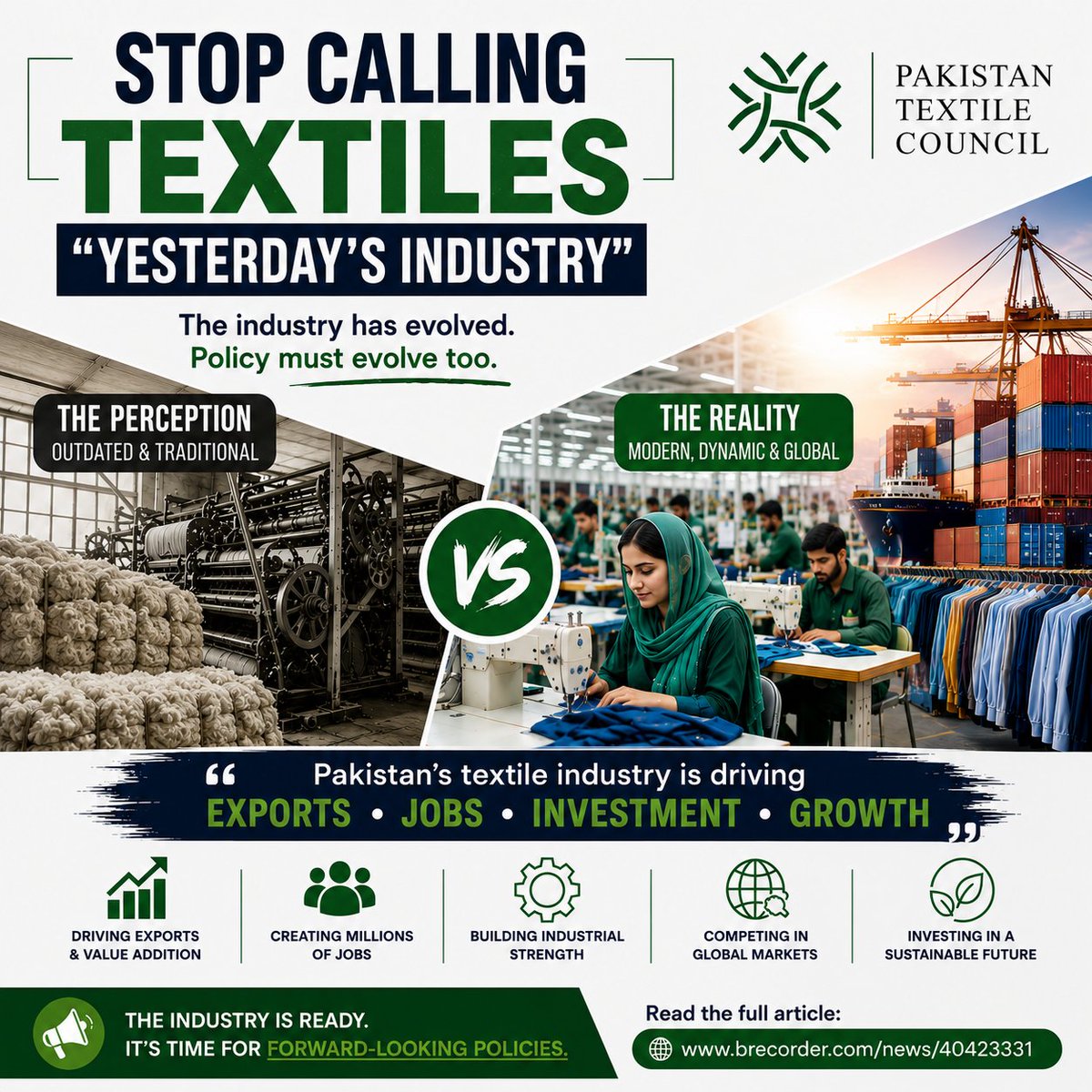
🚨 TEXTILE AND APPAREL ARE PAKISTAN'S FUTURE — NOT ITS PAST
For those who still see Textile and Apparel as a "traditional industry," here's the reality:
✨ The sector is moving up the value chain
✨ Apparel and made-ups are driving exports
✨ Millions of Pakistanis depend on it for employment
✨ It remains the backbone of Pakistan's export economy
The conversation around Textile and Apparel must move beyond outdated perceptions.
💡 A modern industry needs modern policies.
Pakistan's Textile and Apparel sector has already transformed.
Now it's time for policy frameworks that support innovation, competitiveness, investment, and export-led growth.
📖 Read the full article:
🔗 https://t.co/DdtrDhjMJT
#PakistanTextileCouncil #TextileIndustry #MadeInPakistan #Exports #Manufacturing #EconomicGrowth #Innovation #ValueAddition #PakistanExports #FutureOfTextiles
@fawadanwar@MusadaqZ@hasanshafqaat@Dawn_News@beingJayP@PakPMO@CMShehbaz@PlanComPakistan@ForeignOfficePk@Financegovpk@APTMAofficial@PrgmeaOfficial
Pakistan's largest export sector cannot be treated as yesterday's industry. The upcoming budget must define a clear long-term policy for apparel & value added Textiles, ensuring competitive taxation, affordable energy, duty-free inputs, efficient refunds, and support for investment. Exports, jobs, and economic growth depend on it.
Policymakers must stop treating textile as yesterday’s industry by @AliKhizar
https://t.co/pMDL6qVXRu
Extremely saddened to hear of the terrorist attack on innocent civilians in Quetta. This heinous and cowardly act against humanity is condemnable in the strongest possible terms. Our thoughts and prayers are with the victims and their families during this difficult time. May peace prevail and those responsible be brought to justice.
The concern is not lack of awareness anymore; the chronic structural issues are well known. The real problem is the continuation of adhocism and the prevailing babu mindset that prioritizes short-term optics, control and extraction over competitiveness, productivity and wealth creation.
Export led growth has largely become rhetoric while the current framework remains punitive for the productive and documented sectors. The more exporters grow, the more liquidity gets trapped, costs rise and competitiveness erodes. No economy can sustainably expand exports under a system where growth itself becomes a burden.
At the same time, the salaried class continues to face an unsustainable tax burden, while structural leakages in SOEs, inefficiencies in the power sector and excessive federal government expenditures remain largely unaddressed. Productive sectors are repeatedly squeezed to compensate for governance and structural failures elsewhere in the system.
Pakistan has enormous untapped potential, surplus industrial capacity and established global market linkages. Yet instead of embarking on a new journey based on the principles of equity, productivity and long term industrialization, we continue searching for quick fixes while squeezing the shrinking formal economy.
Perhaps the most telling reflection of priorities was that the country’s largest export sector and employer was allocated barely one hour because “other priorities” existed. Nations that succeed place exports, manufacturing and industrial competitiveness at the center of policymaking, not at the periphery.
This upcoming budget will expose the true priorities of the state and provide a clear indication of our near term economic future. The opportunities before Pakistan are immense, but unless the mindset changes from adhocism to strategic economic thinking, we risk becoming our own worst enemy.
@ansukhera@MusadaqZ@DrIkramulHaq@shahzadsaleem@mubarakzebdawn@KhaleeqKiani@2010Ghumman@TextilePtea@APTMAofficial@PakTexCouncil
KIBOR rising despite the policy rate being at 11.5% reflects tightening liquidity, heavy government borrowing, inflationary concerns and market expectations that rates may remain elevated for longer.
In simple terms, the market is pricing money higher than the current SBP policy signal. This is increasing financing costs for industry and exporters despite limited change in the policy rate.
@mubarakzebdawn@81ShahbazRana@AliKhizar@TextilePtea@PakTexCouncil@APTMAofficial
Proposal for a uniform all-inclusive electricity tariff of eight cents per kilowatt-hour represents not a concession but a minimum survival requirement. Without regionally competitive energy pricing, all rhetoric regarding export-led growth becomes hollow.
https://t.co/mFYJmZW9iV
The recommendations represent a national warning that Pakistan must shift from an extractive fiscal model to a production-led, export-competitive economy or remain trapped in cycles of debt, stagnation and external dependence.
https://t.co/mFYJmZW9iV
Pakistan is standing at a defining economic moment.
In his latest article published in Business Recorder, Chairman PTC, @fawadanwar , presents a candid assessment of Pakistan’s debt crisis and outlines why exports, policy stability, and population management must become central pillars of national economic strategy.
Key highlights from the article:
• Pakistan’s public debt has reached approximately USD 289 billion (PKR 80.6 trillion), around 70% of GDP, exceeding the legal ceiling under the Fiscal Responsibility and Debt Limitation Act.
• Pakistan has remained trapped in a structural debt rollover cycle, borrowing new money largely to service existing liabilities.
• Exports remain the only sustainable path to long-term external sector stability.
“You can’t borrow your way to prosperity. You export your way there.”
• Pakistan’s exports have remained stagnant around USD 25–30 billion for nearly two decades, while regional competitors surged ahead:
- Bangladesh now exports more than twice Pakistan’s level
- Vietnam exports nearly eleven times more
• The World Bank estimates Pakistan has nearly USD 60 billion in untapped export potential.
• Excessive taxation, withdrawal of export facilitation mechanisms, delayed refunds, policy instability, and uncompetitive energy pricing are eroding Pakistan’s export competitiveness.
• Pakistan’s exporters now face one of the highest effective tax burdens in the region under the shift from FTR to NTR.
• High electricity and gas costs continue to divert export orders toward regional competitors.
• Population growth without corresponding human capital investment is further shrinking fiscal space and limiting productivity growth.
The article also proposes a clear reform roadmap:
✔ Restoration of Final Tax Regime (FTR) for exporters
✔ Competitive energy pricing with long-term policy certainty
✔ Automated and time-bound refund systems
✔ Revival of Export Facilitation Scheme (EFS) in its original tax-neutral form
✔ Diversification into IT, digital services, halal food, and value-added exports
✔ Population management and female education as economic priorities
✔ Stable long-term industrial and export policy frameworks
Pakistan has the manufacturing base, entrepreneurial capability, strategic location, and human potential to become a globally competitive export economy. What is required now is policy consistency and political commitment to export-led growth.
Read the full article here:
https://t.co/mxgkjk0MKj
#Pakistan #Exports #Textiles #Economy #IndustrialPolicy #Trade #Manufacturing #PTC #PakistanTextileCouncil #ExportLedGrowth #Energy #TaxPolicy #Investment #EconomicReforms
Export-Led Growth Or Fiscal Self-Harm?
No country has ever taxed itself into industrial prosperity. The world’s successful export economies facilitated production first and extracted revenues later from expanded economic activity. Pakistan has reversed that sequence.
The joint recommendations presented on May 12, by the country’s leading textile and export associations represent a broader warning from Pakistan’s productive economy that the present fiscal and industrial structure has become increasingly incompatible with export competitiveness, industrial expansion and long-term economic stability
@PakPMO@CMShehbaz@Financegovpk@jam_kamal@betterpakistan@BilalAKayani@DrIkramulHaq
https://t.co/hgmuwRvnKH