Crypto neobanks are one of the most underrated narratives to watch.
Stablecoins gave crypto a currency layer.
Cards gave stablecoins real-world distribution.
Neobanks will package everything into one consumer app.
Crypto card volume already grew from ~$100M/month in early 2023 to $1.5B+/month by late 2025.
---
Top 7 crypto neobank projects I’m watching:
1/ @cryptocom
- 150M+ users globally.
- 400+ crypto assets.
- Visa card with up to 5% CRO rewards.
Reported $1.5B revenue in 2024 and ~$750B transacted
This is the “mass retail crypto bank” play.
2/ @Revolut
- 68.3M retail users.
- $6B revenue in 2025.
- $2.3B profit before tax.
- $67.5B customer balances.
- 14M+ crypto users.
Not crypto native, but distribution is king.
3/ @CashApp
- 9.7M primary banking actives.
- Cash App gross profit +38% YoY in Q1 2026.
- BTC buying, Lightning support, debit card, P2P payments.
This is how Bitcoin quietly enters normal finance.
4/ @wirexapp
- 7M+ users.
- $20B+ processed volume.
- 130+ countries.
- 150+ crypto/fiat currencies.
Old player, but still one of the clearest “spend crypto like cash” products.
5/ @BITofficial_EN
- ~$6B AUM.
- ~$10B AUM + custody.
- ~$5B monthly trading volume.
More institutional than consumer, but important for Asia’s crypto finance stack.
6/ @ether_fi
- ~$2.8B TVL.
- $237M annualized fees.
- $54M annualized revenue.
- 3% cashback card.
- Spend at 100M+ locations.
This is the DeFi-native neobank angle: stake, earn, borrow, spend.
7/ @gnosispay
- Self-custodial Visa card.
- Safe smart account infrastructure.
- 150M+ Visa merchant locations.
- 200+ countries/territories acceptance.
The key idea: users keep custody, but still spend like a normal card.
---
The winners won’t just be “crypto cards.”
They will be apps that combine:
- Bank account.
- Stablecoin wallet.
- Card spending.
- Yield.
- On/off-ramp.
- Self-custody or compliant custody.
Crypto neobanks are where stablecoins stop being a trading asset and start becoming daily money.
$HYPE vs $LIT: who wins the perps DEX war?
Right now, the numbers say $HYPE.
@HyperliquidX is in a different weight class:
> TVL: $5.76B vs $507M
> 30d volume: $252B vs $46.9B
> Open interest: $8.99B vs $729M
> 30d revenue: $64M vs $2.93M
> Market cap: $14.3B vs $448M
That means Hyperliquid has around:
- 11x more TVL.
- 5.4x more 30d volume.
- 12x more OI.
- 22x more revenue.
- 32x higher market cap.
In perps, liquidity is the moat.
More liquidity means better execution.
Better execution brings better traders.
Better traders bring more volume.
More volume brings more revenue.
→ That loop is why Hyperliquid is winning today.
But $LIT is still interesting.
@Lighter_xyz does around 18.6% of Hyperliquid’s 30d volume, but only trades at around 3.1% of its market cap.
So $HYPE is the dominance trade.
$LIT is the asymmetric challenger trade.
---
Short term, $HYPE wins.
Long term, $LIT can become the strongest challenger if ZK-verifiable perps, Ethereum security, and zero-fee trading become a real narrative.
The perps war is not about better tech alone.
It is about who owns trader liquidity.
And today, Hyperliquid owns it.
Which one would you pick?
Bag working season is where quiet coins become timeline wide discussions.
The last 350x started the same way: early attention, strong conviction, and everyone calling it noise until it wasn’t.
I’m watching what Ray gonna found.
$ZEC just had a dump that shook the whole market.
@Zcash got hit by reports of a serious Orchard Pool vulnerability, the privacy layer behind its newer shielded transactions.
The scary part?
Some believe the bug could allow fake $ZEC to be created without being detected right away.
Market reaction was brutal.
$ZEC dumped over 30%.
The chart lost its bullish structure.
Dip buyers became long term holders overnight.
But the real debate is not only the bug.
It is how fast the market moved, almost like someone already knew where the pain was.
Bad news arrived at the perfect time to flush liquidity, wipe out longs, and turn retail panic into exit liquidity.
Crypto runs on narratives.
Sometimes price does not dump because of bad news.
Sometimes bad news appears because someone needs price to dump.
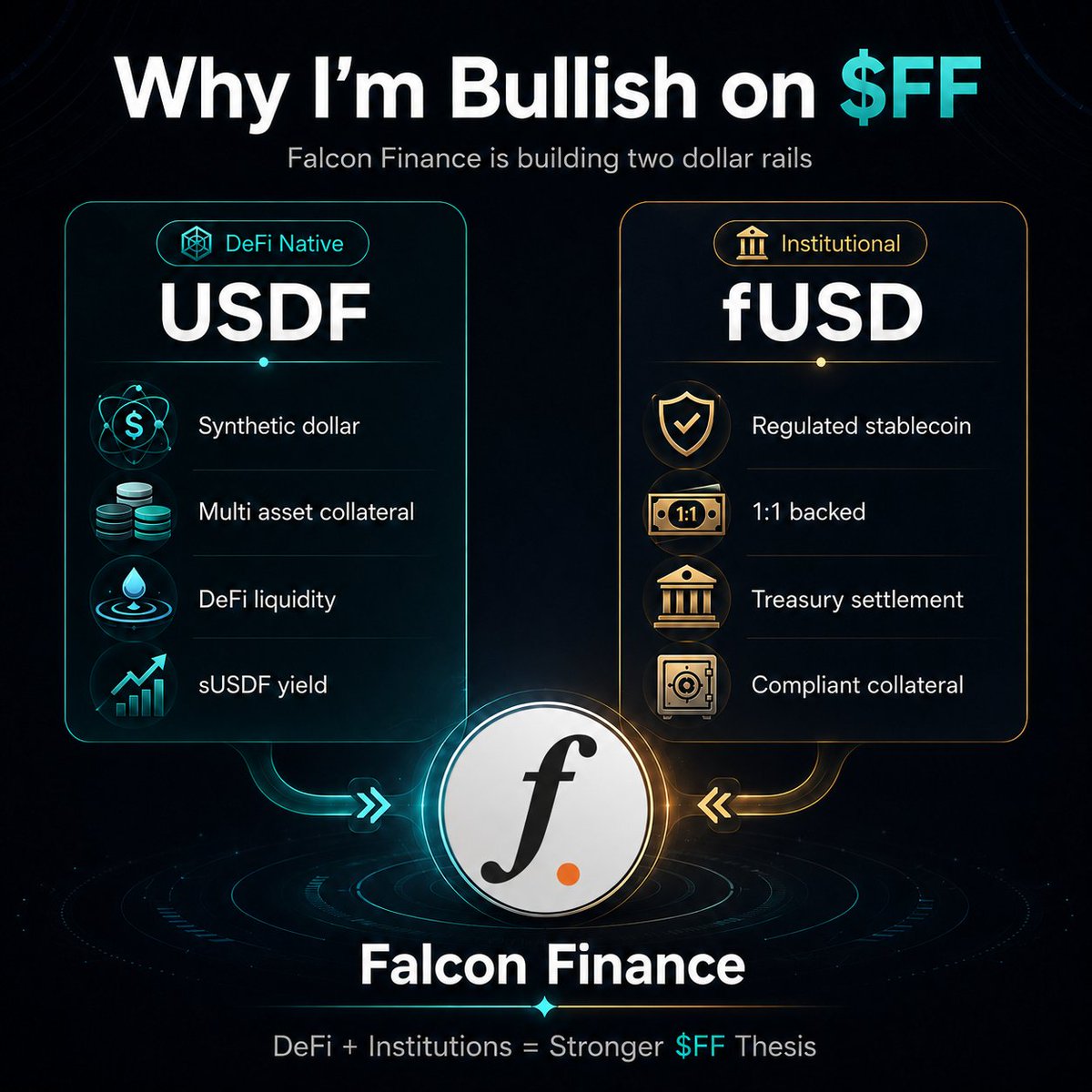
Found out @falconfinance is interesting more than I think!
It is not building one stablecoin product, it is building two dollar rails for two different markets.
USDf is the DeFi native synthetic dollar, where users can deposit stablecoins, BTC, ETH, altcoins, or tokenized RWAs as collateral to mint liquidity without fully exiting their positions.
The real edge is that USDf is overcollateralized and connected to sUSDF, so users can move from a stable dollar asset into a yield bearing version while Falcon manages strategies behind the scenes.
Then fUSD gives Falcon a more institutional lane.
It is a regulated one to one backed stablecoin built for treasury, settlement, collateral, and compliant dollar flows, with cash and short dated Treasuries as backing.
That is why I am bullish on $FF.
USDF gives Falcon exposure to DeFi liquidity and yield demand, while fUSD opens the door to institutional stablecoin adoption.
Most protocols are fighting for one side of the market, but Falcon is building across both.
If both products scale, Falcon Finance can become a serious dollar infrastructure player this cycle.
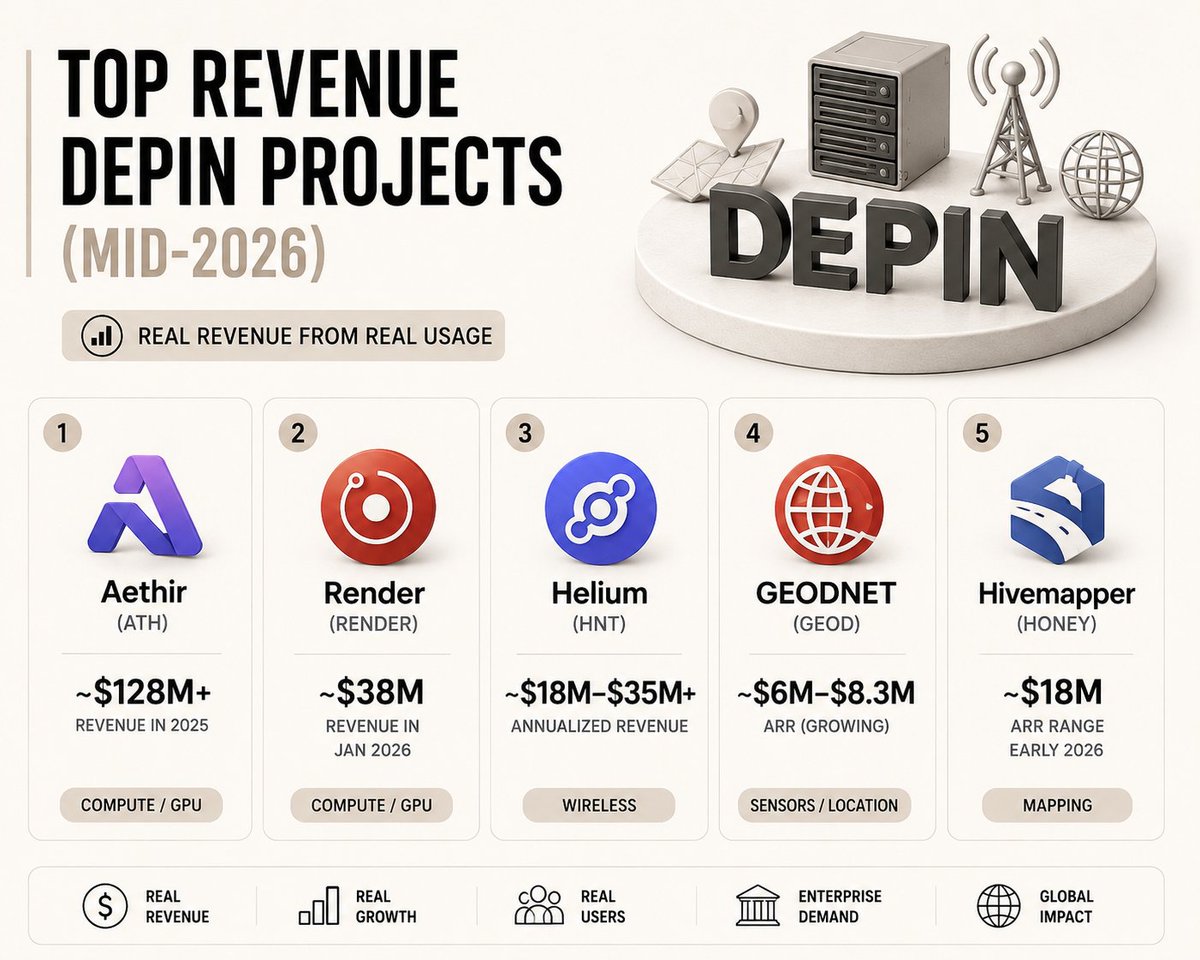
DePIN is finally proving it can generate real revenue, not just emissions.
And the biggest winners right now are compute networks.
➤ Top revenue generating DePIN projects in 2026:
1/ @AethirCloud ($ATH) The clear leader.
Aethir built a decentralized GPU cloud for AI and gaming workloads, and enterprises are actually paying to use it.
~$128M+ revenue in 2025.
~$147M–166M ARR.
435K+ GPU containers.
1.5B+ compute hours delivered.
Where the money comes from:
AI inference, model training, cloud gaming, media rendering, enterprise GPU rentals.
The key difference: real utilization from real customers.
2/ @render ($RENDER)
Originally focused on decentralized rendering, but now heavily benefiting from AI demand.
- $38M revenue in Jan 2026 alone.
- Millions of frames rendered.
- Growing AI inference activity.
Where the money comes from:
3D rendering, AI image/video generation, creative workloads, GPU compute access.
As GPU shortages continue, Render becomes an alternative compute marketplace.
3/ @helium ($HNT)
The first DePIN project that truly achieved mainstream adoption.
Helium monetizes decentralized wireless infrastructure.
Hundreds of thousands of mobile subscribers
Revenue from mobile plans + data credits.
Partnerships with telecom giants like T-Mobile.
Where the money comes from:
5G/mobile usage, IoT connectivity, carrier offloading.
This is one of the few crypto networks with real world recurring subscription revenue.
4/ @GEODNET ($GEOD)
Quietly becoming critical infrastructure for drones, robotics, and autonomous systems.
- 21K+ RTK stations globally.
- $6M–8M ARR and growing fast.
Where the money comes from:
Precision GPS/RTK correction data sold to enterprises.
Use cases:
drones, surveying, robotics, agriculture, autonomous navigation.
5/ @Hivemapper
Building decentralized Google Maps style infrastructure.
Drivers collect street level imagery while enterprises pay for constantly refreshed map data.
Where the money comes from:
mapping APIs, enterprise geospatial data, logistics and autonomous driving datasets.
Fresh real world data is becoming extremely valuable for AI and robotics.
---
The bigger trend: DePIN revenue is shifting toward AI infrastructure.
Storage mattered in the last cycle.
Compute, bandwidth, mapping, and wireless matter now.
The market is rewarding projects with: real usage, enterprise demand, sustainable token models,
recurring revenue.
The era of “token incentives only” is fading.
Now the question is:
Which DePIN networks can scale into actual infrastructure businesses?
Prediction markets were never supposed to be limited to a few curated headlines.
@42space is turning every narrative, every opinion, every community into something tradable.
The most valuable markets won’t be created by institutions.
They’ll be created by users.
Everyone talks about RWA growth.
But when I look deeper, not every sector is actually being USED.
Some sectors are huge on paper.
Others are smaller but already generating real yield inside DeFi.
Current RWA market:
Total on-chain RWA → ~$29B
Treasuries/Bonds → $22.7B
Tokenized Gold → $5.99B
Private Credit → $3.79B
Reinsurance → $352M
Equities → $1.29B
---
The interesting part is DeFi utilization.
Private Credit already has ~30% actively used in DeFi.
Real-world lending.
Real cash flow.
5–12% yield.
I’m watching @maplefinance & @centrifuge closely here.
Reinsurance is even crazier.
Almost 89% utilization in DeFi leading by @re .
This is one of the few sectors where crypto actually improves capital efficiency instead of just tokenizing assets for narrative.
---
And the TAM is massive.
If only 10% of traditional reinsurance moves onchain, we’re potentially looking at a near $100B sector alone.
Treasuries are still the giant.
But most of the liquidity is sitting idle.
Ondo, BUIDL, USYC are leading, but composability still feels early.
Then there’s RWA perps & tokenized equities.
This might become the easiest gateway for TradFi users entering crypto.
@HyperliquidX , @Ostium , @PreStocks are already proving demand exists.
Especially for pre-IPO exposure.
---
Right now, I think the strongest long term opportunities are still:
- Private Credit.
- Reinsurance.
Because they combine:
- Real economic yield.
- High DeFi usage.
- Massive traditional markets.
That combination is hard to ignore.
$XMR vs $ZEC — the two privacy giants.
But if privacy demand explodes again, who actually has more upside?
$XMR chose one path: full privacy, all the time.
Every transaction is hidden by default.
No opt-in. No transparent mode.
With FCMP++ now live, Monero’s anonymity set became dramatically larger, making tracing far harder than before.
That’s why many still see $XMR as the true digital cash narrative.
But that same strength is also its biggest weakness.
More exchange delistings.
More regulatory pressure.
Less institutional accessibility.
---
Meanwhile $ZEC took a completely different approach.
Optional privacy + compliance flexibility.
Shielded transactions powered by zk-SNARKs are incredibly advanced cryptographically, but users can still choose transparent transfers when needed.
That tradeoff may actually matter a lot in the next cycle.
Because institutions don’t want “untraceable.”
They want “selectively private.”
And that’s where $ZEC is quietly gaining momentum:
- Grayscale trust + ETF narrative.
- Easier exchange listings.
- Growing shielded adoption.
- Better fit for regulated finance.
The market is already reflecting this.
---
$XMR feels stronger fundamentally for real privacy usage.
$ZEC feels stronger for capital inflows and speculation.
If the world moves toward surveillance resistance and decentralized usage → $XMR wins long term.
If TradFi enters privacy crypto through regulated products → $ZEC probably outperforms faster.
One is “privacy purity.”
The other is “compliant privacy.”
Both narratives are getting stronger in 2026.
And honestly, privacy may become one of the biggest crypto narratives again sooner than people expect.
Which one is ur bet?
Watching $ZEC this month !
Hit $640, now $545 but still strong.
Privacy tech + big institutions backing it + real usage = why I’m holding @Zcash .
Momentum looks solid → $600–$640 next? Could happen.
Volatile? Yes.
But this mix makes it worth a spot in my portfolio.
NFA!
I think the biggest moat in AI will not be the model.
It will be privacy plus real usage.
That is why $VVV stands out to me.
---
@AskVenice already has:
- 2M+ registered users.
- 26M website visits in Q1 2026.
- Hundreds of millions of AI inferences.
- 33.7M $VVV burned.
- Around 42% of original supply removed.
- Around 69% of circulating supply staked.
- Roughly $800M+ market cap.
Revenue from subscriptions and API tied to buybacks and burns.
---
Most AI tokens still depend on narrative.
$VVV has a working product, real users, real compute demand, and a token model that directly connects platform growth to supply reduction.
As AI becomes part of trading, research, agents, robotics, and business workflows, private inference becomes more valuable.
Models can be copied.
Distribution can be competed away.
But trust, privacy, and usage based value capture are much harder to replicate.
That is why I see $VVV as one of the strongest AI crypto moat plays right now.
Top Altcoins I Am Watching For The Next Bull Run
I am watching projects that sit directly inside the biggest crypto narratives: AI, RWA, scalable DeFi, privacy, payments, and institutional infrastructure.
1/ $SOL
Still one of the strongest Layer 1 ecosystems.
Fast execution, low fees, strong retail activity, memecoins, DeFi, NFTs, gaming, and growing payment use cases.
For me, SOL remains a core high beta bull market asset.
2/ $ETH
ETH is still the settlement layer of crypto.
DeFi, L2s, staking, ETFs, tokenization, and institutional adoption all keep Ethereum relevant.
Less explosive than smaller caps, but still one of the strongest anchors.
3/ $SUI
SUI is one of the newer Layer 1s with real performance upside.
Move language, parallel execution, strong gaming potential, and fast ecosystem growth make it worth watching.
If next gen apps get traction, SUI can move hard.
4/ $TAO
AI will likely remain one of the biggest narratives.
Bittensor sits directly in that lane with decentralized machine intelligence and subnet based incentives.
High risk, but also one of the clearest AI crypto leaders.
5/ $HYPE
Hyperliquid is not just a perp DEX anymore.
It is becoming serious on chain trading infrastructure with strong volume, strong community, and real usage.
If trading keeps moving on chain, HYPE benefits directly.
6/ $LINK
Chainlink is one of the most important infrastructure plays in crypto.
Oracles, RWA, cross chain messaging, DeFi data, and institutional integrations all point to one thing: LINK is boring until it suddenly matters.
7/ $ARB
Arbitrum gives exposure to Ethereum scaling.
If DeFi activity returns strongly, L2s should benefit, and ARB remains one of the biggest names in that sector.
8/ $ZEC
Privacy can become a major narrative again.
With rising regulation and growing demand for financial privacy, ZEC is worth keeping on the radar.
9/ $ONDO
RWA is one of the strongest long term narratives.
Tokenized treasuries, yield products, and TradFi bridges make ONDO one of the clearer plays in this sector.
10/ $RNDR
AI needs compute.
Render sits at the intersection of GPU demand, graphics, and decentralized infrastructure.
If AI crypto heats up again, RNDR should stay relevant.
---
The next bull run will not reward every altcoin equally.
I am watching coins with clear narratives, real usage, strong liquidity, and a reason for capital to rotate into them.
Narrative gets attention.
Usage keeps attention.
Liquidity creates the move.
NFA!
I think large cap memecoins are starting to look interesting again.
The meme sector is still volatile, but attention is clearly not dead.
As of May 2026, the sector is sitting around $38B, and the strongest narratives are coming from Solana memes, NFT IP, AI memes, PolitiFi, and broader BTC or ETH momentum.
For large caps, my watchlist is simple:
1/ ethereum:0x6982508145454ce325ddbe47a25d4ec3d2311933
This still feels like the cleanest momentum play.
High volume, strong culture, easy meme, and still one of the first names traders rotate into when meme season heats up.
2/ solana:2zMMhcVQEXDtdE6vsFS7S7D5oUodfJHE8vd1gnBouauv
This one is more than just a meme.
Pudgy Penguins has real IP, NFT history, toys, brand awareness, and a community that can onboard normies better than most crypto memes.
If NFTs wake up again, solana:2zMMhcVQEXDtdE6vsFS7S7D5oUodfJHE8vd1gnBouauv can move fast.
3/ siren-2:native
This is the risky momentum pick.
Recent price action has been explosive, and the AI plus meme angle gives it attention. But whale concentration makes it very dangerous, so I would treat it as a high risk trade, not a comfortable hold.
4/ $DOGE and $SHIB
Less explosive, but still the safest large cap anchors.
When retail comes back, these two usually get attention first. I do not expect the biggest upside here, but they still matter for meme market direction.
---
For potential runners below large cap, I am watching:
$WIF
$FLOKI
solana:9BB6NFEcjBCtnNLFko2FqVQBq8HHM13kCyYcdQbgpump
$SPX
$BONK
$TRUMP
And for higher risk attention plays:
$WOJAK
$TROLL
$REDO
$UTYA
---
If meme season comes back, the first wave usually goes to liquid large caps like ethereum:0x6982508145454ce325ddbe47a25d4ec3d2311933 and $DOGE.
The second wave usually goes to strong narrative coins like solana:2zMMhcVQEXDtdE6vsFS7S7D5oUodfJHE8vd1gnBouauv, $WIF, $SPX, and $FARTCOIN.
The final wave is where smaller hype coins can go crazy, but that is also where most people get trapped.
I am bullish on the meme narrative, but I still think risk control matters more than prediction.
Memecoins can explode fast.
They can also erase gains even faster.
Who got the most community strength? Show me!
➤ TON Ecosystem 5 minutes Read
I see TON as one of the few ecosystems where distribution is already built in.
Most chains need to fight for users first. TON starts from Telegram, and that changes the game.
1/ Core Platforms
> Telegram @telegram
The gateway to 1B+ users and the biggest reason TON has a real mass adoption path.
> TON @ton_blockchain
The native Layer 1 blockchain built around fast payments, apps, tokens, and Telegram native user flows.
2/ EVM Expansion Layer
> $TAC @TacBuild
TAC is one of the most important pieces in the TON expansion story.
It is a purpose built Layer 1 blockchain built with Cosmos SDK and Ethermint, acting as an EVM network extension for TON.
3/ GameFi & Tap To Earn Mini Apps
GameFi is still one of the strongest onboarding engines on TON.
The reason is simple: users do not need to understand wallets, chains, or DeFi first. They just enter through Telegram and start playing.
> Catizen @CatizenAI
> Duckygram @fireheadz_games
> Gatto @Gatto_game
4/ Getting Started On TON
These apps make the first touchpoint with TON extremely easy for new users.
> Getgems @getgemsdotio
> Hamster Kombat @hamster_kombat
> Notcoin @notcoin
> Dogs @realDogsHouse
5/ Marketplace
> Sticker Store @stickers_tg
A very Telegram native marketplace category, and one that fits TON’s social distribution perfectly.
6/ Memecoins
Memecoins on TON are gaining momentum because the community layer is already strong inside Telegram.
> Resistance Dog @redotoken
> TON FISH MEMECOIN @tonfish_tg
> Utya @TonUtyacoin
> Povel Durov @PovelDurev
7/ DEXs & DeFi
TON DeFi is focused on fast trading, low fees, liquid staking, and lending.
The DeFi side is still early, but if Telegram native users start moving deeper onchain, this category can become much bigger.
> https://t.co/YthIrdv9w8 @ston_fi
> DeDust @dedust_io
> EVAA Protocol @evaaprotocol
8/ Wallets
Wallets are the real front door of TON.
> Tonkeeper @tonkeeper
> Wallet @wallet_tg
The easier the wallet experience becomes, the easier TON can convert Telegram users into real onchain users.
9/ Social
> ROoLZ @Roolznft
Social is one of the most natural directions for TON because Telegram already has the user base and social graph.
10/ Other Infrastructure
TON also has several core primitives that support the ecosystem:
- TON DNS.
- TON Storage.
- TON Sites.
- Jettons.
- TON Space.
- TON Pay 2.0
---
TON is not just competing as another Layer 1.
It is competing as a consumer crypto ecosystem with Telegram as the distribution layer.
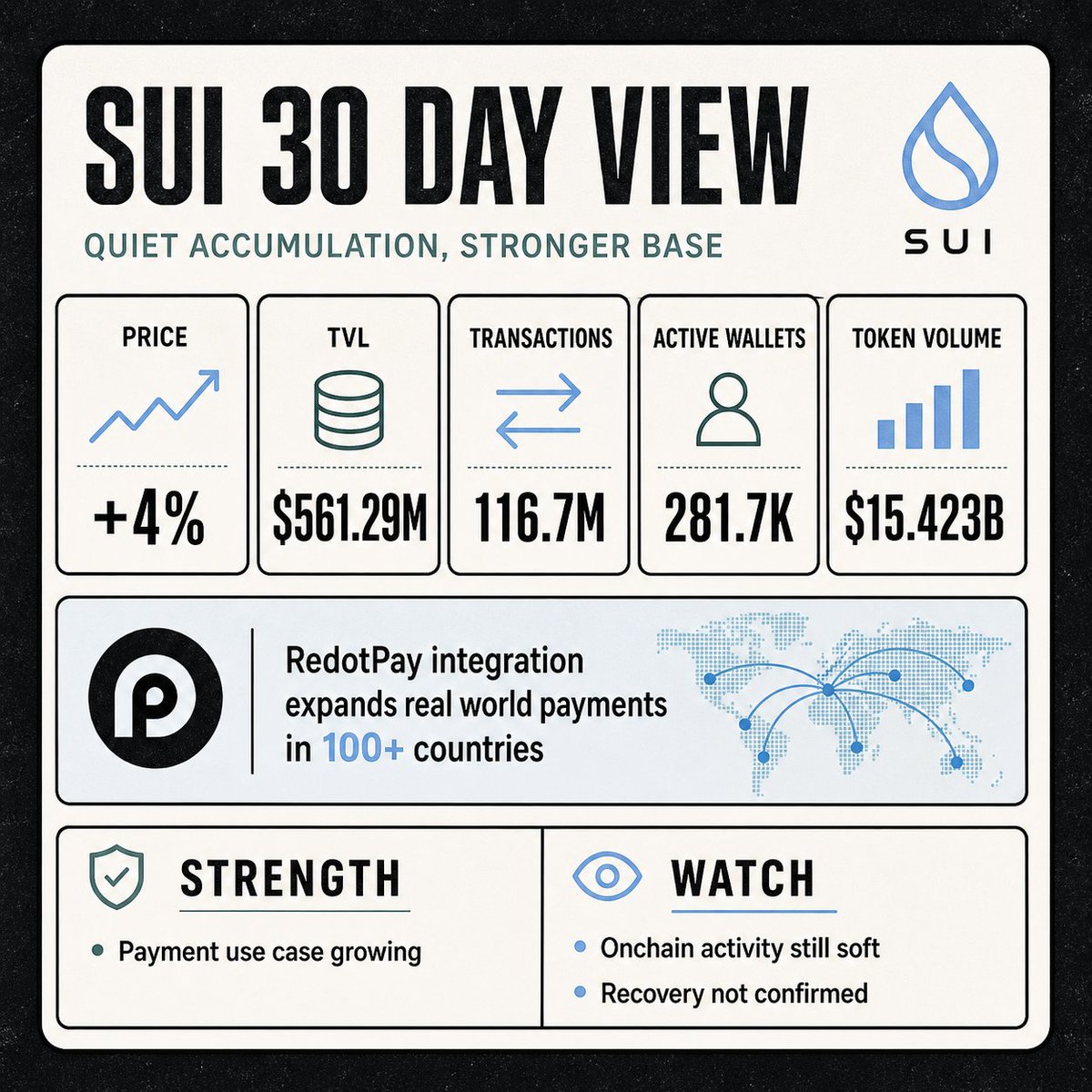
sui:native : Accumulation Zone!
Not explosive yet, but the foundation is slowly getting stronger.
Over the past month, sui:native recovered around +4%, trading near $0.9282.
Nothing too aggressive, but this feels more like an accumulation phase while the broader crypto market is still waiting for clearer momentum.
----
What caught my attention is @RedotPay integrating SUI and USDC on Sui.
This allows users to send, receive, and spend native Sui assets across more than 100 countries through traditional payment rails like cards and bank transfers.
For me, this is important because it pushes Sui closer to real world payment usage, not just DeFi speculation.
On the ecosystem side, @SuiNetwork now has around 150 projects, down 6 projects over the past 30 days. That shows growth has slowed a bit, which is understandable in a weak market.
Ecosystem market cap remains around $87.10B, mostly flat compared to last month.
TVL increased slightly by about +1.24% to around $561.29M, putting Sui back around the top 13 chains by TVL.
---
The onchain data is more mixed.
Transactions dropped from around 124.1M in February to 116.7M in March.
Active wallets also fell from 362K to 281.7K, although around 135.6K new wallets were still activated.
Monthly fees declined to around $268.9K, showing that network activity is still quiet.
Token trading volume also dropped around 40%, from $21.234B to $15.423B. Still, liquidity remains relatively healthy compared to the overall weak market condition.
---
My personal view:
SUI still has strong long term signals.
- RedotPay integration is a real adoption catalyst.
- Chainalysis integration helps strengthen compliance and security.
- Grayscale and Bitwise ETF related progress also keeps Sui on the radar for institutional narratives.
But I would not ignore the short term weakness.
Most key onchain metrics are still declining, including transactions, active wallets, fees, and token volume.
→ That tells me real user activity has not fully recovered yet.
So for now, I see SUI as a project in accumulation mode.
Not the loudest chart in the market, but the foundation is still being built quietly.
NFA!
.@megaeth post launch is getting hard to ignore.
This is no longer just another fast L2 pitch.
Mainnet is live. $MEGA TGE is done. Liquidity is moving in.
Apps are starting to compete for real users.
➥ Some numbers I’m watching:
1. Chain performance
MegaETH is targeting sub 10ms block times, 100k plus TPS potential, and Web2 like latency while settling on Ethereum.
Before mainnet, stress tests reportedly hit around 35k TPS and processed nearly 11B transactions.
That gives the chain a much stronger base than the average L2 launch narrative.
2. Post launch traction
TVL has already been reported around $355M to $521M.
Stablecoin liquidity is also growing fast, led by native USDM.
That matters because speed without liquidity is just a benchmark.
Speed plus liquidity is where real DeFi demand starts.
3. $MEGA token stats
TGE happened on April 30, 2026.
Current price is around $0.154 to $0.156.
Market cap is around $175M.
FDV is around $1.5B.
Total supply is 10B $MEGA, with around 1.1B circulating, about 11 percent.
The key detail: more than 53 percent of supply is tied to performance milestones, not just random time based unlocks.
That makes adoption metrics extremely important.
4. Top ecosystem projects
@kumbaya_xyz is the current liquidity leader, with around $59M to $72M TVL and roughly 57 to 60 percent of chain TVL.
@worldmarketsinc has around $12M TVL and is one of the key high speed trading plays.
Aave V3 and GMX bring major lending and perps liquidity.
Cap is building around stablecoin yield and capital efficiency.
Other names I’m watching: Brix, GTE, Euphoria, Prism, HitOne, TopStrike, Avon, Nectar AI, Ubitel and Monster.
MegaETH already has around 120 apps live or deploying through Rabbithole.
5. Biggest opportunity right now
Terminal Points Season 1 runs from April 28 to June 23.
Duration: 8 weeks.
Reward allocation: 2.5 percent of $MEGA supply.
At current FDV, that is roughly $40M in potential rewards.
Users can earn through swaps, LP, trading, gaming, app usage, weekly boosters and NFT clan boosts.
----
MegaETH has entered the proof phase.
The next big signals are TVL growth, USDM supply, active wallets, app volume and Terminal Points activity.
If those numbers keep moving together, $MEGA becomes more than a launch trade.
It becomes one of the strongest real time L2 adoption plays of 2026.
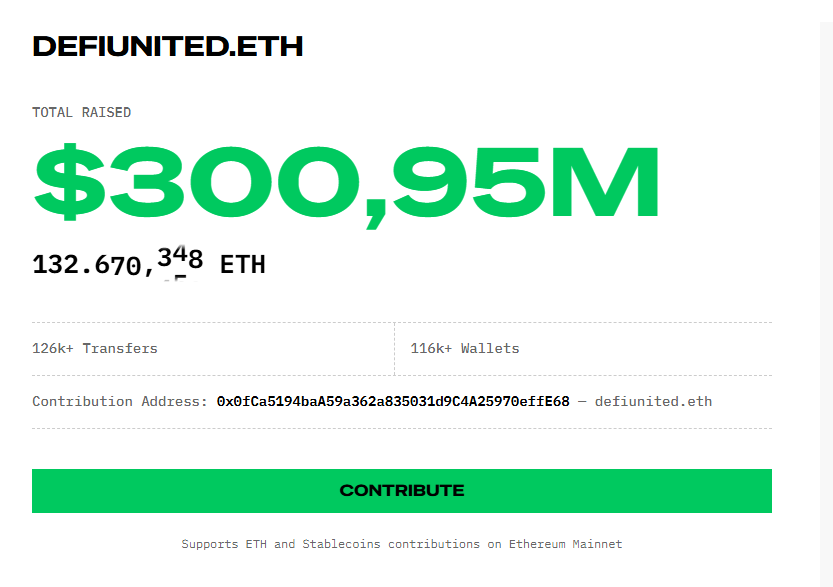
DeFi United is turning into one of the biggest recovery efforts DeFi has ever seen.
After the rsETH exploit, the goal is simple: restore backing, clear bad debt, and stop contagion before it spreads deeper.
Major support so far:
- @arbitrum Security Council: 30.7K ETH.
- Consensys and @ethereumJoseph : 30K ETH.
- @Mantle_Official : 30K ETH credit facility.
- @aave DAO: 25K ETH.
- @StaniKulechov : 5K ETH.
- @ether_fi : 5K ETH.
- Lido Finance: up to 2.5K stETH.
- Kelp DAO: 2K ETH.
- @GolemFoundation : 1K ETH.
- Community donations: around 592 ETH. ( Wilcosx 0.0x ETH).
- Babylon Foundation: $3M USDT.
- Justin Sun, TRON, HTX: $20M USDT.
Others supporting: Ethena, Ink, Tydro, BGD Labs, Avalanche Foundation, Circle Ventures, and several individual contributors.
Total pledged support has crossed 132K ETH, worth over $300M.
DeFi just proved something important. UNITED!
Just want to show some support for crypto and not hoping for any airdrop back!
DEFI UNITED TIME