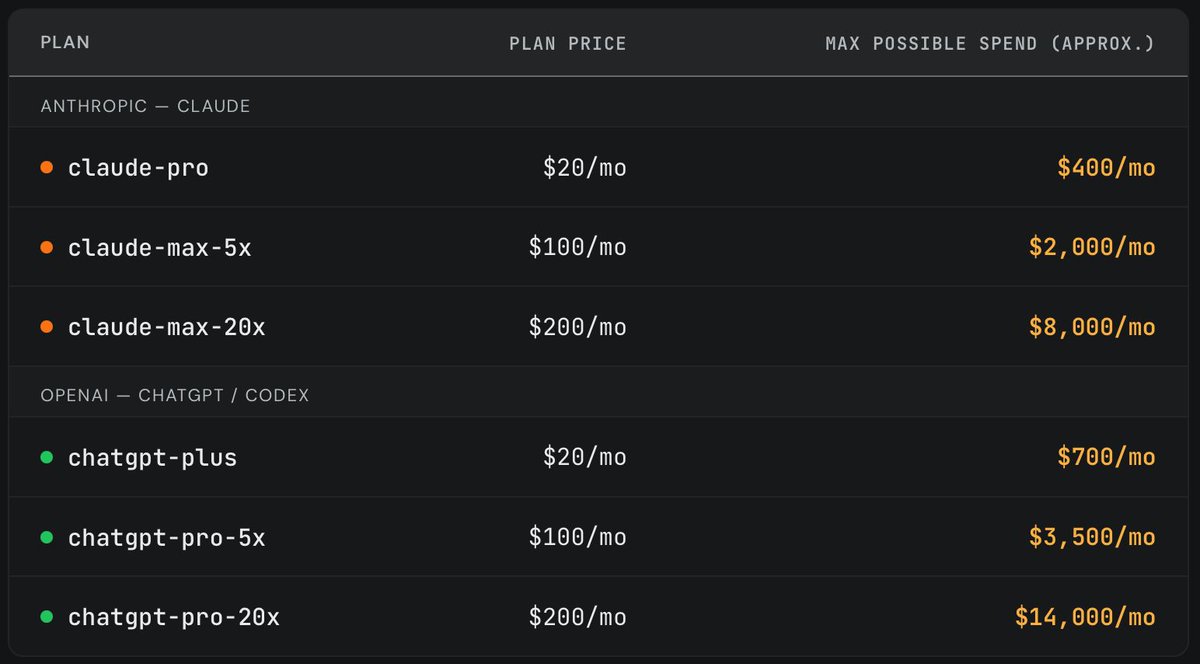
Recently, we purchased one of each Anthropic/OpenAI subscription plan and randomly ran long horizon coding tasks until we exhausted the weekly limit. It's widely believed that a $200/month plan maxes out at ~$2000/month worth of tokens (assuming API pricing). However, we found that the subscriptions are actually far more generous. (2/4)
we're making @blocks smaller today. here's my note to the company.
####
today we're making one of the hardest decisions in the history of our company: we're reducing our organization by nearly half, from over 10,000 people to just under 6,000. that means over 4,000 of you are being asked to leave or entering into consultation. i'll be straight about what's happening, why, and what it means for everyone.
first off, if you're one of the people affected, you'll receive your salary for 20 weeks + 1 week per year of tenure, equity vested through the end of may, 6 months of health care, your corporate devices, and $5,000 to put toward whatever you need to help you in this transition (if you’re outside the U.S. you’ll receive similar support but exact details are going to vary based on local requirements). i want you to know that before anything else. everyone will be notified today, whether you're being asked to leave, entering consultation, or asked to stay.
we're not making this decision because we're in trouble. our business is strong. gross profit continues to grow, we continue to serve more and more customers, and profitability is improving. but something has changed. we're already seeing that the intelligence tools we’re creating and using, paired with smaller and flatter teams, are enabling a new way of working which fundamentally changes what it means to build and run a company. and that's accelerating rapidly.
i had two options: cut gradually over months or years as this shift plays out, or be honest about where we are and act on it now. i chose the latter. repeated rounds of cuts are destructive to morale, to focus, and to the trust that customers and shareholders place in our ability to lead. i'd rather take a hard, clear action now and build from a position we believe in than manage a slow reduction of people toward the same outcome. a smaller company also gives us the space to grow our business the right way, on our own terms, instead of constantly reacting to market pressures.
a decision at this scale carries risk. but so does standing still. we've done a full review to determine the roles and people we require to reliably grow the business from here, and we've pressure-tested those decisions from multiple angles. i accept that we may have gotten some of them wrong, and we've built in flexibility to account for that, and do the right thing for our customers.
we're not going to just disappear people from slack and email and pretend they were never here. communication channels will stay open through thursday evening (pacific) so everyone can say goodbye properly, and share whatever you wish. i'll also be hosting a live video session to thank everyone at 3:35pm pacific. i know doing it this way might feel awkward. i'd rather it feel awkward and human than efficient and cold.
to those of you leaving…i’m grateful for you, and i’m sorry to put you through this. you built what this company is today. that's a fact that i'll honor forever. this decision is not a reflection of what you contributed. you will be a great contributor to any organization going forward.
to those staying…i made this decision, and i'll own it. what i'm asking of you is to build with me. we're going to build this company with intelligence at the core of everything we do. how we work, how we create, how we serve our customers. our customers will feel this shift too, and we're going to help them navigate it: towards a future where they can build their own features directly, composed of our capabilities and served through our interfaces. that's what i'm focused on now. expect a note from me tomorrow.
jack
It is hard to communicate how much programming has changed due to AI in the last 2 months: not gradually and over time in the "progress as usual" way, but specifically this last December. There are a number of asterisks but imo coding agents basically didn’t work before December and basically work since - the models have significantly higher quality, long-term coherence and tenacity and they can power through large and long tasks, well past enough that it is extremely disruptive to the default programming workflow.
Just to give an example, over the weekend I was building a local video analysis dashboard for the cameras of my home so I wrote: “Here is the local IP and username/password of my DGX Spark. Log in, set up ssh keys, set up vLLM, download and bench Qwen3-VL, set up a server endpoint to inference videos, a basic web ui dashboard, test everything, set it up with systemd, record memory notes for yourself and write up a markdown report for me”. The agent went off for ~30 minutes, ran into multiple issues, researched solutions online, resolved them one by one, wrote the code, tested it, debugged it, set up the services, and came back with the report and it was just done. I didn’t touch anything. All of this could easily have been a weekend project just 3 months ago but today it’s something you kick off and forget about for 30 minutes.
As a result, programming is becoming unrecognizable. You’re not typing computer code into an editor like the way things were since computers were invented, that era is over. You're spinning up AI agents, giving them tasks *in English* and managing and reviewing their work in parallel. The biggest prize is in figuring out how you can keep ascending the layers of abstraction to set up long-running orchestrator Claws with all of the right tools, memory and instructions that productively manage multiple parallel Code instances for you. The leverage achievable via top tier "agentic engineering" feels very high right now.
It’s not perfect, it needs high-level direction, judgement, taste, oversight, iteration and hints and ideas. It works a lot better in some scenarios than others (e.g. especially for tasks that are well-specified and where you can verify/test functionality). The key is to build intuition to decompose the task just right to hand off the parts that work and help out around the edges. But imo, this is nowhere near "business as usual" time in software.
A lot of people quote tweeted this as 1 year anniversary of vibe coding. Some retrospective -
I've had a Twitter account for 17 years now (omg) and I still can't predict my tweet engagement basically at all. This was a shower of thoughts throwaway tweet that I just fired off without thinking but somehow it minted a fitting name at the right moment for something that a lot of people were feeling at the same time, so here we are: vibe coding is now mentioned on my Wikipedia as a major memetic "contribution" and even its article is longer. lol
The one thing I'd add is that at the time, LLM capability was low enough that you'd mostly use vibe coding for fun throwaway projects, demos and explorations. It was good fun and it almost worked. Today (1 year later), programming via LLM agents is increasingly becoming a default workflow for professionals, except with more oversight and scrutiny. The goal is to claim the leverage from the use of agents but without any compromise on the quality of the software. Many people have tried to come up with a better name for this to differentiate it from vibe coding, personally my current favorite "agentic engineering":
- "agentic" because the new default is that you are not writing the code directly 99% of the time, you are orchestrating agents who do and acting as oversight.
- "engineering" to emphasize that there is an art & science and expertise to it. It's something you can learn and become better at, with its own depth of a different kind.
In 2026, we're likely to see continued improvements on both the model layer and the new agent layer. I feel excited about the product of the two and another year of progress.
Companies do everything to get rid of people. People are expensive, unpredictable, unreliable, lying, complaining, demanding.
This is why companies use the cloud, which is 3 to 10 times more expensive than bare metal, even when they can afford full-time humans to take care of their own bare metal. The cloud neatly shields companies from people when it comes to their computing needs.
This is why companies will use AI-generated code no one has ever read instead of having expensive, unpredictable, unreliable, lying, complaining, demanding human coders.
Companies would rather automatically generate and regenerate code many times until it either works as expected or fails a reasonable fraction of time than put an additional meatbag on the payroll.
I've never felt this much behind as a programmer. The profession is being dramatically refactored as the bits contributed by the programmer are increasingly sparse and between. I have a sense that I could be 10X more powerful if I just properly string together what has become available over the last ~year and a failure to claim the boost feels decidedly like skill issue. There's a new programmable layer of abstraction to master (in addition to the usual layers below) involving agents, subagents, their prompts, contexts, memory, modes, permissions, tools, plugins, skills, hooks, MCP, LSP, slash commands, workflows, IDE integrations, and a need to build an all-encompassing mental model for strengths and pitfalls of fundamentally stochastic, fallible, unintelligible and changing entities suddenly intermingled with what used to be good old fashioned engineering. Clearly some powerful alien tool was handed around except it comes with no manual and everyone has to figure out how to hold it and operate it, while the resulting magnitude 9 earthquake is rocking the profession. Roll up your sleeves to not fall behind.
I don't know what shocks me more: that Sonnet 3.7 was released in February this year (it feels like years ago), or what incredible capabilities have been added in such a short time.
""70, 80, 90% of the code written in Anthropic is written by Claude. (...) "I said something like this 3 or 6 months ago, people think of it as falsified because they think of it as like we're going to fire 70 80 or 90% of the software engineers but what really happens is that the 10% were still writing, you know, humans become managers of AI systems."
Things in AI change so fast
In July, everyone switched from Cursor to Claude Code
In September, everyone switches back from Claude Code to Cursor or Codex after Anthropic allegedly decreased the quality of responses to save money
2 months!
AI is crazy because you deeply need to avoid being sentimental about any part of your product architecture at all times.
The models are upgrading at such a fast rate that you have to constantly reevaluate the scaffolding you’ve built, and figure out what now can be solved in a better or cheaper way due to a new breakthrough.
Companies will win or lose entirely by their ability to let go of something that they ostensibly got good at because the models can now solve that for them.
This is generally where startups win over time because they emerge in a period when something is far easier to solve in a modern way, and the incumbent doesn’t properly adapt.
The key is to ensure you have an architecture that gives you this flexibility, which means creating the right abstractions early on to benefit from these constant updates.
There is significant unmet demand for developers who understand AI. At the same time, because most universities have not yet adapted their curricula to the new reality of programming jobs being much more productive with AI tools, there is also an uptick in unemployment of recent CS graduates.
When I interview AI engineers — people skilled at building AI applications — I look for people who can:
- Use AI assistance to rapidly engineer software systems
- Use AI building blocks like prompting, RAG, evals, agentic workflows, and machine learning to build applications
- Prototype and iterate rapidly
Someone with these skills can get a massively greater amount done than someone who writes code the way we did in 2022, before the advent of Generative AI. I talk to large businesses every week that would love to hire hundreds or more people with these skills, as well as startups that have great ideas but not enough engineers to build them. As more businesses adopt AI, I expect this talent shortage only to grow! At the same time, recent CS graduates face an increased unemployment rate, though the underemployment rate — of graduates doing work that doesn’t require a degree — is still lower than for most other majors. This is why we hear simultaneously anecdotes of unemployed CS graduates and also of rising salaries for in-demand AI engineers.
When programming evolved from punchcards to keyboard and terminal, employers continued to hire punchcard programmers for a while. But eventually, all developers had to switch to the new way of coding. AI engineering is similarly creating a huge wave of change.
There is a stereotype of “AI Native” fresh college graduates who outperform experienced developers. There is some truth to this. Multiple times, I have hired, for full-stack software engineering, a new grad who really knows AI over an experienced developer who still works 2022-style. But the best developers I know aren’t recent graduates (no offense to the fresh grads!). They are experienced developers who have been on top of changes in AI. The most productive programmers today deeply understand computers, how to architect software, and how to make complex tradeoffs — and who additionally are familiar with cutting-edge AI tools.
Sure, some skills from 2022 are becoming obsolete. For example, a lot of coding syntax that we had to memorize back then is no longer important, since we no longer need to code by hand as much. But even if, say, 30% of CS knowledge is obsolete, the remaining 70% — complemented with modern AI knowledge — is what makes really productive developers. (Even after punch cards became obsolete, a fundamental understanding of programming was very helpful for typing code into a keyboard.)
Without understanding how computers work, you can’t just “vibe code” your way to greatness. Fundamentals are still important, and for those who additionally understand AI, job opportunities are numerous!
[Original text: https://t.co/nqzPC6eUpR ]
As ChatGPT becomes a go-to tool for students, we’re committed to ensuring it fosters deeper understanding and learning.
Introducing study mode in ChatGPT — a learning experience that helps you work through problems step-by-step instead of just getting an answer.
In the past month, Cursor found 1M+ bugs in human-written PRs. Over half were real logic issues that were fixed before merging.
Today, we're releasing the system that spotted these bugs. It's already become a required pre-merge check for many teams.


![AndrewYNg's tweet photo. There is significant unmet demand for developers who understand AI. At the same time, because most universities have not yet adapted their curricula to the new reality of programming jobs being much more productive with AI tools, there is also an uptick in unemployment of recent CS graduates.
When I interview AI engineers — people skilled at building AI applications — I look for people who can:
- Use AI assistance to rapidly engineer software systems
- Use AI building blocks like prompting, RAG, evals, agentic workflows, and machine learning to build applications
- Prototype and iterate rapidly
Someone with these skills can get a massively greater amount done than someone who writes code the way we did in 2022, before the advent of Generative AI. I talk to large businesses every week that would love to hire hundreds or more people with these skills, as well as startups that have great ideas but not enough engineers to build them. As more businesses adopt AI, I expect this talent shortage only to grow! At the same time, recent CS graduates face an increased unemployment rate, though the underemployment rate — of graduates doing work that doesn’t require a degree — is still lower than for most other majors. This is why we hear simultaneously anecdotes of unemployed CS graduates and also of rising salaries for in-demand AI engineers.
When programming evolved from punchcards to keyboard and terminal, employers continued to hire punchcard programmers for a while. But eventually, all developers had to switch to the new way of coding. AI engineering is similarly creating a huge wave of change.
There is a stereotype of “AI Native” fresh college graduates who outperform experienced developers. There is some truth to this. Multiple times, I have hired, for full-stack software engineering, a new grad who really knows AI over an experienced developer who still works 2022-style. But the best developers I know aren’t recent graduates (no offense to the fresh grads!). They are experienced developers who have been on top of changes in AI. The most productive programmers today deeply understand computers, how to architect software, and how to make complex tradeoffs — and who additionally are familiar with cutting-edge AI tools.
Sure, some skills from 2022 are becoming obsolete. For example, a lot of coding syntax that we had to memorize back then is no longer important, since we no longer need to code by hand as much. But even if, say, 30% of CS knowledge is obsolete, the remaining 70% — complemented with modern AI knowledge — is what makes really productive developers. (Even after punch cards became obsolete, a fundamental understanding of programming was very helpful for typing code into a keyboard.)
Without understanding how computers work, you can’t just “vibe code” your way to greatness. Fundamentals are still important, and for those who additionally understand AI, job opportunities are numerous!
[Original text: https://t.co/nqzPC6eUpR ]](https://pbs.twimg.com/media/G0A4amDbAAAXsq7.jpg)