WELT: "Der Bundesagentur für Arbeit droht Ende dieses Jahres aufgrund der Wirtschaftskrise ein neues Milliardenloch. Um das zu stopfen, könnte es für Steuerzahler teuer werden – und am Ende könnte sogar die Arbeitslosen treffen."
Die Lösung wäre so einfach: Personalabbau.
Die BA beschäftigt etwa 113.000 Mitarbeiter. Vermutlich ließen sich 50 % durch Prozessautomatisierungen einsparen, denn nur etwa 39.000 Mitarbeiter sind in der Arbeitsvermittlung und im Kundenservice tätigen.
Die große Masse der Beschäftigten ist Bestandteil eines riesigen Verwaltungsapparates, der im KI-Zeitalter nicht mehr zeitgemäß ist.
Everyone knows these timelines are incompatible with progress.
Grant funding takes 2–3 years from idea to award and another 3–5 years to publish the work.
Good scientists are already using whatever fungible resources they have available to pursue the most promising ideas while simultaneously playing the grant-writing game as a separate endeavor. The grant process and the science itself operate on different dimensions, with the grant process consuming sometimes over 90% of a scientists time.
Any serious reform effort should start by acknowledging this reality. The goal of science funding should be to accelerate discovery, not hinder it with bureaucracy.
Two economists just published a mathematical proof that AI will destroy the economy.
Not might. Not could. Will — if nothing changes.
The paper is called "The AI Layoff Trap." Published March 2, 2026. Wharton School, University of Pennsylvania. Boston University. Peer reviewed. Mathematically modeled.
The conclusion is one sentence.
"At the limit, firms automate their way to boundless productivity and zero demand."
An economy that produces everything. And sells it to nobody.
Here is how you get there.
A company fires 500 workers and replaces them with AI. A competitor fires 700 to keep up. Another fires 1,000. Every company is behaving rationally. Every company is following the incentives correctly. And every company is building a trap for itself.
Because the workers who were fired were also customers.
When they lose their jobs faster than the economy can absorb them, they stop spending. Consumer demand falls. Companies respond by cutting costs — which means automating more workers — which means less spending — which means more falling demand — which means more automation.
The loop has no natural exit.
The researchers tested every proposed solution. Universal basic income. Capital income taxes. Worker equity participation. Upskilling programs. Corporate coordination agreements.
Every single one failed in the model.
The only intervention that worked: a Pigouvian automation tax — a per-task levy charged every time a company replaces a human with AI, forcing them to price in the demand they are destroying before they pull the trigger.
No government has implemented this. No major economy is seriously discussing it.
Meanwhile the numbers are already tracking the curve. 100,000 tech workers laid off in 2025. 92,000 more in the first months of 2026. Jack Dorsey fired half of Block's workforce and said publicly: "Within the next year, the majority of companies will reach the same conclusion."
Nobody is doing anything wrong. Companies are following their incentives perfectly. That is exactly the problem.
Rational behavior. At scale. Simultaneously. With no mechanism to stop it.
Two economists built the math. The math leads to one place.
Source: Falk & Tsoukalas · Wharton School + Boston University ·
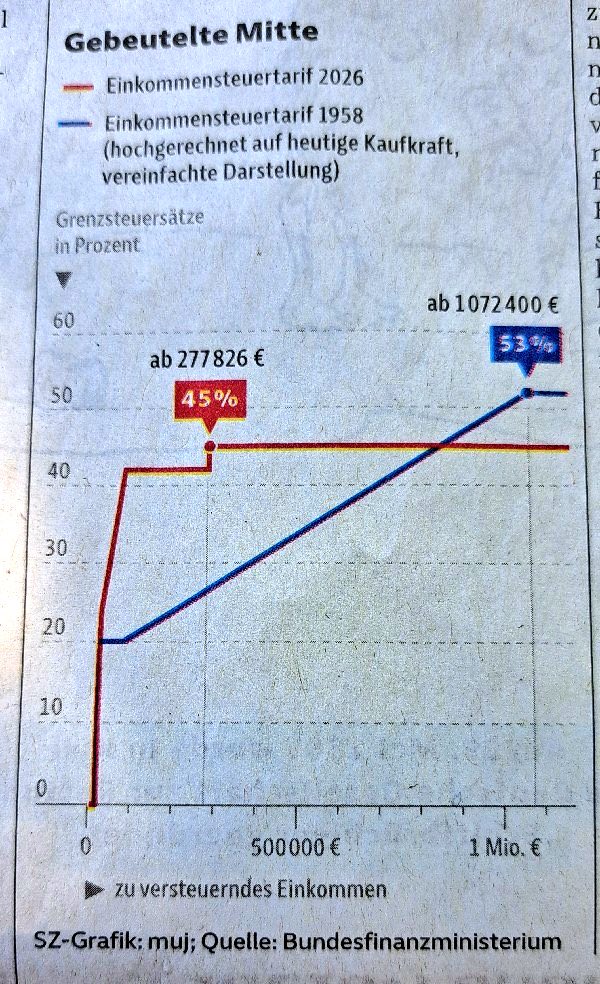
Diese Grafik zeigt wie der gierige Staat unsere Mittelschicht zerstört hat. In den Jahren des deutschen Wirtschaftswunders bezahlten gut verdienende Arbeitnehmer einen Steuersatz von etwa 25 %.
Familien konnten sich Häuser leisten. Ein Einkommen genügte. Das Fundament für eine stabile Gesellschaft wurde gelegt. Der Spitzensteuersatz in Höhe von 53 % griff inflationsbereinigt erst ab 1.072.000 €.
Heute kennt das Steuersystem keine Mittelschicht mehr. Wenn Du eine guten Job hast, kommt sofort der Staat und verlangt 42 %. Vermögensaufbau wird unmöglich. Das eigene Haus wird zum fernen Traum.
Linke Politik hat ein Steuersystem erschaffen, das die Bürger knechtet. Es ist hochgradig ungerecht.
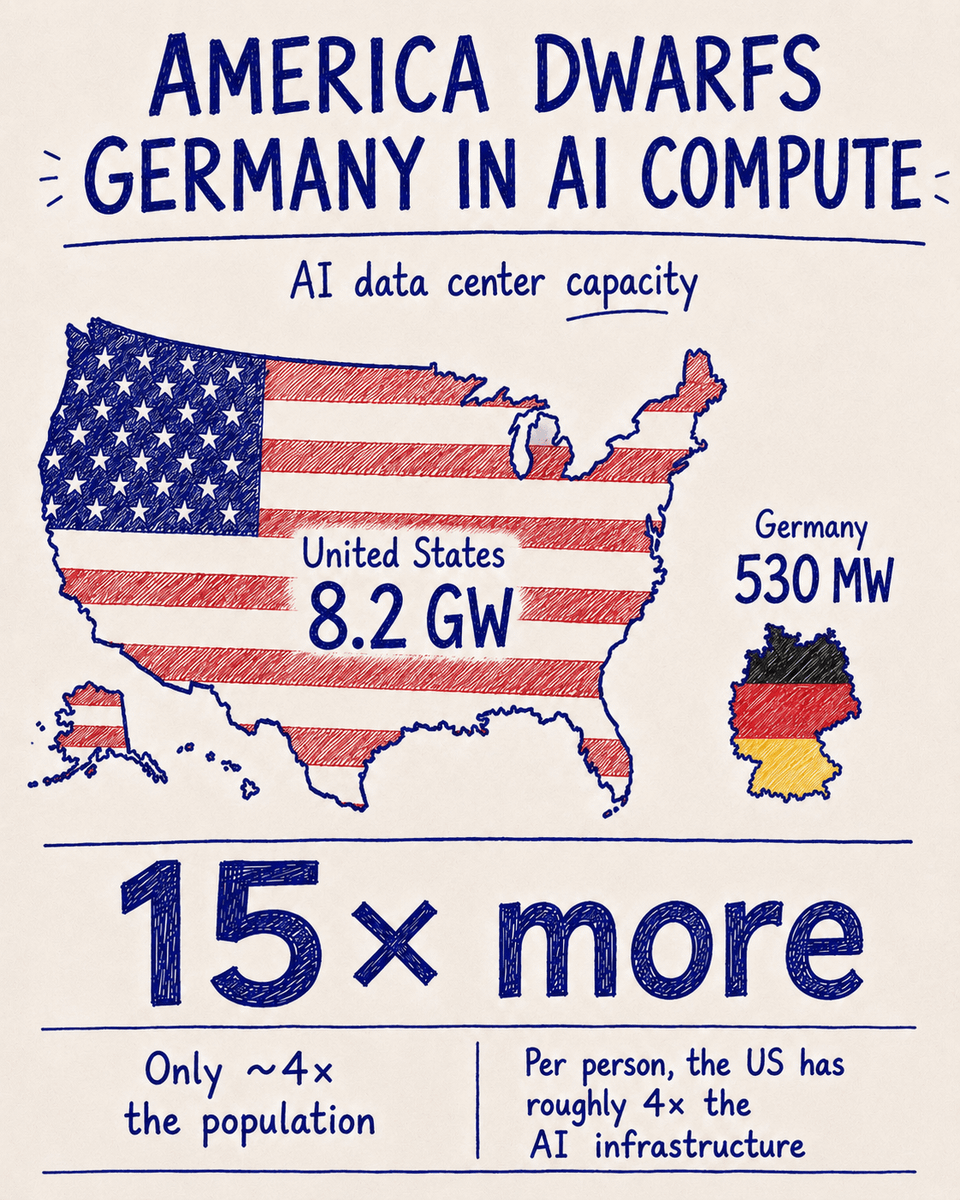
The difference is staggering. GPU capacity is THE new industrial capacity. Germany, traditionally continental Europe's preeminent economic and industrial power, is in particular shockingly far behind. Meanwhile the GPU capacity buildup in the US is not slowing down. Within the next few years will reach the point where we have more GPUs than people.
WELT:
- Der Spitzensteuersatz traf zuletzt Steuerpflichtige schon beim 1,3-Fachen des durchschnittlichen Bruttogehalts aller Arbeitnehmer. 1965 lag der Wert noch beim 15-Fachen, 1980 beim Fünffachen, 1990 beim 3,2-Fachen. Ein Steuersatz, der sprachlich nach Reichtum klingt, trifft heute breite Teile der leistungsorientierten Mitte.
- Wenig hilfreich sind Sätze wie „Auch Spitzenverdiener müssen ihren Beitrag leisten“. Er suggeriert, dass dies bisher nicht der Fall ist. Das Bundesfinanzministerium weist aus, dass die oberen zehn Prozent der Lohn- und Einkommensteuerpflichtigen 2026 bereits rund 57 Prozent des gesamten Lohn- und Einkommensteueraufkommens zahlen.
The idea that universities and hospitals are uniquely equipped to absorb massive amounts of money is one of the great scams of the modern biomedical era.
Fully equipped lab space can be leased for $35/sq ft. Scientists can be hired directly at salaries 50% higher than academia with no problem attracting talent. People no longer need a university brand on their CV to do important work.
What universities uniquely provide now is bureaucracy, branding, administrative empire building, and prestige signaling tied to legacy institutional names.
Give a stagnant university medical center another $100M and most of it disappears into bureaucracy and wealth extraction with very little relationship to scientific output.
Give $100M to a truly creative scientist and they could build an entirely new research institution capable of outperforming a billion-dollar academic system.
The idea that universities and hospitals are uniquely equipped to absorb massive amounts of money is one of the great scams of the modern biomedical era.
Fully equipped lab space can be leased for $35/sq ft. Scientists can be hired directly at salaries 50% higher than academia with no problem attracting talent. People no longer need a university brand on their CV to do important work.
What universities uniquely provide now is bureaucracy, branding, administrative empire building, and prestige signaling tied to legacy institutional names.
Give a stagnant university medical center another $100M and most of it disappears into bureaucracy and wealth extraction with very little relationship to scientific output.
Give $100M to a truly creative scientist and they could build an entirely new research institution capable of outperforming a billion-dollar academic system.
Personal update: I've joined Anthropic. I think the next few years at the frontier of LLMs will be especially formative. I am very excited to join the team here and get back to R&D. I remain deeply passionate about education and plan to resume my work on it in time.
I'm German.
Germany's ENTIRE AI data center capacity is less than 1/2 of just one site being built in Texas.
We have 530 megawatts of AI data center capacity in the entire country.
The US has 8.2 gigawatts. That's 15x more compute on a country with only 4x the people.
Per German, the US has roughly 4x the AI infrastructure.
One university computer at MIT is 4x faster than Germany's most important commercial AI facility.
The obvious reaction here is "so what, German companies can just rent compute from AWS."
But that's the same logic Germany applied to Russian gas for two decades.
Roughly 70% of German enterprise AI today runs on American cloud providers like AWS, Microsoft, and Google. Which means it runs under American law.
Every AI tool running in German hospitals, courts, ministries, banks, and factories sits on a foreign platform.
Here's why this can actually become problematic. Imagine these scenarios:
> The next GPU generation launches and American companies get access first because they own the data centers. German firms wait 12 months and pay 2-3x more for what's left.
> A frontier AI model gets released and US export controls block it from being deployed in Germany. SAP and Siemens watch American competitors integrate it for a year before they can.
> And in the worst case, a US president decides to use AI access as leverage in a trade dispute. German companies get cut off from the models their American competitors are still running.
All of them are compounding problems that will negatively impact the German economy (and everyone's standard of living/jobs etc).
None of this is hypothetical.
> The US pulled Starlink as leverage with Ukraine in March 2025
> Chip exports to China have been throttled for three years
> And the CLOUD Act lets the US demand any data stored by American cloud providers (even when the customer is a German company and the servers are physically in Germany).
Germany doesn't have an answer for any of those scenarios today because the infrastructure that would make those answers possible isn't built yet.
Now look at why this is actually happening on the ground.
In the last 3 months Germany rejected 3 AI data center projects in a row:
> Groß-Gerau, February: Vantage Data Centers, €2.5 billion, 174 MW. Voted down 18-14 by the local council
> Maintal: EdgeConnex, €1 billion, 170 MW. Blocked over a backup gas generator the developer needed because grid connections in Germany take 7-10 years and a data center is built in 2
> Freyenstein, Brandenburg, April: 700 MW AI campus. Killed by protests before construction
€3.5 billion in AI infrastructure turned away in one quarter.
And the situation is more urgent than it looks because compute is getting harder to access, not easier.
NVIDIA's Blackwell GPUs are already allocated through the second half of 2027. The American hyperscalers locked in the bulk of new production with forward orders placed in 2025. TSMC's advanced packaging lines (the actual bottleneck) are sold out through 2026.
Germany has no hyperscaler of its own. That means German industry sits at the back of the queue, and the gap compounds every quarter that goes by.
Where Germany is falling short right now comes down to three things:
> Public backlash, because the case for what AI data centers actually do for a country has never been made to the people voting on them
> Industrial electricity at €0.16-0.18 per kWh vs about $0.08 in Texas. For a 1 GW campus that's $700-900 million extra per year just for power
> Grid connections taking 7-10 years for large facilities when the data center itself is built in 2. No serious operator runs on math where the wait is longer than the build
And the first one is the biggest. Electricity policy and grid timelines are fixable. Public consent isn't, until someone makes the case that this infrastructure isn't nice-to-have. It's the foundation everything else runs on.
The average person only feels the downside (noise, rising electricity cost, terror attack vector)
We have a big messaging and marketing problem around data centers and why they are critical for everyone's future.
Germany still has the foundation to win this if it moves now.
Germany adopted its first national data center strategy in March 2026. 28 concrete measures, annual progress reports, doubling overall capacity and quadrupling AI capacity by 2030. The plan exists.
The Industriestrompreis launched on January 1st of this year. It targets 5 cents per kWh for half of an industrial user's annual consumption. If data centers get cleanly pulled into that framework, the electricity cost gap with Texas gets significantly closer.
Deutsche Telekom turned on 10,000 NVIDIA Blackwell GPUs in Munich in Q1. One facility increased Germany's available AI compute by roughly 50% overnight.
And the demand is already domestic. SAP, Siemens, BMW, BASF. The German industrial anchors that benefit most from AI are German companies. The customers are at home, the infrastructure should be at home too.
And this is the thing that most people forget.
Germany won the second industrial revolution. By 1900 German chemical output had passed Britain's, Siemens was wiring the world, and BASF and Bayer were inventing industries that didn't exist before they built them.
The companies that came out of those decisions are still the largest employers in Germany 130 years later.
Germany sat out the third industrial revolution, the software one, and that was survivable because software didn't run factories.
But AI runs factories. It runs hospitals, logistics, courts, and financial markets. This one is infrastructure in the same category as railways and chemical plants.
The plan is written and the money is ready.
The only question left is whether the country will let it get built.
There's a lot of work left to do, but I'm staying optimistic.
Elon Musk hat ein Vermögen von ~800 Milliarden Dollar.
Würde man es ihm wegnehmen und auf alle Menschen der Welt verteilen, hätte jeder etwa 97 Dollar. Einmal schick essen gehen. Danach ist es weg.
Was macht Musk stattdessen mit diesem Kapital?
Er baut Raketen, die die Menschheit mehrplanetarisch machen sollen. Er elektrifiziert den Automobilmarkt. Er baut Satelliten-Internet für die entlegensten Regionen der Welt. Er finanziert KI-Forschung. Er kauft eine Plattform und stellt sie für freie Meinungsäußerung zur Verfügung.
Das Geld liegt nicht auf einem Konto. Es steckt in Unternehmen, Technologie, Arbeitsplätzen, Innovation. Hunderttausende Menschen haben durch seine Visionen Arbeit. Millionen profitieren von seinen Produkten.
In den Händen eines Visionärs schafft Kapital Fortschritt, Wohlstand und Mehrwert für alle. In den Händen des Staates verwässert es – und finanziert Bürokratie statt Fortschritt.
Woher kommt in Deutschland dieser Reflex, Erfolg bestrafen zu wollen – statt ihn zu feiern?
Der Weltklimarat zieht die Katastrophenszenarien mit einer Erwärmung von 3-5 Grad zurück und kommt in seinem wahrscheinlichsten Szenario auf eine Erwärmung von noch nur zusätzlich 1,1 Grad bis 2100. Deutschland mit einem CO2-Anteil von 1,45 % am Welt-CO2 trägt dann nur noch 0,0145 Grad zur Erwärmung bis 2100 bei. Wann gibt es eine Sondersitzung des Deutschen Bundestages, der die CO2-Abgabe, das Verbrennerverbot und das Heizungsgesetz kassiert?https://t.co/7UwBCU4elB
Diesen offenen Brief von Bernd Kütscher @brotdirektor (CEO Bäckerei „Die Lohners“) an @larsklingbeil sollten alle lesen:
„Lieber Lars Klingbeil, vor genau drei Jahren standen wir abends nebeneinander. Heute kann ich nicht länger schweigen.
——
Immer am 5. Mai feiern wir den Tag des Deutschen Brotes. Vor genau drei Jahren, am Abend des 5. Mai 2023, wurden Sie für ein Jahr zum Brotbotschafter ernannt (Foto).
Heute sind Sie Finanzminister. Ich selbst trage inzwischen Verantwortung für über 2.000 Menschen. Immer öfter höre ich, dass trotz guter Löhne und Überstunden am Monatsende nichts übrig bleibt.
Wir sehen es auch in den Fachgeschäften: Kunden zögern, greifen oft zu unserer Friedenskruste, die wir als Zeichen gegen Krieg und Inflation bewusst preisgünstig anbieten: 750 g Mischbrot mit Natursauerteig für nur 2,50 €.
Brot war Symbol für Würde, Genuss und Heimat. Heute wird es zur Frage des Geldbeutels.
——
Herr Klingbeil, Sie haben letztes Jahr 990 Milliarden Steuern eingenommen. Fast eine Billion - absoluter Rekord! Dazu 600 Milliarden „Sondervermögen". Ein neuer Name für neue Schulden. 2026 kommen 180 Milliarden dazu. Bis 2029 planen Sie mit weiteren 800 Milliarden Schulden. Die Zinsen werden uns bald ruinieren.
Trotzdem funktioniert vieles nicht. Weder Bahn noch Bildung, weder Brücken noch Bundeswehr. Auch in Digitalisierung und andere Zukunftsfelder wurde viel zu wenig investiert.
Stattdessen lese ich von Milliarden für Klimafinanzierung im Ausland, von fast 200 Milliarden Sozialausgaben allein im Bundeshaushalt, von 305 Milliarden für das Personal der öffentlichen Hand.
Während die Wirtschaft durch falsche Weichenstellungen immer mehr Stellen abbauen muss, leisten sich Bund, Länder und Kommunen immer mehr Personal und erzeugt so nebenbei immer mehr Bürokratie. Hier sind die Prioritäten verrutscht.
——
Ihre Antwort, Herr Klingbeil? Forderung nach noch höheren Steuern. Noch mehr Umverteilung von oben nach unten. Klingt sozial. Ist es nicht.
Irgendjemand muss leisten. Früh aufstehen, Risiko tragen, Backöfen anheizen. Diese Menschen werden ausgepresst, während der Staat immer fetter wird. Deshalb verlassen immer mehr Menschen unser Land. Auch Firmen und Arbeitsplätze.
——
Die Quittung haben Sie längst: Ihre Partei war einmal Volkspartei mit über 45 Prozent. Heute steht die SPD bei 12, Tendenz fallend. Ein Wunder, dass die Parteibasis das mitmacht.
Ich erinnere Sie an Ihren Amtseid: den Nutzen des Volkes zu mehren und Schaden von ihm abzuwenden.
„Das deutsche Volk" ist im Grundgesetz kein ethnischer Begriff. Es ist die Gemeinschaft derer, die diesen Staat tragen. Die etwas leisten und zur Gesellschaft beitragen wollen. Egal aus welchem Land.
Heute habe ich zum ersten Mal politisch den Mund aufgemacht. Es muss etwas passieren. Bis bald.“
Nearly every scientist funded by NIH is committing some form of fraud.
Grant proposals are based on work that was already done or mostly anticipated as incremental extensions of ongoing work. Researchers construct elaborate narratives projecting years into the future because that is what the system demands for R01 funding (roughly half the NIH budget) and other grants as well. Grants can take years to obtain, but science moves on a much faster time horizon, giving the best scientists no room to follow the actual rules of the grant.
Fanciful grant proposals, sometimes approaching 1000 pages, are written describing grand initiatives, collaborations, teamwork, programs, intersections, management structures, and coordinated scientific agendas. In reality, once the money arrives, people (in many cases university bureaucrats or those highly connected to them) largely do their own thing. Meanwhile actual meetings which are supposed to be about science revolve around preparing the next grant application, writing the minimum necessary for progress reports, or staging the next dog-and-pony show for site reviews and NIH officials visiting campus.
The grants funded often have little to do with the work actually being done. If scientists literally followed their proposals, scientific progress would stop because the proposals themselves are largely bureaucratic exercises and have little to do with scientific innovation.
What the best scientists do is write what they think reviewers and NIH bureaucrats want to hear, get the funding, and then pursue what they actually think is scientifically important. What most do is waste the money once they get it.
Both are technically forms of fraud. However, one produces great value for society. The other does not. The solution is to stop the bureaucratic grantsmanship games, fund the best people, and hold those who have taken large amounts of money and produced nothing accountable.
Nearly every scientist funded by NIH is committing some form of fraud.
Grant proposals are based on work that was already done or mostly anticipated as incremental extensions of ongoing work. Researchers construct elaborate narratives projecting years into the future because that is what the system demands for R01 funding (roughly half the NIH budget) and other grants as well. Grants can take years to obtain, but science moves on a much faster time horizon, giving the best scientists no room to follow the actual rules of the grant.
Fanciful grant proposals, sometimes approaching 1000 pages, are written describing grand initiatives, collaborations, teamwork, programs, intersections, management structures, and coordinated scientific agendas. In reality, once the money arrives, people (in many cases university bureaucrats or those highly connected to them) largely do their own thing. Meanwhile actual meetings which are supposed to be about science revolve around preparing the next grant application, writing the minimum necessary for progress reports, or staging the next dog-and-pony show for site reviews and NIH officials visiting campus.
The grants funded often have little to do with the work actually being done. If scientists literally followed their proposals, scientific progress would stop because the proposals themselves are largely bureaucratic exercises and have little to do with scientific innovation.
What the best scientists do is write what they think reviewers and NIH bureaucrats want to hear, get the funding, and then pursue what they actually think is scientifically important. What most do is waste the money once they get it.
Both are technically forms of fraud. However, one produces great value for society. The other does not. The solution is to stop the bureaucratic grantsmanship games, fund the best people, and hold those who have taken large amounts of money and produced nothing accountable.
Der Kanzler sagt beim #DGB, dass zwei Arbeitnehmer nicht einen Rentner mit ihren Beiträgen finanzieren können. Die Delegierten lachen ihn aus. Man lernt: Betriebsräte sitzen warm und sicher, und Mathe oder Demographie sind ihnen schnurz.