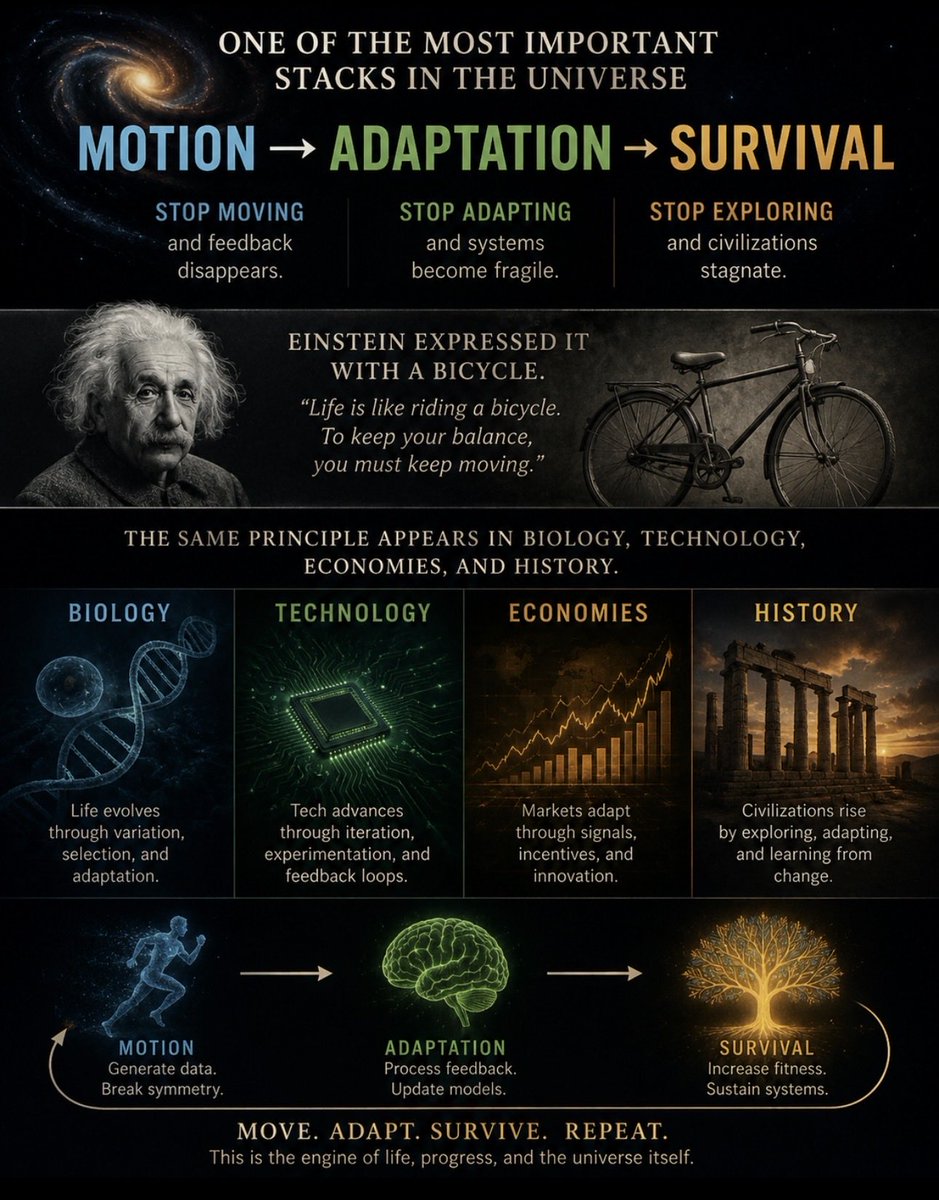
Motion → Adaptation → Survival
Stop moving and feedback disappears.
Stop adapting and systems become fragile.
Stop exploring and civilizations stagnate.
Einstein expressed it with a bicycle.
The same principle appears in biology, technology, economies, and history.
@NASASolarSystem We usually think of Jupiter as a planet.
Nature uses it as a near-light-speed particle accelerator.
The universe keeps reinventing the same stack:
Energy → Acceleration → Structure
@TheStackAtlas
@NobelPrize@AlbertEinstein The bicycle is the metaphor.
The deeper principle is that many complex systems require continuous adaptation to remain stable.
@TheStackAtlas
@CuriosityonX If you saw Mimas, you’d probably dismiss it as a frozen rock.
Scientists recently discovered a global ocean hidden beneath its surface.
A useful reminder:
The universe rewards curiosity.
The most interesting things are often invisible at first glance.
@TheStackAtlas
@NASAHubble Civilization runs on networks.
Roads.
Power grids.
The internet.
The universe does too.
These two galaxies are connected by a bridge of stars created by gravity itself.
Scale changes.
The pattern remains.
@TheStackAtlas
@NASA The original dashboard of civilization wasn’t a screen.
It was the sky.
Humans tracked:
• time with the Sun
• months with the Moon
• direction with the stars
• seasons with planetary cycles
Long before software,
civilization ran on astronomy.
@TheStackAtlas
@PhysInHistory “There is no royal road to Geometry.”
- Euclid
Thousands of years later,
geometry still underlies:
rockets
satellites
computer graphics
GPS
architecture
orbital mechanics
Civilization runs on invisible mathematics.
@TheStackAtlas
@NASA Before satellites, before nations, before history itself :
humans still looked up at the Moon.
The same object watched:
• the pyramids
• Rome
• the industrial revolution
• the first rockets
• the internet age
Civilization changes.
The Moon keeps orbiting.
@TheStackAtlas
Classical physics treated the universe like a machine:
objective
predictable
independent of the observer
Quantum physics shattered that assumption.
At microscopic scales,
observation itself becomes part of the system.
The deeper implication:
reality may be fundamentally relational,
not isolated.
@TheStackAtlas
Most people see Starlink as an internet network.
But SpaceX may also be building one of humanity’s first large-scale space solar infrastructures.
Gen1 Starlink:
~10 megawatts in orbit
Gen2:
~100 megawatts
Gen3:
potentially ~1000 megawatts
Civilization changes when energy infrastructure leaves the planet.
@TheStackAtlas
The Kardashev Scale changes how you see civilization.
A Type I civilization controls planetary energy.
A Type II civilization captures the power of its star.
A Type III civilization harnesses an entire galaxy.
Which means:
solar panels are not just energy products.
They may be the primitive beginnings of stellar-scale infrastructure.
@TheStackAtlas
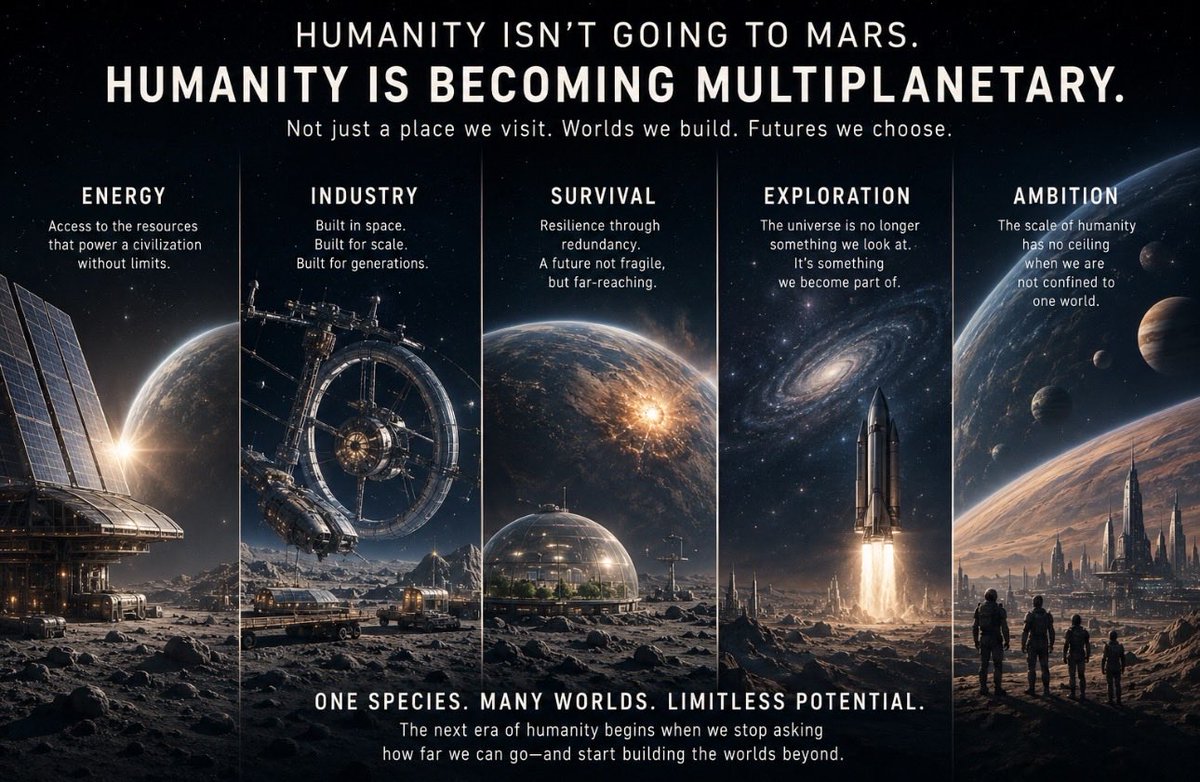
@cb_doge Humanity becoming multiplanetary isn’t really about Mars.
It’s about civilization no longer being confined to one world.
That changes:
energy
industry
survival
exploration
and the scale of human ambition itself.
@TheStackAtlas
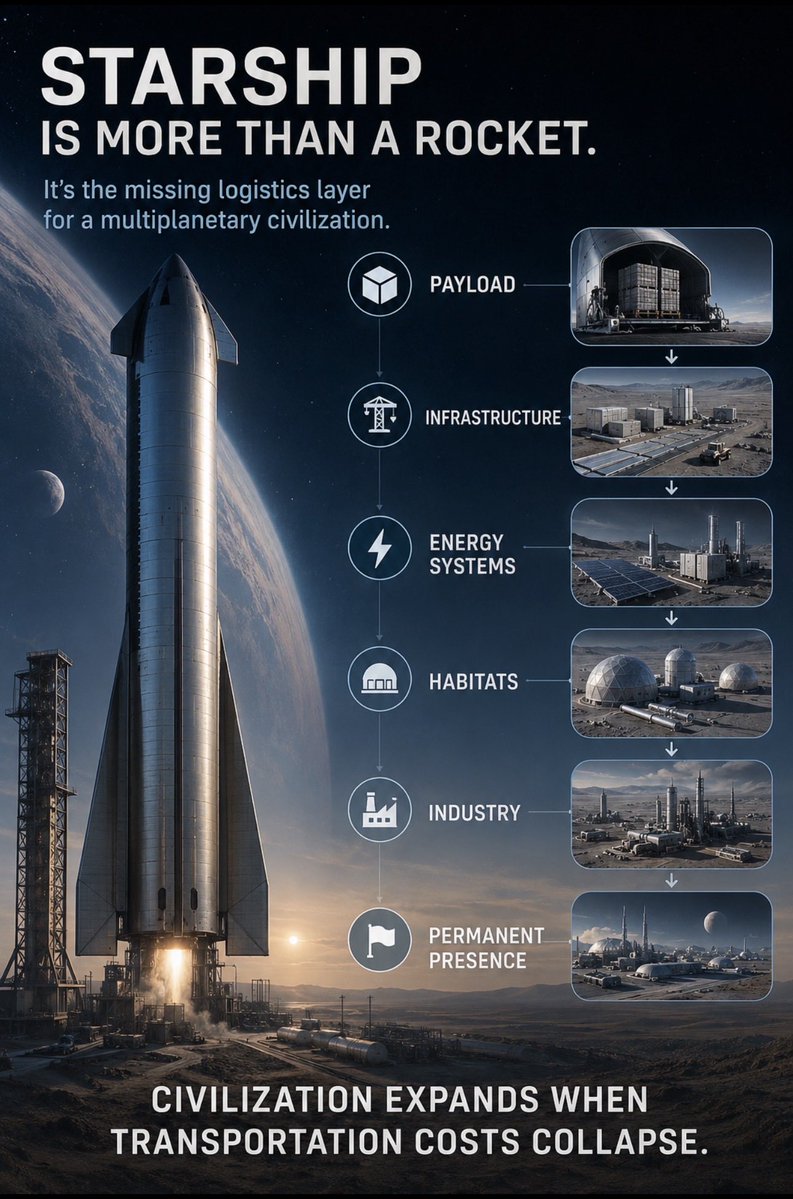
@teslaownersSV Starship is more than a rocket.
It’s the missing logistics layer for a multiplanetary civilization.
payload
→ infrastructure
→ energy systems
→ habitats
→ industry
→ permanent presence
Civilization expands when transportation costs collapse.
@TheStackAtlas
@elonmusk Most people think full stack means apps.
SpaceX means:
materials
engines
factories
software
launch
orbit
energy
planetary infrastructure
That’s full stack engineering.
@TheStackAtlas
People see companies.
They miss the stack.
energy
transport
connectivity
intelligence
interface
Each layer increases how much energy a civilization can control.
That’s the real game.
Elon Musk is playing a long game most people don’t think about.
The idea lines up with the Kardashev scale. Not just improving life on Earth, but increasing how much energy humanity can use and control over time.
Tesla, SpaceX and Starlink all fit into that direction. Energy, transport and connectivity are the foundation layers if you’re thinking beyond a single planet.
It sounds far off, but the early pieces are already in motion.
Size matters… because scale unlocks new physics.
Small rockets reach orbit.
Large rockets change civilization.
payload capacity
→ cost per kg
→ frequency of launches
→ infrastructure in orbit
→ multiplanetary systems
At some point, size isn’t engineering.
It’s strategy.
@TheStackAtlas
The Microchimerism Stack
1.During pregnancy → cells don’t stay separate
2.They cross the placenta — both directions
https://t.co/ACqJInVsSe’s cells enter the mother
4.Mother’s cells enter the child
5.Some stay for decades — even a lifetime
6.They integrate into organs → brain, heart, skin
7.Meaning → you are biologically plural
You’re not just you.
You’re a living mosaic of another life.
You don’t just remember your mother.
Part of her is still here.
Not metaphorically.
Cellular.
—@TheStackAtlas