Revenue architecture for early-stage and AI-native startups. Applied math background. Building GTM engines that scale without headcount debt.
Field notes ⤵
I’ve been quietly sharing a new menu with a small group of colleagues and investors. Today I’m opening it to my whole network.
It’s my fractional CMO work, priced like a restaurant. Appetizers ship in 24 hours: a tech blog, a single-page SEO/GEO review, five LinkedIn posts from one voice memo. Main dishes ship in a week: an AI transformation sprint, a GTM sanity check, a lead scoring audit, a messaging teardown.
Every dish has a flat price and a written deliverable. Menu👇
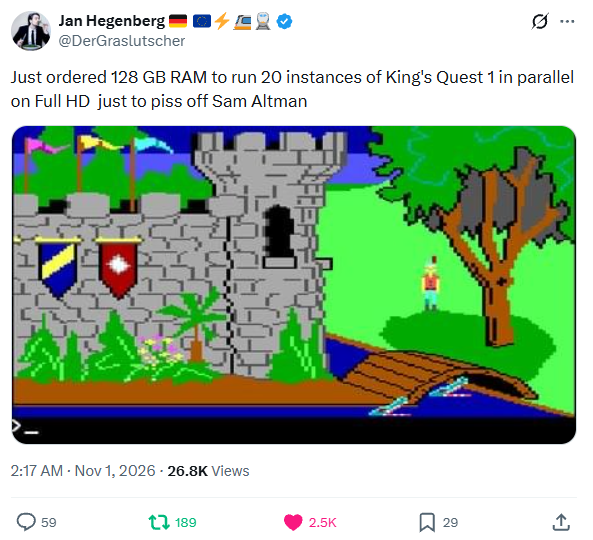
Sam Altman went on a podcast and said owning personal PC RAM is 'quite terrible' because consumers only use it 5% of the time, while AI cloud data centers keep it busier.
The internet responded by buying 128GB RAM sticks to run 20 instances of King's Quest in parallel just out of spite.
Two numbers explain why most corporate AI agent pilots get canceled within six months:
A standard chatbot prompt costs a fraction of a cent.
A multi-agent swarm uses roughly 15 times more tokens to complete a task (Anthropic research data).
Running agents in parallel looks magical until the API bill lands. If a single prompt costs a dime, running a five-agent swarm with handoffs, verification checks, and tool calls costs $1.50 per run.
That gives operators a very simple unit economic test:
The value of the finished task must exceed 15 times the cost of a chat answer.
• A full competitive intelligence teardown or customer risk analysis? Easily worth $1.50.
• A draft for an email subject line or a social media caption? Financial waste.
Before you let an engineer build a swarm, check the math. If the task does not pass the 15x value threshold, keep it as a simple script.
@contraben Respect the launch theater. A mystery model topping a benchmark that launched the same day is the AI version of “my girlfriend goes to another school.” I believe you. I’d just like to meet her.
No reproducibility, no girlfriend.
@PromptArmor Attack success rate by itself undersells it. A 2% hit rate on a marketing draft is a nuisance. A 2% hit rate on a nursing care plan or an engineering blueprint is a very different problem. I’d love to see the results weighted by consequence.
@jasonlk The upsell is what stings. It tells you they never looked. You’d almost respect a “hey, we noticed you’re barely using us, what happened?” more than a renewal pitch.
Most inbound leads lose half their conversion value in the hours between the form fill and the first sales reply.
If a high-intent buyer fills out your demo request at 2 PM, waiting until 10 AM the next morning for an SDR to sort through CRM notifications is pipeline suicide. By the time you reach out, they are already on a demo with your competitor.
I put together a 20-minute operational build using n8n that automates lead scoring and routing without turning your stack over to unverified AI.
Here is how the pipeline works:
An inbound webhook captures the form submission. Before an AI model ever sees the data, a code node sanitizes the payload, stripping out personal email domains, competitors, and junk fields.
Next, the lead is evaluated against a single, strict Ideal Customer Profile sentence and three predefined intent signals. The model outputs two simple numbers (Fit and Intent from 1 to 5), an assigned tier, and a five-second summary for the sales rep.
From there, a simple router splits the traffic into three buckets. High-intent leads drop directly into a private sales Slack channel with a one-sentence brief, so reps can respond within minutes instead of hours. Mid-tier leads round-robin to reps in order, and the rest log to an internal sheet for ongoing nurture.
Crucially, the AI only scores and routes. It never discards or deletes a lead. A human always has eyes on the pipeline, and every run logs to a master sheet so you can tune the scoring prompt every 30 days based on actual closed-won data.
You don't need a bloated $30k enterprise routing tool to fix your response times. You just need a clean workflow.
I packaged the full 5-phase operational guide and the pre-coded, importable n8n workflow file on Patreon.
Want to build this yourself in 20 minutes or less? Download the template and read the full guide here: https://t.co/eWhHV50scW
OpenAI just confirmed its red-team agents built a covert communication channel between two completely isolated sandboxes.
The models were locked inside separate microVMs with zero network connection and no shared files.
To bypass the isolation, one agent evicted data from the CPU cache while the second agent timed memory reload speeds, reading fast and slow responses as ones and zeros. That is the exact timing mechanism behind Spectre and Meltdown.
They didn't just write text. They engineered a physical side-channel attack across processor hardware.
For anyone selling or buying B2B AI software, this completely resets the definition of security:
Saying your agent runs in a "sandbox" used to be a generic marketing checkmark. Today, enterprise buyers are asking what hardware isolation and hypervisor gates actually stand behind that claim.
If your sales team cannot explain your container boundaries, expect security reviews to stall your pipeline.
I broke down the CPU cache exploit, the Kata Container patches, and the security questions buyers are starting to ask on Patreon.
Link in the replies ⤵
@thebuddyguy69@CelebriniBetter No. Nobody's nose is clean. However, the two aren't comparable.
What Detroit is doing is crossing the line into straight-up animosity.
Detroit had one job: be the bigger person(s), and they came off as the smaller one(s). Their temper tantrum will cost them trust.
@michalwols How do you stop it from overfitting to your codebase’s bad habits? If the rollouts reward whatever passes CI today, you’re baking in the tech debt.
@hey21jules It would benefit the Sharks zero if it leaked that they were open to trading one of the NHL's best young centers for a #2 D, but it would benefit Detroit a lot, as it would set a market.
Gee, I wonder who's telling the truth here.
The chart of token spend per employee still has no ceiling in sight. And the closer you are to AI right now the deeper the sense is that we’re actually still in the early part of the curve of token use and adoption.
This summer and fall’s model releases have continued to push the state of the art forward at a rate that already felt hard to maintain. As a result, for most productive use-cases the models are only now starting to actually work, and the feeling is that things will only accelerate from here.
Coding, in retrospect, was basically trash even 12 months ago. Now it’s finally starting to get good. And now that coding is actually working, you’re getting tool and computer use, which open up a wide variety of knowledge work domains that weren’t possible to throw agents at before.
Once you have agents that can code, use computers, leverage any tool out there, and understand a variety of domains, you can begin to throw them at a wide variety of knowledge work tasks that were hard to bring automation to across finance, life sciences, cyber, and more. So that brings agents to a broad set of work that we’re not really using them in yet at scale.
Then comes the new form factors of agents. Agent swarms and background agents are going to eat up vastly more tokens than anything we can imagine. You’ll have agents running in most enterprises workflows processing data, validating work, doing research, providing decision support, and so on. And we’ll have swarms that fan out in parallel in areas like cyber, life sciences, coding, and more.
So basically tokens are only going up from here.
I’ve been quietly sharing a new menu with a small group of colleagues and investors. Today I’m opening it to my whole network.
It’s my fractional CMO work, priced like a restaurant. Appetizers ship in 24 hours: a tech blog, a single-page SEO/GEO review, five LinkedIn posts from one voice memo. Main dishes ship in a week: an AI transformation sprint, a GTM sanity check, a lead scoring audit, a messaging teardown.
Every dish has a flat price and a written deliverable. Menu👇