$IREN isn't a good long-term hold.
A lot of people I respect in this community hold this company, so I want to be honest and fair about this.
Power is one of the hardest things to get in AI right now, and despite $IREN having it, I have genuine concerns about what it takes to turn that into a long-term profitable, cash-flowing business.
This comes right after SemiAnalysis' latest review and Goldman's note warning that rising opex and a capex plan that needs more financing could pressure the stock.
My concern isn't demand. I think IREN will get capacity online and find plenty of customers. It's what it costs to get there, whether the revenue and the business behind it are strong enough to turn into real profits and cash flow, and whether shareholders keep any of it at the end.
The money:
IREN guided $25-30B of capex for FY27. They have about $14B lined up in cash, committed GPU financing and customer prepayments, and they're targeting another $8B. There's still a gap of several billion, and that's only one year.
Jensen Huang puts an AI factory at $50-60B per GW, and IREN's pipeline is 5GW+. Where is that kind of cash going to come from? Definitely not traditional places.
How they're funding it (so far):
IREN has raised about $19B over the past year, with only around $3B coming from equity. Here's where the rest came from.
- Customer prepayments. The cheapest money there is, but only top-tier customers like Microsoft write those checks. Microsoft's alone was $1.9B.
- GPU-backed debt. $3.6B against the Microsoft contract, plus $2.4B from Blue Owl for Mackenzie.
- Convertible notes. $3B in May at a 1% coupon. Cheap in cash, paid for in future shares.
- Equity. Straight share sales through the ATM.
- Stock as currency. Acquisitions like Mirantis, paid in shares.
- Next up, data center financing against sites they've kept unencumbered.
The cheap sources are limited by how many Microsofts you have. Everything beyond that costs more, either in interest or in shares.
The cost of money:
Line the deals up and one thing is clear. In this industry, the interest rate follows the customer.
When Microsoft is behind it, IREN borrows like the leaders. Its Microsoft financing came in around 5.9%, due 2031, essentially the same pricing CoreWeave got on its Meta-backed loan in March, the first GPU loan ever rated investment grade. Nebius got SOFR+2.5% in July against an investment-grade customer, with debt and customer cash flows covering over 100% of the capex. Credit where it's due, the Microsoft deal is well structured.
The difference shows up everywhere else. Mackenzie, without Microsoft behind it, cost 9% from Blue Owl on a 30-month term. IREN has to pay that back in two and a half years, while its new contracts average about four. That's debt running off faster than the revenue that pays for it.
Now, someone will say the same applies to $NBIS and $CRWV. And they're right, the rule is the same for everyone. Nebius raised $5.75B in convertibles in August, and CoreWeave pays up too when the customer isn't investment grade. The difference is how many Microsofts each one has, and how long their money lasts.
- CoreWeave has over $100B of backlog, and even its riskier loan this August, priced about the same as Mackenzie, runs to 2031. It went from ~15% loans in 2023 to investment grade this year, and has cut GPU-backed loans from 73% of its debt in 2024 to 38% this June.
- Nebius has a Meta deal worth up to ~$27B and a multi-billion Microsoft contract, plus $40B+ of further customer commitments it can borrow against.
- IREN has Microsoft ($9.7B) and NVIDIA ($3.4B), roughly $2.6B of its contracted ARR. Beyond that, it's Mackenzie-style money, and that's what most of the 5GW pipeline will need.
Same rules, very different hands. SemiAnalysis also says Nebius can charge premium prices because of its software, which means more margin to service the same debt.
IREN's cheapest money today is really Microsoft's credit rating, and debt has already gone from under $1B to roughly $7.6B in one fiscal year.
What it means for shareholders:
Share count went from 258M to 394M in about 14 months, up roughly 53%, with ~$3.5B still left on the ATM.
The $3B convertible from May could add around 41M more shares if it converts at ~$73, partly offset by a capped call.
The $625M Mirantis deal is paid in shares too. And NVIDIA's "$2.1B investment" is a right to buy shares at $70.
With the stock around $40, that money only comes in if it rallies more than 70%.
Revenue growth, but at what cost?
I do think revenue grows massively. It could go from $707M in FY26 to roughly $7.3B in FY28 and $14B in FY29, and EBITDA looks incredible. But look at what's left after paying for the hardware and the debt.
On consensus estimates, depreciation and interest swallow almost all of it. FY28 pre-tax is still slightly negative, and FY29 is negative again at about -$478M, with ~$1.7B going to interest alone.
Kinder estimates show a modest profit in FY29 and real EPS only around FY30, with free cash flow still deeply negative.
That's my whole point. If tens of billions of capex turns into single-digit net margins at best, before more dilution, what is the shareholder actually getting?
And that's the base case. It assumes everything goes their way. Every gigawatt delivered on schedule, utilization staying high, financing markets staying open on similar terms, and opex kept under control.
Any slip in execution or the cost of capital lands directly on margins that are already thin, or still negative.
Management and communication:
This is the part I find hardest to get comfortable with, and I don't think anyone should be. Communication patterns tend to repeat, so they matter as much as the numbers.
- In May, the NVIDIA partnership led the same release as a quarter where losses widened to $248M and revenue fell again. The stock jumped ~9% after hours. Five days later, IREN priced a $3B convertible. Raising on strength is normal, but it shows where the focus is.
- On the Q4 call, management said they deliberately don't tie the $25-$30B capex to a specific number of megawatts, because data center spend runs ahead of delivery. That's a lot of capital without a clear measure.
- The co-CEO RSUs vest on time, not performance. The chair's explanation was that earlier performance hurdles were cleared too quickly. That's a reason to set harder targets, not drop them.
- The 10-K says IREN owns and operates every layer of the stack, while its CCO says no managed services are live yet. Explain that, please?!
The cloud layer (software matters, and IREN is behind):
Owning GPUs in a building is infrastructure. What customers pay a premium for is the software on top, the scheduling, health checks, monitoring and automatic fault recovery.
$CRWV and $NBIS built that and are rated Platinum by SemiAnalysis, while $IREN was placed in "Not Recommended - Underperforming."
Mirantis is a smart step toward closing that gap, but today the company mostly sells bare metal, the most commoditized layer of the stack.
Reliability:
The pushback on SemiAnalysis has fair points. Outages happen everywhere, including at Nebius this August, and Mackenzie is still being commissioned, so this is mainly about Prince George. My concern is narrower.
The multi-day outages reportedly came from grid brownouts the site couldn't ride through without enough backup generation, which is the design issue SemiAnalysis raised. And customers renewing during a GPU shortage shows strong demand more than it shows quality.
What's going right:
Childress and Sweetwater look far better than the Canadian sites, and even SemiAnalysis says so. The Microsoft financing is genuinely well structured.
Microsoft, NVIDIA, Perplexity, Figure and a frontier lab are real customers. Most of the $684M Q4 loss was non-cash mining write-downs. And nobody builds gigawatts cheaply. Nebius' own CEO put 5GW at around $250B of financing.
Where I land:
For me, $IREN isn't a good long-term hold. Not because AI demand is slowing, and not because the team hasn't executed on power, but because the financing structure makes it hard for shareholders to keep the profits from all that growth, and that burden looks set to weigh on the stock for years.
I can get exposure to this theme higher up the stack with less risk to underwrite. If you hold it, I'm not here to tell you you're wrong. I just think the risks deserve as much airtime as the upside, and I'd love to hear how you're thinking about them.
If you want this theme with a lot more peace of mind, $NBIS is where I'm at 🤝
After holding $INTC for three years, I can tell you for sure that there will be a number of rumours/talks/headlines about Intel’s potential deals. This happened a lot in the past and will surely continue to occur in the future. Those are noise you just have to ignore sometimes. But there are some indisputable facts about the company that I consider are the bases for my long term holding:
(1) it’s a bipartisan goal to make Intel foundry great so that US will not depend on Taiwan. Be it government equity investment or Chips Act policies. This goal will not be changed for the decade to come (unless IFS surpasses TSMC within the next a few years in terms of volumes, which I doubt). This goal will not be changed no matter who is the president or controls the senate/house.
(2) Intel is the ONLY US leading semi IP holder and will remain so. TSMC does not and will not have US IPs that are superior than their Taiwan HQs. This is required by Taiwanese government and laws. This is also the basis of so-called silicon shield that Taiwan wants to maintain to leverage US power to defend itself against China. For this reason, Terafab has to work with Intel, unless @elonmusk just wanted to build it as a second-class fab using TSMC inferior IPs, which I highly doubt.
(3) Intel has gone through several reorganization efforts - cut layers of middle management, brought in cost efficiency, changed the customer service culture, etc. Under Lip bu and current management’s leadership, Intel is ready to take advantage of opportunities.
(4) The opportunities are the AI compute shortage and CPU playing central roles in agentic AI. As AI chips are becoming larger, TSMC is now catching up on Intel’s EMIB packaging technologies. With the booming business in CPUs, advanced packaging and success of 14A, we will see foundry business to be profitable next year. This is not to mention the potential surprises from the memory and optical and ASIC business …
@herbertong@thejefflutz No, we will build and run the fab. Let there be ZERO doubt about that.
Maybe TSMC subleases part of the Terafab if they want, but nothing more than that.
Intel will continue to work with Elon Musk on Terafab, an audacious attempt by the trillionaire to break into the production of cutting-edge chips, according to Chief Executive Officer Lip-Bu Tan. https://t.co/GPtBWq3MD0
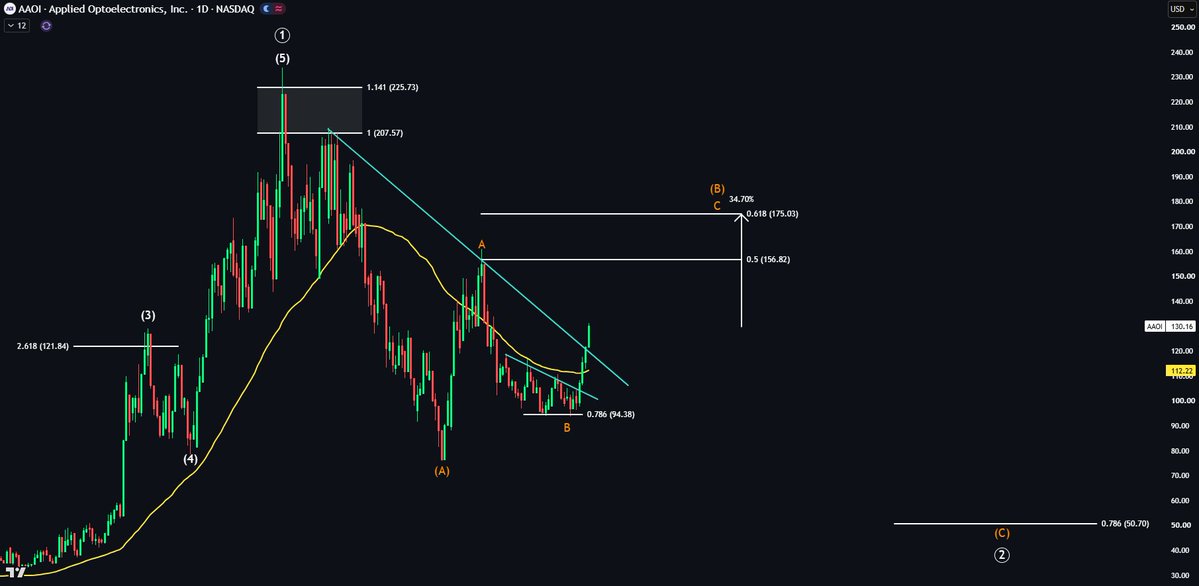
$AAOI This has been perfect 👀
Price is up 7% today and over 30% since I bought a week ago today.
If price tests the 50DMA, I'll be buying again.
Wave B target: 34% 🚀