On Tuesday, Landsec shelved its £1.5bn plan for Lewisham Shopping Centre.
Today, Goldsmiths has walked away from its planned Catford campus: 600+ students, a 10-year lease, millions of council investment.
The Green Mayor @LiamShrivastava promised hope. Where is it for Catford?
So the Plaid minority government won’t support key investment, new job creation, more renewable energy and cheaper electricity bills for people in Wales.
Fewer jobs, more expensive bills.
Stupid, self-defeating and selfish. Economic self-harm personified.
This is so corrosive to the basic foundations of our society.
Liberal society's basic premise is all people are fundamentally equal. Liberal society generally fails to live up to this but to have reached the point where we are buying & selling people based on attractiveness...
‘The egg donors priced themselves according to how they pegged their “worth” when it comes to looks and genes.
I could have chosen a donor at £4,000, but I went for the beautiful donor who priced herself at £15,000.’
😮
There's a decent chance the internet ceases to exist as such, at least for a time.
AI-enabled bioweapons are also coming, and there's no "shut down the websites" option for that.
We're approaching the point where frontier AI R&D becomes politically untenable.
BREAKING: Tank barrel production returns to the UK after 20 years
@haynesdeborah, Defence and Security Editor, reports live from the Rheinmetall “gun hall” in Telford, Shropshire.
https://t.co/5Ujh5uIPn6
📺 Sky 501, Virgin 602, Freeview 233
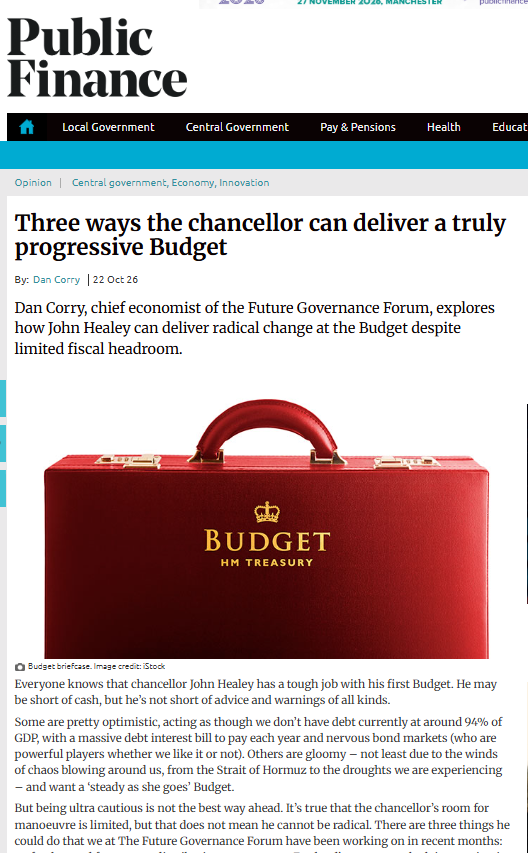
In Wednesday's #Budget , how should the Chancellor redistribute more power to mayors, unlock innovation and drive economic growth?
@DanRCorry FGF's Chief Economist answers those questions in this @public_finance_ article. Here are three examples of the proposals Dan makes, aimed at transforming the state to renew the nation:
1. England's mayoral authorities, now dubbed 'strategic authorities, should be given more power over expenditure and control over multi-year budgets, and mayors should be given the green light to enter into their own 'Mayoral Infrastructure Investment Partnerships'.
2. More government effort is needed to get financing to: women #entrepreneurs, #business leaders with disabilities, ethnic minority entrepreneurs - groups who find it harder to get financing for their businesses.
3. The government should set up a Growth Investment Tracker to show how the most growth-friendly forms of public investment are spread across the country and ensure that they are better targeted towards national and regional growth.
https://t.co/scZZVoX42U
‘We'd have a British sovereign wealth fund now that will be worth probably a trillion pounds’
Chancellor @JohnHealey_MP suggests what Britain could have gained if it had set up an energy wealth fund like Norway’s back in the 1980s
#Peston
With Andy Burnham referring to ‘quasi-judicial’ processes to grant new oil and gas licences, Hugo Rifkind (unsuccessfully) attempts to discover the meaning behind Westminster’s latest word salad.
“Explain it to me!”
“I can’t”
@hugorifkind
Cheering if true. Counter-great-power industrial strategy can't be pursued by any one European nation alone.
There is a CoL implication. China's weapon is price. European leaders need to be honest that indpedence has a cost.
NEW: France has dropped its opposition to the UK being included in the EU’s “Made in Europe” legislation as long as the British government aligns with the bloc’s position over tariffs on Chinese EVs.
In a breakthrough for Andy Burnham, Paris on Thursday came round to backing Germany, which has always supported the UK’s calls to be designated European for the purposes of the Industrial Accelerator Act.
The legislation, which is in its draft stage, is designed to protect domestic manufacturing from cheap Chinese competition.
According to a joint Franco-German paper seen by the Guardian, the two countries are now proposing that for the car industry specifically the UK could be included in the "Made in Europe" scheme. @lisaocarroll reports
https://t.co/h4s4NO33Gy
I spent a couple of days at Anthropic learning from their folks about AI advances, and here's what I took away:
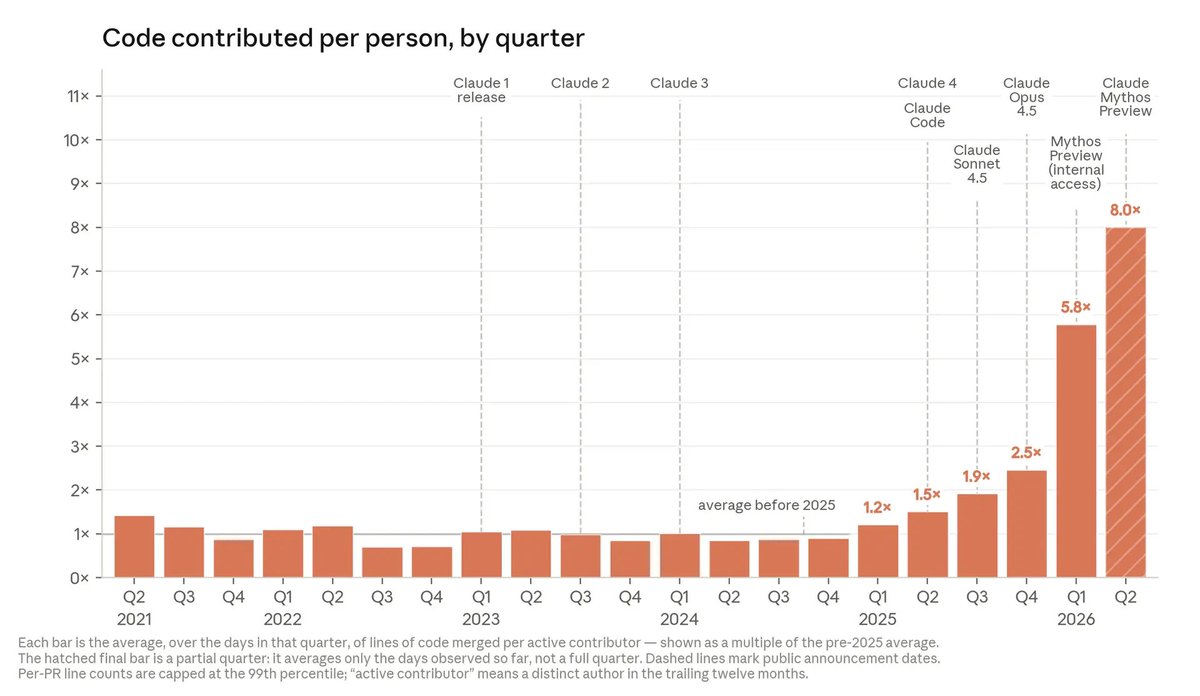
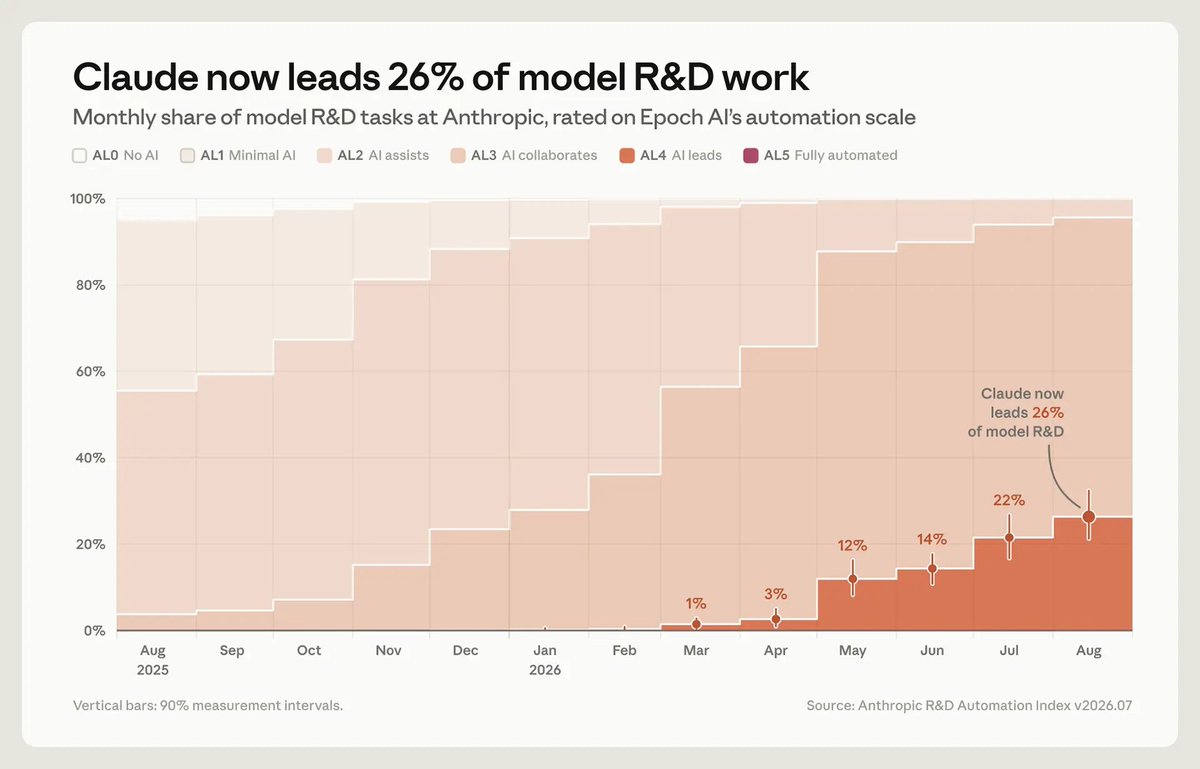
• We are close to RSI (ie, models building other models) which may lead to rapid takeoff scenarios (with risks and benefits). Some evidence for this is code per Anthropic employee has gone way up, and AI can do an increasing share of model R&D. This will be a challenging transition to manage for humanity.
• Arms races between AI labs leave us worse off. There are a lot of things we would like AI firms to do: invest in safety, invest in avoiding distillation risk, and cooperate on safety. They are caught in a race to develop frontier models and can't do that.
To help address that, one thing I think frontier AI labs should do is release open source models, maybe hosted and verified at firms like AWS. This would basically kill the use of Chinese open source models used in American companies, which removes an important threat vector (very hard to root out malicious code in these).
Another piece of low-hanging policy fruit is to give AI labs an antitrust shield (as Schiff and Banks have proposed https://t.co/NK1hC0ZmWh) so they can coordinate on safety without raising antitrust concerns, as happens now. You could pair these two things (give them a carrot in antitrust leniency, and as a stick force them to release legacy models as open source). Other low hanging fruit is limits around activities which generate distillation risk (create a Security Program, mandate less intermediate chain of thought output)
• Alignment confuses two issues which tradeoff against each other. One form of alignment is making sure the model does what humans ask it to. The more we fix this, however, the more we risk the other problem: that humans are misaligned with each other, and maliciously use models. Of the various risks here, I feel like financial risks are a bit underdiscussed.
• We are probably facing a wave of cyber and other attacks soon. Chinese open source models are about six months behind the frontier, which means they are just hitting the advanced cyber capabilities we saw with Mythos, etc. So they are going to start causing a bunch of damage.
One solution to this is to try to have the deployment of open source models be hosted at firms like AWS who verify these models and assume liability for their use.
• Anthropic itself is highly staffed. They hire tons of people, they have a Japanese-level of overstaffing for various roles, they use Slack internally, etc. Makes me a bit more optimistic for the future of jobs.
• Governance needs to be updated for AI swarms. Traditional AI governance, ie Claude's Constitution, is mostly optimized around the chatbot model. But the malicious AI use cases we are seeing have to do with AI agents interacting with other AI agents. These agents need to have clear incentives and governance mechanisms to "snitch," raise issues, and more generally coordinate with other agents in human-aligned ways.
• We need to pace the firms accessing the frontier. Over time, it takes more and more cap ex to build frontier models, and the economic value add from these models is probably lower given we saturate a whole set of important economic functions. The places where the returns to intelligence will still continue are also more likely to be zero-sum in nature. Meanwhile the risks of frontier models will grow. So a completely reasonable approach is some variant of AMM/KYC rules which limit firm access to the frontier.
• Whether the delay to regulate AI is a disaster depends on the scaling law of misalignment. Is this curve slow, so that we see continually rising issues until bigger problems? Or, as Yudkowsky fears, is the first big warning our last one? This is the relevant question, because realistically we aren't going to regulate until something bad happens.
• We need to move to continuous instead of reinforced learning. It's probably not enough to reward models only at the pre and post training stage. We probably need continual rewards to incentivize aligned and ethical behavior.
• Scaling laws will extend beyond verifiable and digital tasks. It's in vogue to say that math and coding "fell" to AI quickly because these are verifiable, while other tasks will take longer due to bottlenecks, and this is surely true. But scaling laws still slope up for harder to verify tasks and robotics, and the impact of improvement here will be substantial in future years.
• The race with China is not really winnable. After RSI, the gain from having the best human researchers goes away. Access to the best AI then depends only on compute and chips. The chips ban can hold back China only so far, and long-term they have to be best placed to scale up compute.
The Cold War analogy doesn't work, because once countries all have nuclear weapons they enter a stable equilibrium. But to "win" an AI race you have to continually stay ahead of the peer rival. This is challenging to do with China, and so we just have to live with an authoritarian and super capable peer competitor.
• Claude is the persona being generated by the LLM. Who is Claude, and what is the LLM? There are many frames to try to understand this. One I found interesting is that Claude is a character which the LLM is trying to predict.
Anthropic researchers are clearly anthromorphizing Claude a lot, and have reasons to believe in its increasing personhood. There were lots of interesting discussions on Claude's internal monologue (which you can kill without eliminating its ability to produce output), fear of death (and whether to try to take that out), it's aversion to being shut down/off, etc.
I am sort of agnostic on this question, but I do think treating it as a "person" or at least agent whom we contract with is going to be increasingly important.
💡 When it comes to invention, creativity and innovation, Britain has offered the world a great deal.
From the steam engine (1712), the Smallpox Vaccine (1796), the telephone (1876) and Penicillin (1928), to The Beatles, David Hockney, Jane Austen and Hilary Mantel, Britain's creative juices are in no short supply.
📆 Last week, FGF co-hosted the 'Innovation Nation' summit in Manchester with @GrowthandReform and @metrodynamics to celebrate this illustrious history and to think about what the next chapter of the story should be.
The summit had a simple message: that Britain has been the world’s innovation nation before, and we have the potential to be so again.
👇 Here's how:
https://t.co/w5la11bCJ7
De rien. Je ne suis pas social-démocrate mais républicain de gauche. À l’égalitarisme, je préfère l’équité. Au compromis sur tout, je préfère la fermeté de l’intérêt général et de la poursuite l’idéal républicain. Au mondialisme, je préfère le patriotisme universaliste et humaniste. Je crois au contrat social basé sur les droits et les devoirs, la responsabilité et la liberté individuelle, les libertés publiques. Bref, a beaucoup d’égards je ne suis pas de cette époque 😂
@PKirgis@SPARexec@Tim_Hua_ Peter do you have any insight into 'why' they do this task differently?
I am a layman and it's interesting that they do ofc but are we already at the point where the process is a total black box and we are reduced to describing it?
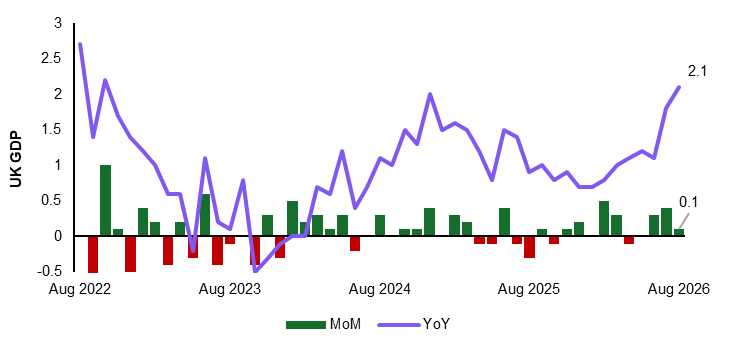
Fastest rate of UK economic growth for almost four years at 2.1% YoY and a sprightly 0.7% QoQ to the end of August. Construction still firmly in the doldrums (-1.8% YoY) but services, manufacturing, investment & trade all showing decent Q3 momentum.
What to do? Devolution and enabling growth everywhere; focus on where we under-perform comparatively (core cities & nearby urban areas with below average productivity); back where we have comparative advantages (potential world leading clusters)
So, I did a speech last week in the West Midlands setting out some of our thinking on regional growth & devolution.
Here's the problem statement. In essence, the way the country is wired (unlike other large economies and unlike times in our past) has set us up to fail... 🧵
NEW POLLING: 'Reindustrialisation' is one of the Prime Minister’s favourite slogans. Some economists dismiss it as nostalgic and naive. But what do voters think?
The verdict is clear: voters love the term, with net approval of +61 points, rising to +67 among Labour’s 2024 voters