Hey everyone, some personal news I’m really excited about...
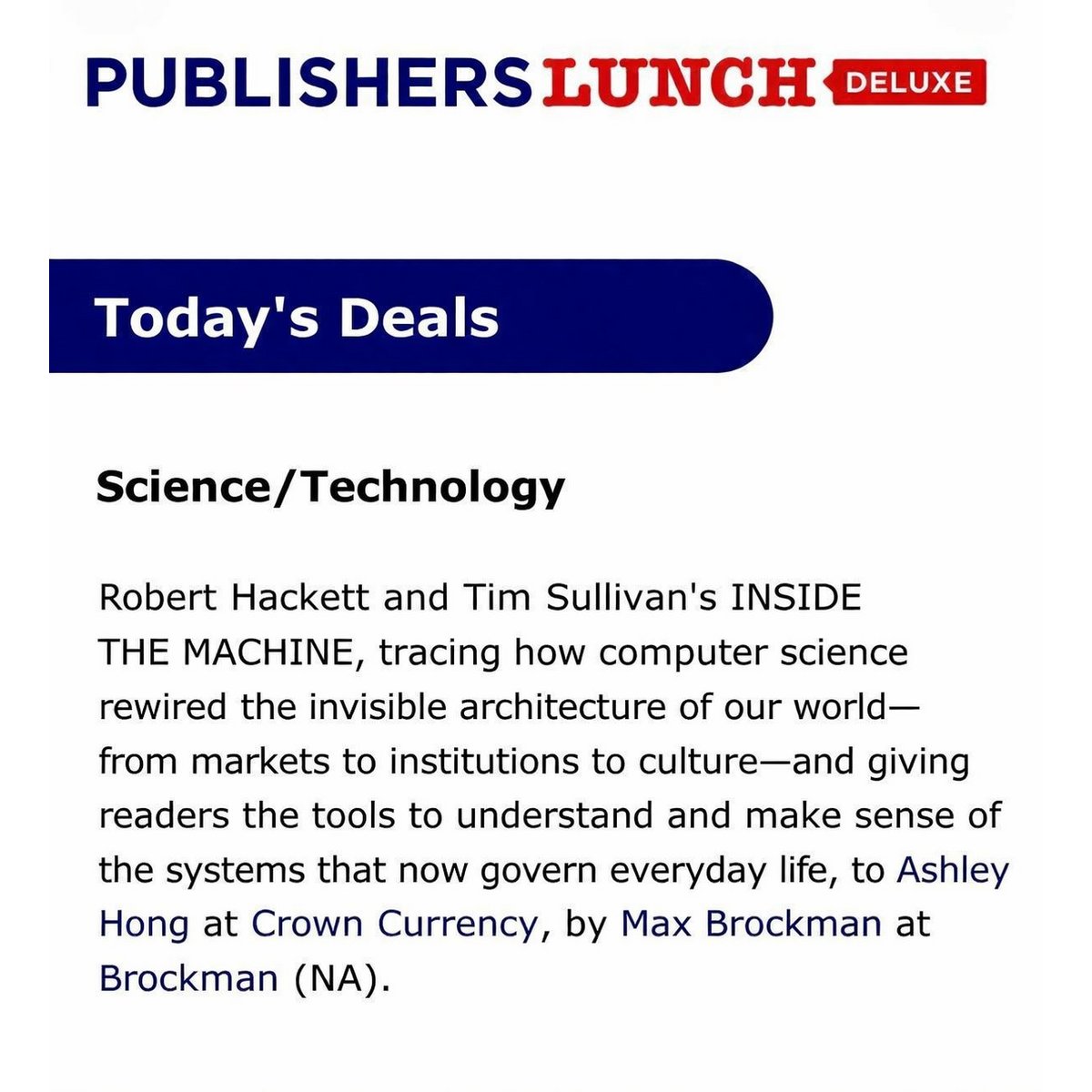
For the past few months I’ve been working on a book proposal with my friend and colleague Tim Sullivan (@Tim_Org). We’re excited to share that it’s just been acquired by Crown Currency at Penguin Random House!
We’re calling it (for now) Inside The Machine: How Computer Science Rewired Everything.
Most of us talk about tech in terms of the shiny stuff — apps, gadgets, platforms, and the people who built them. But this misses a bigger, more interesting story.
Computer science didn't just hand us new tools. It changed how we think about problems in the first place — what even counts as a problem, what looks like a solution, what we optimize for, and what we ignore.
Over time, this way of thinking has seeped outward and saturated everything else. You see it in markets that run like algorithms instead of human institutions, in media that’s tuned for engagement, in companies organized more like software than trad hierarchies. Even in the way people talk: inputs, outputs, signals, noise, etc.
Once you start noticing it, it’s hard to stop seeing it everywhere.
Tim and I have spent years separately reporting on tech, business, science, and economics, and then also as editors on the a16z crypto editorial team. Throughout, we kept running into the same big question: what happens when the logic of computing becomes the logic of society?
This book is our personal attempt to answer that — to trace how these ideas spread (often without us realizing) and how they’ve reshaped the systems we all live with, including the tradeoffs that come with them.
We’re still super early in the process, but we’re thrilled it’s happening. If you want to follow along as the book comes together, we’d love that.
In the meantime, tell us: what’s your favorite example you’ve seen of computer science thinking sneaking into everyday life? Could be in business, politics, dating, whatever — we'd love to know what you all notice.
@chrissyfarr@NickKristof I am very lucky to live where I do and source almost all of my meat from local farms whose farmers I know and whose farms I can, and do, visit.
Warhound, the brain child of Ben Lamm and Palmer Luckey, emerges from stealth to genetically engineer dogs for military and law enforcement.
https://t.co/Por7hr92K2
I am hiring a social media lead for a16z Frontier!! “We’re lucky enough to be living through one of the most consequential curves in human history today” — THIS is the time, come work with us now! ⚡️🔑🔭💥🗺️
https://t.co/gl00pkqP1U
Big personal news today: I have decided to leave @a16z, move to SF, and start a company.
It's time to build :)
It has been almost 10 years since I joined the firm. I met @cdixon, @bhorowitz, and @pmarca in 2017. At the time, I was an engineer at Google Brain working on robotics. I had a deep interest in open source. I knew nothing about investing. Chris meanwhile had already planted the @a16z flag at the frontier that was early crypto with investments in companies like Coinbase. But the crypto team at the firm consisted of only him, and he had the ambition to expand. His pitch to me was simple: "You should leave Google and come help me build the crypto vertical at the firm."
The work we've done together since then to build out our team and support our founders has been the most meaningful work of my life. I am grateful to have spent a decade working with everyone here, supporting our founders, learning from Chris, Ben, and Marc, and living the firm's culture. It is a culture that values integrity, life-long working relationships, and the belief that we humans have the power to build our own future.
Marc and Ben have built a16z into an incredible force for good in the world.
Before I joined the firm, I always thought that my inevitable path was to become a founder. The truth is that I wasn't ready for it then. Somehow, this year I've gotten the overwhelming feeling that this has changed.
As for what I want to build: It is early, but I care most about building infrastructure that enables open software ecosystems. I am starting with two core observations:
1. AI today is largely a single-player technology. Most uses involve one human talking with one agent in isolation from the rest of the world. That will soon change. Most uses of AI will soon be many-to-many: many humans and many agents working together. There will be at least one massive open network on top of which those uses will be built.
2. Software is now free. It can now be written just-in-time, on the spot for a single individual's hyper-targeted use case, and it can even be thrown out after a single use. This means that our entire software stack will have to change. In the limit, it will lead to a whole new kind of AI-mediated operating systems, which in turn will create an ecosystem of AI-native developers who build applications that actively rebuild themselves on the fly.
If you are working on related ideas, and especially if you are in the Bay Area, hit me up. Let's chat!
@bhorowitz , @pmarca, @cdixon, @eddylazzarin, @guywuolletjr, @jasonrosenthal , and our whole team — I want to thank you. Working with you has been the time of a lifetime. I am forever an a16z superfan and your ally.
Onward 🫡
Apropos of nothing, Frederick Jackson Turner argued that the frontier made America: its institutions, its individualism, and its restless inventiveness.