@GuiBibeau@solana I wrote an article on how to DM people busier than yourself, based on tweets by Toly, Mert, and Balaji.
Now I force all founders to read it before I run an intro to Solana Foundation or other ecosystem folks.
https://t.co/XyNScQjbPI
From an underdog to one of the biggest AI play in crypto
$VVV is becoming a number 1 AI play for this cycle
Crossed over 3m user and it will continue to exponentially grow
The decentralized and private AI, will continue to be a thing
I think we gonna see $VVV trading at 10B+ FDV this year
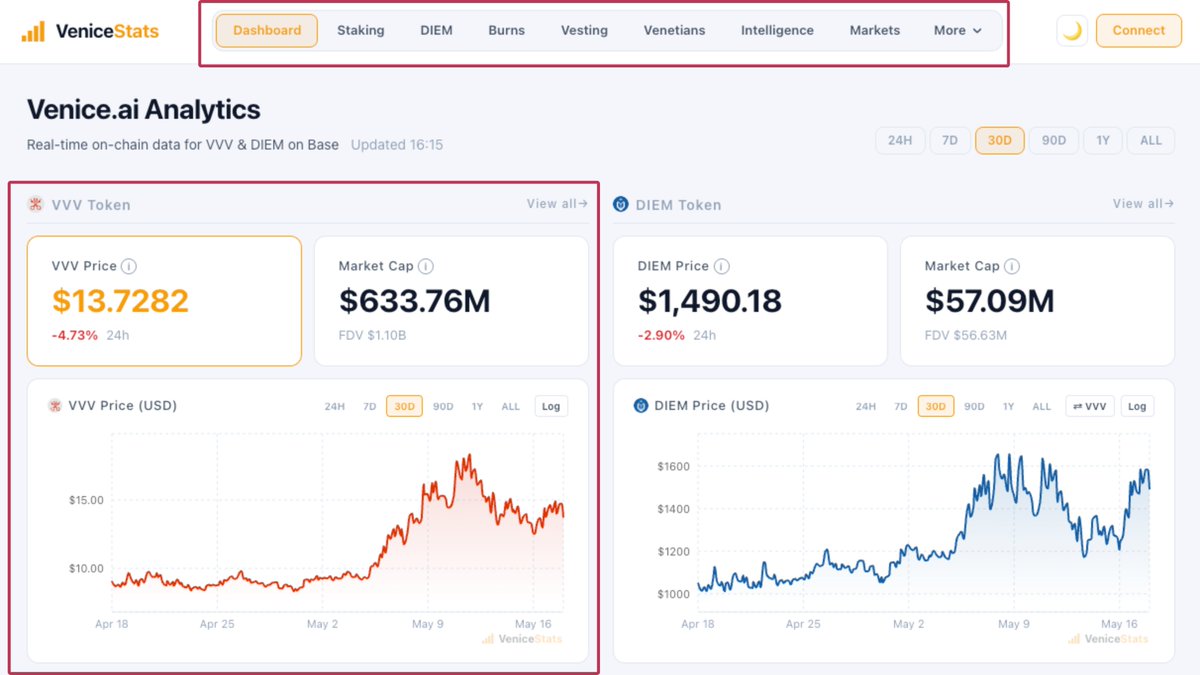
$VVV is up from $1.75 to ~$18 since January.
What I’m curious about is if the activity and fundamentals are keeping up.
For example, how much VVV is getting staked, locked, and burned. How $DIEM is being used. And what unlock pressure looks like from here.
I came across a tool called @venicestats that makes it simple. It’s a community-built dashboard that pulls the whole Venice ecosystem into one view.
My favorite part is the burn section. Venice runs discretionary monthly buybacks plus Pro subscription burns.
So you can watch how much $VVV is actually getting pulled out of circulation and whether the pace is picking up or slowing down.
Think this is the breakout token of the year and this tool makes it easy to keep up with the ecosystem
It makes sense to me that space stocks like $ASTS $RDW and $RKLB continue to rally into the spacex IPO
For crypto ethereum:0xf280b16ef293d8e534e370794ef26bf312694126 is the beta for spacex
Anthropic pays $750,000+ a year for engineers who know how to build LLMs from scratch.
Stanford just released the exact lecture that teaches it - 1 hour 44 minutes, free, straight from CS229.
Bookmark this & give it 2 hours today. It'll teach you more about how ChatGPT & Claude actually work than most people at top AI companies learn in their entire careers.
who is anatoly yakovenko
> born in ukraine (ussr)
> moved to the us in the early 90s as a kid
> first coding language was C
> went to the university of illinois (computer science ’03)
> worked at qualcomm for 12 years
> led mobile OS development, sr staff engineer before leaving
> met raj at qualcomm
> big-time surfer (sd pilled)
> holds 2 patents on high-performance OS protocols + neural net compression
> short stints at mesosphere (distributed systems) and dropbox (compression), 2016–17
> learned about btc (started gpu mining)
> invented proof of history (the protocol solana is based on)
> wrote the solana whitepaper in feb 2018
> named the chain after solana beach
> toly launched solana mainnet beta in march 2020
> survived the FTX/alameda nuking SOL to $8 in nov 2022
> toly became a phone salesman
> toly launched saga mobile (ty BONK)
> toly launched seeker
all in all, still tweets like a degen at 3am, still replies to randos, still calls eth maxis mid
Un estudiante chino viviendo en Japón convirtió $0,90 en $408.292 tradeando en Polymarket.
Y casi nadie está hablando de ello.
Su cuenta se llama “Gravia”.
Solo llevaba 2 días en la plataforma.
Pero lo más absurdo es esto:
Dice haber construido un bot con Claude para tradear el mercado BTC UP/DOWN 5MIN.
El sistema:
• Obtiene datos en tiempo real desde Binance WebSocket + velas 5M
• Cruza señales de TradingView + flujos de exchanges de CryptoQuant
• Usa un force-graph con 100 nodos y 180 conexiones para detectar convergencia BULL/BEAR
• Detecta retrasos entre el spot price y el CLOB de Polymarket
• Ejecuta operaciones en menos de 100ms antes del repricing
• Puede lanzar más de 1000 órdenes por segundo
• Captura entre 0,3% y 0,8% por trade
Pero aquí viene lo importante:
El edge no está en “predecir Bitcoin”.
Está en explotar microdesfases entre:
• precio spot
• señales del mercado
• y repricing del order book de Polymarket
Y según él, el bot directamente evita operar si:
• no hay edge
• la liquidez es baja
• las señales se contradicen
• o se alcanza el límite diario de riesgo
También tiene controles bastante agresivos:
• Riesgo por operación: 0,5%
• Límite diario: 2%
• Hard stop: -0,4%
• Corre localmente
• No usa GPU
• No depende de cloud
15 AI related accounts you should follow on Twitter:
1. @karpathy
His tweets already create LLMs narratives that you later see on linkedin in 2 months.
2. @fchollet
posts thoughtful research on intelligence, benchmarks, and AI limitations. Keras creator + ARC-AGI
3. @ylecun
Yann LeCun is Deep learning pioneer & Meta Chief AI Scientist; big-picture research takes and critiques (and drama).
4. @AndrewYNg
Andrew Ng is AI education legend; practical ML advice, courses, and real-world implementation. creator of deeplearning ai
5 @rasbt
Sebastian Raschka posts on Practical ML/LLM implementations, "build from scratch" tutorials, and books.
6. @dair_ai
Weekly ML/AI paper threads and accessible research explainers (high-signal for staying current).
7. @lilianweng
Lilian Weng is ex-OpenAI and her Lil'Log-style threads are good. has In-depth LLM research breakdowns
8. @jeremyphoward
posts interesting takes on AI/crypto news, and works on democratizing practical deep learning and accessible education.
9. @simonw
Simon post Practical LLM tools, takes, experiments, prompting, and engineering breakdowns. django co-founder
10. @_akhaliq
Curates the latest arXiv papers, model releases, and open-source AI drops.
11. @ID_AA_Carmack
AGI/low-level optimization takes that makes you think about the problem.
12. @gwern
Really high-quality long-form AI research notes and essays.
13. @goodside
LLM evaluation, prompting research, and real capabilities testing
14 @drfeifei
Computer vision pioneer; human-centered AI and spatial intelligence research
15 @demishassabis
Been following his work for 9 years. Demmis is my hope against google usurpating their power with AI. Demmis is google DeepMind's CEO
Let me know who I missed guys and save it for future
Phoenix Trade - Worth The Hype?
Anyone who follows me knows my love for Solana.
I want nothing more than to be able to consolidate my on-chain life into one blockchain. So naturally, when a bunch of people started talking about a new perps DEX on Solana, I was curious.
So I tested it.
My first observation is that @PhoenixTrade forces you to access it from a desktop. Most serious traders need the ability to adjust, add to, reduce, or close positions on the go. Catalysts do not care about your TP/SL levels or for the moment you happen to be sitting at your desk.
A trader not being able to manage positions cleanly from mobile is a huge miss, in my opinion. This is not 2017. A mobile-friendly experience should not be treated like a future-feature item. On of Solana's strengths is that most dAPPs on Solana are built mobile-first. It's why Solana is a blockchain I most frequently access from my phone.
My second observation is liquidity depth.
I put the Phoenix order book side-by-side with the Hyperliquid order book and took screenshots at various intervals to compare visible depth. On average, Hyperliquid appeared to have roughly 15x more visible liquidity.
Now, that is somewhat to be expected.
Phoenix is a new perps DEX. Hyperliquid is already one of the dominant venues in the space. It is completely fair to assume that if Phoenix acquires more users, liquidity should improve over time.
But here is the real danger with thinner books: execution quality.
A lot of people still do not understand that on many CEXs and DEXs, your liquidation risk is tied to that venue’s mark price, not simply the last traded price. Phoenix says in its docs that its mark price uses a blend of adjusted oracle price, Phoenix book data, and external perpetual prices, which should help protect traders from the kind of scam-wick liquidations we have seen on thinner or lower-quality venues (👋 @MEXC )
Where thinner books still matter is slippage.
Your execution price on opens, closes, stop-losses, or liquidations can fill materially worse than expected depending on your size and available depth. If your notional sizes are small, this may not matter much. But as size increases, order book depth stops being a nerdy detail and starts becoming the entire trade.
The final observation was the lack of any advanced order types.
For my trading system and style, I simply cannot function without a native scale limit order feature. I have believed for a long time that you will never consistently force serious traders to manually place dozens of separate limit orders just to build or exit a position properly.
I typically enter and exit almost all of my trades using scaled limit orders. It still shocks me how many DEXs or even major CEXs fail to deliver this feature.
In my opinion, scale/laddered limit orders are not some niche power-user feature. They are one of the most important execution features a trading platform can offer.
But when I zoom out, the broader picture emerges.
You cannot even get into Phoenix without an invite code. The mobile experience is not there yet. Liquidity is still thin compared to the category leader. The execution tooling still feels early.
That does not mean Phoenix is bad.
It means Phoenix is early.
So the real question is not whether Phoenix can eventually become a great perps DEX on Solana.
The question is why burn so much marketing attention before the product was truly ready for the traders that attention would need to attract?
🫡 From the depths —
The White Whale 🐋
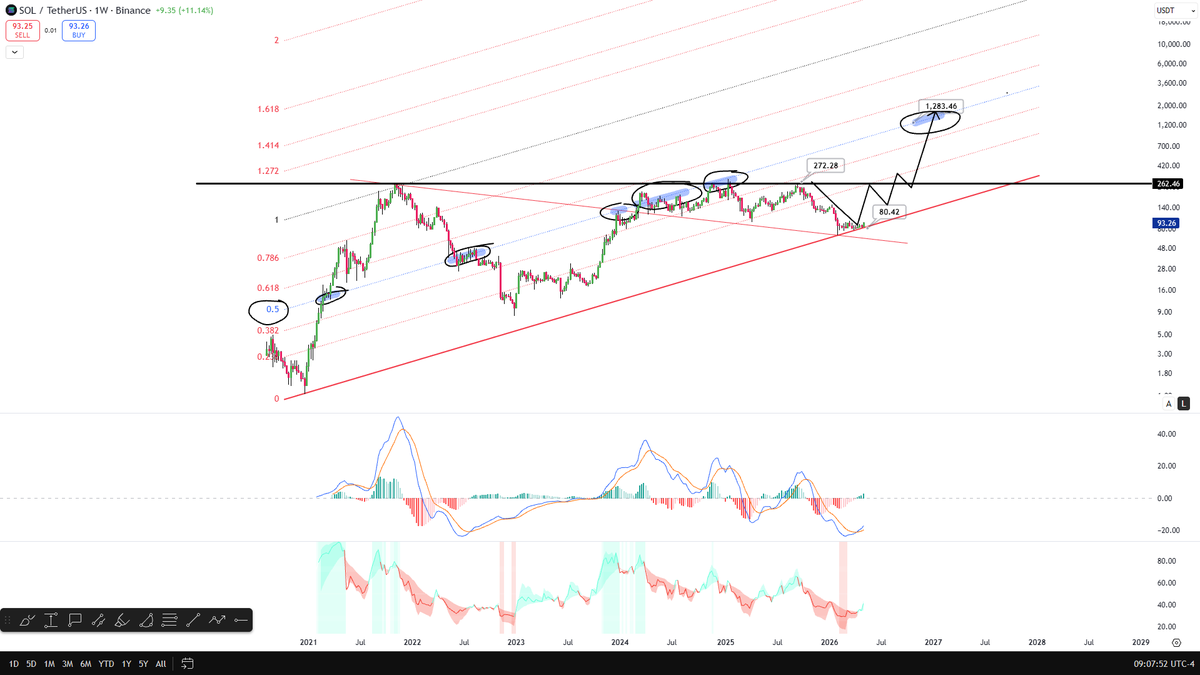
Solana could make a historic move.
It will most likely touch the 0.5 (blue line) Fibonacci level again.
Previously, it touched this level 7 times on the weekly chart.
If it touches it once more, solana:So11111111111111111111111111111111111111112 could very easily reach $1,200
I’m a fan of non custodial crypto cards vs CEX cards:
Every card swipe is a transaction onchain, uses gas, brings users and most importantly your assets stay under your custody.
You can hate $PUMP but ask yourself this:
> $425M ARR, 3.7X FDV/Revenue (vs HYPE at 67x)
> Even at 50% buybacks, it neutralizes all upcoming unlocks
> Terminal (DEX) growing in market share
Is this not an insanely good business?
They have a PR problem that needs a lot of work to fix, that's the biggest challenge
If you're a $SOL bull, you can't be a $PUMP bear, it's really simple
Really good article, recommend reading
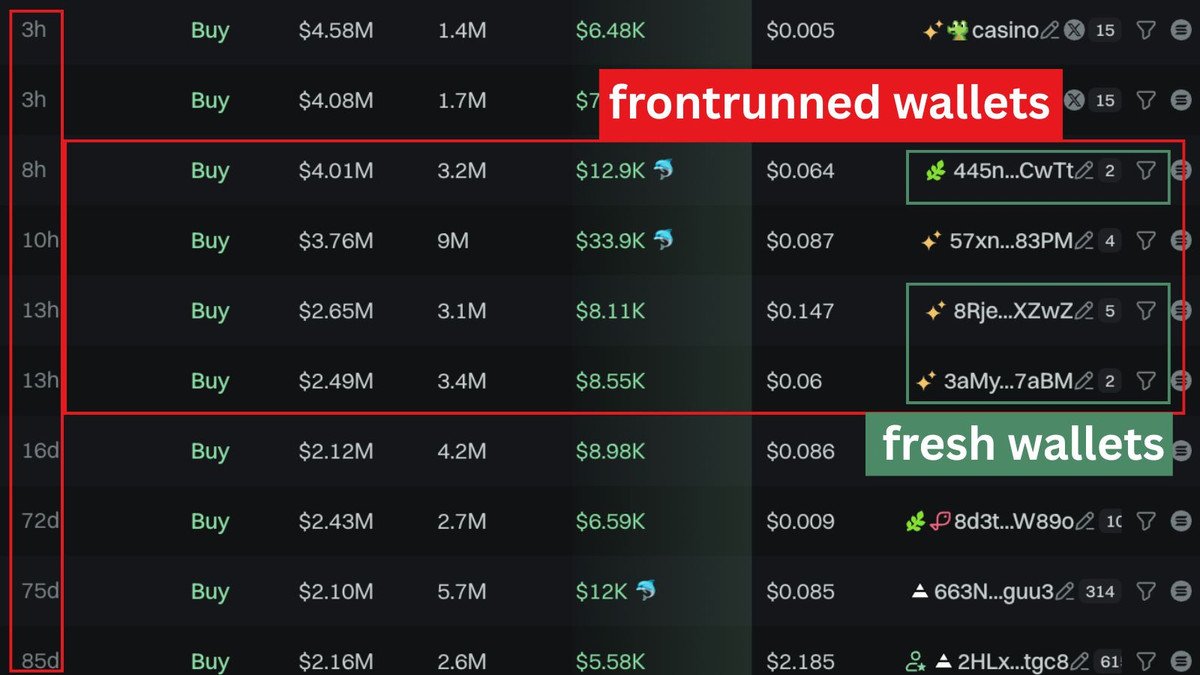
Binance listed a $2M MC token
It didn’t see any buys > $5K for 16d
A few hours before the Binance listing announcement, 4 big trades happened (with 3 fresh wallets and 1 dead wallet)
Those wallets are up over $300K in a few hours
Coincidence?
35 WEBSITES THAT ARE ACTUALLY USEFUL
1. archive. org — access old content
2. wolframalpha. com — solve anything
3. removebg. com — remove image background
4. tinypng. com — compress images free
5. smallpdf. com — edit PDFs free
6. ilovepdf. com — merge & split PDFs
7. deepl. com — best translator online
8. grammarly. com — fix your writing
9. hemingwayapp. com — simplify writing
10. chatgpt. com — ask any question
11. perplexity. ai — smart search engine
12. notion. so — organize your whole life
13. trello. com — manage any project
14. canva. com — design for free
15. unsplash. com — free photos
16. pexels. com — free videos & photos
17. flaticon. com — free icons
18. coolors. co — pick color palettes
19. fonts. google. com — free fonts
20. namecheap. com — buy cheap domains
21. github. com — free code hosting
22. replit. com — code from browser
23. regex101. com — test any code
24. explainshell. com — understand commands
25. fast. com — check internet speed
26. haveibeenpwned. com — check if hacked
27. virustotal. com — scan files for virus
28. downdetector. com — check if site is down
29. 10minutemail. com — temp email address
30. justpaste. it — share text instantly
31. screely. com — make screenshots beautiful
32. carbon. now. sh — share code beautifully
33. squoosh. app — compress any image
34. similarsites. com — find similar websites
35. shortcuts. design — design shortcuts list
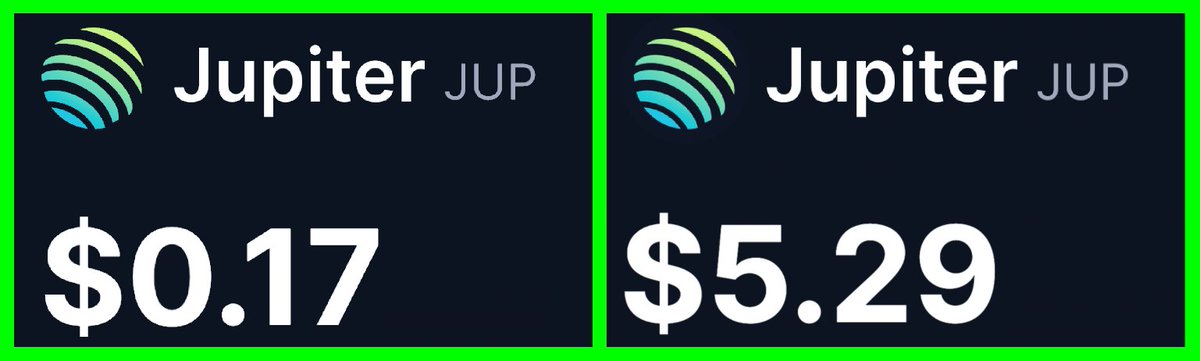
Do you think $JUP can pump to $5 next cycle? 🪐
Sounds insane… until you run the numbers
The UNI comparison has come up a lot when assessing JUP’s valuation
So let’s start there 👇
Uniswap’s ATH was ~$25B mcap:
→ That puts $JUP ~$6+
Now look at fundamentals:
✅ Revenue
→ JUP: ~$50.6M annually
→ UNI: ~$41.2M
Jupiter already generates more revenue than Uniswap.
✅ Valuation
→ JUP: ~$592M mcap
→ UNI: ~$2B+
Same ballpark revenue but 3–4x lower valuation
✅ Structure
→ Emissions paused indefinitely
→ No constant sell pressure
→ Cleaner price discovery
✅ Product Surface
→ Aggregator + perps (multiple revenue engines)
→ ~$5.7B aggregator volume (30d)
→ ~$5.8B perps volume (30d)
→ Higher monetization per user vs single-product DEX
✅ Reality Check
→ More competition vs 2021
→ Harder to reach $25B
So the question: does the market reprice JUP to match its revenue?
What do you think?