WARNING: Long post and pointed critiques ahead...
Developing a successful radiotherapy regimen for pancreatic cancer has long been something of a white whale to #radonc’s Ahab, with decades of phase III studies failing to produce any level 1 evidence supporting routine RT for localized disease. The challenges of treating this RT-refractory cancer have been compounded by chronic weaknesses in clinical trial design, including:
--> Excess enthusiasm for therapies that lack rigorous early-phase data, leading to herding, where multiple studies pursue the same target
--> Slow accrual and an inability to adapt trial designs to improving systemic therapy outcomes
--> Inaccurate projections of treatment benefit/effect size with radiation
--> Study statistical plans that cloud interpretation of trial results
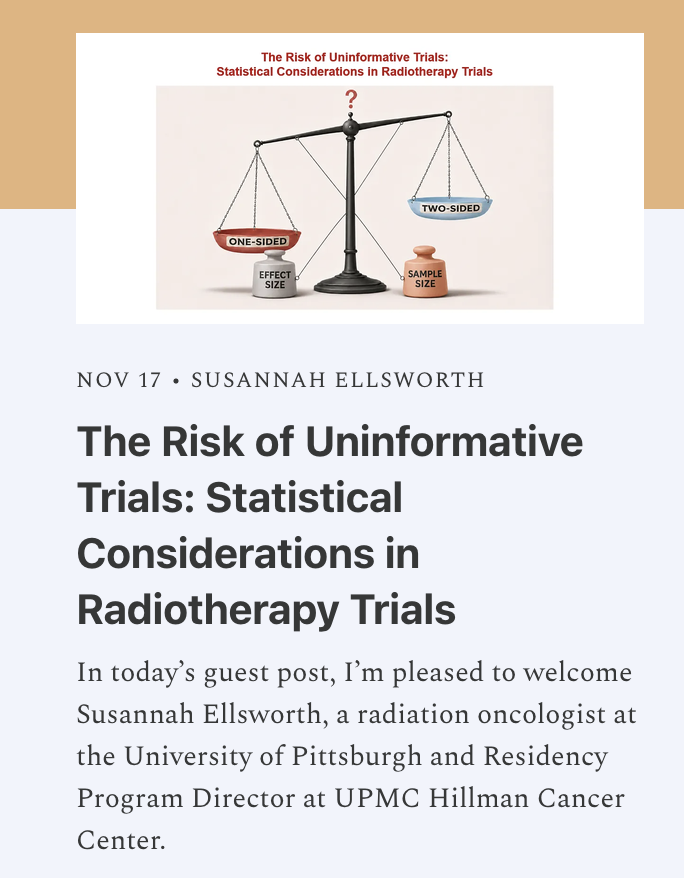
@Timothee_MD and I discussed many of these issues in a recent European Journal of Cancer perspective piece. However, I wanted to write for the Oncology Shot in more detail about the often-overlooked design aspects of ambitious effect size projection and one-sided significance testing. Both these approaches permit studies to utilize a smaller sample size while maintaining statistical power, making studies cheaper and faster - an appealing combination. However, the reduced costs and faster accrual come at a cost: a risk that the study will fail to generate any informative data whatsoever.
Although it wasn’t a pancreatic study, a recent randomized comparison of proton vs. photon SBRT for HCC (NRG-GI-003), nicely illustrates the pitfalls of excessively optimistic sample size projections (details in the Substack post). GI-003 estimated that proton SBRT would nearly double overall survival compared with photon SBRT. When the study failed to meet its endpoint, these projections were characterized as a surprising overperformance in the photon arm. However, several contemporaneous publications demonstrated substantially better outcomes with photon SBRT that GI-003 had projected, suggesting that the single study on which GI-003’s control-arm survival estimates were based was likely an outlier. Since GI-003 utilized one-sided significance testing for its primary endpoint, rendering it unable to assess whether the inferior outcomes seen in the proton therapy arm were actually due to *harms* from proton SBRT, this was not just a negative study but an uninformative one.
NRG’s current randomized pancreatic cancer trial, GI-011, may encounter similar problems due to its unsubstantiated effect size projections - remarkably, the protocol fails to provide even a single citation supporting its projected control-arm survival estimate - and the planned use of one-sided significance testing. If the study fails to reach its primary endpoint, an outcome that I believe is likely due to overly pessimistic survival projections in the control arm, the design choice of one-sided significance testing will make it impossible to rule out whether dose-escalated RT is harmful in locally advanced pancreatic cancer. Since the ethical principle of equipoise requires legitimate doubt to be present regarding which arm is better when enrolling patients on a randomized superiority study, and there is an elevated risk of severe late GI toxicity with dose-escalated RT for pancreatic cancer, one-sided significance testing is, in my opinion, not a justifiable choice for a clinical trial in this setting.
Finally, as we discussed previously, GI-011 also does not provide any mechanism to update its approach in response to advances in systemic therapy. GI-003 may have been affected similarly by advances in systemic therapy, with 6 OS-based FDA approvals of systemic therapies for HCC during its accrual period.
Pharma conducts dozens of studies for every phase 3 RT trial that is completed, meaning that drug approvals will continue to outpace RT trial data for the foreseeable future. Uninformative RT clinical trials not only fail to provide actionable data but crowd out other, more promising approaches, setting the field back in ways that failed drug trials do not. New approaches to clinical trial design in RT are badly needed in order to allow studies of local therapy to keep up with ever-evolving progress in systemic treatments.
https://t.co/DCN9STjIh5
https://t.co/uLqFmR9XiS
A new guest post "Oncology Shot" is out !
@free_radical28 expands on a recent manuscript we published together in EJC and its implications for past and ongoing radiotherapy trials.
Check it out!
https://t.co/hZT2fx5EBY
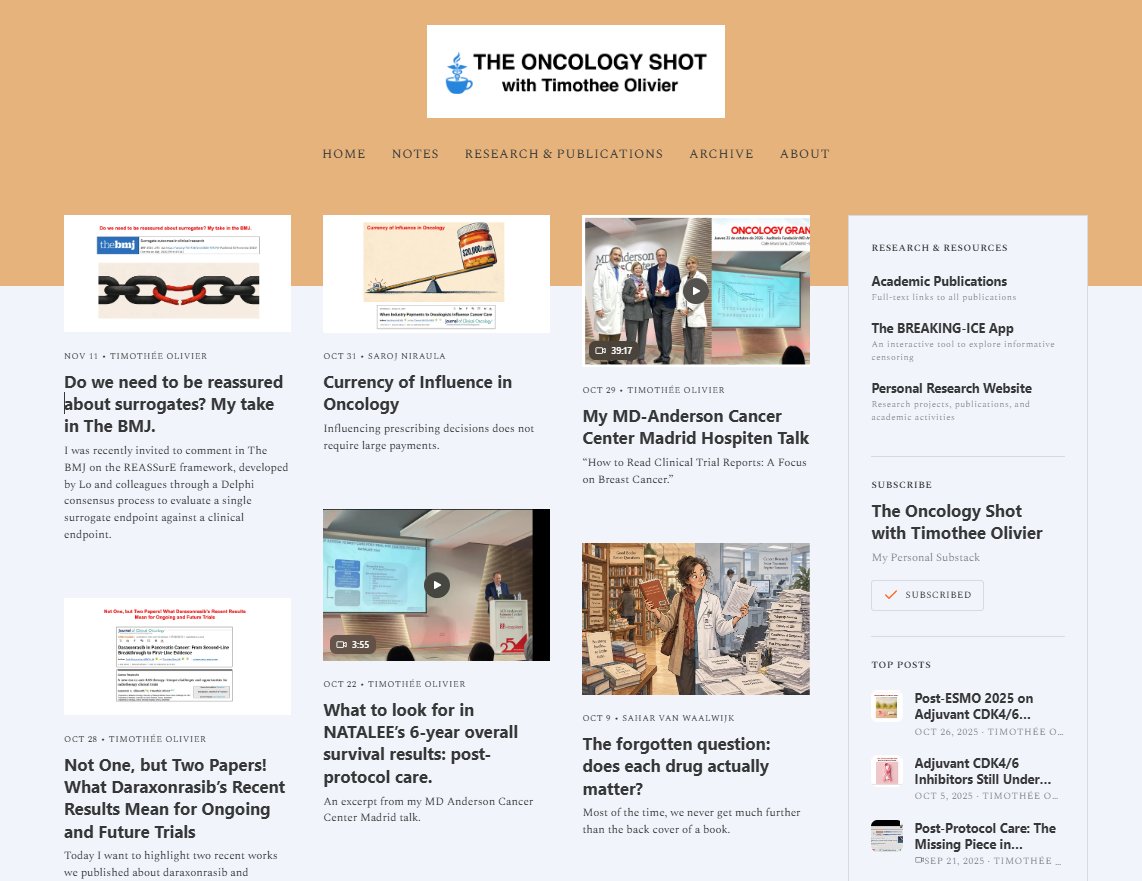
The Oncology Shot is a newsletter where I regularly share analyses, videos, and invite colleagues to discuss their work!
If you haven’t already, take a look and subscribe for free!
https://t.co/zBrqbzl6J1
Glad to be part of the OncoWisdom Webinar to talk about key trials @myESMO#ESMO26 with my peers and colleagues with a global audience!
I hope you’ll find some unique insights here!
Friday, 20th, 3:00 pm Swiss🇨🇭time (7:30 pm IST)
Register for free!👇
Oncowisdom is happy to invite you all for this academic webinar on key trials from esmo 26.
20 th November 7.30 pm IST
If u missed the Q& A sessions at esmo26 , do join us to dive deep. @Timothee_MD Dr Saeed Rafii @DrUddiGoswami Dr T P Sahoo . Scan to register 🙂 👇
Oncowisdom is happy to invite you all for this academic webinar on key trials from esmo 26.
20 th November 7.30 pm IST
If u missed the Q& A sessions at esmo26 , do join us to dive deep. @Timothee_MD Dr Saeed Rafii @DrUddiGoswami Dr T P Sahoo . Scan to register 🙂 👇
Surrogate endpoints can come at the cost of greater uncertainty: improving a surrogate may not improve what ultimately matters to patients.
Can new recommendations on surrogate endpoints lead to meaningful patient benefit?
https://t.co/rkvXYijzaX
I wonder why the ECOG lenalidomide smoldering trial final OS results have never been presented. It has longer follow-up than AQUILA. I suspect there is zero overall survival benefit, because patients in the US get good treatment when they develop myeloma unlike in AQUILA.
Before declaring Bot/Bal the "holy grail" that will "melt MSS solid tumors," let’s look at the math. UNICORN MSS combo: N=14. That 36% MPR is 5 patients, 95% CI stretching down to ~13%. Hyping a 14-patient window trial as a paradigm shift rhymes with all of the AI hype everywhere
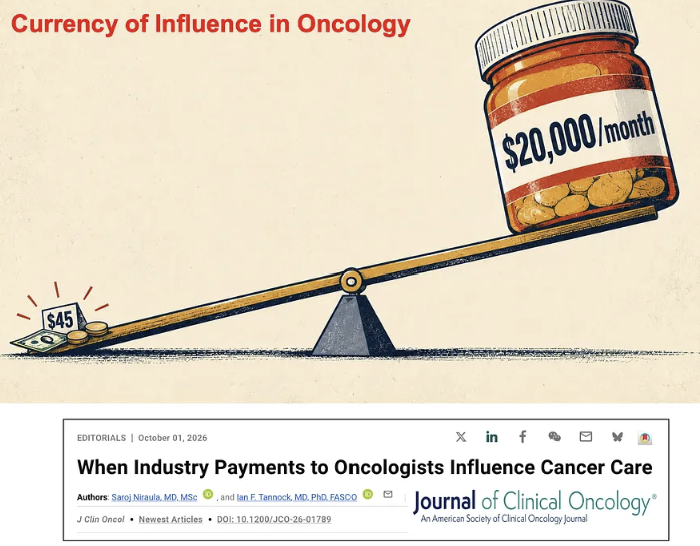
Ask oncologists whether they would change a cancer prescription because a pharmaceutical company bought them dinner, writes @sarojniraula . Almost everyone would say no. Most would probably even find the question insulting. Now consider what @TheWonkologist et al researchers found when they examined actual prescribing behaviour.
https://t.co/VSI81zJEcR @mgtmccartney@susan_bewley@LarkinJames@DrMarkLythgoe
Great guest post by @sarojniraula, discussing his recent @JCO_ASCO editorial with Ian Tannock!
@TheWonkologist et al. showed that payments as small as $45 are associated with prescribing decisions involving anticancer drugs.
And these drugs can cost tens of thousands of dollars per month!
Post here: https://t.co/F8CpptJFXN