Titanium Strength crece en Europa fiando su apuesta por la musculación y el ‘home fitness’
Lo contamos de la mano de @TitaniumSTR
https://t.co/VCbI2rwvaR
La mejor forma de saber qué es y qué no es. Así habla quien ha montado su gimnasio con Titanium Strength #BusinessGrowth#emprendedores https://t.co/pTjDNJi9eY
Dr. Andrew Huberman (@hubermanlab) explains Dweck & Mueller’s landmark study showing why effort-based praise fuels real learning.
"Rewarding yourself for effort is the best way to improve performance; rewarding yourself based on identity labels can actually undermine performance."
NEW STUDY: People who consistently do vigorous exercise have slower rates of epigenetic aging compared to those who don't. Light to medium activities don't cut it https://t.co/AwcydGtYah
Adding more potassium-rich foods to your diet, such as bananas or broccoli, might have a greater positive impact on your blood pressure than just cutting sodium. Researchers suggest that "Early humans ate lots of fruits and vegetables, and as a result, our body's regulatory systems may have evolved to work best with a high potassium, low sodium diet,"
A recently published modeling analysis (PMID: 39447116) looked at how dietary potassium and sodium affect blood pressure through renal sodium handling and fluid balance regulation (including in the analysis known sex differences).
Study:
- The modeling used validated sex-specific differences in human kidney physiology.
- Potassium intake was doubled from baseline values while sodium intake was held at twice typical dietary levels, approximating intakes in industrialized societies.
- Models evaluated how changes in electrolyte intake influenced renal sodium transport, kidney excretion of sodium, and systemic blood pressure.
Mechanism:
- Increased dietary potassium reduced proximal tubule sodium reabsorption, promoting increased kidney excretion of sodium and volume excretion.
- Enhanced activation of potassium-sodium exchange and kidney excretion contributed to downstream blood pressure regulation.
- Female exhibited inherently lower sodium reabsorption in the, offering greater resistance to hypertensive effects of higher sodium.
Findings:
🔹 Systolic blood pressure reduction:
- Doubling potassium intake led to a predicted 14 mmHg decrease in men and 10 mmHg in women, despite persistently high sodium intake (2x recommended amounts).
🔹 Electrolyte Balance:
- Restoration of a higher potassium-to-sodium intake ratio aligned with evolutionary dietary patterns and improved modeled cardiovascular outcomes.
Limitations:
🔸 Model-based: findings are from computational simulations, not clinical trials. No real-world interventions were tested in this study.
🔸 Outcomes are predictive and require experimental validation.
🔸 Models assume normal renal function and may not generalize to individuals with hypertension, CKD, or other comorbidities.
🔸 While biologically plausible, clinical relevance needs tested.
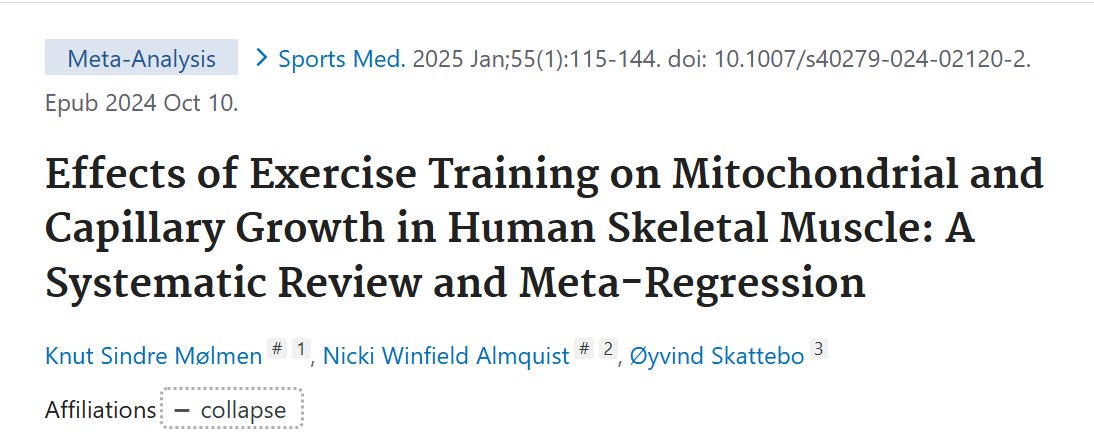
Don't let people fool you, if you're training hard, you're improving mitochondrial health. The intensity doesn't matter much (high or low both work).
Check out this quote from a recent systematic review & meta-analysis.
TLDR: Continuous endurance training, high-intensity intervals, and sprint intervals all produced nearly identical increases in mitochondrial content.
"increases in mitochondrial content in response to exercise training increased to a similar extent with ET (23 ± 5%), HIT (27 ± 5%), and SIT (27 ± 7%) (P > 0.138), and were not influenced by age, sex, menopause, disease, or the amount of muscle mass engaged."
PMID: 39390310