In-context imitation learning helps robots adapt to new tasks from just a few demonstrations.
But existing approaches only condition on state–action trajectories. They don’t model why those actions are taken or what the high-level task objective is. This limits the performance in complex and ambiguous settings, where the same actions may correspond to different task intents.
💡Inspired by the advancements of CoT prompting in LLMs/VLMs, we introduce ICLR: In-Context Imitation Learning with Visual Reasoning, a simple yet effective method that incorporates visual reasoning into robotic in-context imitation learning, guiding the learning process beyond surface-level in-context action imitation.
🪜 What if humanoids could climb ladders and work on them straight out of simulation?
Meet LadderMan: a perceptive system for zero-shot sim-to-real ladder climbing and on-ladder manipulation.
Watch the humanoid climb, stabilize, and manipulate—all in one system. 🤖👇
Humanoid robotics is hitting a data wall. Teleop and mocap took us far, but they don’t scale to every object, terrain, and behavior.
We’re releasing GRAIL: https://t.co/LxTKtMPtw0 — a fully digital pipeline for generating loco-manipulation data before the robot moves. 🧵(1/8)
We are back again :) After three weeks of quiet building.
Introducing Genesis World 1.0, our latest simulation platform, the second release in our full-stack suite. Open-sourced.
Robotics is still bottlenecked by the 1× speed of the physical world. Every model, checkpoint, and data recipe eventually needs to be tested on physical hardware, slowly, expensively, and with limited coverage.
One hour in reality can become 100 days in simulation. That is how robotics model iteration moves from a wall-clock bottleneck to a compute problem.
To make this work, simulation has to be both fast and trustworthy.
Over the past year, we rebuilt the entire stack: a GPU-accelerated cross-platform compiler, penetration-free multi-physics contact solvers, unified rigid and deformable physics, and a photo-realistic renderer purpose-built for physical AI applications.
We built Nyx, a high-performance path-traced rendering engine for robotics application.
Genesis World 1.0 achieves near realtime performance with our latest development for penetration-free IPC solver, supporting various types of deformables beyond rigid bodies. It supports contact-rich, dexterous manipulation simulation across different embodiments: unitree, sharpa, wuji, genesis hand and various types of grippers.
Under the hood is Quadrants, our effort in pushing forward cross-platform GPU-accelerated computation. Quadrants started as a fork of Taichi, and we rebuilt most of the critical parts for optimizing simulation workloads, giving 10x faster launch time and up to 4.6x runtime performance compared to the initial Genesis release.
Together, they bring us to an unprecedentedly low sim-to-real gap, enabling zero-shot real-to-sim model evaluation and much faster iteration of GENE.
All available today.
Genesis World 1.0: https://t.co/aknCM3eqws
Quadrants: https://t.co/uXqPNI4cb6
Nyx: https://t.co/R8j0djqGnV
You can’t lift a fridge with just your hands. Your whole body needs to conform to its shape, and bear the load between your arms and torso.
Here, @BostonDynamics' Atlas uses proprioception to manage the whole-body interaction and adapt to a shifting 100+ lb load. Enabling this type of high performance manipulation is exactly why we walked away from what was arguably the world’s best implementation of MPC for humanoids, and shifted entirely to RL without looking back.
This level of whole-body controls is a fundamental building block of physical intelligence and key to the value proposition of humanoids.
More technical details in:
Blog: https://t.co/oIRjVfh7jJ
Behind the scenes video: https://t.co/LgaImMAyhX
We have news!
We created a new robotics model called Loop Model 1.
On the zip-tie insertion task, it achieves 20x more throughput per unit of data than "Pi06 + RLT" from Physical Intelligence, a top model for such tasks.
It’s the missing piece that makes MicroFactory work, because now deployment becomes so simple and fast that our users can do it themselves.
My god, this is insanely cool. 🤯
Unitree just unveiled GD01, a manned transformable mecha starting at $650,000; the company says it is the world’s first production-ready manned mecha, built as a civilian vehicle and weighing around 500kg with a person inside.
It can transform from humanoid to quadruped mode, and Unitree founder Wang Xingxing even climbed inside to test it himself.
People talk, listen, watch, think, and collaborate at the same time, in real time. We've designed an AI that works with people the same way.
We share our approach, early results, and a quick look at our model in action.
https://t.co/AFJZ5kH7Ku
text-to-cad got hands
this hand model was generated in one prompt with GPT 5.5 (not functional, but looks awesome!)
also just crossed 2k stars on github! 💫
new release:
- 4x faster STEP file generation and renders
- improved skill workflow
- fewer ocp artifacts
happy cad-ing
1/ 🤲 LeRobot has made low-cost robot learning widely accessible — but most policies are still blind to contact.
Today we release LeFlexiTac: a tactile extension for the LeRobot platform using FlexiTac sensors. Make tactile robot learning as easy as possible.
Project page: https://t.co/6PY8oTmAjU
Code/docs: https://t.co/11HW0Zwrtb
What do you get when you cross multi character motion matched interactions, active ragdoll physics, and some awesome mocap?
Cinema.
Here's a little sneak peek on what we're working towards. I usually don't like to share early but this was too good to keep hidden, enjoy!
Also you'll want to unmute for this ;)
#UE5 #animation #gamedev
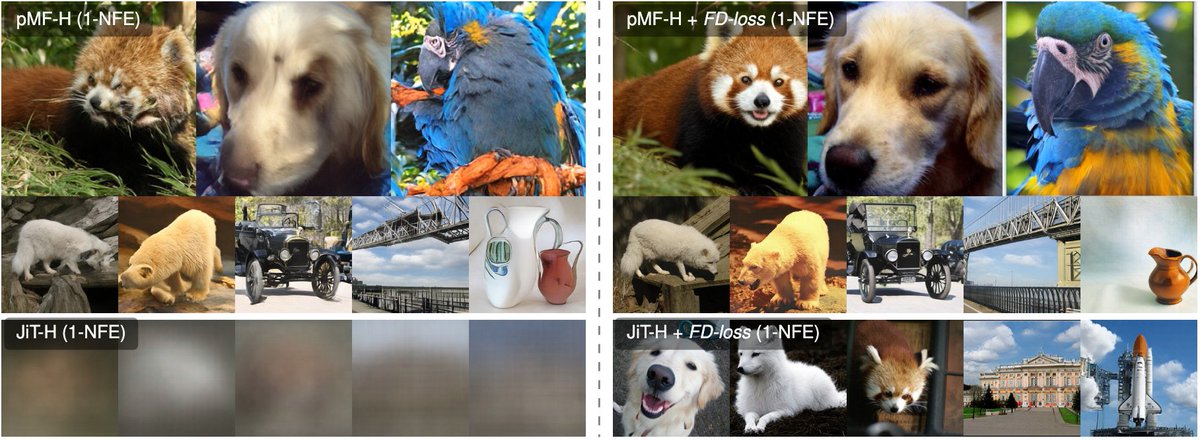
Two months ago, I vaguely posted a number: 0.9 FID, one-step, pixel space.
Now it is 0.75, and can be even lower.
Many wonder how.
I thought it might end as a small FID prank: simple and deliberate.
It started with one question: can FID be optimized directly, and what does it reveal?
Introducing FD-loss.
Heterogeneous simulation (different mesh per world) is now fully supported in mjlab. If you were hesitant about using mjlab for manipulation, now is a great time to switch over 🙂
https://t.co/u41fUdIKxM
This is Stringman. An open source room scale CDPR compatible with LeRobot and designed for picking up laundry. @IlirAliu_
$1235 assembled at https://t.co/UY0T5oTlwZ