@Bensam123TV@RepLuna@CommunityNotes@NASA Loeb proposed an escape trajectory that requires Del V ~2.7 km/s, or 2x what is available (at best). Grok just repeats Loeb's paper. The proposal is not feasible.
This is where we are. The interstellar navigation approach says that NH must be at the intersection of the two lines. (You can only see where the given star is in you're on its line.) The intersection falls right on the known trajectory from DSN tracking. The method works!
New Horizons is so far away that the nearest stars have shifted markedly from where we see them on Earth. With NH-based positions for two stars alone we can figure out where the spacecraft is. This technique would be used on interstellar voyages. https://t.co/roJ1ExMXn9
These are the two stars that we used: Wolf 359 (L) and Proxima Centauri (R). These are simultaneous images from Earth and New Horizons on April 23, 2020.
@tribelaw As an astronomer who has greatly enjoyed your posts on major legal and constitutional issues, I'm delighted to see your curiosity for the things that we fiddle with.
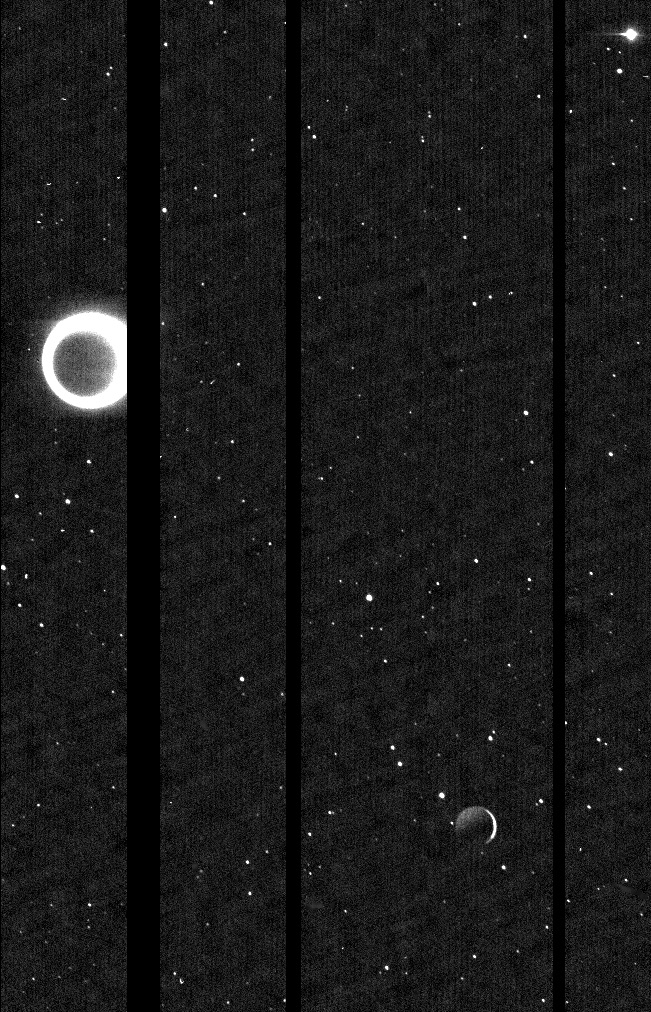
@ThePlanetaryGuy Here's another one to go with it. Note the Pluto-shine lighting up Charon, which is likewise mostly night-side, but for the thin crescent of solar illumination.