✍️ My Monday post is live. It’s a big one.
❝
Therapist and patient may have the illusion they have completed therapy when real therapy never even started.
Read here 👇
https://t.co/Lcu4e1dayG
Skilled therapists don’t build “rapport” by talking about themselves. It’s a beginner’s mistake.
Non-therapists (and poorly-trained therapists) bring a frame of reference that applies to *social* relationships, not therapy relationships. They are fundamentally different.
https://t.co/lxIoUreGxp
"CORE PSYCHODYNAMIC CONCEPTS RELEVENT TO ALL THERAPIES"
https://t.co/sZAEmWlJ4I
Most popular of our 'TALKING THERAPY" podcasts- probably because it shows therapists how to become even more effective by iintegrating the different therapy schools.
Love talking to @GoldfriedMarvin
✍️ A 3-question test to determine if you are getting meaningful, in-depth psychotherapy (2 min read)
“Think of a time you were upset with your therapist.”
Read free 👇
https://t.co/Zrho7dr91a
Listening non-judgmentally is not something therapists learn from a book or class. It takes years of work.
We can listen without judging because we have examined the dark corners of our own souls in personal psychotherapy.
What you think shocking, we know to be simply human.
Therapists who have not done the painstaking work of in-depth personal psychotherapy do not and cannot listen non-judgmentally.
They can tell themselves they do, they can play the role, they may even believe it—but it is playing a role and, at some level, patients feel it.
Without knowing it, the therapist subtly recoils from areas of the patient’s inner life, subtly signals approval or disapproval, and so closes off entire territories to exploration.
We cannot face another’s demons with equanimity, curiosity, and acceptance before we have learned to face our own. We cannot accompany our patients to places we ourselves have not visited.
This is one more reason why, if we hope to offer in-depth therapy to our patients, in-depth psychotherapy for the therapist is non-negotiable.
Today, everyone seems to be looking for a bypass around the honest hard work of developing self-knowledge and self-awareness.
There is always the next new technique, certification, workshop, acronym, tool, hack, buzzword, and trend. None of them substitute for the sustained work of in-depth personal psychotherapy.
There are no bypasses.
My thoughts, as promised:
Words of condolence can be a mistake. Suppose the patient had expressed rage and bitterness toward the parent and told the therapist they wished for their death. Suppose they felt extremely guilty about those feelings.
Saying “I’m so sorry for your loss” makes it difficult for the patient to explore complex and contradictory feelings in therapy. If they are feeling guilty about their feelings, they will go underground. That’s the opposite of what we want.
Saying “I’m so sorry for your loss” may be well-intentioned, but the message the patient hears may be, “your feelings are not acceptable here either.” The patient has heard that message their entire life.
👉To be most helpful as a therapist, we have to view the situation through a *therapy* lens, not a conventional social lens.
The relevant question is: will our response open space in therapy for the patient to experience and express the full range of their emotional experience, or could it constrain it?
Emotional life is complex, layered, and frequently contradictory. A helpful therapist response creates maximum space for the patient to explore *their own* emotions without presuming to know them in advance.
One alternative is simply to acknowledge the difficult circumstance, respond to the scheduling issue, and not make assumptions about the patient’s state of mind:
“I fully understand. Unless I hear from you otherwise, I will plan to see you at our regular time next week.”
When we make assumptions, or substitute social conventions for therapeutic curiosity, the space for emotional exploration shrinks. This may seem counterintuitive, but in-depth psychotherapy requires more than intuition. As Otto Kernberg reminds us, “Psychotherapy starts where common sense ends.”
Can a therapist communicate their human concern and emotional availability without making assumptions, closing space for emotional exploration, or retreating to a social rather than a therapeutic mode of responding?
Social media therapy influencers often traffic in performative displays of virtue and empathy. They may be quick to dismiss the suggested therapist response as cold or uncaring and position themselves as “human” and “authentic.”
Performing empathy is easy, but real psychotherapy cannot be performative. It is attunement to our actual patient, building an increasingly authentic connection, and opening space for the patient to explore *their own* experience—whatever it may be.
There are no fixed rules about the “right” or “wrong” way for a therapist to respond—but there is one very clear *principle*:
A response that preserves maximum space for the patient to explore and communicate their ongoing experience is helpful. A response that contracts that space is unhelpful.
Skilled psychotherapy builds on that principle. The specific application of the principle is a matter of tact, timing, empathy, and attunement.
__________
✍️ Related reading
“Much of What Is Called Therapy Is Not Psychotherapy” https://t.co/lxIoUreGxp
✍️ My Monday post is live (2 min read)
When Psychotherapy Works, Then What?
Psychotherapy cannot cure the human condition. It can free us to meet it.
Read free 👇
https://t.co/SFypT5ZHW3
❝
Many “psychopharmacologists” adopt the attitude that they can be responsible for diagnostic assessments and medication management and do a good job of it while distancing themselves from the emotional lives of their patients.
✍️ Therapist Ethics is Not About Following Rules (2 min read)
❝
We maintain confidentiality not because it’s an ethics rule, but because no one will open up to us unless they know that what’s said in therapy stays in therapy.
Read free 👇
https://t.co/I9WWrlr5Ht
🎙️ Interview: What Makes Psychotherapy Meaningful?
I discuss psychiatry, psychotherapy, therapy-speak, and what gets lost when mental health treatment becomes a procedure.
On the Psychiatry Boot Camp podcast with Dr. @MarkRMullen
listen free 👇
https://t.co/TnHP6DbDYu
In meaningful psychotherapy, we help patients move from the general to the specific, from the abstract to the personal. We encounter resistance along the way, which itself becomes the focus of our attention and curiosity.
👉Tell me what you mean
👉Can you give me an example
👉Say more
👉I notice you didn’t mention
👉Something makes it hard to talk about this
👉Perhaps there’s a reason you left that out
👉What more comes to mind
👉I notice you looked sad when you said
👉Perhaps it’s easier to focus on this than that
👉Can you put words to those tears
👉I notice we quickly got away from the topic of
👉Help me connect the dots
These comments are made in a spirit of non-judgmental curiosity, intended to invite the patient to *be curious* with us, without blame or shame.
They help create space for the patient to notice, attend to, and begin to put words to areas of experience that were previously unknown or unacknowledged.
This approach to psychotherapy takes account of unconscious mental life: we do not fully know our own hearts and minds, there are multiple layers of experience, and emotional life is complex and often contradictory.
This is how we become more self-aware and more whole.
The therapeutic stance of *finding out together* is very different from providing tips, tools, worksheets, advice, or solutions.
It is also very different from automatically affirming or validating whatever is on the surface, before we could possibly understand what we’re validating.
The starting point of in-depth psychotherapy is recognizing there is more than meets the eye, and working to develop a relationship in which patient and therapist can discover it together.
“We live in a culture that is psychologically illiterate; that elects psychopaths and malignant narcissists to political office; that falls for mental health snake oil and fads; that is fooled by performative Insta-therapists and mistakes self-promotion & marketing for knowledge;
🆕 My Monday post is live (5 min read)
Students think they are learning psychology. Instead, they are taught caricatures.
Read free 👇
https://t.co/oa3IsMlyyA
❝ The available evidence indicates that effect sizes for psychodynamic therapies are as large as those reported for other treatments that are actively promoted as ‘empirically supported’ and ‘evidence based.’
It indicates that the (often unacknowledged) active ingredients of other therapies include techniques and processes that have long been core, centrally defining features of psychodynamic treatment.
Finally, the evidence indicates that the benefits of psychodynamic treatment are lasting and not just transitory, and extend well beyond symptom remission. ❞
Source: Shedler, J (2010). The Efficacy of Psychodynamic Psychotherapy. American Psychologist, 65, 98-109.
https://t.co/1XeSnJ18mk
“The goals of treatment should be realistic, to be achieved by mechanisms that can be explained to and discussed with the patient; the patient should not assume that simply by showing up he or she will be magically cured by the therapist.”
—Otto F. Kernberg
🆕 My Monday post is up (3 min read)
❝ The therapist ‘validates’ the patient instead of helping her to better understand herself. It makes me wonder whether the therapist is the product of a training culture that defaults to validating students instead of teaching them how to think clinically.
Read free 👇
https://t.co/6XIFmC2Bv7
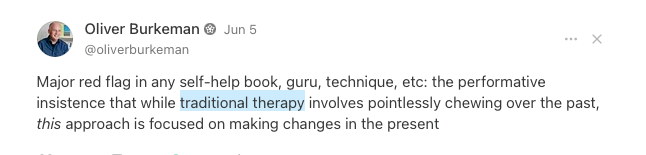
All legitimate psychotherapy is focussed on making changes in the present. That is literally the purpose of psychotherapy.
When someone needs to invent an imaginary straw man to use as a foil, they are showing you that whatever they are selling cannot stand on its own merits.