Today, we welcome Usman Muzaffar as our Chief Technology Officer.
At Arc, he'll bring over two decades of engineering leadership, most recently as SVP of Engineering at Cloudflare, to advancing our Virtual Cell Initiative and Arc's broader computational infrastructure.
Arc’s Virtual Cell Initiative focuses on the full-stack development of an accurate AI model to advance complex disease research. At TED2026, Executive Director @SKonermann joined @TEDchris to talk about what we’re building.
https://t.co/uONFa1JyXw
🌟 Congratulations to our Senior Scientist Dr. Ming Sound Tsao on receiving the Lifetime Achievement Award from the Canadian Lung Cancer Conference! 🌟
@UHN_Research@pmcancercentre@UHN
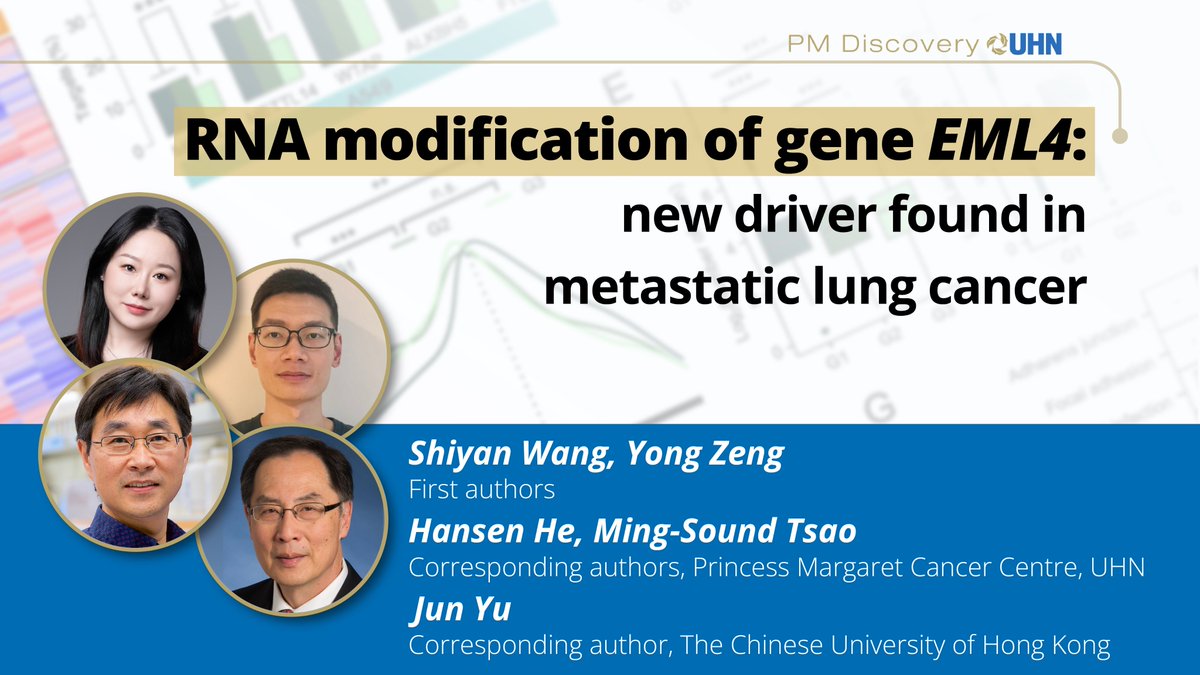
🫁Recent study from @pmcancercentre@UHN has unlocked a new understanding of lung cancer through the lens of m6A epitranscriptome. They’ve found a novel driver of metastasis, EML4, opening doors for potential therapeutic targets.
Read on @CD_AACR: https://t.co/uE5F2KUJf0
#News: Excited to share we completed our business combination with DYNS and debut as a public company as $SNTI on @Nasdaq today! Plan to advance lead #oncology programs toward IND filings in 2023. Learn more: https://t.co/1ysaCJMCxE #syntheticbiology#genecircuits
@hansenhe7@mfphotograph @StanInScience I wonder if the case is different with tumor-infiltrating T cells vs. Circulating or in vitro T cells. Also is it transcription driven expression, and/or other processes such as trogocytosis ?
Congrats to Dr. De Carvalho @PMResearch_UHN@UHN for receiving @AACR-Waun Ki Hong Award for Outstanding Achievement in Translational and Clinical Cancer Research! The award recognizes his work on developing a sensitive & accurate blood test to detect & characterize #cancer.
A deep mechanism of how AR and MYC equilibration contributes to responses to supraphysiological androgen therapy. Kudos to Shaoyong and Haiyang. Another great collaboration with Dr. Steven Balk's group. Thanks to the support from @tfri_research and others https://t.co/IMV3ifxh4o
Just out in Cell, by in vivo CRISPR screens, we identify the E3 ligase, Cop1, as a new immunotherapy target.
By coupling multi-omics, machine learning and experiments, we find the underlying mechanism relies on protein degradation and macrophages.1/n 🧵👇
https://t.co/Yi89oXf2SM