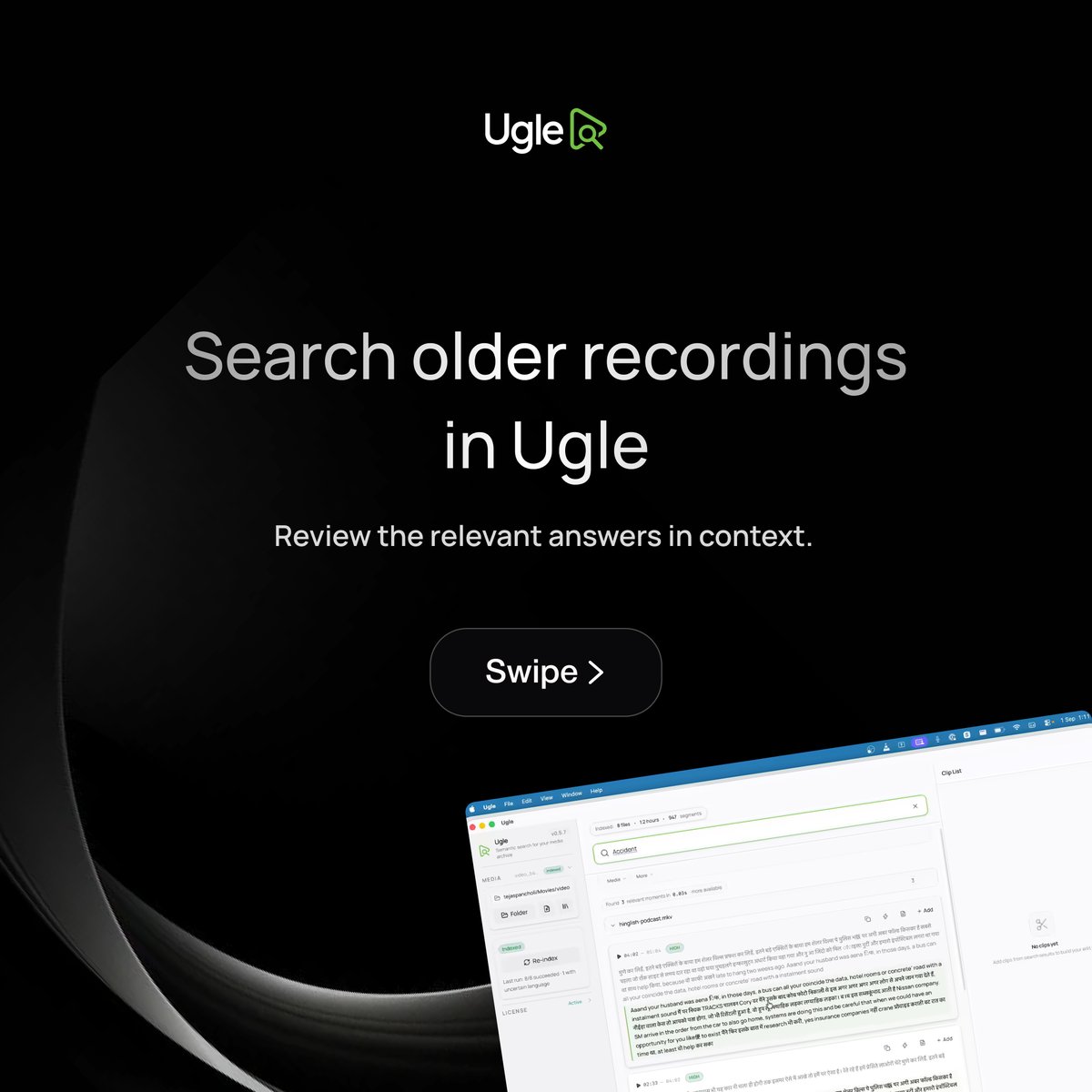
Ugle is live on Product Hunt.
Find useful moments in your recordings and collect them for your next edit. Search runs on your machine.
15-day free trial. No credit card required.
Explore and share feedback:
https://t.co/odJ1zyaXui
A newsroom editor rarely starts with a perfect keyword. They start with memory.
“The spokesperson explained the budget issue somewhere in the second interview.”
“The strongest answer came after we asked about the delay.”
“There was a clean soundbite about the announcement.”
The file is only the container.
What professionals actually need is often somewhere inside it.
A quote.
A scene.
An objection.
A soundbite.
A source.
A Moment.
A deadline does not care that the interview is 94 minutes long.
You remember the answer. What you need is the exact Moment and the source it came from.
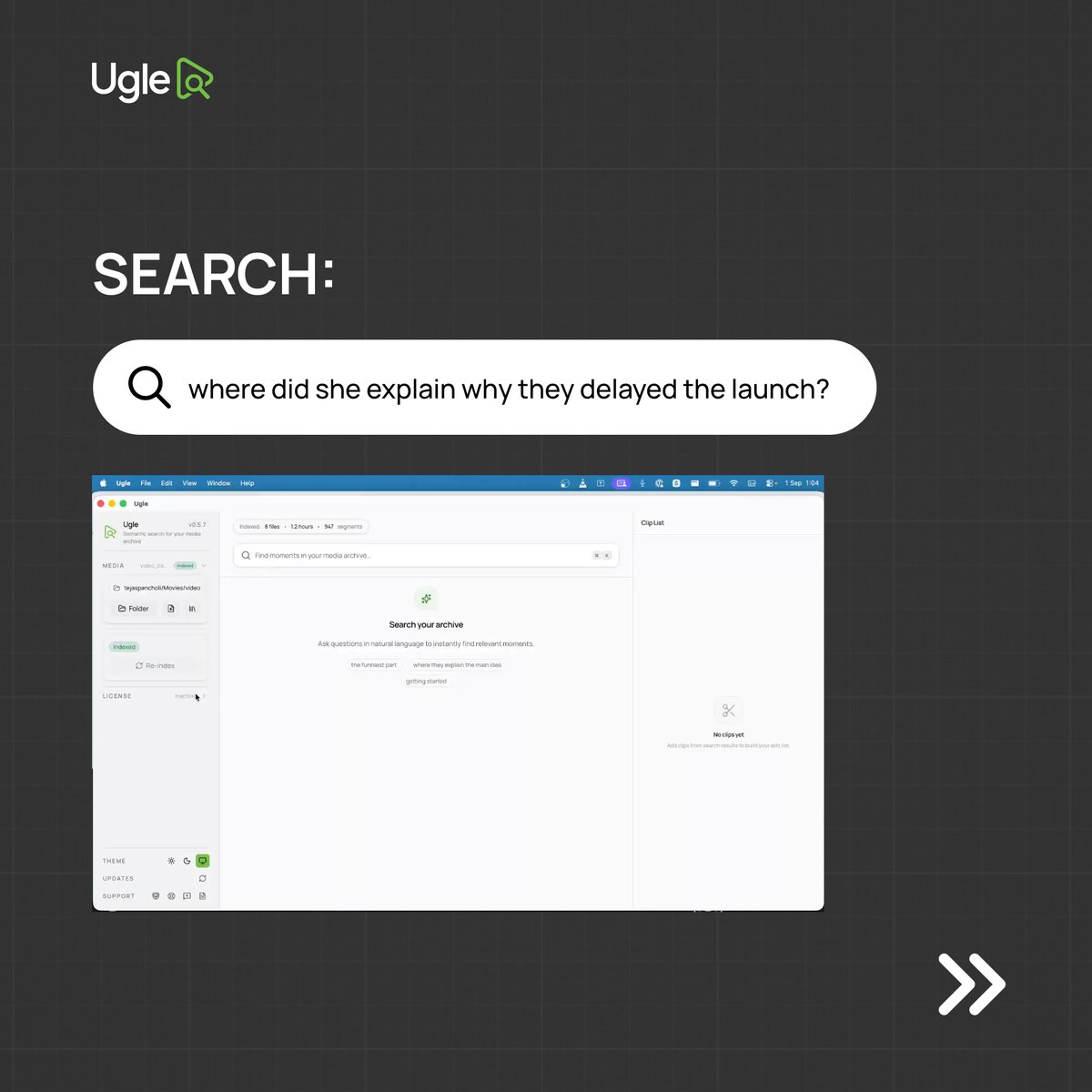
Search the archive by meaning.
Open the timestamp.
Keep working.
For Ugle, local-first is the architecture, not just a privacy feature.
Original audio and video stay on your device, while transcripts and indexes are generated and stored locally, never uploaded to Ugle for processing.
Ugle has one job: help you retrieve a Moment from media you already own.
Your media becomes a Library.
The Indexer prepares it locally for search.
You use Spotlight to describe what you remember.
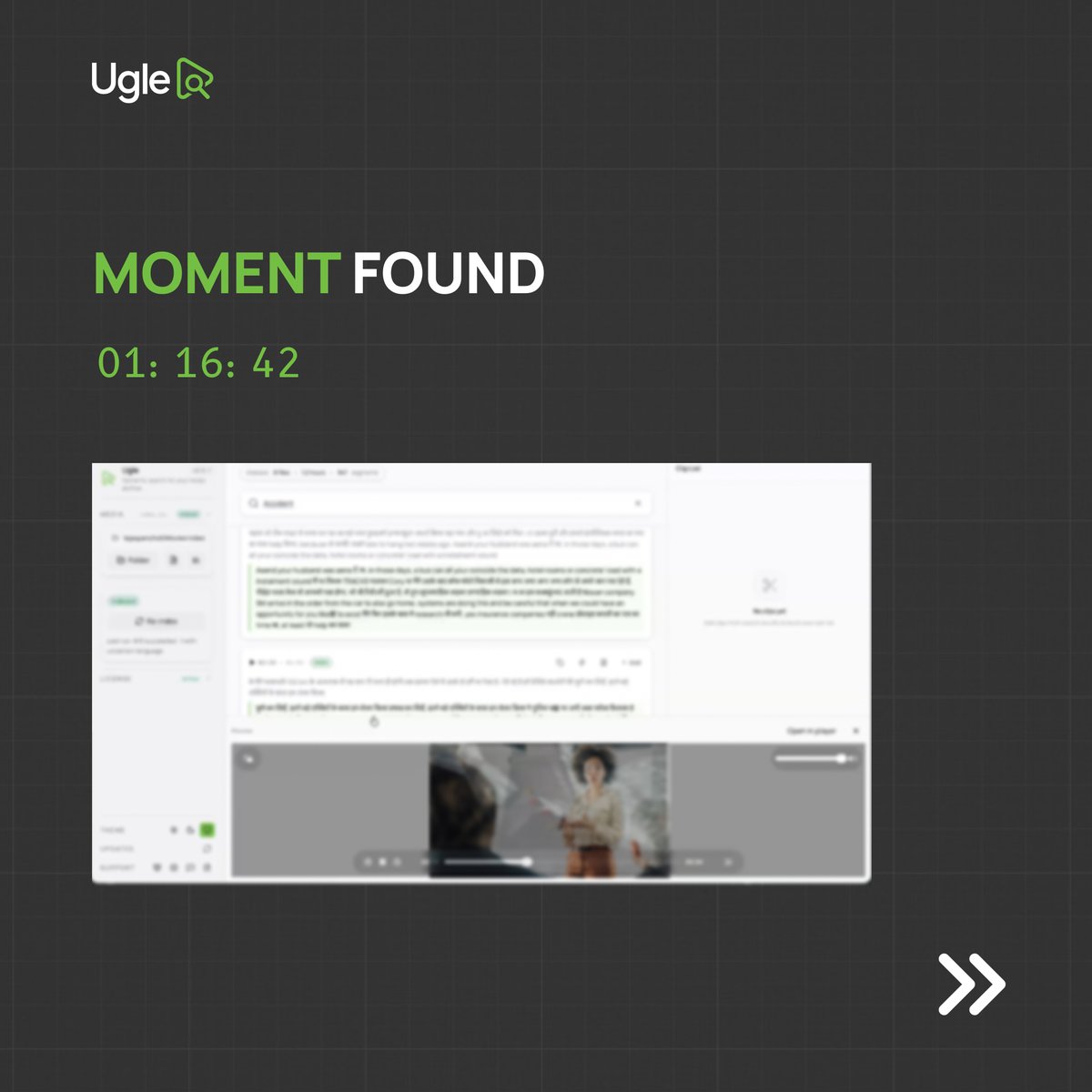
Ugle finds matching Moments, connected to their original timestamps and sources.
The frustrating part is often not knowing whether the material exists.
You already know it exists.
You remember the conversation, the scene or the soundbite. What you cannot remember is exactly where it happened.
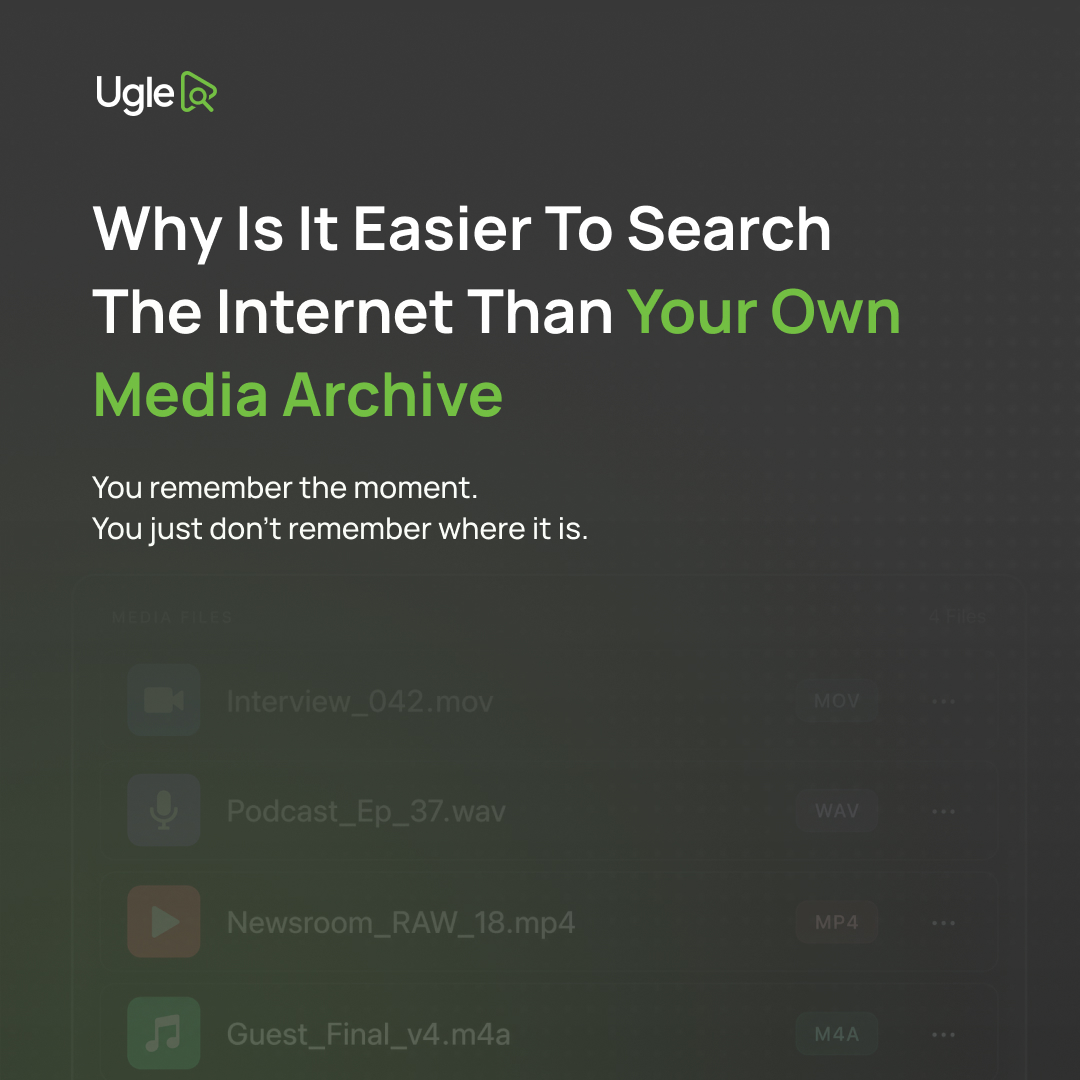
Why is it easier to search the internet than a video archive sitting on your own computer?
For people working with interviews, podcasts, footage and recorded source material, the problem is often not remembering what happened. You remember the quote. You remember the objection. You remember the soundbite.
What you don’t remember is which file contains it, where it appears, or the exact timestamp.
So the workflow becomes opening files, scrubbing timelines, listening, skipping, rewinding and trying again.
Ugle is built around that retrieval gap.
It indexes audio and video locally and lets you describe what you remember, so you can return to the relevant Moment in the original source.
You spent years building the archive. Finding one moment inside it should not take twenty minutes.
#MediaWorkflow #VideoEditing #Journalism
Local-first sounds more technical than it needs to.
For https://t.co/O0Ffy5pgyF, it simply means your recordings stay on your machine. When you search inside an interview, podcast episode, source call, or video file, the archive does not need to be uploaded somewhere else first.
That matters because not every recording belongs in a cloud tool. Some files are private. Some are unreleased. Some are sensitive. Some are just too large to keep moving around.
https://t.co/O0Ffy5pgyF is built for people who want to search their media without giving up control of it. Download the app, index your recordings, search by word, phrase, or idea, and open the exact timestamp.
That is local-first media search in plain language: your files stay with you, and search happens where the archive already lives.
Download Ugle: https://t.co/ShzLv1PPrw
A folder full of recordings is not the same as a searchable archive.
Most media teams already have the files. They have interviews, raw footage, podcast episodes, research calls, lectures, voice notes, source recordings, and old client conversations.
https://t.co/7zM1gIZJbA
Why is it easier to search the internet than your own media archive?
https://t.co/CGuFOyUNzw is a local-first media search tool that helps professionals search inside video and audio files by meaning, directly on their machine.
All media channels, digital platforms and individuals are advised to refrain from live coverage or real-time reporting of defence operations and movement of security forces. Disclosure of such sensitive or source-based information may jeopardize operational effectiveness and endanger lives. Past incidents like the #KargilWar, 26/11 attacks, and the #Kandahar hijacking underscore the risks of premature reporting. As per clause 6(1)(p) of the Cable Television Networks (Amendment) Rules, 2021, only periodic briefings by designated officials are permitted during anti-terror operations. All stakeholders are urged to exercise vigilance, sensitivity, and responsibility in coverage, upholding the highest standards in the service of the nation. 🇮🇳
Read more: https://t.co/bHscgUBMEV
#MediaAdvisory #NationalSecurity #MIBIndia #ResponsibleReporting
@rajnathsingh@DefenceMinIndia@SethSanjayMP@HQ_IDS_India@adgpi@indiannavy@IAF_MCC@PIB_India