Today’s market strength was textbook. This is exactly what markets do during corrections when they get stretched to oversold levels. As I said just recently, "some of the biggest rallies occur during bear markets and corrections." Today was a perfect example.
Traders rushed in after headlines hit that Iran’s president signaled a willingness to end the conflict with the U.S. The Dow exploded higher by 1,125 points. But let’s not confuse cause and effect. The news may have been the trigger, but the market was already set up for a rally. It was oversold and primed. Now comes the part where discipline matters.
We ignore the first few days of a rally attempt. That’s potential noise. What matters is whether the market can follow through and whether leadership begins to emerge and proper setups develop.
Technically, this is a classic snapback: Indexes that broke below the 200-day are rallying back toward it, while Indexes that held the 200-day are bouncing off it. That’s typical countertrend behavior until proven otherwise.
Expect volatility to remain elevated. That’s not where low-risk money is made, but it's certainly where the risk is. Your job during corrections is simple: identify the stocks showing the best relative strength and the tightest price action. Those are your future leaders when the market finally turns.
On the macro side, nothing has been resolved. Higher crude prices are still a problem. Yesterday’s rally did nothing to materially bring down oil. The bigger issue is still in play and the jury still out. Oil at these levels feeds inflation, pressures growth, and gives the Fed a reason to stay on hold longer. Yields stay elevated in that environment.
To cut through all the noise, I look to the market itself, which has a much better track record of telling us the truth than the politicians, the analysts, the news, and the gurus.
The four steps of the bottoming process are:
1. Oversold – The difference between an ordinary pullback and an oversold condition starts with price, but it does not end there. Poor breadth and and a lack of volume confirmed follow through describe a one-sided market, and one not to trust.
2. Rally – Inevitably, the market bounces from its oversold condition. A high-quality rally is broad-based. A low-quality rally is defined by short covering and driven primarily by the stocks that have declined the most. Again, the character of the rally is important to distinguish. So far, we simply don't have enough data to make a confident determination, so patience is the watch word while we wait.
3. Retest – After the rally, there is almost always a retest. The popular averages approach, and in some cases breach, their oversold lows. The key to a successful retest is less selling pressure, such as fewer stocks below their moving averages, fewer stocks, sectors, and markets making new lows, less total volume, and less downside volume. If the retest fails, the process reverts and we generally start looking for divergences during lower lows. In the event of unexpected news, it is possible for the market to recover in a "V" fashion with no retest. In that case, we look at breadth confirmation and participation.
4. Breadth thrusts – In the final phase, not only do benchmark indices rally sharply with few pullbacks, but they do so with an extremely high percentage of stocks, sectors, and markets participating, or what technical analysts call breadth thrusts. In rare cases, the market has skipped step 3. With strong enough breadth, retests are not necessary. The Covid bottom is an example of a pretty powerful V-shaped recovery.
Bottom line:
This was an oversold rally, sparked by headlines—but not defined by them, and certainly not confirmation of a reliable bottom.
Now we watch:
--Quality of follow-through
--Emergence of leadership
--Market internals and model health
If the rally lacks quality, if economic pressure builds, or if leading stocks begin to deteriorate, then this remains what it likely is—a rally within a correction.
Stay objective. Let the market prove itself. If you are going to trade, do so incrementally.
https://t.co/JXzFFTmMtn
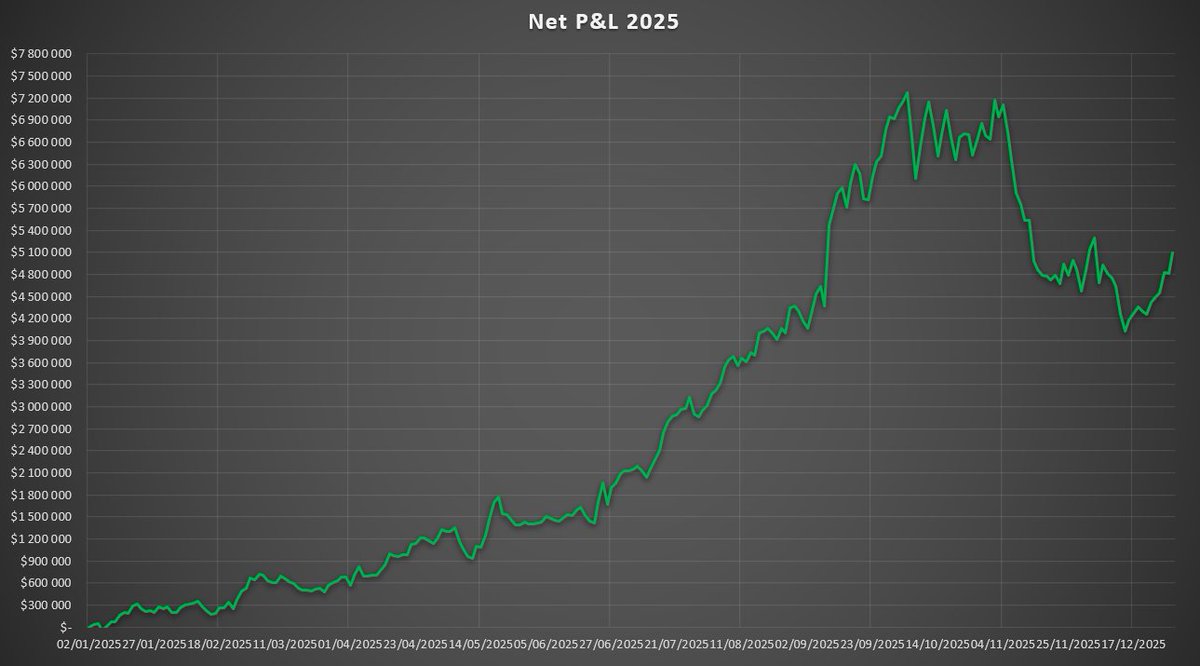
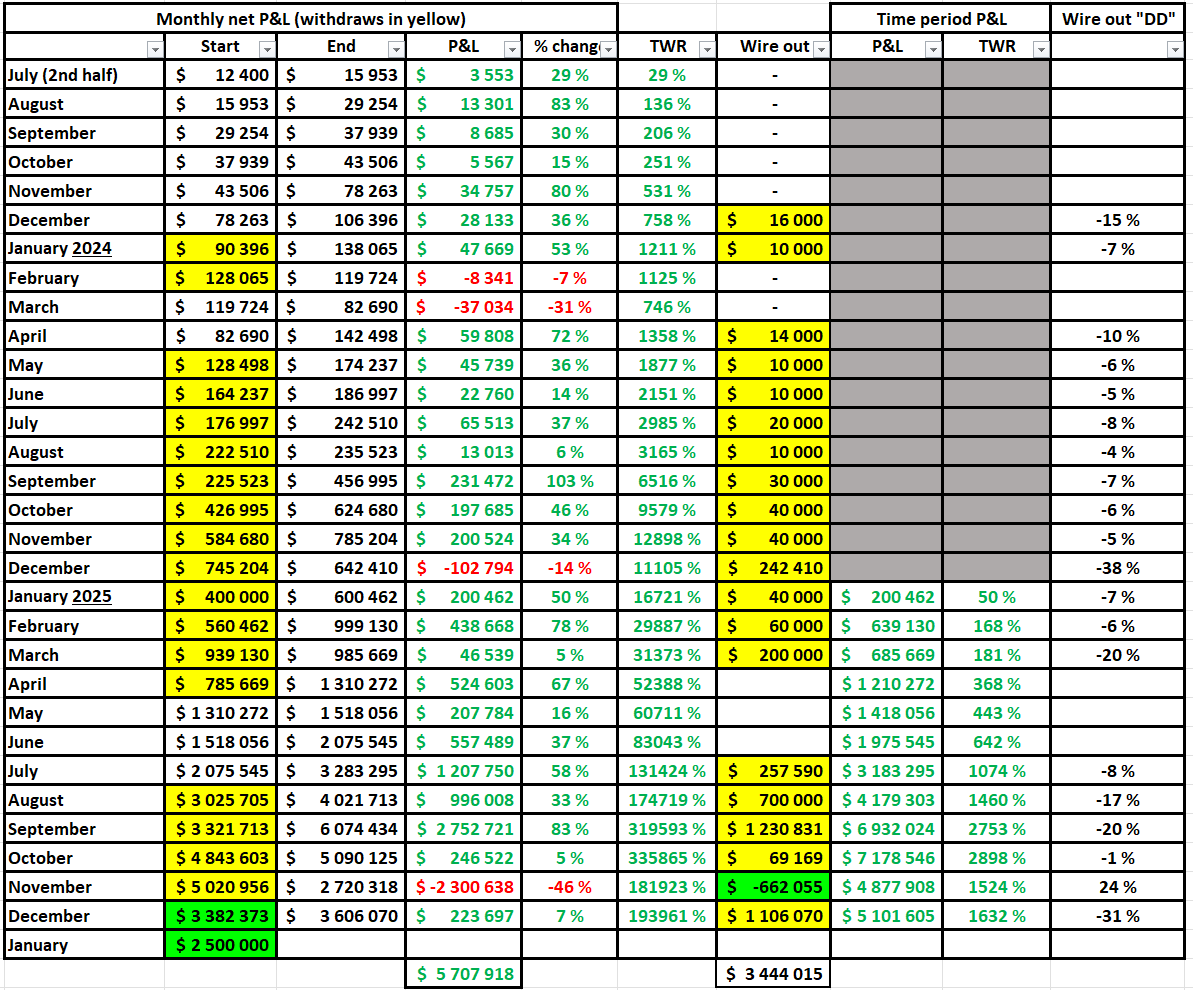
2025 recap / Net P&L +$5,101,605 / +1,632%
Started the year with a 400k account and set two goals:
1) +1000% growth (TWR)
2) $2-5M net profits
Result: Goals achieved 🥳
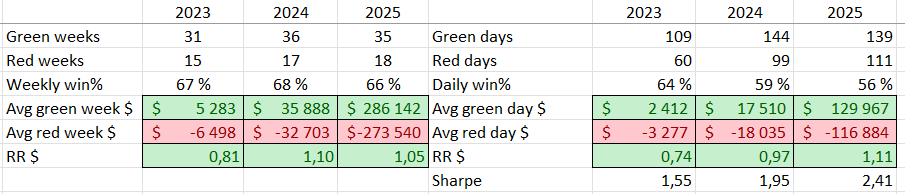
Overall I'm happy with how the year went. Looking back a bit further it was only during the second half of 2023 that I became profitable. And in 2024 I reached 736k/+1,204% growth. 2025 continued nicely on this growth trajectory. The last screenshot clearly demonstrates the scaling up and growth between the years with weekly and daily stats.
My approach ended up being pretty much what I laid out in my 2025 trading goals post https://t.co/0ocVLof2T7 in regards to a "trading factory". System setups, first executed manually and later on automated with algorithms was the backbone of my trading. On top of that I added to the compounding with discretionary short trades in small caps + bigger picture swings.
Automating my system strategies was perhaps the biggest milestones in 2025. I went full size on my algo at the start of July and made in Q3 over 3M profits with the algo. Q4 proved to be more challenging with almost -1M algo losses. Still, making over $2M profits from automated trades in 6 months is something I'm quite happy about. Especially as my one of my goals has been to systematically work towards minimizing my screentime.
On discretionary side I made my first 7 figure trade with $UNH in early September netting +$1,365,000 from that trade alone. Later in the year I made records on the other side losing in November a bit over -$2,200,000. Big part of those losses would've been preventable - I was not in the right mindset there. To quote Druckenmiller on his 3 billion loss "I didn't learn anything. I already knew I wasn't supposed to do that". Overall made a decent amount on the discretionary side also so will continue to do that on the side when there are some A+ opportunities.
Maybe a bit of a side track but few words on compounding and wiring out profits:
On compounding: I'd very much like to see where I could take my account if I didn't wire out anything. Bigger account is tougher to grow with the same % but at the same time it would intrigue me to see what the $ could be. That said my main goal in trading is not to make maximal $ but rather firstly provide for my family and make enough to live the highest quality life possible and only secondly quench my thirst for competition and pushing for maximal growth. Therefore I've continued to wire out quite a lot in 2025 and heading into 2026 I'm wiring out some more so that I'll start 2026 with $2.5M account.
Just to give a rough idea why I ended up wiring out total of roughly $3M in 2025:
- Around 760k for 2025 personal capital gain taxes (LLC taxes to be paid later)
- 300k for down payment of our dream Lakehouse (rest 1.1M loaned)
- 330k to Lakehouse renovation (expect to pay another 300k in 2026)
- 210k investment to an start-up company
- 100k for holidays
- many other "small" expenses like 30k for Porsche Taycan down payment
- last but definitely not least: Cash buffer that is enough for my whole family to live off for the next 4-5 years if needed
- Side note: I'll clarify in 2026 goals post on how I plan to utilize some of the wired out equity for further wealth generation instead of letting it sit in my bank account
I'd definitely be compounding at higher $$$ without such high expenses. But I'm not a young guy anymore. At 37 years with a wife and two young kids I plan to live life to the fullest. It would be a bit different if I was still in my 20's with no kids.
I was going back and forth on if I should make such a big wire out at the end of the year as it severely slows down compounding. But as said my highest priority is the financial security of my family. And with that handled I should be able to execute better as there is pretty much zero pressure to make money. I still think that in 2025 out of everything I posted the post that most described the underlying reason for my increased success was "The less I care the easier it becomes.".
Back to the yearly recap -> Despite the disappointing Q4 performance I am more than happy with the results of 2025. Not only the P&L but also automation of my system setups that freed up time for both things outside of trading as well as for managing discretionary trade opportunities better. I'll soon post more on 2026 plan & goals. For now just wishing Happy and Prosperous New Year to all my fellow traders!
One of the best decisions I made in my career was to stop looking to the market indexes as a barometer of health for breakout stocks and leading names, or even specific industry groups. The big turnaround for me came when I started letting the individual stocks themselves do the talking, and I did the listening.
Whewwwwww what a morning! I'll say this, there's SO MUCH MONEY TO BE MADE FORM TRADING CHOPPY STOCKS LIKE $ASPC $SOPA $ORBS $BNAI $GVH its actually unbelievable if you're prepared and it still blows my mind how narrow-minded too many traders are. Literally every single person reading this should be a millionaire if you studied enough and master the https://t.co/oFda0GUF2y framework. I know, I know it sounds crazy, but there's just so many opportunity, so much volatility, so much liquidity these days, it's the height of all laziness and ignorance not to capitalize. Remember this, retweet this and please take advantage of it allllll aye aye aye
Trader 'madazmoney' traded $CCTG $MTC with a loss of: -$164,577.91, earning the rank 'CHASED' on 2025-11-05. @madaznfootballr See more trades & create your own trades/profit charts! https://t.co/ZNPXvu2nWj
$700M Shorts Wiped Out‼️
Bitcoin and Ethereum surged as $700M in shorts liquidated in just two days, sparking talk of “Uptober.”
BTC hit $120.5K, ETFs saw record inflows, and the market cap topped $4.14T.
Uptober isn’t just hype, it's happening! 💥
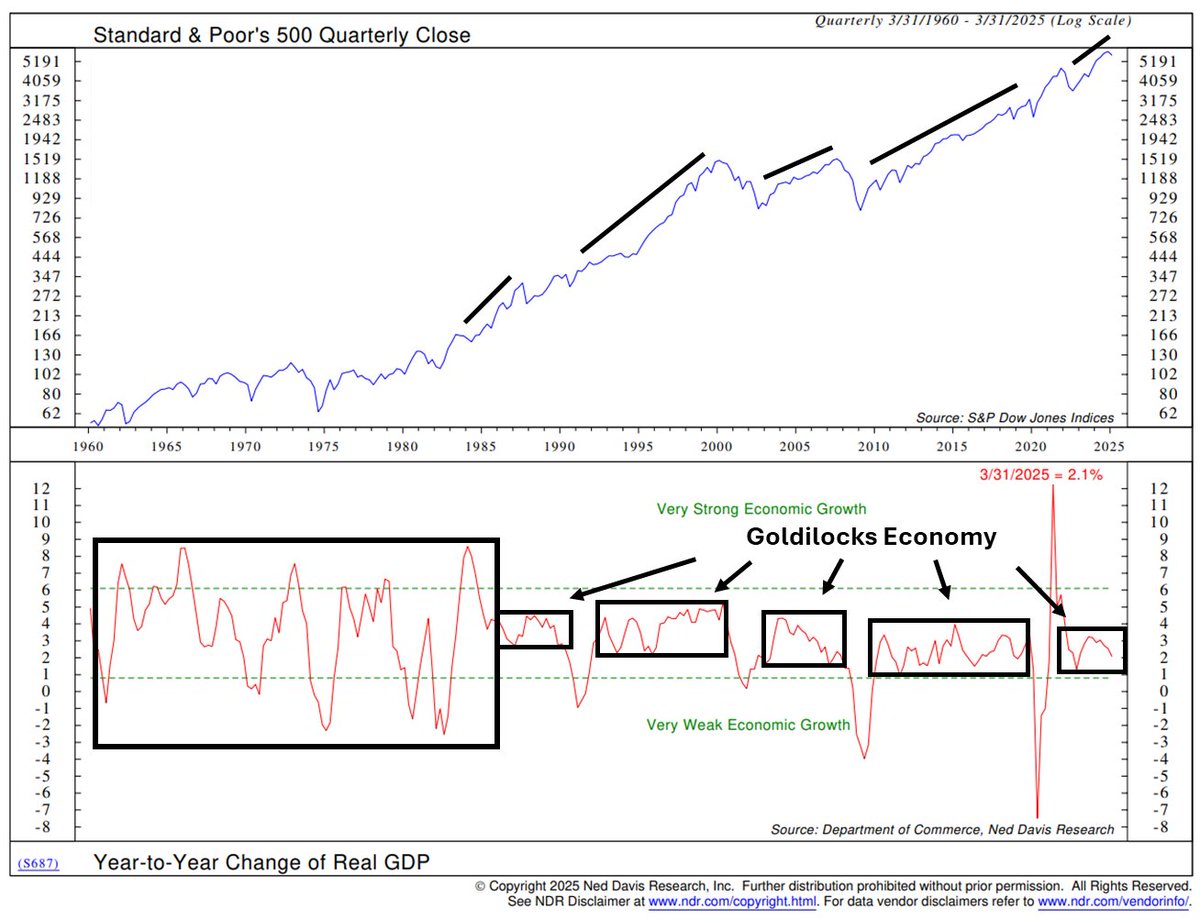
The only data the market truly embraces as bullish is benign data—not too hot, not too cold. Historically, bull markets sustain themselves during moderate, stable economic periods—what we call a Goldilocks Economy.
Strong data → signals no rate cuts.
Weak data → revives recession fears.
Mild, steady data → the “just right” scenario that keeps the market climbing.
In short, the best data for the market is the kind that doesn’t move the needle too far in either direction. https://t.co/JXzFFTmMtn
The market looks poised to breakout to the upside. We already bought $IWN several days ago in anticipation of small cap outperformance. We also added a number of individual stocks longs; making good progress out of the gate. As always, all of our positions have relatively tight stop-losses.
https://t.co/JXzFFTmMtn