Every tool & procedure that I have is based on the observable truths about the market, with logical tests built in.
Everything I do, I can explain WHY.
I exploit specific situations.
Can you say that about your system? Or are you just winging it?
If you want long term success, you need to know WHY you trade the way you do
• Understand how markets function
• Know what information each tool is giving you
• Know why that is actionable
And no, “because ICT said so” isn’t enough.
If you don't understand the logic/theory behind your tools, you're not going to be able to build & refine. You'll just stay stuck.
🪨It's not all that widely known, but Britain has one of the world's biggest tungsten resources.
And tungsten is one of the world's most important metals. Problem is, the mine has been out of action for years.
You may recall our film on this last year👇
Well now, some news...
Lot of people were wondering about $SIVE earnings in 2 days.
What I'm watching out for:
1. I'm hoping for more visibility on photonics co-development/qualifications/contracts.
-> $AAOI stated multiple customers approaching them for CPO lasers (but had to turn them away)
-> $MTSI stated many customers approaching them for CW capacity (but doesn't come online until H2 2027)
So read through for a company serving as $GFS reference laser, $JBL for pluggables (ex. intel siph), to Ayar for CPO.
And in a merchant position:
-> with independent CW DFB supply (with Win semi)
-> CPO-grade lasers.
Is incredibly positive for more customers approaching Sivers.
2. Ongoing developments turning into volume
-> I'm most excited about $JBL, which would probably be the main revenue ramp in H1 2027.
-> $AEVA is likely much smaller in comparison, but should be a contributor H2 2026.
-> Ayar and optical I/O players already stated 2028 for HVM, so not really expecting much there.
-> Co-developments from their other pluggable players (from last ER) turning into qualifications -> volume).
Aside from that:
3. NASDAQ listing
-> We already got timelines for that "next few quarters", so it's not really a focus to narrow that down further. Always nice to get an update.
4. Financials
-> Again, current financials aren't a focus for qualification-cycle players. Just a heads up, there's some one-time accounting this quarter, which affects things optically.
Main thing is volume ramps for future quarters.
-> revenue pipeline increase
-> any early volume contracts signed
Balance sheet concerns should be cleared now given their recent $70m fundraising + bootstrap dilution overhang gone.
Bonus cookies:
-> Any information about allocations secured "eg. we have substantial CW capacity secured -> would be extremely high signal given current shortages.
-> Reiterate demand that AOI, Macom, Lumentum, Coherent stated. "eg. any capacity we get would be filled from demand"
$AAOI had their massive $30 -> $220 rally after they stated like $471M expected capacity in 2027, and reiterated that into revenue guidance. (but then had a lot of ATMs)
An ambitious bull case + full capacity revenue statement for future timelines like H1 2028 for Sivers would be nice, but not expected.
A further re-rating would help for M&A with a Cloud Light type acquisition for revenue acceleration in future earnings.
Obviously Sivers has other volume ramps, but I think photonics is what the market is primarily underwriting.
Regardless, excited for what's up and coming.
Study mathematics to understand physics.
Study physics to understand chemistry.
Study chemistry to understand biology.
Study biology to understand psychology.
Study psychology to understand economics.
Study economics and philosophy to be free :
https://t.co/qXmw13Z8H7
In 1986 a guy got kicked out of every casino in Vegas for counting cards. So he flew to Hong Kong with $180,000 and started betting on horses instead. He walked away with almost $900 million.
It's Bill Benter. He figured horse racing was just another counting problem. Same math, more moving parts.
He and a partner showed up with $180k and a computer. Benter spent years teaching that computer to guess one thing, the real chance each horse had to win. If his number was better than the odds the bookies gave, he bet. If not, he skipped it.
That's the whole trick. Expected value.
EV = p · b − (1 − p)
Only bet when your win chance p, at odds b, is worth more than your chance of losing.
This recording was never meant to be some hidden gem. Nobody expected Professor Tsitsiklis to hand the whole foundation away in 45 minutes, but that's exactly what happens on the board. Students in that room pay over $80,000 a year to sit through it. It's free right here. It's free right here.
Every quant, every professional bettor, every hedge fund analyst started with this exact hour. Benter just watched it and actually did the homework.
Almost nobody knows this lecture even exists. Watch it before it gets taken down.
The answer is in this video.
My most shocking loss ever
I remember like it was yesterday
The start of U.S. bombing of Iraq
Chronology
I was long Crude - about 30,000 barrels
Price broke out of a channel on Jan 14, 1991
Slight down day on Jan 15
Firm close on Jan 16 to close at 30.29
At about dinner we were watching TV when the U.S. began its bombing campaign of Iraq
Price on the curb (dealer to dealer) in London had climbed about $3 to $33 or so when I confidently went to bed in MN
CLASSIC BUY THE RUMOR, SELL THE NEWS
Market opened down $11 from London curb. Did I wait for a rally to lessen the damage. NEVER
I exited at the market. My policy is to never speculate with a loss
I hope you guys had stop losses on AI stocks.
If not, you're probably down a decent amount on $NBIS, $AAOI, $SNDK, and the rest of the industry.
So, here's the strategy I use to ensure I limit downside risk (and maximize upside potential):
----------------------------------------------------------
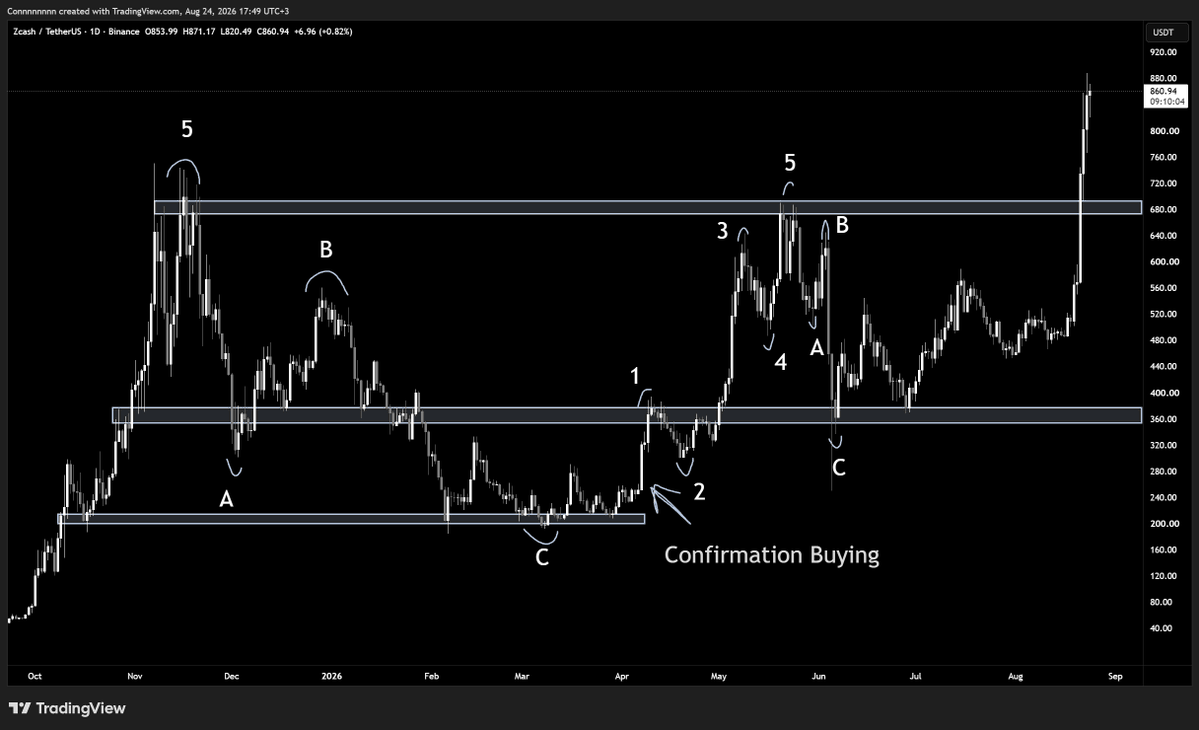
1) Define your strategy (are you a bottom knife catcher, or a confirmation buyer, or sometimes both?)
If you're a "knife catcher" or you try to time the bottom, you can wait for support (on confluence of EWT and Fibonacci levels), and then buy in when there is no confirmation of a leg up happening.
You can have a tight stop loss below the support level, and then wait for confirmation to get back in.
It's riskier, and you have a bit more % gains here (ex below is $ZEC), but you risk 5% for a potential 40% gain.
I'd say AI stocks are at this point in time right now.
Then, there is confirmation buying.
This is what I like to do more often.
You wait for a confirmation in a trend shift (usually claiming and accumulating on support, making a higher high), then I buy.
This is what I did for AI beneficiaries, this is what I did for AI enablers early on, this is what I did for crypto too.
But to fully do this strategy, we must create support/resistance lines.
This goes into my second point.
----------------------------------------------------------
2) Have clear support/resistance lines
To find these zones, we must look for areas where candlesticks have previously formed.
If the previous candlesticks are above the price we are currently at, then it is resistance.
If it is below us, then it is support.
This seems so basic, but this is actually THE most important step.
If you draw the zones in a wrong manner, then you might make a unprofitable trade.
Examples are below (in the previous 2 charts).
But we don't want to be holding stocks when they fall below support.
So, this brings us to point number 3.
----------------------------------------------------------
3) Have clear stop loss numbers
Once we have support/resistance lines, we look at the support, and put a stop loss below it.
I'd put it 5% below the support you buy it at.
That's a great way to give you some "wiggle room" just in case we do a deviation below support.
If that happens, then you get liquidated, and again, you would have to buy on confirmation of a trend accumulation (above support).
But what if the price breaks above resistance? What could be a way to buy in, instantly?
----------------------------------------------------------
4) Have clear buy stop orders
This is great for confirmation trading.
It fills an order above the price you are right now (that you set it to).
You can have a buy stop order above resistance, and if that happens, you probably have a long way of profit still ahead of you.
And again, you can put a stop loss below that new support zone (the previous resistance level).
----------------------------------------------------------
5) Create a plan (and stick to it)
This is for you to figure out.
Test strategies with a small % of your portfolio and do what performs best for you.
I just gave you the frameworks I use (that you can use too).
Now, becoming a profitable trader is up to you.