We all know those journals every young ecologist quietly hopes to publish in one day? For me, one of those journal always was #EcologyLetters - and thanks to an amazing co-author team ( @SKatsanevakis@TeunEverts@TrashTalkRes@SerhanTarkan@DanishAliAhmed and others ), today, that list got a little shorter.
Our new synthesis paper in Ecology Letters looks at what actually happens at the leading edges of biological invasions. These invasion fronts are not just lines on a map. They are dynamic zones where #population densities drop, traits diverge, spatial sorting accelerates, and novel interactions form shaping both how fast species spread and the impacts they cause. Understanding these core-to-front gradients gives us better leverage for predicting, monitoring, and managing invasions before they fully establish and non-native #species spread further.
If this resonates with your work or network, I’d really appreciate you sharing it.
Access the full paper here: https://t.co/98CMcZBYGb
#InvasionBiology #BiologicalInvasions #Ecology #EvolutionaryEcology #EcologyLetters #Conservation #RangeExpansion #EcoEvolutionaryDynamics #InvasiveSpecies #ScienceCommunication
This one is close to my heart.
After experiencing the early-career struggle first-hand for years, I’m incredibly happy to see our work finally published in @Nature Human Behaviour.
https://t.co/f6lMRq1Ale
Our argument: academia may be selecting against exactly what science needs most — creativity, intellectual risk-taking & bold ideas.
Precarity, hypercompetitive funding, peer review, publication costs & metric-driven evaluation increasingly make “playing it safe” the rational career choice for young scientists.
One paper won’t change academia overnight. But we hope it sparks a discussion about the system we’ve built — and whether it actually enables the kind of science we claim to value.
with @ismasoto@TrashTalkRes@TeunEverts and many others!
EarlyCareerResearchers #Academia #AcademicResearch #Science #ScientificResearch #ResearchCulture #AcademicCareers #SciencePolicy #ScientificCreativity #ResearchFunding #HigherEducation #NatureHumanBehaviour #EarlyCareerResearchers #ScientificCreativity
🚀🚀 Just published in #Oikos:
*Interplanetary frontiers: terraforming from an invasion science perspective*
What if making Mars or other planet habitable means deliberately introducing Earth species? We explore this ultimate ecological experiment through the lens of #invasionscience (propagule pressure, boom-bust dynamics, secondary invasions, and the very real risks of unintended ecological surprises...) but on a #planetary scale.
https://t.co/YYexoCIhZo
w/ @TeunEverts@InvasionsPlant@FishInvasionLab@INVASBio@ESAinvasionecol@Invasivesnet@InvasiveSppEco@InvasiveAliens@InvasivesShow
New paper out in *Conservation Biology*.
Biodiversity does not follow political borders — but conservation policy, funding, and data access still do. This mismatch fragments management and weakens conservation outcomes.
https://t.co/kAetBTOXpa
🚨 New paper altert 🚨
New review in BiologicalReviews: The #impacts of biological invasions.
We synthesize nearly a century of evidence across taxa and #ecosystems to clarify what invasion impacts are, how they arise, and why they are so hard to assess.
https://t.co/wciE9PJZiD
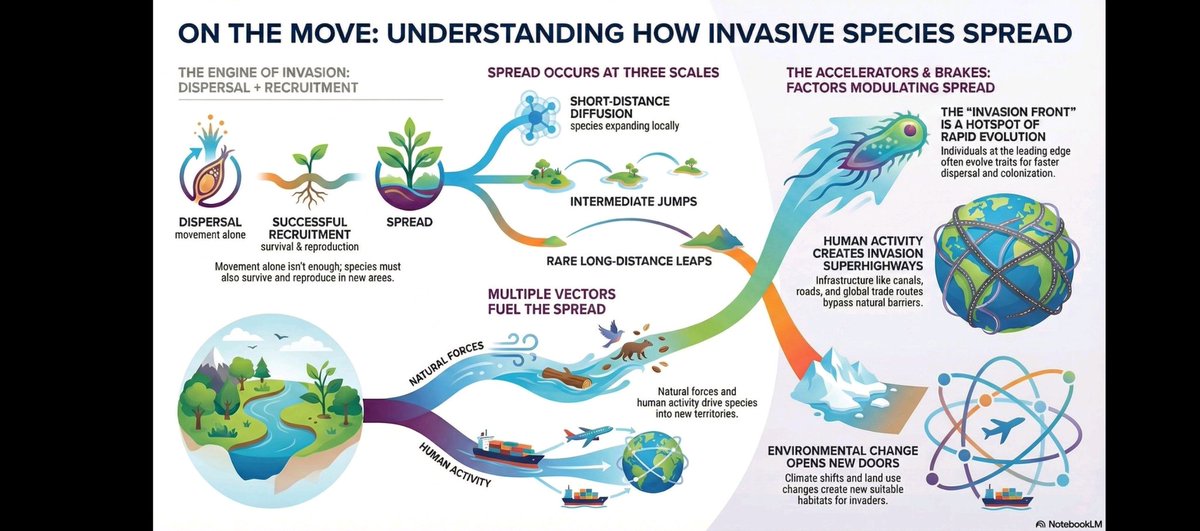
New open-access review in #BiologicalReviews: The spread of #nonnative#species.
While introductions are well studied, spread—the step that turns them into large-scale invasions—has lacked a cross-system synthesis.
https://t.co/cxZBAnYbBc
Invasive nonnative species were among the major threats discussed at the UN Biodiversity Conference COP16. Despite scientific evidence for urgent management, pop media & opinion pages of journals give voice to animal rights ideologues who seek to dismiss concern. Hence, a repost:
20 years after our first paper on microplastic pollution, the accumulated scientific evidence of harm https://t.co/xWiWbFbRUZ is is now echoed in an amazing 6 track album Microplastics @zoeblade