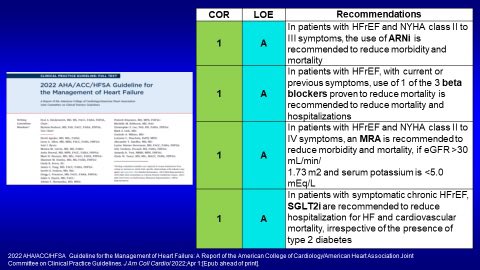
🫀 Quadruple GDMT for HFrEF is one of the great wins in cardiology, yet adoption lags badly 😔
The evidence has been here for years:
🔴 Beta-blocker (1996): ↓35% mortality 🟠 ARNI (2014): ↓28% 🟢 MRA (1999): ↓30% 🟣 SGLT2i (2019): ↓17%
Together: 72.9% RRR, NNT = 4 📉
💔 HFrEF
🧯 Markedly reduce the early window of vulnerability
❤️🩹 Achieve rapid clinical stabilization
🥅 Obtain substantial early ⬇️ in 🏨/☠️
ARNI+BB+MRA+SGLT2i from Day 1
Win-win-win-win
Among older patients 🏨 for HFrEF eligible for GDMT
HF steals as much as 16.3 years of median survival
Quadruple GDMT (ARNI+BB+MRA+SGLT2i) can give years of survival back, but only if prescribed
Worth overcoming therapeutic inertia?
https://t.co/TAbhQL11kH
Evidence to routine clinical practice:
💔 BB ☠️⬇️ evidence since 1996, yet 27% of eligible patients not treated
🤬 MRA ☠️⬇️ evidence since 1999, yet 64% of eligible patients no Rx
🫣 SGLT2i ☠️⬇️ evidence since 2019, yet 66% of eligible patients no Rx
Delay, delay, delay
🆘
The 2022 AHA/ACC/HFSA guidelines are explicit in recommending that patients with HFrEF be treated with each of the 4 classes of foundational, disease-modifying, survival-enhancing GDMT as Step 1 of care, in the absence of contraindications
Cardiometabolic disease does not fit neatly into silos, and our care models should not either.
I am proud that Saint Luke’s Mid America Heart Institute is part of the new CHROME initiative, a national multisite effort launched with the AMCP Research Institute to evaluate how comprehensive cardiometabolic care models work in the real world, including their clinical impact, operational structure, patient and provider experience, and economic value.
This is exactly the kind of work the field needs.
We already know that many evidence-based therapies can improve outcomes in obesity, diabetes, cardiovascular disease, kidney disease, and related conditions. The harder question is how to organize care so the right patients are identified earlier, treatment is started more effectively, multidisciplinary care is sustained, and health systems and payers can realistically support it at scale. CHROME is designed to help answer those questions.
At Saint Luke’s Mid America Heart Institute, through the Michael & Marlys Haverty Cardiometabolic Center of Excellence, we have been committed to building and studying practical care models that improve diagnosis, treatment uptake, and long-term outcomes. Our participation in CHROME reflects that mission and gives us an opportunity to help shape the evidence base for what modern cardiometabolic care should look like.
What makes this initiative especially important is that it goes beyond clinical endpoints alone. CHROME will also examine governance, staffing, referral pathways, treatment protocols, diagnostic workflows, patient experience, provider workflows, payer decision-making, and implementation barriers.
That is where scalable care models either succeed or fail.
I am grateful to partner with AMCP Research Institute, Lilly, Geisinger, and the Patient Advocate Foundation’s Patient Insight Institute on this effort. If we want to close the gap between evidence and execution in cardiometabolic care, this is the kind of work that matters.
https://t.co/tH9aAp2u0g
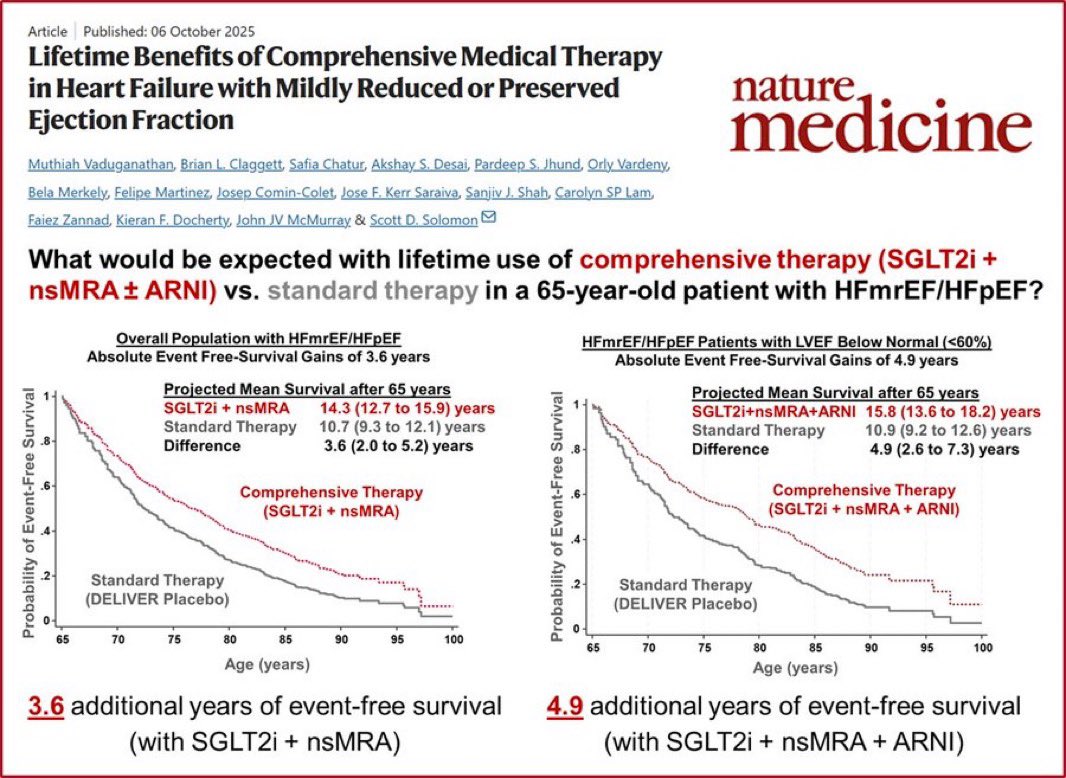
💊🫀 What does optimal therapy actually buy a 65-year-old with HFmrEF/HFpEF?
From Nature Medicine (Vaduganathan et al., 2025):
🔴 SGLT2i + nsMRA → +3.6 years event-free survival
🔴 SGLT2i + nsMRA + ARNI → +4.9 years (LVEF <60%)
vs. standard therapy alone.
Nearly 5 extra years without hospitalization or death.
💡 These drugs exist. They work. Are all eligible patients receiving them?
Vaduganathan et al. Nature Medicine, Oct 2025
@mvaduganathan
#HeartFailure #HFpEF #HFmrEF #SGLT2i #ARNI #Cardiology #MedTwitter #NatureMedicine
Only 9% of eligible HFrEF patients were on quadruple GDMT
The treatment nihilists said it couldn’t be done — “too many meds, too much hassle”
But relentless work through GWTG‑HF has changed this
We’re now at 68.1%
This is what progress looks like💥❤️🩹
https://t.co/tf1QtvH5Rs
Worldwide red alert🚨
HF attributed ☠️ ⤴️⤴️⤴️
Critical to prioritize prevention and improved treatment of HF globally
Effective evidence-based strategies/therapies exist and are guideline recommended, yet massive implementation gaps, variations, and disparities