I had no idea that Brazil has its own central bank-created payments system, used by over 80% of the population, where merchants pay 0.33% per transaction, compared to 1%-4% for Visa / Mastercard / Amex.
If a government can save its businesses a few percent per transaction, and keep the fees in-country, why wouldn't they do it?
300 bond auctions per year. Zero undersubscribed. Ever.
The people warning you about a US bond market collapse are making a basic accounting error.
They are confusing what happens on the secondary market with what happens on the primary market.
On the primary market, banks buy bonds using reserves that were created by the government deficit itself.
The central bank sets the rate on reserves lower than the rate on bonds.
Banks will always swap. It is a mechanical certainty, not a market gamble.
I used double entry bookkeeping tables in Ravel(c) to prove exactly why the doom predictions get this wrong.
For a more comprehensive understanding, refer to the full video presentation given in the comments.
#SteveKeen #BondMarket #USDebt #Economics #DoubleEntryBookkeeping
"A permanent EU-backed bond programme at scale would attract global finance and facilitate a redirection of the bloc’s significant savings export into domestic investments."
This is impossible. Exports are paid for, which means that "savings" increase for the exporter in the form of bank deposits (in whatever currency). Whether the exporter then buys a EU bond does not change the fact that "savings" have increased in the Balance of Payments. Hence, the article is mistaken in assuming that somehow "attracting global finance" is something worth pushing for. The main currency of the EU is the Euro, which can be created by the ECB and the national central banks. Governments of the member states create euros via their NCB when they spend. Banks create promises of payment denominated in euros when they lend. The one thing that is flexible is the exchange rate. It goes up when foreigners buy more EU assets and it goes down when they buy less. When the euro is more expensive, competitiveness goes down and vice versa. So, a priori there is no case for a European "safe asset" based on the arguments put forward. Currently, all national government bonds are safe assets. It might as well stay that way for a long time, given that the electorate currently does not want a United States of Europe. Only when it does, should talk about a European "safe asset" resurface, because that is the context in which it makes sense.
https://t.co/GisD0y8Yfl
Western economists: "We need to do something about housing affordability, because it is beginning to create domestic political problems (aka youth voting socialist)."
Also western economists: "China is screwed bc they got home prices back to 2006 levels without a recession."
🤔
The real issue is not a universal debt/GDP ratio. It is whether a country faces an external constraint. Does it have reserves or does it borrow in foreign currency? The US is not in the same position as some countries in the eurozone or many peripheral economies /3
Senior Scholar L. Randall Wray has been with the Levy Institute since 1992. His pivotal scholarship has played a critical role in developing the framework and insights of Modern Money Theory.
Here we take a look at a small portion of Wray’s influential portfolio.🧵
🇨🇳 "La croissance chinoise ralentit plus vite que ne ralentirait une croissance typique dans le monde, mais la Chine continue de croître à des taux significativement plus élevés que ceux que l'on pourrait attendre"
Ma traduction
👉 https://t.co/j0h09mBDae
It would be strange to assume that somehow higher interest rates can reduce energy prices. The only possible logic would be that in order to fight inflation one would have to kill the economy. But that doesn't work since energy demand is global.
Check out our latest long-form briefing: Zero interest rates seen as not a problem for China, thanks to Abenomics and Bernanke
China's top economists debate fiscal vs. monetary policy
Despite marquee differences in political ideologies, China and the West have much in common when it comes to the social contract that they’ve established with citizens on core matters of economic management.
Like any Western nation, the Chinese government is entrusted with the twin yet conflicting missions of maintaining enough economic growth to provide employment, while at the same time keeping a lid on unchecked price inflation.
The tools that China uses to fulfil these missions are also the same as in other major world economies.
Beijing employs macroeconomic policy - in the form of fiscal policy (government spending and taxation) and monetary policy (interest rates and the money supply) - to regulate levels of growth in both output and prices.
(Read the briefing in full right here: https://t.co/2ROFQA7qiv)
As with other nations, China is similarly host to heated debate between policymakers and pundits on how to best use these tools to achieve the twin macroeconomic mandates of steady growth and stable inflation.
At present, China’s economic opinion-makers have reached significant consensus on the need for expansionary macroeconomic policy and higher deficit levels - given Beijing has made both an explicit part of its development agenda since the end of 2024.
The key area of contention currently concerns whether fiscal policy or monetary policy is the best tool for effectively priming China’s economy.
(Read the briefing in full right here: https://t.co/2ROFQA7qiv)
Sheng Songcheng (盛松成), formerly the head of the Chinese central bank’s statistical office, argues that monetary policy has lost much of its power to move the economy, due to low official interest rates and the ailing profitability of the state-owned banks.
The ex-central bank official believes that fiscal policy - not monetary policy - is the best means for boosting growth at present, as China continues to confront the dilemmas of insufficient domestic demand and unresolved tensions with the West.
In sharp contrast Zhang Bin (张斌), a senior researcher with the China Finance 40 (CF40) Forum and the deputy-head of the World Economy and Political Research Institute at the Chinese Academy of Social Sciences (CASS), argues that fiscal policy is fast losing its effectiveness as the economy matures.
Zhang believes that what the Chinese economy needs most right now is more vigorous rate cuts from the central bank.
He goes as far as to argue that China can cut interest rates to zero without fear of adverse consequences, pointing to what he considers to be the positive experiences of the US Federal Reserve and the Japanese central bank with such extreme monetary policy expedients.
(Read the briefing in full right here: https://t.co/2ROFQA7qiv)
In this briefing:
- Why China shelved its unleashing of monetary policy.
- Fiscal policy seen as only short-term fix for China’s economy.
- How China’s monetary policy supports fiscal policy.
- Could zero interest rates save China’s housing market?
- Fiscal policy in China destined to lose its effectiveness.
- Advances in monetary policy make it the inevitable choice.
- China to follow the historic precedent of advanced economies.
- Bernanke and Abenomics as models for China.
He does not seem to understand that with every extra hour worked, productivity falls. Also, he seems not to grasp that an increase in productivity means that we can afford to work less. His ideas are pure microeconomics with not a hint of macro. They will fail in reality.
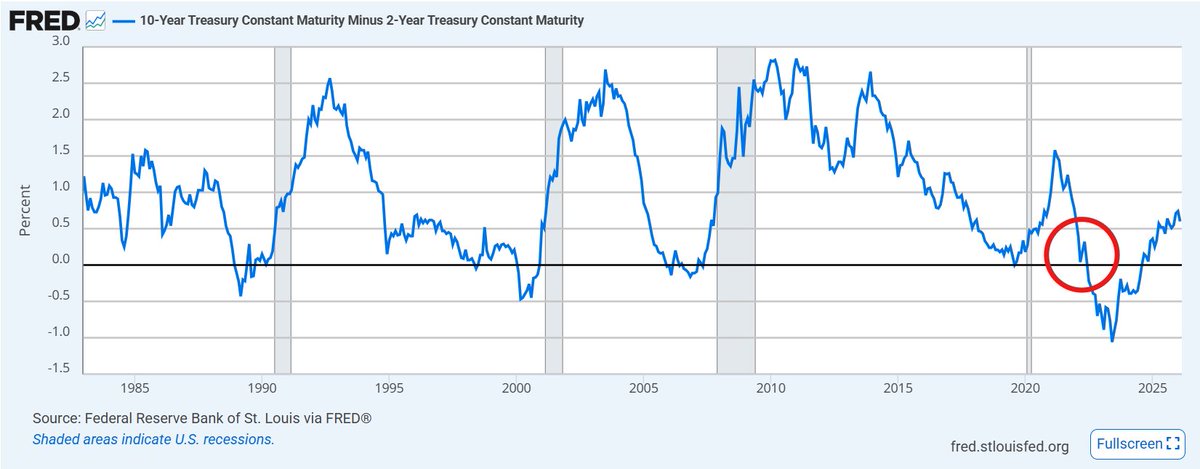
Nearly 4 years since the yield curve inverted and we never got a recession. In fact, 6 months after the inversion we got a historic bull run.
I took so much crap at the time for arguing that MMT understands rates better than the mainstream, but it turned out MMT was right.
Brad Setser says that "China is not dumping US Treasuries". This isn't likely to be nearly as exciting as an article that claims that "China is dumping US Treasuries!", but the math, the data and the reasoning are much better.
https://t.co/8VqciYW2D2 via @ft