@kantan3340@ColeMacro I saw a post suggesting there may be legal issues they can't do this. Even if that is the case, no reason a third party can't mm.
@ColeMacro@Strive You nailed it with the cap comment. It's an easy short. The only way to do what you are doing is to defend a floor, like $97. But that mean less $BTC purchases.
The Clarity Act.
Standards, Strategy and America’s Next Own Goal
Will the US Let China Set the Standards for the New Digital Financial World?
Secretary Bessent has been unambiguous about what is at stake: standards are strategy. In a world where code increasingly substitutes for law, whoever defines the protocols of the next economy will, in effect, write its rules; those who do not will live under someone else’s operating system.
As Bessent puts it, you either set the standards or live under standards set by someone else. The live question is whether Washington is prepared to score another own goal and allow Beijing to set those standards for the emerging digital order. Read through that lens, the Clarity Act looks less like a boutique exercise in financial regulation and more like a statement of national security doctrine. Passing it is, to my mind, a national security decision masquerading as a regulatory one.
The United States has seen this pattern before. A muddled, complacent policy regime allowed critical parts of the semiconductor supply chain to migrate offshore, forcing Washington into emergency industrial policy to claw back capacity. The lesson is simple: cede the standards and you will eventually cede the industry, and with it leverage over its geopolitical use. Digital finance now sits at a similar hinge point.
Bessent’s remarks in New York stripped away any remaining ambiguity. This is not about speculative assets at the periphery of the system; it is about the future of money and the plumbing that carries it. Financial technology is being treated as critical national infrastructure. Digital assets, tokenization, stablecoins and new payment systems are not curiosities, but the rails on which trade, savings and statecraft will run.
The global economy is already drifting toward value being recorded and settled on blockchains. The question is not whether that transition happens, but whose standards mediate it. Does the United States define the protocols and keep its capital markets and the US dollar, at the centre of this new settlement fabric, or does it once again allow the ecosystem and its norms to crystallise elsewhere, particularly in Asia?
Traders still assume the Clarity Act will die in committee. Bitcoin Maxis are fighting amongst themselves. DC keeps delaying, Wall St wants the status Quo.
That complacency is not just naive; it is dangerous. The global economy is moving onto digital rails whether the vested interests in Washington and on Wall Street like it or not.
The choice is stark: either the United States sits at the centre of this new global digital platform, or it reconciles itself to running on rails designed in Beijing or Brussels. Bessent’s argument is brutally simple.
If America intends to remain the reference point for money, markets and standards, it must set the rules of this new system. That means treating digital financial infrastructure as a core national security interest, and passing the Clarity Act as if the strategic balance depended on it, because in time, it will.
STRC is flawed because it was an easy short at $100. They should have had a standing bid at $98 to make shorting less attractive.
- There is $7.85B in STRC at current prices.
- MSTR has $1.4B stated, but probably more if they hit the ATM recently.
- Saylor should work his magic and raise another $2B to buy back STRC and break the shorts
- Keep a standing bid at $98 moving forward.
ofc, I'm just a guy who sells art.
Best post I've seen on this.
Question- Let's assume STR was trading back above par. I've always felt it was an easy short because the only risk is the yield. However, what if MSTR bought STRC back every time it hit 98 (they can buy in the open market per the filing)? It would mean much less cash for BTC buys, but it would be much more sustainable in the long run.
@hwjr284@TrustlessState@BitMNR They discounted it to 80 and sold 350M I believe. The 9.5% is on 100 regardless of market price. Also, they don't sell more over 100 like STRC.
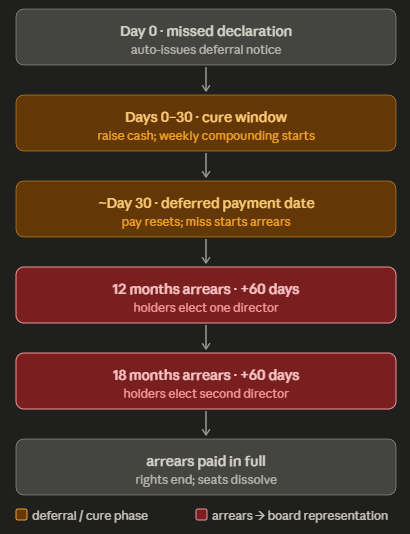
@TrustlessState@BitMNR Here's happens if BitMine misses a weekly dividend and keeps missing it, from the first skip through the second board seat. The amber stages are the deferral/cure phase; the red stages are the arrears phase where holders gain board representation.
@BitMNR BMNP is getting lumped in with STRC. Unless I'm missing something, it's easily payable with staking and option income. If the shit hits the fan, it sits senior to the entire stack.
I was in the first wave of EF layoffs in Summer 2024. Two years in, many emotional phases went by.
Today, I actually think what EF is doing is right. Not comfortable saying. But I believe it.
The EF didn't just train people in protocol design or cryptography. It trained people in how to think, how to imagine what society could be, how to care about decentralization not as a technical property but as a human one. Democracy. Self-organization. Resilience.
Those values don't disappear when a contract ends. People like me who left are still holding the values, still doing the work, just in their own flavors now. That's not failure. That's the design working.
I won't pretend this is painless, and we have to be clear-eyed about the moment we're in. The energy is different now, fewer active builders, harder to ignore the noise around us, and AI is reshaping everything around us. Utopian thinking won't carry us through this. Clear eyes and adaptation will.
What I genuinely hope is that we, as ecosystem builders, keep showing up for each other. Not waiting for a foundation to validate the work. Not chasing the hype cycles. Just builders supporting builders, the ones who stayed with the mission even when it wasn't exciting, the ones still quietly building.
This matters more now than ever. Because decentralization isn't just a protocol property, it's a social one.
A new player enter the game: @SakanaAILabs
Raised $400M and now competes with Fable & Mythos across several benchmarks... what's interesting is that Fugu is not a frontier model, but an orchestration layer.
A model decides which other models should work, how they should collaborate, and how their outputs should be combined.
On one side, you have frontier models doing everything they can to build the smartest models in the world.
On the other, orchestration layers that make use of all these models, get them to work together, and achieve excellent results with far fewer resources.
Cost to stake:
DATs, <$0.1 per eth per year
LSTs, ~ $1 per eth per year
Solos, ~$10 per eth per year
Squads, $10+ per eth per year
Any curve which constricts issuance after ‘enough stake’ is wittingly or unwittingly handing the chain to the centralised orgs. At least some cappers are intellectually honest about it and don’t gaslight.
@d_gusakov@ethereum Agreed. There are so many different unforeseen scenarios and ripple effects. Keep it simple, but have enough incentive for people to stake instead of just holding - kinda like what we have now.