I’m excited to announce the launch of BPCCIR:
Building the Future of Interoceptive Neuroscience
—a new 5-year, $3.5M NIH Blueprint U24 Coordination Center focused on advancing the science of brain–body communication. 1/3
In the 1950s, John Lilly built the first float tank to ask whether consciousness would persist without external stimulation. Seventy years later, using modern questionnaires, we sought to characterize these states.
Our new article, “Aquahenosis: a non-pharmacological altered state of consciousness induced by floatation-REST in individuals with anxiety and depression,” is out now in Neuroscience of Consciousness: https://t.co/XRJnuLbMRz.
We found that in treatment-seeking adults with anxiety and depression, floatation induced a state marked by oceanic boundlessness, disembodiment, and experience of unity, which overlapped experientially with ketamine and low-dose psilocybin on these dimensions. The oceanic quality also played a mechanistic role, significantly mediating improvements in mood.
We call this non-ordinary state of consciousness aquahenosis, or a oneness with water. We argue that floatation-REST deserves attention not just as a clinical tool, but as an elicitor of altered states and a tractable model for understanding their role in therapeutic improvement.
Grateful to @KhalsaLab, Justin Feinstein, @joel_frohlich, and our collaborators at the @LIBR_Tulsa and the @FloatResearch for making this research happen.
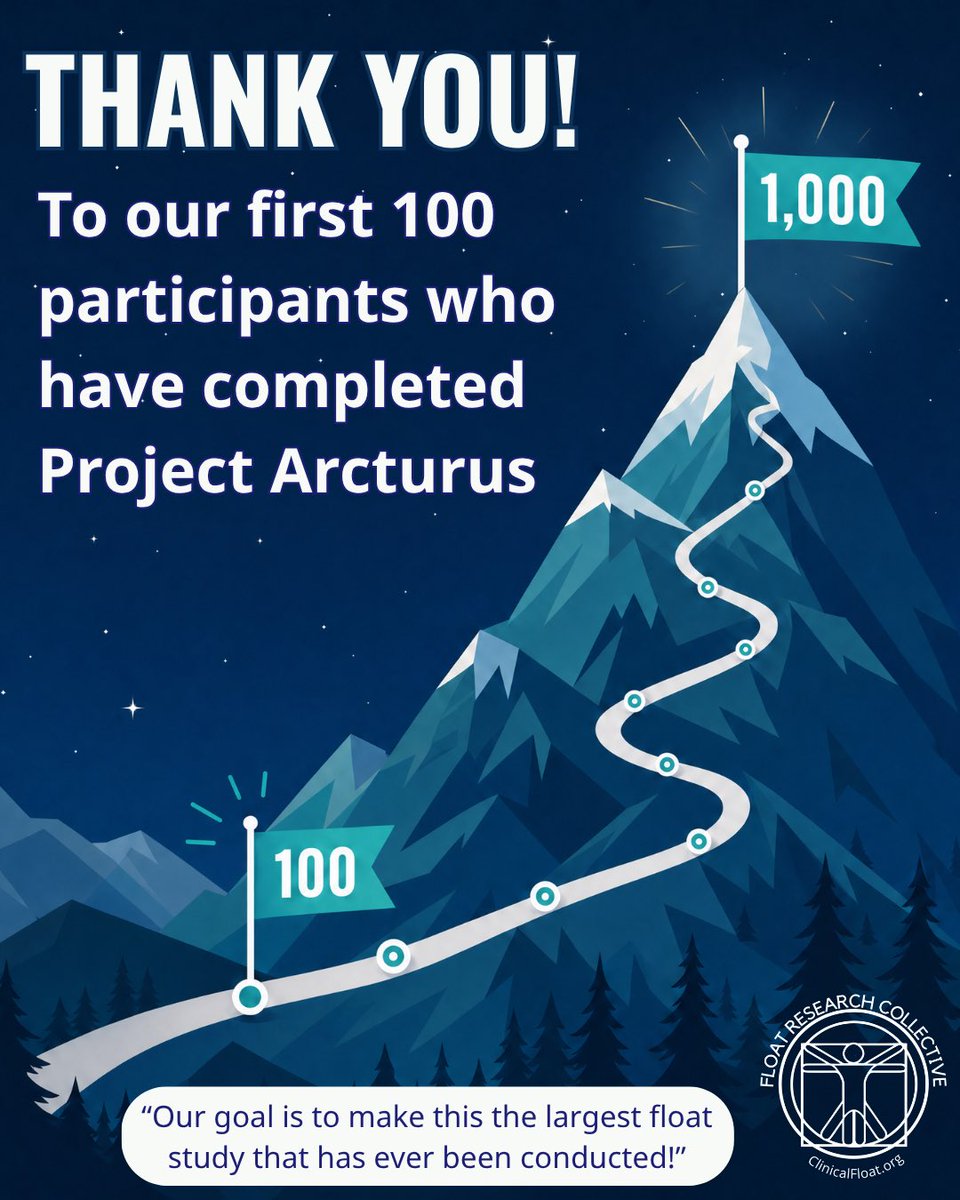
Our international research study launched a month ago across float centers in USA and Canada, and we’re pleased to report that our first 100 participants have completed the study!!!
The first micro-phenomenological study regarding Floatation-REST is out: We assessed the diachronic and synchronic structure of experience related to altered states of consciousness, out of time and self:
https://t.co/wCchUAegdf
I am pleased to announce the Embodied Minds Summit, a two-day gathering on interoception, consciousness, and the future of self-understanding in the age of artificial intelligence. May 2–3, 2026 | Los Angeles
https://t.co/YL66CdNke4
Our Maui Calm float facility is finally ready to be shipped across the world... from Floataway’s factory in the countryside of Norwich, England all the way to the Westside YMCA in Lahaina!
Tuesday, 3.3.2026, at 3.15 pm CET, Dr. Justin Feinstein, President and Director of @FloatResearch Collective gives a talk at the @IGPP_Freiburg. Stop by at the institute or join via zoom by requesting an email link here:
https://t.co/COeVivSh9a
@gothburz The fact that you removed safety from your mission statement speaks volumes to the unethical rot infecting your company and original “nonprofit” mission
Also hot off the press: new evidence of a potential role for float therapy in methamphetamine addiction recovery. While the Scientific American article briefly references this study, the full details can be found here:
https://t.co/UgLasnpNrJ
engineered to be waterproof, saltproof, soundproof, lightproof, and temperature- and humidity-controlled so that both the air and water match the temperature of your skin.
Today marks two years since the devastating wildfires on Maui. While the physical destruction was immediate, the emotional toll is still unfolding, and the latest research reveals that the mental health crisis on Maui is even more severe than anticipated.
3rd birthday of the @IGPP_Freiburg Floatation-REST cabin at Prana built by https://t.co/GCVRT1adUT, supported by @FloatResearch. Our research on ASC resulted in four studies: 1 article, 1 preprint, 2 manuscripts; 2 study grants by @seidel_hanns and @bialfoundation. More to come.