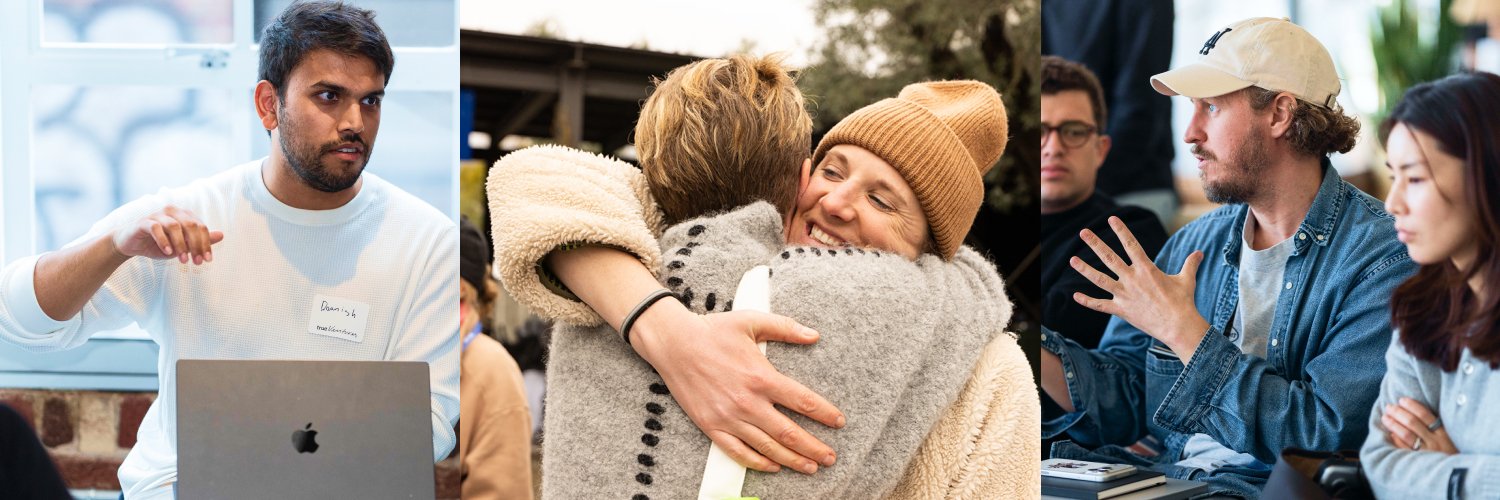
Today, ChatSee announced a $6.5M seed round led by True Ventures, alongside First Rays Venture Partners and Seven Hills Ventures.
https://t.co/8i3PKjRZlQ is building the failure intelligence layer for autonomous AI systems, helping enterprises detect, classify, and learn from agent behavior in production.
As AI agents move from demos into real operating environments, the challenge is no longer just model performance. It’s trust, governance, and knowing how systems behave when no one’s watching.
When we first spent time with Sekhar Sarukkai and Sanjay Agrawal, what stood out wasn’t just their technical depth. It was how clearly they saw the next layer of infrastructure the market would need.
We're proud to be first believers in this team and excited to support their journey. More from @puneet324 on the True Blog: https://t.co/9CCjPtAtGq
Most AI conversations right now are about speed. This one is about judgment.
In a episode of Consumer VC Podcast, @tonysphere talks about what actually matters when building enduring companies: choosing the right partners, resisting inflated early valuations, backing founders over categories, and knowing the difference between momentum and pressure.
From the early days of the web to today’s AI platform shift, Tony shares a grounded perspective on how great companies are really built and what tends to break when things move too fast.
Worth the listen for anyone building right now: https://t.co/MSnaCTR3v7
Years ago, a handful of ICEYE engineers carried an early prototype onto the roof of their office in Finland and asked a simple question:
What if we could see the International Space Station from here?
The experiment sounds almost ridiculous. That's part of what makes it memorable.
Visionary founders and engineers are often willing to run the small, unlikely experiment that everyone else would dismiss. Not because they know it will work, but because they need to find out.
A prototype. A tent. Some scaffolding. A few minutes of orbital cooperation.
Reasonable questions. Unreasonable effort.
From that rooftop experiment, you can draw a straight line to more than 70 SAR satellites now orbiting Earth, helping governments and organizations see what was previously invisible.
Today's €1 billion Series F and €10+ billion valuation is a milestone. But the more interesting story is what it represents: sovereign intelligence from space is becoming critical infrastructure.
True was fortunate to be the first investor in @rmodrzewski, @pekkalaurila, and the @iceye_global team more than a decade ago. We've had a front-row seat to what can happen when builders keep asking "what if?" long after others stop. Read more from Rohit Sharma on the True Blog: https://t.co/cZB5YjxtEo
And congratulations to the entire ICEYE team. Welcome @generalatlantic, TCV, Qatar Investment Authority, and @nokia.
Onward.
Excited to announce Concentrate AI’s $5.1M pre-seed!
Todd Lieberman and I are launching Concentrate AI (the fifth company we've started together).
Most companies are not in control of their AI spend or the data they’re sending to AI.
@concentrateai solves that.
Why are we building it? What problem does it solve? And why now?
Two people. Two very different paths. One shared commitment to pushing the frontier of AI.
This year's Top 100 Women in AI list recognized leaders shaping how AI is researched, built, and applied in the world. We're glad to see two members of the True community among them: @brieski, Chief Scientific Officer at @lifeschemistry, and @kakuls, CEO of @splice.
Hannah brings AI into one of the most complex scientific challenges there is: discovering new medicines from nature.
Kakul helps creators work with AI in ways that expand creativity in music.
The headline is the recognition. The story is the years of work, curiosity, and persistence behind it.
Congratulations to Hannah, Kakul, and everyone recognized on this year's list. 👏🏽
To be first to believe is to see the signal before it is obvious.
@iceye_global 's €1B raise at a €10B valuation is another clear signal from a team that has always known how to find what others couldn’t yet see.
From all of us at @trueventures , congratulations to @rmodrzewski@pekkalaurila and every single ICEYE team member on this milestone.
And most importantly, congratulations on the years of unreasonable effort, technical courage, and absolute conviction it took to get here.
Leading a new era of sovereign intelligence from space.
ICEYE Series F funding round exceeds €1B, led by @generalatlantic, at a valuation of over €10B.
Read more: https://t.co/vwoeEY9euM
Startups rarely move in a straight line. Over a 10+ year journey, there are moments that test everything: the product, the market, the team, and the belief behind it all.
That's why we keep coming back to a different question early on: why this, and why this particular founder?
Because purpose has a way of showing up everywhere. In culture. In resilience. In the decisions made when the obvious path stops working.
@puneet324 shared this perspective recently at @StartupGrind Conference: the founders who endure often have something deeper driving them than the outcome alone.
Special thanks to the team at Startup Grind for bringing together a thoughtful conversation around what actually matters in the earliest days of building.
We’re back.
Connected Stack 2026.
The builders, backers, and buyers defining the future of enterprise AI.
One room. September 10. San Francisco.
Watch last year’s recap and register early: https://t.co/zJdx3oRhMB
One of the most challenging parts of AI adoption at scale is moving together as a team as new models and tools roll out daily.
At True's AI Workflow Summit, @kevinrose shared a challenge many leaders are navigating right now: how do you bring engineering teams along when what they've spent years mastering is being completely rewritten?
The pace of change is unlike anything we've seen before. A model someone tested three months ago bears little resemblance to what's out there today. But adoption doesn't happen because a new tool exists. It happens when people have the space, context, and the confidence to learn.
The future belongs to teams that can keep learning together.
AI is making it easier to build. It’s also making it harder to know what actually moves the needle.
Right now, founders and builders aren’t just testing tools. They’re reinventing workflows, teams, communication norms, and the way work itself gets done.
That’s why we’re bringing the AI Workflow Summit to San Francisco on June 17.
This is not a day of keynotes. This is laptops open and live demos.
The conversations look more like:
→ What exactly did you build and how?
→ Does it really work? What broke?
→ Where is the human? In the loop or on the edge?
→ What’s helping your team move faster today?
If you're curious and building, we’d love to have you in the room.
June 17 | San Francisco
Request an invite at https://t.co/dEwhPJpRO8
It's referral-based, so drop in the name of a True founder or team member who referred you when applying.
Most breakthrough companies start before there's enough data to make everyone comfortable.
At the earliest stages, we're not looking for perfect metrics. We're looking for signals: relentlessness, speed, curiosity, and a clear point of view about where the world might be headed.
Building something new rarely starts with certainty. It starts with a founder who's willing to tinker, learn fast, and keep going when the path isn't obvious.
That's been true for 20 years. And it's still what we look for today.
The playbook changed faster than the company.
For Gather, the product was working. The challenge was getting it in front of the right people.
So instead of following a traditional SaaS go-to-market motion, @mayankm and his team built their own AI-powered growth engine in a weekend: one that researches prospects, writes personalized outreach, tests messaging, and continuously improves itself.
The result wasn't just more meetings. It was a reminder of what's possible when founders use AI to rethink the systems around the product, not just the product itself.
A project that once would've required a dedicated team became a two-day experiment with a meaningful impact on growth. And because great ideas accelerate when they're shared, the team open-sourced it.
Sometimes the biggest unlock isn't building something new. It's rebuilding the way you work. 🚀
Thanks again to @YourProtagonist for welcoming our own Puneet Agarwal of team True and Mayank to the Fund/Build/Scale podcast.
"If you have a software product you want to build, it will build it, it will suggest things, it will pivot, it will keep on trying until it gets it right"
Brian, founder building with Polsia
Most AI conversations right now are about speed. This one is about judgment.
In a new podcast conversation, @tonysphere talks about what actually matters when building enduring companies: choosing the right partners, resisting inflated early valuations, backing founders over categories, and knowing the difference between momentum and pressure.
A moment we keep coming back to:
— “Consumer may go in and out of favor with investors, but it never goes out of favor with consumers.”
From the early days of the web to today’s AI platform shift, Tony shares a grounded perspective on how great companies are really built.
Worth the listen for anyone building right now. 🎧 https://t.co/B2OAR4wXgj
“There are two emotions a venture capitalist can project onto a founder: fear or safety,” shares Puneet Agarwal, partner at True Ventures.
Startups are built in uncertainty. Founders are constantly making decisions with imperfect information, taking risks, and pushing forward without guarantees.
And according to Puneet, the emotional environment around them matters more than most people realize, especially right now as teams build, ship, and iterate their products and workflows at the most rapid pace we've seen.
Fear creates paralysis:
second-guessing, hesitation, risk aversion.
Safety creates space:
for creativity, conviction, experimentation, and growth.
The most important technology shifts don’t feel incremental. They open up entirely new ways to experience the world.
@DShankar, founder and CEO of @BigscreenVR, shares what drew him into VR in its earliest days: not improving what already existed, but exploring something fundamentally new.
From reliving memories instead of simply viewing them, to building products that create entirely new forms of presence and connection, his vision for VR goes far beyond screens and entertainment.
And when it comes to AI, his advice for founders is grounded:
The advantage won’t come from using the most new tools.
It’ll come from using them to solve meaningful problems for real people.