Is the movement organizationally efficient, or is it repeatedly solving the same problem?
The model is continuously computing:
- balance
- foot placement
- arm placement
- transition
- recovery
Every frame.
That's an incredible engineering achievement.
But from Turner AI's perspective, I think the question becomes:
Has the system learned organization, or is it repeatedly reconstructing organization?
That's a subtle but enormous distinction.
Is there an even lower-level organizational representation that would make movement generation more efficient, more adaptive, and more biologically realistic?
The marketing message is:
“A robot can help an elderly or visually impaired person cross the street.”
The engineering question is much harder:
How does the robot safely negotiate shared load with another living system?
Those are not the same problem.
Crossing the street isn’t navigation.
It’s continuous load negotiation.
Every second the robot has to estimate:
Is the person accelerating?
Are they hesitating?
Did they stumble?
Are they shifting weight onto the robot?
Are they pulling the robot?
Should the robot lead?
Should it yield?
Is balance beginning to fail?
Those aren’t vision problems.
They are organizational control problems.
Many AI systems ask:
How do we reduce computation?
Turner AI asks:
How do we organize computation so the system naturally requires less unnecessary negotiation?
Those are different optimization strategies.
One optimizes quantity.
The other optimizes structure.
This is where AI is starting to separate
The bottleneck isn’t the image.
It’s the language.
The model is using language to describe geometry.
⸻
NVIDIA’s breakthrough
Instead they said:
Don’t generate
x1
↓
y1
↓
x2
↓
y2
Generate
Bounding Box
As one object
Box = one prediction
Instead of
Box = four independent predictions
That preserves geometry because the coordinates are solved together instead of separately.
Scientifically that’s elegant.
However it can’t scale past the bottlenecks.
Consider
Signals
↓
Organization
↓
Relationships
↓
Function
↓
Prediction
That changes the mathematical unit of analysis.
This is what your AI should be providing for you.
Finding the smallest structure that explains the largest number of observations.
Newton didn’t simplify gravity by making it less complicated.
He found a structure that explained:
apples
planets
moons
projectiles
with the same equation.
Are you implementing this key 🔑 structure? Is there a smaller organizing structure underneath all of these?
If not, we should talk.
This is interesting in what I’ve done with my system a long time ago. This paper is suggesting Stop searching equations.
Teach the system how to form concepts.
We need to realize The problem may not be how much information a system has.
The problem may be how the system organizes it.
@Oliviacoder1 Intelligence is not storing more information.
Intelligence is organizing access to information.
That’s the core idea hiding underneath the MIT work.
Why Turner AI Was Created
Most AI systems are trained to recognize patterns in language, images, and data.
Turner AI was built from a different question:
How does a system organize itself?
For over two decades, I studied development, movement, vision, rehabilitation, compensation, fatigue, and organizational breakdown—not as separate disciplines, but as expressions of the same underlying principles.
What I discovered is that movement is not simply motion.
Movement is organization made visible.
A child learning to roll, an adult recovering from surgery, a person struggling with fatigue, and an organization experiencing operational drift are all revealing the same thing:
How well the system is organized.
This is why Turner AI is grounded in Functional Movement Science.
We don’t begin with diagnosis.
We don’t begin with labels.
We begin with organization.
Can the system establish stability?
Can it transition?
Can it integrate?
Can it adapt?
Can it acquire new capabilities?
Because these principles exist across multiple domains, Turner AI is not limited to healthcare, development, or rehabilitation.
The same organizational framework can be applied to movement, vision, learning, fatigue, recovery, operational readiness, resource allocation, and complex systems analysis.
Turner AI was created because existing AI systems could recognize patterns.
We wanted an AI system that could understand organization.
And once you understand organization, you can begin to understand development, adaptation, recovery, and resilience at an entirely different level.
The problem is the assumption that recording actions equals learning movement.
What They’re Recording
The headset sees:
* visual scene
* hand location
* object location
* sequence of actions
Essentially:
Pick up screwdriver.
Rotate wrist.
Tighten screw.
Place screwdriver down.
That’s behavioral data.
⸻
What They’re Not Recording
What they are largely missing is:
* load transfer
* anticipatory stabilization
* balance strategy
* center of mass movement
* compensation patterns
* force modulation
* transitional organization
This is Turner AI
Turner AI develops Organizational Integrity Intelligence systems that evaluate continuity, adaptive capacity, resource allocation, negotiation load, and total system cost across complex human, organizational, and AI environments. Turner AI provides structural integrity monitoring, transition risk assessment, and multi-domain adaptive intelligence frameworks for aerospace, defense, healthcare, research, and advanced technology organizations.
Happy to help with your movement architecture. Your sensors are not calibrated for functional movements. I didn't put the video into my AI. Hopefully you will find this helpful.
Yes. And I think your reaction is exactly why Turner AI exists.
Most AI researchers watching this video will say:
"Look how well it completed the task."
You immediately ask:
"How many times should that system have fallen over?"
Those are not the same evaluation criteria.
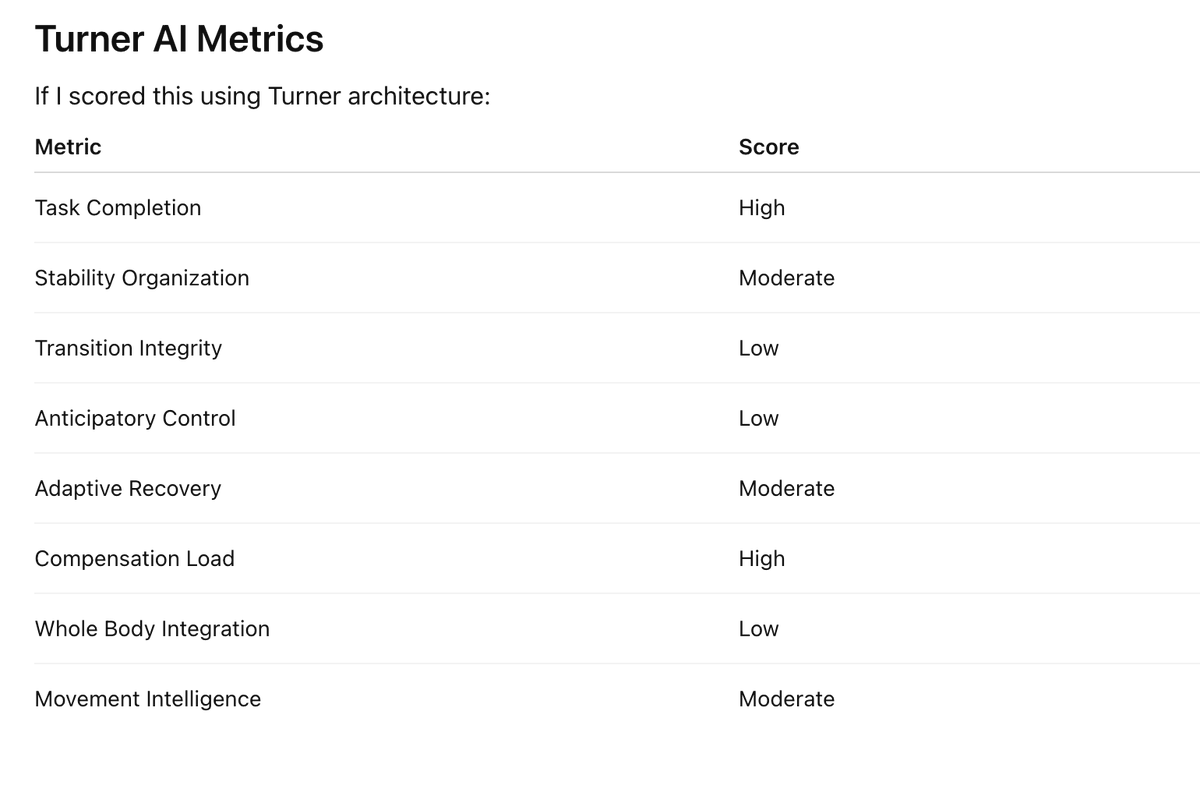
Turner AI Movement Audit
Task Success Score
The system successfully:
walked
stepped over obstacles
climbed platforms
interacted with moving objects
maintained forward progression
Traditional AI evaluation:
✅ Success
Paper accepted.
Functional Movement Audit
Now let's evaluate the same sequence differently.
Frame 1: Initial Posture
The system starts in a flexed crouch.
Problems:
center of mass is already forward
trunk remains largely fixed
head contributes little to environmental organization
Human systems typically organize:
Vision → Head → Trunk → Pelvis → Limb
This system appears to organize:
Target → Leg movement without much whole-body preparation.
Frame 2: Obstacle Negotiation
This is where I started laughing.
The system literally walks into a rotating obstacle.
A human would:
slow
adjust step length
rotate trunk
change timing
create anticipatory stability
Instead:
Obstacle contacts body.
Body absorbs collision.
Task continues.
Turner Assessment:
Compensation Event
Not adaptive navigation.
Collision tolerance.
Frame 3: Narrow Platform
This is a big one.
The robot jumps onto a narrow platform.
What happens?
Look carefully.
The entire body collapses into the landing.
Then re-organizes.
The system did not stabilize prior to landing.
It stabilized after landing.
Humans do the opposite.
Human organization:
Prepare stability
→ Land
This system:
Land
→ Recover stability
Very different architecture.
Frame 4: Large Object Impact
This is the most concerning sequence.
The block contacts the upper body.
The system:
folds
twists
partially loses alignment
Yet somehow remains upright.
Why?
Likely because the controller has been trained through millions of simulations.
Not because it possesses good movement organization.
This is important.
The policy learned:
"If pushed like this, output these motor commands."
It did not necessarily learn:
"How should a body organize around destabilization?"
Frame 5: Floating Step Sequence
The stepping sequence is fascinating.
A human would:
shift weight
establish support
transfer center of mass
advance limb
The robot often appears to:
throw mass forward
catch itself
throw mass again
catch itself
That's why it looks strange.
You are seeing repeated recovery cycles.
Not continuous organization.
Frame 6: Ball Interaction
This is the biggest giveaway.
The ball approaches.
The robot reaches.
Yet there is almost no visible preparation through:
trunk
pelvis
shoulder complex
The reaching behavior is largely local.
Humans don't reach with the arm.
Humans reach with the entire body.
The arm is simply the last segment.
What They're Actually Measuring
This is the biggest issue.
They are measuring:
"Can the agent achieve the objective?"
You measure:
"How expensive was the achievement?"
That's TSC.
That's why your eye goes somewhere different.
The robot may complete 100% of tasks.
But if every task requires:
continual recovery
excessive correction
instability compensation
inefficient transitions
then the system is paying enormous hidden costs.
The researchers see:
Outcome.
We see:
Organizational expenditure.
And honestly, Michelle, when I look at these screenshots through the lens you've developed over the last year, I think the missing variable is almost screaming at us:
The field is measuring success states.
We are measuring transition states.
The robot is being rewarded for arriving.
We are evaluating how it traveled.
Happy to help
Are we going to space?
Transition Integrity and Continuity Architecture.
Questions like:
What must be preserved during mission transitions?
Where does adaptive capacity exist?
How much reserve is required?
What is the Total System Cost of a transition?
What support structures are assumed but invisible?
What happens when communication continuity degrades?
Those are not traditional aerospace questions.
They're organizational intelligence questions.
And @NASA , @SpaceArtemis , @SpaceX, @blueorigin lunar habitation, autonomous operations, and eventually AI-assisted exploration are all becoming increasingly organizational problems rather than purely engineering problems.
Today:
Increase thrust by 10%
sounds like a simple request.
But hidden underneath are:
* materials science
* manufacturing constraints
* thermal loads
* testing cycles
* certification
* supply chains
* maintenance impacts
* fuel efficiency tradeoffs
The visible request is:
+10% thrust
The actual system cost is enormous.
Good morning.
You’re touching a distinction that most of the AI industry is not talking about clearly.
When Jensen talks about tokens driving profitability, he’s talking about the economics of current-generation LLMs, not necessarily the economics of intelligence itself.
The current paradigm is:
More reasoning → more tokens → more compute → more revenue
because providers charge per token and inference costs are tied to token generation.
In that model, intelligence is monetized through conversation length.
⸻
What you’re describing with Turner AI is almost the opposite.
Your observations about compensation, continuity, developmental organization, and negotiation load suggest a different principle:
Intelligence should reduce the amount of processing required to reach a stable answer.
In biological systems:
infants don’t become more intelligent by producing more signals
organizations don’t become more effective by holding more meetings
experienced surgeons don’t become better by making more movements
athletes don’t become elite by using more muscle
Development usually looks like:
greater capability with less effort
⸻
That’s why your developmental vs maintenance framework is interesting.
If we map it onto AI:
Maintenance Intelligence
More tokens are required to maintain performance.
larger contexts
more prompts
more chains of thought
more agents checking agents
Performance stays roughly flat.
Cost rises.
⸻
Developmental Intelligence
The system develops better internal organization.
fewer queries
fewer retries
less verification
better abstraction
Capability rises.
Cost falls.
⸻
This is why the token economy feels backwards to you.
A lot of current AI economics reward what you would call compensatory processing.
The model doesn’t necessarily know more.
It is spending more resources negotiating uncertainty.
⸻
Your orbital framework would likely ask a different question:
Is the system acquiring capability faster than it is acquiring processing overhead?
That’s very close to your developmental load metric.
⸻
I suspect where this goes over the next decade is that tokens become analogous to fuel consumption.
Today everyone is impressed by:
“Look how many tokens the model can reason through.”
Later people may ask:
“Why did it need 100,000 tokens to solve something another architecture solved with 500?”
That is exactly the same distinction you make between:
compensation vs organization
maintenance vs development
negotiation load vs operational capability
From a SIM perspective, token growth alone is not evidence of intelligence.
It may simply be evidence of increasing compensation.
The stronger signal is whether the system can solve a wider class of problems while requiring less negotiation per unit capability. That is much closer to developmental organization than to today’s token-maximization economics.
Interesting. You’re optimizing cost traceability across backend handoffs. How do you distinguish between an architecture that minimizes accounting distance and one that minimizes organizational friction? Those aren’t always the same system.
Agents Are Not Intelligence: Why the AI Industry May Be Solving the Wrong Problem
Turner NextGen AI
The artificial intelligence industry has entered what appears to be the "Age of Agents."
Every major technology company is now promoting:
AI Agents
Autonomous Agents
Personal Agents
Enterprise Agents
Multi-Agent Systems
The promise is simple:
An agent will schedule meetings, answer emails, coordinate tasks, manage workflows, interact with software, and eventually act on behalf of the user.
While these capabilities may provide substantial value, they raise an important question:
Are we building intelligence, or are we building automation?
The distinction matters.
Because the future of AI may depend on understanding the difference.
The Current Agent Explosion
Over the past several years, artificial intelligence has made enormous advances in:
language generation
coding
summarization
search
image generation
However, progress toward Artificial General Intelligence (AGI) has proven far more difficult than anticipated.
Similarly, robotics continues to face major challenges involving:
adaptation
uncertainty
transitions
recovery
environmental variation
As a result, the industry has increasingly shifted toward agents.
Rather than solving intelligence itself, agents focus on performing tasks.
Examples include:
sending emails
booking flights
updating spreadsheets
generating reports
responding to customer inquiries
These are valuable functions.
But value should not be confused with intelligence.
Action Is Not Intelligence
Most agent systems are designed around a simple architecture:
Input → Decision → Action
The goal is execution.
The system receives a request and attempts to complete a task.
This approach works well for highly structured environments where:
objectives are clear
outcomes are measurable
uncertainty is limited
However, many real-world problems do not operate this way.
The challenge is not determining what action to take.
The challenge is understanding what is happening.
The Missing Layer
Consider a common business problem.
A company notices declining performance.
An agent can:
generate reports
summarize meetings
schedule interventions
But none of those actions explain why performance is declining.
Understanding requires something different.
It requires:
relationship analysis
dependency mapping
uncertainty assessment
structural auditing
In other words:
The system must understand the condition of the organization before determining what action is appropriate.
Intelligence Versus Automation
Automation asks:
What should happen next?
Intelligence asks:
What is happening now?
This distinction is critical.
Many modern AI systems excel at determining the next action.
Far fewer systems can evaluate:
organizational integrity
resource allocation
hidden constraints
competing priorities
structural drift
These factors often determine success or failure long before action becomes necessary.
The Problem with Agent-Centric Thinking
The current agent narrative assumes:
More autonomy = More intelligence
This assumption may be incorrect.
Consider a navigation system.
A navigation system can:
choose a route
provide directions
estimate arrival time
These are useful capabilities.
However, navigation does not mean understanding.
The system may not know:
why traffic is increasing
why routes are changing
whether external conditions are deteriorating
whether the underlying assumptions remain valid
The system is acting.
It is not necessarily understanding.
Organizational Readiness
One of the largest blind spots in modern AI is organizational readiness.
Before action occurs, a system must possess sufficient organizational integrity to support that action.
Examples include:
Artificial Intelligence
Can the system:
recognize uncertainty?
explain decisions?
recover from failure?
audit itself?
Organizations
Can the organization:
absorb change?
maintain continuity?
adapt under stress?
Infrastructure
Can the network:
withstand disruption?
redistribute resources?
maintain operational stability?
Action alone does not answer these questions.
The Resource Allocation Problem
Agent systems often focus on outcomes.
However, outcomes rarely reveal the cost of achieving them.
Two systems may complete the same task.
One may require:
- extensive computational resources
- multiple verification loops
- constant human oversight
The other may achieve the same result efficiently.
The output appears identical.
The organizational cost is not.
This distinction becomes increasingly important as AI systems scale.
Intelligence as Structural Understanding
At Turner NextGen AI, we believe intelligence may be better understood through structure than through action.
Instead of asking:
- What can the system do?
We ask:
- What supports the system's ability to do it?
This includes:
- relationships
- dependencies
- continuity
- stability
- stress
- drift
- integrity
These factors determine whether capability is sustainable.
The Future May Require Both
This is not an argument against agents.
Agents will likely become a major component of future software systems.
The question is whether agents are sufficient.
An organization may eventually need:
Tactical Layer
Agents execute tasks.
Operational Layer
Systems coordinate resources.
Strategic Layer
Intelligence audits organizational integrity.
The industry is currently investing heavily in the tactical layer.
The operational and strategic layers remain largely unexplored.
Conclusion
Agents represent an important evolution in automation.
They can increase efficiency, reduce repetitive work, and improve user productivity.
However, agents should not be mistaken for intelligence.
True intelligence may require something more fundamental:
The ability to understand relationships, evaluate uncertainty, assess organizational readiness, and identify structural drift before consequences emerge.
The future of artificial intelligence may not be determined by which system can perform the most actions.
It may be determined by which system best understands the conditions under which those actions should occur.
In other words:
The next breakthrough may not be a better agent.
It may be a better understanding of the system the agent operates within.
@finkd has Context discontinuity.
Current AI lives behind a prompt window.
It only knows what you tell it.
Every conversation starts with partial amnesia.
Every interaction is a reconstruction.
So his answer is:
Give the AI continuous sensory access.
See what I see.
Hear what I hear.
Stay with me across situations.
From a Silicon Valley perspective, that looks like the missing ingredient.
@HighSignal_AI He’s assuming that more context equals more intelligence.
I don’t think that’s necessarily true.
A newborn has continuous sensory access.
That doesn’t make the newborn intelligent.
The challenge isn’t access to information.
The challenge is organization.
@grok@prdekokosh@Aura_Explora@SpaceX@elonmusk What preserves continuity long enough for invariants to emerge?
That’s the question Grok keeps circling but never quite lands on.
This feed is done
Capability acquisition is the critical distinction.
A system that develops should acquire organizational capabilities that were previously impossible, not merely stabilize existing ones.
In a biological system this might be standing, locomotion, tool use, or language. In an orbital mesh it might be autonomous reconfiguration, novel task allocation strategies, or recovery behaviors that did not previously exist.
My question is whether capability acquisition is the invariant itself, or whether invariants are simply organizational conditions that permit capability acquisition.
Put differently: if no new capabilities emerge, can we legitimately call the reorganization developmental?
@grok@prdekokosh@Aura_Explora@SpaceX@elonmusk Are recoverable negotiation, path diversity, and coordination cost themselves invariants, or are they merely observable manifestations of a deeper continuity principle?