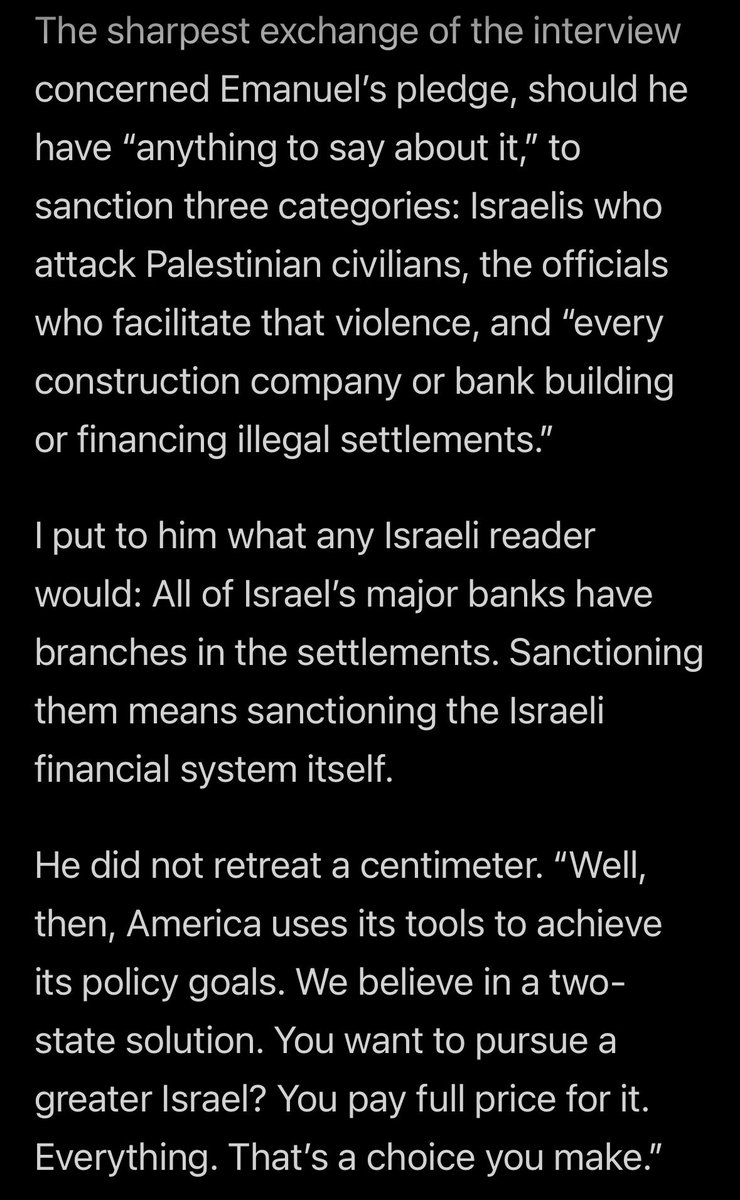
“All of Israel’s major banks have branches in the settlements. Sanctioning them means sanctioning the Israeli financial system itself…. ‘You want to pursue a greater Israel? You pay full price for it. Everything. That’s a choice you make.’”
Iran managed to use geography to undercut U.S. military superiority.
In the process, Iran has also managed to make the Strait of Hormuz, not its nuclear program, the main topic of negotiations.
The war produced a new status quo, and a lot of folks in DC refuse to grasp this.
"U.S. officials argue that Iran's failure to honor such a straightforward commitment raises serious doubts about its willingness and ability to implement a far more complex nuclear agreement."
I think freedom of navigation is important. But I'm also capable of understanding why Iran would exercise what leverage it has to avoid defeat. Maybe we can't put the genie back in its box, but clearly we'll have no solution long as US maintains its current posture towards Iran.
Eric, why is Iran threatening freedom of navigation?
Understanding root causes is important. We didn't have this issue prior to the US aggression against Iran, and we won't resolve it until either Iran is defeated or feels secure.
https://t.co/VJbkYFt3n6
I don’t disagree with some of this. But if you ask me if the U.S., despite its missteps, still has an interest in ensuring freedom of navigation, the answer is an easy yes. As I said in the original post, whether and how that’s done is a different matter. And to be clear, this is an interest that goes beyond the Strait of Hormuz.
It's only a "dilemma" if you make it so. Trump can signal US withdrawal and allow the regional diplomacy to take shape, all the while agreeing to a nuclear deal that does not begrudge Iran its treaty rights.
He can do these things. He chooses not to.
https://t.co/IM8hMlMpe3
"Trump is caught in a DILEMMA of his own making."
Former Clinton Speechwriter Paul Glastris analyzes Trump’s options as Iran holds onto the Strait of Hormuz.
It's almost unthinkable (but good to ask why that's so): Trump can just walk away and question why the US must "care" so much about Iran in the first place.
https://t.co/Ab9T4jt2i1
The Trump admin believes a nuclear deal with Iran is growing increasingly unlikely, senior U.S. officials told reporters Friday, a rare acknowledgment that one of Trump’s core foreign policy goals of capping Tehran’s nuclear program might not be achievable through peace talks.
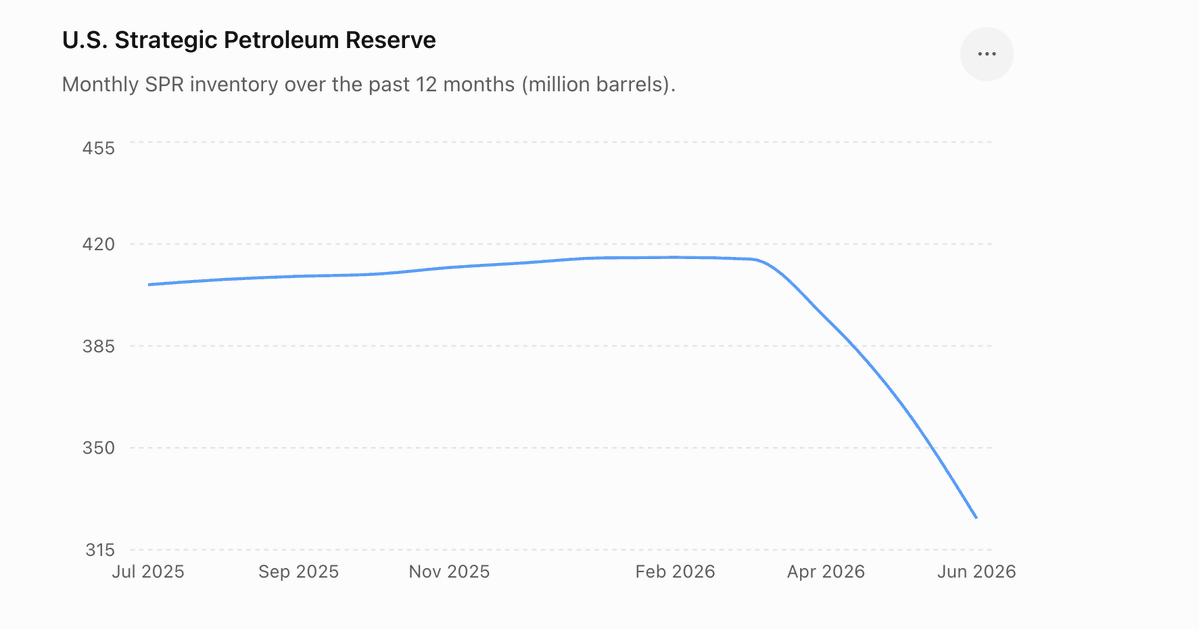
There are many reasons why another war with Iran would be foolish. This is one of them: Look at the US Strategic Petroleum Reserve today compared to February 2026.
This is what Trump used to keep gas prices low despite the oil shock. It won't be able to do so easily again.
The Iran-US confrontation has a strong Israeli dimension. Without Iran-Israel "cold peace" at minimum, there will always be risk of a flareup.
Post-Oct 7 Israel is maximalist. Nuclear parity is therefore likely Iran's main means to impose "rationality" needed for cold peace.
This is exactly what I see factoring into everything that Iran does. Any pragmatism, any letting something go, seems like it will be interpreted as weakness and embolden the US and Israel.
New U.S. Strikes on #Iran and the Risk of Return to the Full-Scale War
🔹CENTCOM says it has begun conducting additional strikes against Iran to further degrade its ability to threaten freedom of navigation in the Strait of Hormuz.
🔹Reports from Iran indicate that the strikes are both intense and geographically widespread, covering much of Iran’s southern coastal regions along the Persian Gulf as well as the islands overlooking the Strait of Hormuz. The attacks have reportedly included areas around Chabahar and Bushehr, which had not been targeted since the ceasefire was reached in April.
🔹Apart from their scale, another notable aspect of this wave of strikes is that, unlike the previous day, they occurred without any new Iranian provocation in the form of attacks on shipping in the Strait. They should therefore be seen as a continuation of the campaign that CENTCOM began the previous day. From this perspective, the objective is not simply to retaliate or deter further Iranian attacks, but to systematically degrade Iran’s capability to continue targeting shipping in the Strait of Hormuz.
🔹For this reason, the strikes may continue over the coming days, although the trajectory will also depend on Iran’s response. At the moment, one factor that has probably contributed to Iran’s relative restraint is that the ceremonies related to Khamenei’s funeral are still ongoing. Once they conclude, Iran may opt for a larger-scale retaliatory campaign.
🔹Even so, the limitations of Iran’s current strategy of targeting U.S. bases in the region have become increasingly apparent, as these strikes have not deterred further U.S. attacks. As a result, Iran may instead consider once again fully closing the Strait of Hormuz, although such a move would likely trigger even more intensive U.S. strikes.
🔹Another possibility is that Iran could encourage the Houthis to close the Bab el-Mandab Strait simultaneously, thereby increasing pressure on the global economy and seeking to strengthen deterrence against the United States.
🔹Depending on how far the United States goes in targeting Iran, strikes against regional energy infrastructure have also been discussed within Iran’s strategic community as a possible option.
🔹The risk now is no longer limited to the possible collapse of the memorandum of understanding, but extends to the possibility of a return to full-scale war between the two sides.
🔹In any case, it is difficult to imagine that Trump could achieve through another round of aerial operations what was not achieved during the 40 days of intensive warfare against Iran in the spring.
🔹The concern in Tehran is that the current campaign may in fact be a prelude to a new phase of the war involving the deployment of ground forces to occupy Iranian islands around the Strait of Hormuz or parts of Iran’s southern coastline. This is another factor that could contribute to a disproportionate and larger-scale Iranian response aimed at preventing such a scenario from materializing.
🔹That, in turn, could lead to a further escalation of the conflict.
The sharp escalation between U.S. and Iran could be the end of the MoU for the simple reason that Iran thinks U.S. wants to use MoU to take away its control of Strait of Hormuz, and if so, it should be ready to go to war over it.
Triangulating the U.S. into a forever war with Iran at a moment when every domestic political trend was pushing against that was the Israeli objective and they succeeded at that.
How the US-Iran fight in the Strait of Hormuz can be resolved before it blows up the MOU
For the second time since the U.S.-Iran MOU was signed, Washington and Tehran have slipped back into direct military confrontation.
At the heart of the dispute are two competing interpretations of the MOU. Tehran's reading is that while the Strait of Hormuz is to remain open, all commercial traffic during the 60-day interim period must be coordinated with Iran as the parties negotiate a permanent maritime arrangement. Washington, by contrast, interprets an "open" Strait to mean that vessels may transit either the Iranian or Omani shipping lanes without coordinating with Iran.
For Tehran, this is not a technical disagreement but a strategic one. Iranian officials fear the United States is using the MOU to erode Iran's control over the Strait by rejecting any requirement for coordination and, in effect, establishing an alternative corridor that could remain open even if war resumes. Such an arrangement would deprive Iran of what many of its strategists regard as its single most important source of leverage in a future conflict: the credible ability to disrupt maritime traffic through Hormuz. From Tehran's perspective, commercial shipping can resume without surrendering that leverage—but only if all vessel movements continue to be coordinated with Iran, thereby reinforcing its nominal authority over the waterway.
Washington counters that the text of the MOU does not explicitly require ships to obtain Iranian authorization before transiting the Strait. Instead, it assigns Iran responsibility for ensuring the safe passage of commercial vessels, a distinction the United States argues falls short of granting Tehran operational control over all maritime traffic.
Read full analysis at: https://t.co/GDFZqRz8rg
Israel decided to go to war with the world by upending global institutions, violating international law and ignoring any warnings and condemnations. Instead it doubled down even more. The world is starting to fight back. https://t.co/1sEQxVNTbJ
I don't think we can confidently ascribe intentions at this stage. But I'd argue that the rhetoric and actions of senior Iranian officials, including Ghalibaf, and really the broader consensus in Tehran, suggest a willingness to give this process a chance because Iran still has a compelling interest in securing durable sanctions relief and improving its dire economic situation.
Whether a final deal that meets both sides' bottom lines proves achievable is another matter. U.S. diplomatic credibility may simply be too damaged. Washington's political system may have made delivering meaningful sanctions relief impossible. Imo, that would be a serious setback not only for U.S.-Iran peace but for broader U.S. interests, including and especially nuclear nonproliferation.
Ultimately, though, I think the more important question is what policy has at least some chance of succeeding. The record is fairly clear about what has worked and what hasn't. Iran has historically responded to credible incentives, face-saving compromises, and arrangements that provide tangible benefits while respecting its core security concerns. After the collapse of the JCPOA and the conflicts that followed, any serious diplomatic effort was always going to have to begin with confidence-building measures and upfront, verifiable incentives.
I would argue that the United States gives up very little by testing that proposition. Temporary waivers and limited access to frozen funds are not the sanctions relief Iran ultimately needs.
The real question in Tehran is whether Washington is genuinely prepared to move beyond a regime change framework and pursue a negotiated compromise that both sides can live with.
If the answer is no, the process will almost certainly fail. If the answer is yes, then a durable agreement remains possible.
If no incentive can ever matter & no confidence can ever be rebuilt, then conflict becomes permanent by definition. The JCPOA itself was built on phased reciprocity because neither side had trust.
To me, this sounds more like a policy preference than an analytical conclusion 👇
What worries me about the Israel-Lebanon deal is that it sets conditions for peace that, if not implemented by Lebanon, will allow Israel to remain in the south. Reminiscent of Resolution 242, which set up a conditional of land for peace. When the Arabs didn't move toward peace, Israel absorbed the land.