Today, we are introducing Inkling.
Inkling reasons efficiently across text, image, and audio modalities. We are making the full weights available.
https://t.co/Ghebq5mG30
Available today for fine-tuning on Tinker. Play with it in the Inkling Playground. 🧵
A KPI more CEOs should be tracking is:
Annual Revenue per Employee.
What is it today (at pre-seed likely sucky, less than costs)
Targets for each quarter going forward (should be going up)
Target for each Fundraising (Seed, Series A, etc.)
I have a Pre-Seed B2B software company that in the last year increased it from $100K to $1.2M. (crushing it)
I have a mature pre-IPO company that is at $13M (God Tier).
While early, most companies suck at this number, the whole goal of ANY company is to get to the God Tier. Or at least to the top decile of your competitors (proving you have a more profitable model.). If you are crushing this number for your stage, you will get more meetings and stand out in the fundraising crowd.
While your mileage may vary, here is what I am seeing as top decile numbers at each stage.
Angel: >$50K
Pre-Seed: >$100K
Seed: >$200K
Series A: >$400K
Series B: >$750K
Once we have completed our review for security vulnerabilities, we will make the entire codebase of 𝕏 open source, with no exceptions.
Moreover, we will invite third party reviewers to examine the system that is running to confirm that the open source code is what is running.
Trust through total transparency is the only thing that should be believed.
the 90% will go down as context around tasks improves, harnessing improves, and humans get better at managing agents.
it’s still so early - the room for improvement is immense 🚀
"Wasted tokens are the new headcount bloat."
Most firms have thin layer of doers at the bottom, with the rest of the org stacked in management.
Token usage follows a similar structure, with 10% of tokens shipping useful output, and 90% wasted on unproductive loops.
Hebbia CEO George Sivulka on why AI mimics middle management, and how firms should respond: https://t.co/F1SfhwX7kN
evals are critical
they act as:
- proof a change you’ve made hasn’t hurt the capability of an agent
- an sla baseline to show agent can take on work it was set out to do
- a mechanism for determining confidence and relevance of task pre / post work being done
- and many more
tell me you’re building agents, I’ll ask you about your eval stack 😉
One of the many properties that code has that makes it highly amenable to agents is that you can more or less quickly test it. You can either go see if the application works manually, or you can actually run a test on what you built.
Most other areas of work don’t have this benefit. You only get the testing when the final product hits the real world in some capacity - a stock trade is executed, a contract is negotiated, a sales pitch is delivered, and so on.
There’s probably going to be a whole new set of opportunities for how we begin to test the rest of work in this way. Ultimately it will mean more agents being layered into workflows.
It also means we need much better evals on most of our workflows. Most work today in enterprises doesn’t have an associated eval to know if something broke or improved with a model, prompt, or system change.
The enterprises that are able to eval their knowledge work the best also stand to gain the most from AI. Will become a critical aspect of agent adoption over time.
human labour is ~50% of global gdp
knowledge work is about ~70% of that
we are the rate the limiter to faster / better output - most markets are hamstrung by supply not meeting demand fast enough
demand will absorb supply as fast as it arrives - generally speaking
and wait until AI robotics kick in 🚀
Lucas Swisher of Coatue (@LucasSwisher1) does not frame AI as a zero-sum shift.
On How I Invest with David Weisburd (@DWeisburd), he argues that technology grows the productive capacity of the economy.
durability is in owning and controlling as much of the AI stack as possible - you want to be able to tweak every layer of the stack to gain advantage - it’s a capability edge and margin control game.
The durable advantage in AI may be moving from the model itself to the workflow it reshapes.
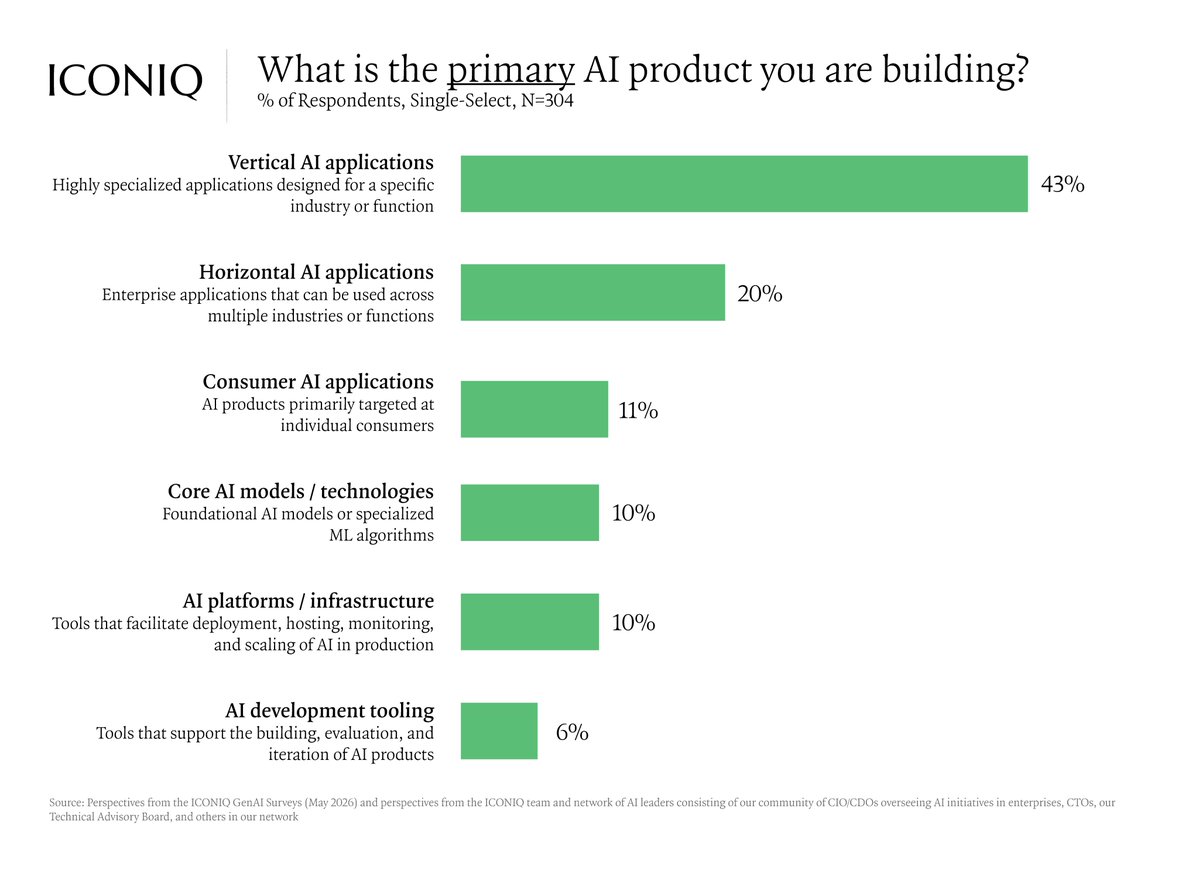
Nearly two-thirds of builders surveyed are focused on horizontal or vertical AI applications, with vertical alone at 43%.
Download the 2026 State of AI report: https://t.co/XozucuBncL
Disclaimer: https://t.co/fdP8ALDhEm
depends on the founders
depends on the incentives
think this could be more common going forward
cost of production is less than ever before so capital efficiency can be greater
depends on how fast you want to grow really
Hearing a lot of founders say they are raising their last private fundraise the company will ever do.
It’s a good story to build demand, but when the company continues to do well, I’ve never seen this to be true.
why I love this - because it’s simple and obvious - I think it’s directionally and principally correct - but I read it as clarity.
it’s a good bite size read to think about where the puck is going - and then you decide if you agree.
The pre-AI engineering leader mind can’t comprehend that their most cracked engineer is also extremely online..
While the agents are working, X becomes the dopamine spike they need as they wait.
I think time on X numbers especially in tech will continue to go up!