LG’s CLOiD: 14 ARM JOINTS. 10 ACTUATED FINGERS. NO LEGS.
Instead of making it walk, LG put it on wheels.
More stable.
Cheaper to build.
Probably safer around kids and pets.
The upper body still does the human-like work.
It can grab food from the fridge, use appliances, help make breakfast, start laundry, fold clothes, and move around the home on its own.
Each arm has 7 degrees of freedom.
Each hand has 5 independently actuated fingers.
Maybe the best home humanoid won’t be fully humanoid at all.
Would you rather have this on wheels — or wait for one that can walk?
10 MILLION OPTIMUS ROBOTS A YEAR.
That’s the long-term capacity Tesla is targeting in Texas.
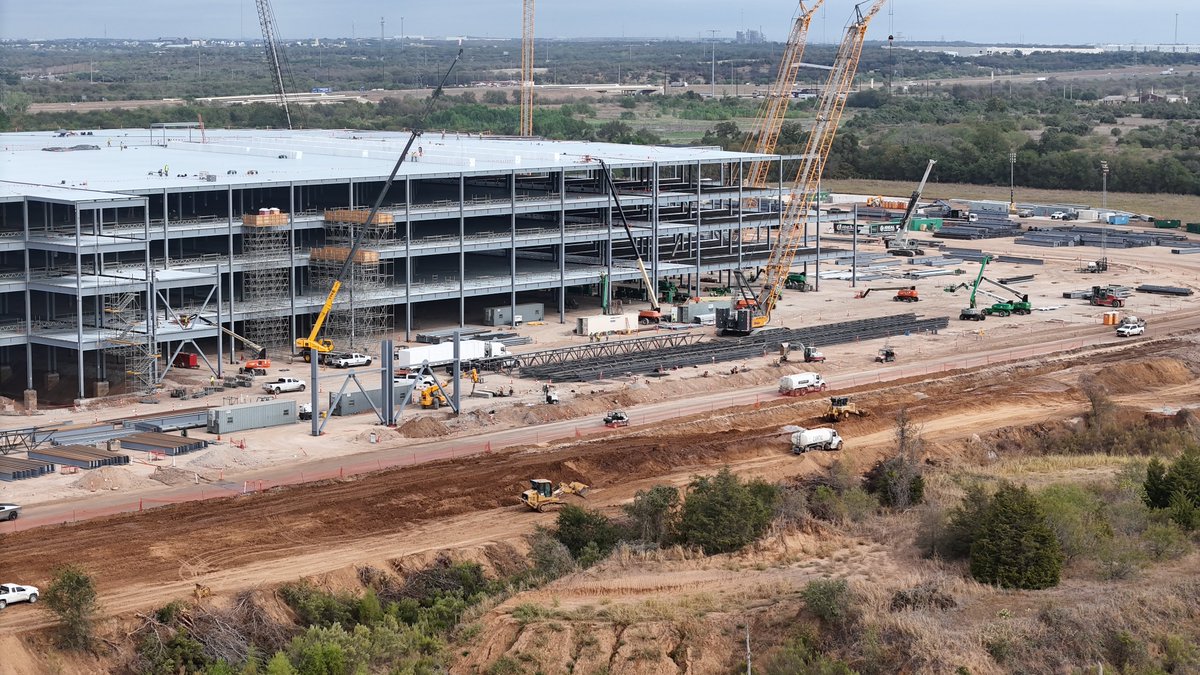
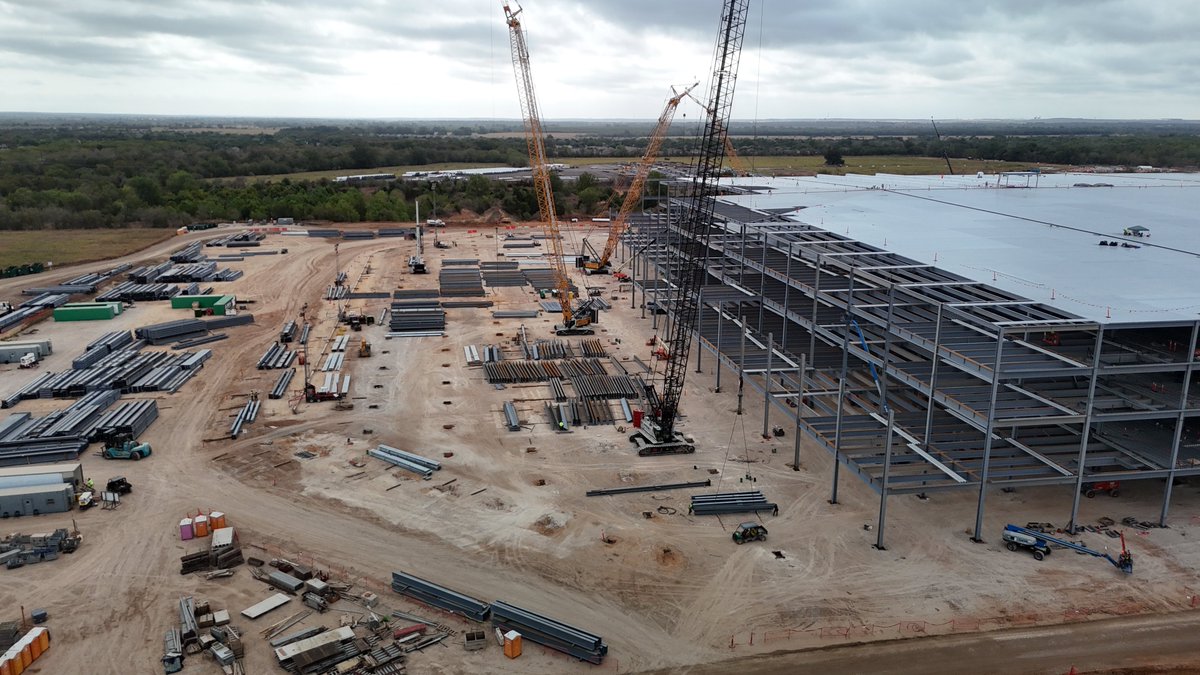
The factory will span more than 7 million sq ft, and the steel structure is only around 40% assembled so far.
At this point, the humanoid race is no longer just about AI or flashy demos.
It’s about who can actually manufacture at scale.
Giga Texas Optimus factory construction update with 2 short video clips, one 360 at medium-altitude & a closer, lower flight showing tight views of the main steel structure!
Ground work started in late March, with 1st steel on May 27. By 1 October, the frame was nearly at the north grade beam, large sections of upper floors were poured, & roofing insulation is arriving. The E side & the entire S half of the foundation have footings & grade beams, but no steel yet. The basic steel structure is ~ 40% assembled so far.
This is the dedicated high-volume 7+ million sq ft (~ 650,000 sq m) Gen 4 Optimus plant. @Tesla has not given a standalone cost, but 2026 company capex was guided at ~ $20–25 billion for AI, robotics, & factory expansion; outside estimates put the broader N Campus at ~ $5–10 billion.
This is in addition to the Fremont California Optimus plant (which is the Gen 3 pilot line) is sized at ~ 1 million units a year, expected to begin production in late 2026.
The Giga Texas plant is 10X larger & has a planned capacity of ~10 million robots a year at full scale (a long-term ceiling, not the startup rate). The current target for limited initial production is late 2027.
What is still ahead for construction over the next 6 to 8 months? Electrical conduit, water & sewage pipes, fire-water loop, storm water management drainage & underground pipes, exterior walls, roofing, ground slab & upper floor concrete & mechanical rough-in then equipment deliveries & installation. As you can see, lots of progress already, but there is a lot left to do before production line setup can happen.
@spaceandtech_ This looks simple, but it’s actually a pretty delicate robotics task. Do you think harvesting will be one of the first farm jobs robots fully take over?
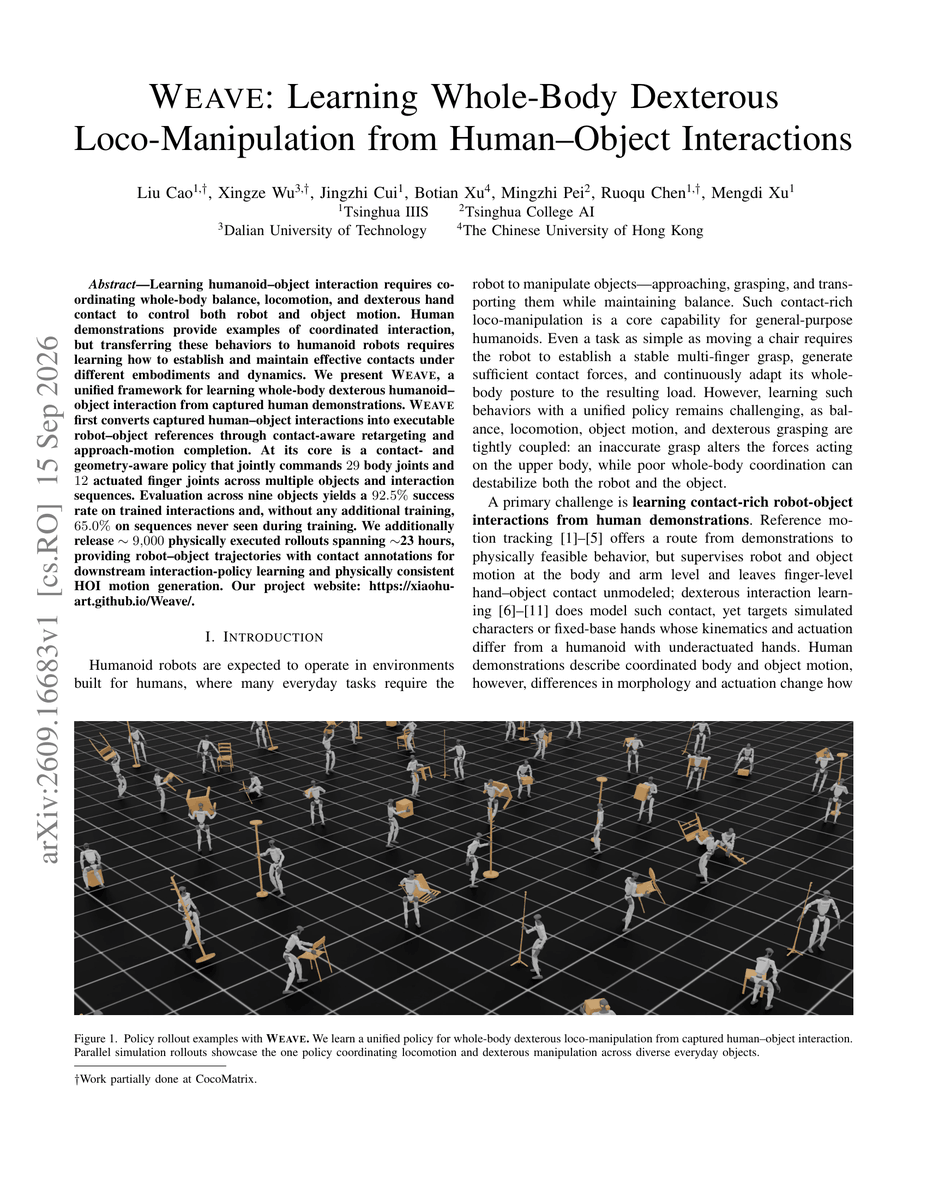
Maybe the race for better robot hands is missing half the problem.
The moment a humanoid grabs something heavy, its fingers, arms, posture and balance all become part of the same task.
WEAVE trains that coordination as one policy.
That sounds a lot closer to real dexterity than judging the hand alone.
@thesupermannx Worth noting: the 100× speedup is for Time to First Token on 4M-token sequences, not overall LLM performance.
Still impressive though. The real test will be how this scales in normal workloads.
For warehouses, this form factor makes a lot of sense.
Arms where human-like manipulation matters.
Wheels where walking doesn’t.
Do industrial humanoids actually need legs?
THE MOST BEAUTIFUL PHONE THAT COULDN’T SURVIVE A POCKET.
In 2019, Xiaomi showed the Mi MIX Alpha.
A 7.92-inch AMOLED wrapped around the front, sides, and most of the back.
No selfie camera - you just flipped it over and used the 108MP main camera with the rear screen as a viewfinder.
No volume buttons either. The sides were pressure-sensitive.
It looked incredible.
The problem was simple: you couldn’t really put a case on a $2,800 phone that was almost entirely screen.
The phone was delayed, then cancelled.
Amazing idea. Probably impossible to live with.
Would you have bought this and used it without a case?
THIS ISN’T GAMING ANYMORE. 🏍️
High-end racing simulators move the whole rig in milliseconds with linear actuators.
So when the car loses grip, hits a curb, shifts weight, or crashes, you don’t just see it.
You feel it.
That’s the point.
Elite drivers aren’t only learning the track.
They’re building reactions: muscle memory, spatial awareness, timing, instinct.
The goal isn’t to make the game feel more realistic.
It’s to make your body respond before you have time to think.
At that point, the simulator stops feeling like practice.
It starts becoming part of the training.
Would you trust a simulator to prepare you for a real race?
A 21-YEAR-OLD 3D-PRINTED A FULL MOVING SUIT IN TWO MONTHS. 🤖
This suit was built by 21-year-old engineering student Huang Yanjun in about two months.
He designed the entire system in CAD, 3D printed the parts, and built the panels so they open, move and lock around the body as one coordinated shell.
That sounds simple until you think about the tolerances.
Every hinge has to clear the next panel.
Every moving part has to avoid the body.
Every sequence has to happen in the right order.
One misaligned joint and you can’t move properly.
It’s not a powered exoskeleton.
It’s wearable animatronics.
And that’s still seriously difficult engineering.
Looks incredible. But is this engineering - or a very hard costume?
THE BACK OF YOUR PHONE IS BECOMING A SECOND INTERFACE. 📱
The Xiaomi 18 Pro Max has a 2.9-inch 120Hz OLED built into the rear camera island.
And it’s not just there to show the time.
You can use it as a selfie viewfinder with the main Leica cameras, plus notifications, media controls, widgets, timers, and custom AI cards.
That’s the part I find most interesting.
Instead of waking the front screen for every tiny task, the back of the phone can handle quick interactions on its own.
It feels less like a gimmick and more like Xiaomi trying to use a part of the phone that has done almost nothing for years.
Would you actually use a second screen on the back — or forget it exists after a week?
APPLE POLISHED THE PHONE. XIAOMI PUT A SCREEN ON THE BACK. 📱
iPhone 18 Pro Max vs Xiaomi 18 Pro Max.
Apple is still refining the smartphone we already know.
Xiaomi is adding another layer to it: a second display on the back.
One is chasing a more perfect version of the same phone.
The other is experimenting with the form itself.
Which approach would you rather see more of?
YOUR NEXT MONITOR MIGHT BE 310 INCHES. AND IT FITS ON YOUR FACE. 👓
A Mac mini.
A keyboard.
A pair of XREAL glasses.
That’s basically the whole setup.
Put the glasses on and the physical monitor disappears.
Instead, you get a virtual screen floating in front of you. With XREAL One, it can stretch into an ultrawide display up to 310 inches.
No giant monitor.
No fixed screen size.
No permanent workstation.
Your computer stays small.
Your workspace becomes something you wear.
The wild part is that this already works today.
The only thing I’m still not sure about is comfort.
Is this the future of work — or just a cool travel setup?
THE MONITOR IS BECOMING OPTIONAL. 👓
You put on the glasses, drop a screen in mid-air, resize it, and work.
No desk layout.
No physical display.
No “27-inch or 32-inch?” decision.
The computer stays the same.
The workspace becomes software.
At some point, “how big is your monitor?” stops being a hardware question.
Would you actually give up the screen on your desk?
SAME TINY ROBOT. 4.5× FASTER. THE UPGRADE WAS THE BRAIN. 🤖
MIT built an insect-scale flying robot that now moves much closer to a real insect.
The hardware wasn’t the main breakthrough.
The controller was.
A new AI-based control system made it fly 447% faster and accelerate 255% harder than in previous tests.
It also pulled off 10 consecutive flips in 11 seconds — while staying within a few centimeters of its planned path.
That’s the part I like most.
Sometimes better robotics doesn’t mean building a new machine.
Sometimes the machine was already capable of more.
It just needed a better brain.
For robots this small, that matters.
They could eventually fly through rubble, narrow gaps, and unstable spaces where normal drones can’t go.
Same body.
Much better intelligence.
And suddenly it feels like a different robot.
YOUR ENTIRE DESKTOP CAN NOW FIT IN A BACKPACK. 👓🖥️
Mac mini + XREAL glasses is a strange little setup.
The Mac mini does the computing.
The glasses become the monitor.
Put them on and a virtual screen floats in front of you. No physical display required.
A current Mac mini starts at $899.
XREAL One is around €399.
So for roughly the price of a decent laptop, you can build a desktop that barely needs a desk.
The part I like most is the split.
Your computer stays tiny.
Your “monitor” goes wherever your head goes.
Would you actually work like this for 8 hours a day?
The supply chain is starting to look more real than the robot itself.
If suppliers already have orders and Tesla is auditing production lines, the manufacturing side may be much further along than we can see from public demos.
Do you think V3 appears before the first real production ramp?
@techniahqrobot Exactly. That’s where you start seeing the things demos hide: heat buildup, cable stretch, actuator drift, sensor noise, grip degradation.
A hand can look perfect for 2 minutes and be a completely different machine by hour 8.