Developing mathematical models to better understand biochemical networks and identify drug therapies. Directed by Dr. Stacey Finley, Professor of BME @USC
after sharing the news with family and friends, i am thrilled to announce that i have been promoted to Professor of Biomedical Engineering and Quantitative and Computational Biology @USC !!
@USCViterbi@uscbme@qcb_usc
submit an abstract by Friday to present at #SACB2025! we are building on excellent meetings held bi-annually since 2016. this time, we’ll be at @CUAnschutz, a great location to connect and share our science.
Abstracts are due this Friday for #SACB2025! A great meeting for those who are employing systems approaches in cancer. We have an incredible array of speakers and a fantastic new location near Denver, Colorado.
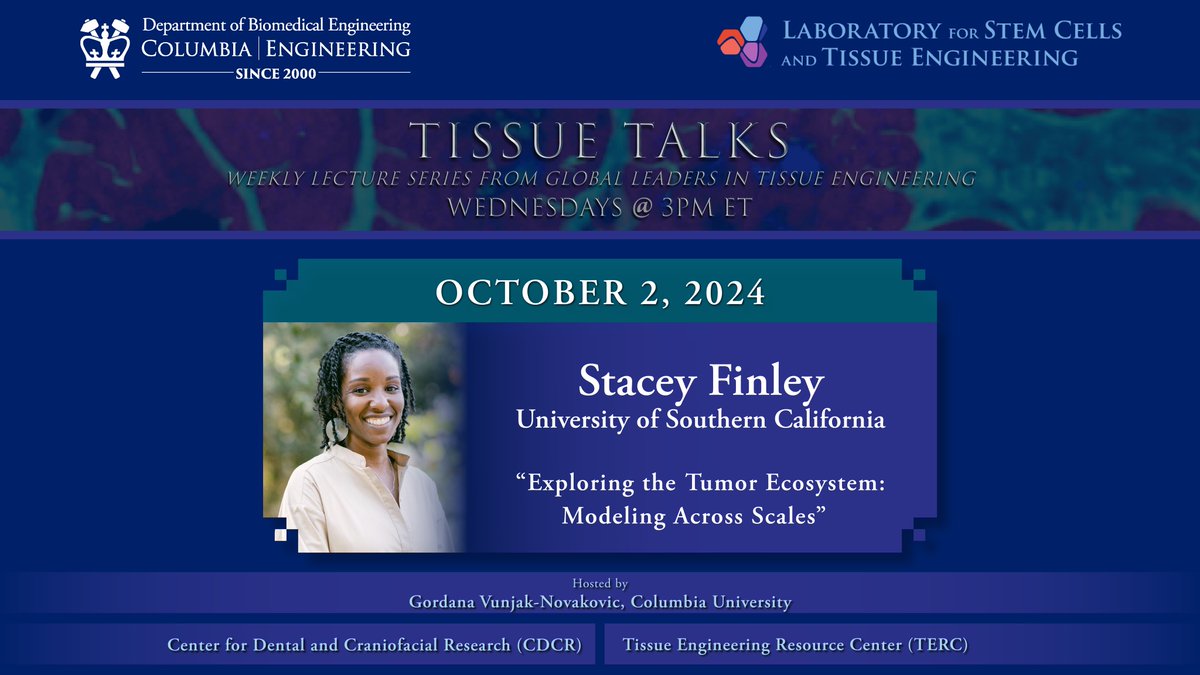
Join us this Wednesday, October 2nd at 3pm EST for a #TissueTalk from @USC Prof. Stacey Finley @USCSysBio_Lab on "Exploring the tumor ecosystem: modeling across scales."
See you there: https://t.co/cvdpWVcfPJ
We have ONE MORE set of talks in the @SMB_MathBiology Diversity in Math Bio 2024 summer seminar series!
Tuesday, August 13 at 8:00 PDT / 11:00 EDT / 17:00 CEST.
Register to receive zoom info: https://t.co/udgET2uUDL
Dr. Malena Español (@EspanolMalena) from @ASU will present “A Deep Neural Network Approach for Electrical Impedance Tomography”
Rachel Sousa from @UCIrvine will present “Identifying Critical Immunological Features of Tumor Control and Escape Using Mathematical Modeling”
Dr. Van Pham from University of South Florida will present “An extendible use of DNA tensegrity triangle model”
Dr. Alex Ochoa from Duke University will present “Models for diverse human genetic data”
The 4th set of talks in the
@SMB_MathBiology Diversity in Math Bio seminar series will be Tuesday, July 30! 8:00 PDT / 11:00 EDT / 17:00 CEST
Get Zoom info: https://t.co/udgET2uUDL
Join to learn about the breadth of research and range of researchers in mathematical biology!
@NCIsysbio A9: I am just starting to understand how important it is to engage patient advocates in #CancerResearch. I would love to see more conversations with patients, where we learn from each other and get inspired about impactful #SystemsBiology work. #SysBio4CancerResearch
#SysBio4CancerResearch:
Mathematical modeling has made a significant recent impact in the design of treatment scheduling protocols that are evolution-based strategies to mitigate the evolution of resistance.
But there is still many unanswered questions, and #MathOnco or #SysBio approaches will be key to future work. We’ve outline open questions in the field here:
https://t.co/tJjjtDuPb0
#SysBio4CancerResearch:
Another important future direction is the integration of AI/ML approaches with mechanistic modeling.
Combining highly predictive black-box approaches with parameterized math models to gain mechanistic insight into that black-box:
https://t.co/wktOKE5JKu
@NCIsysbio A8: I also think there may be opportunities for more translational #SystemsBiology initiatives like @ARPA_H ADAPT, which aims to harness advanced technologies and a deep understanding of tumor biology to build cancer #biomarkers. https://t.co/toOvfgyjkf #SysBio4CancerResearch
#SysBio4CancerResearch: The best way to bring preclinical data to bear on clinical translation is the integration of mathematical models to interpolate or extrapolate these data, and to test & generate hypotheses about underlying biological mechanisms.
A great example of this model iteration process from Paras Jain & @mkjolly15:
https://t.co/XbETLmmwPI
#SysBio4CancerResearch: The best way to bring preclinical data to bear on clinical translation is the integration of mathematical models to interpolate or extrapolate these data, and to test & generate hypotheses about underlying biological mechanisms.
A recent great example of model iteration is @stroblmar’s paper on PARP inhibitors in ovarian cancer:
https://t.co/YnJE3VkdVu
@NCIsysbio A7: modeling of adaptive therapy from Bob Gatenby @MoffittNews has already led to clinical trials showing good outcomes (https://t.co/YqWUVw0cKW) #SysBio4CancerResearch 2/2
@NCIsysbio A7: tumors are constantly evolving and adapting to their environment. it is exciting to see #SystemsBiology models that exploit that evolution, leading to adaptive therapy. #SysBio4CancerResearch 1/2
@NCIsysbio A6: for example, RNAseq data can be used to build genome-scale metabolic models (work from Melissa Kemp @CoulterBME: https://t.co/y6QNHuuGtW) and to construct gene regulatory networks (https://t.co/AXFVN697Hh). # SysBio4CancerResearch 2/2