New Beach Landing Vessel For The Marine Corps Breaks Cover
The Ancillary Surface Craft is part of a growing fleet of new amphibious vessels that is helping lay the groundwork for future Marine island-hopping operations.
https://t.co/moEZMjUDJv
The U.S. Navy is in the process of renaming the the fourth Gerald R. Ford-class aircraft carrier, USS Doris Miller (CVN-81), named for Messman Second Class Doris Miller, an African American Sailor who received the Navy Cross for his heroic actions during the Japanese attack on Pearl Harbor, according to an exclusive report by CNN.
Currently, it is unclear what the Navy is seeking to change the name of the carrier to, though two of the sources said there have been internal conversations about renaming it to honor President Donald J. Trump. In what would be an unprecedented move to name an aircraft carrier after a sitting President of the United States.
Pure politics for it to be named for Miller in the first place. He had a destroyer named after him and another Arleigh Burke destroyer should be named after him. Carriers are named after Presidents and historic events/locations. Trump will not be in office when it is done. But I think it too soon. Time to stop naming after Presidents for awhile. Should be Midway, Lexington etc. They are also planning on a USS Clinton. They should name a submarine after him.
Multiple sailors aboard the USS Abraham Lincoln have attempted to go overboard as the carrier's deployment stretches into its ninth month. https://t.co/MeprGaFh5j
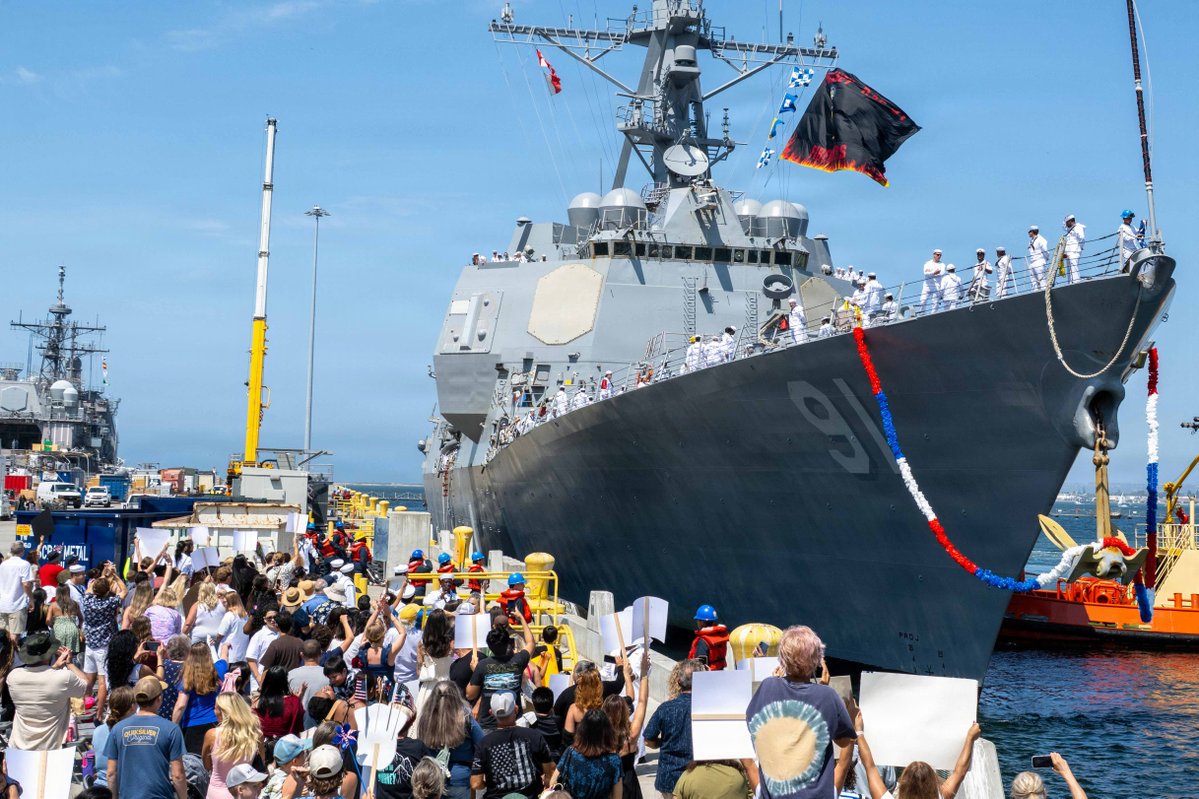
⚓📰 #USNAVY UPDATE: USS Pinckney returns to San Diego Following Operations in the Indo-Pacific and Middle East
SAN DIEGO – Arleigh Burke-class guided-missile destroyer USS Pinckney (DDG 91) returned to its homeport of Naval Base San Diego, following 9 months of operations supporting regional security and combat operations in the Indo-Pacific and Middle East, Aug. 09, 2026.
“Pinckney’s Firewalkers answered every mission with professionalism, resilience, and unwavering commitment,” said Cmdr. Timothy DeVall, commanding officer of Pinckney. “Whether operating in the Indo-Pacific or supporting combat operations in the Middle East, our Sailors consistently demonstrated the readiness and adaptability required to execute our mission. I couldn’t be prouder of what this team accomplished.”
We have liftoff on Apollo 11! At 9:32 am on July 16, 1969, Neil Armstrong, Michael Collins, and Buzz Aldrin launched atop a mighty Saturn V rocket on their historic journey to the Moon: https://t.co/QPgbhtQepV
82 years ago today, the funeral of Theodore Roosevelt Jr. is held in Normandy. 🇺🇸
18 years later, Henry Fonda gets to say his most famous quote in “The Longest Day” 🪖
Today in History (July 16, 1945): "Trinity," the world's first-ever nuclear test, was detonated in the New Mexico desert. Developed under the Manhattan Project, the plutonium-implosion device codenamed "The Gadget" was not dropped from an aircraft; it was tested atop a 100-foot tower, marking the dawn of the atomic age.
Colourized and digitized archival footage of British Tommies taking a spin on their country's newest weapon: a tank.
Clipped from Peter Jackson's 2018 documentary 'They Shall Not Grow Old.'
Marines Used Anti-Drone Netting During Recent Logistics Exercise
Across the globe, more militaries are relying on mesh netting to protect against the growing threat of small drones.
https://t.co/E7jkajRASC
The Trump administration would do well to remember that Japan signed treaties, some that reduced battleships and gun size.
"The United States was at peace with that nation and, at the solicitation of Japan, was still in conversation with its government and its emperor looking toward the maintenance of peace in the Pacific." ~FDR 1941
Japan had taken control of the Pacific Mandated Islands and fortified them "in absolute violation of her written word." ~FDR fireside chat 1942
I'm aware of this because my father's ship transported one of the "illegal" 18-Inch barrel of their naval battleship guns from Japan to Naval Proving Ground in Dahlgren, Virginia
Pointe du Hoc
Normandy
June 6 1944
To the west or right flank of the Americans on Omaha Beach rose the Pointe du Hoc, a cliff upon which German heavy coastal artillery was emplaced. The guns had nearly a range of twelve miles and could deliver a fire on the ships and craft of Allied invasion fleet. A force of 200 Rangers under Lt. Col. James Rudder had been trained to scale the cliff and destroy the enemy guns and gunners.
Rudder led a small force against Pointe du Hoc. The bulk of his Rangers were boated, awaiting his signal that the cliff had been taken; then they would come ashore and move overland toward the point. But the signal never came. Rudder was delayed by enemy fire. His Ducks carrying his ladders were unable to penetrate a bomb pitted shelf beneath the cliff. The Rangers began firing their mortar propelled grapples but the water-soaked ropes were too heavy and fell short. Finally a few of them lodged and the Rangers began hauling themselves up hand over hand, while the Germans dropped grenades on them. An American destroyer swept inshore and cleared the cliff with 5-inch gunfire. The Rangers began bellying over the top.
They found a deserted, bomb-pitted tableland but no big guns. Then patrols pushing inland found the guns intact in an apple orchard. They had been hidden there to escape the American aerial bombardment but also might have been removed from sight from the big Allied battleships which their unprotected gunners might have been reluctant to duel. Whatever the reason, Rudder's Rangers disabled them by blowing their breeches, holding onto Pointe du Hoc against determined enemy counterattacks until reinforcements reached them two days later.
Meanwhile, the remaining Rangers offshore, receiving no signal, went roaring toward the beaches in their assault boats, losing some of them and taking casualties as they did. They began moving westward toward the base of Pointe du Hoc, fighting with great bravery and skill, adding their own considerable push to the slowly rising impetus of the American assault on Omaha Beach.