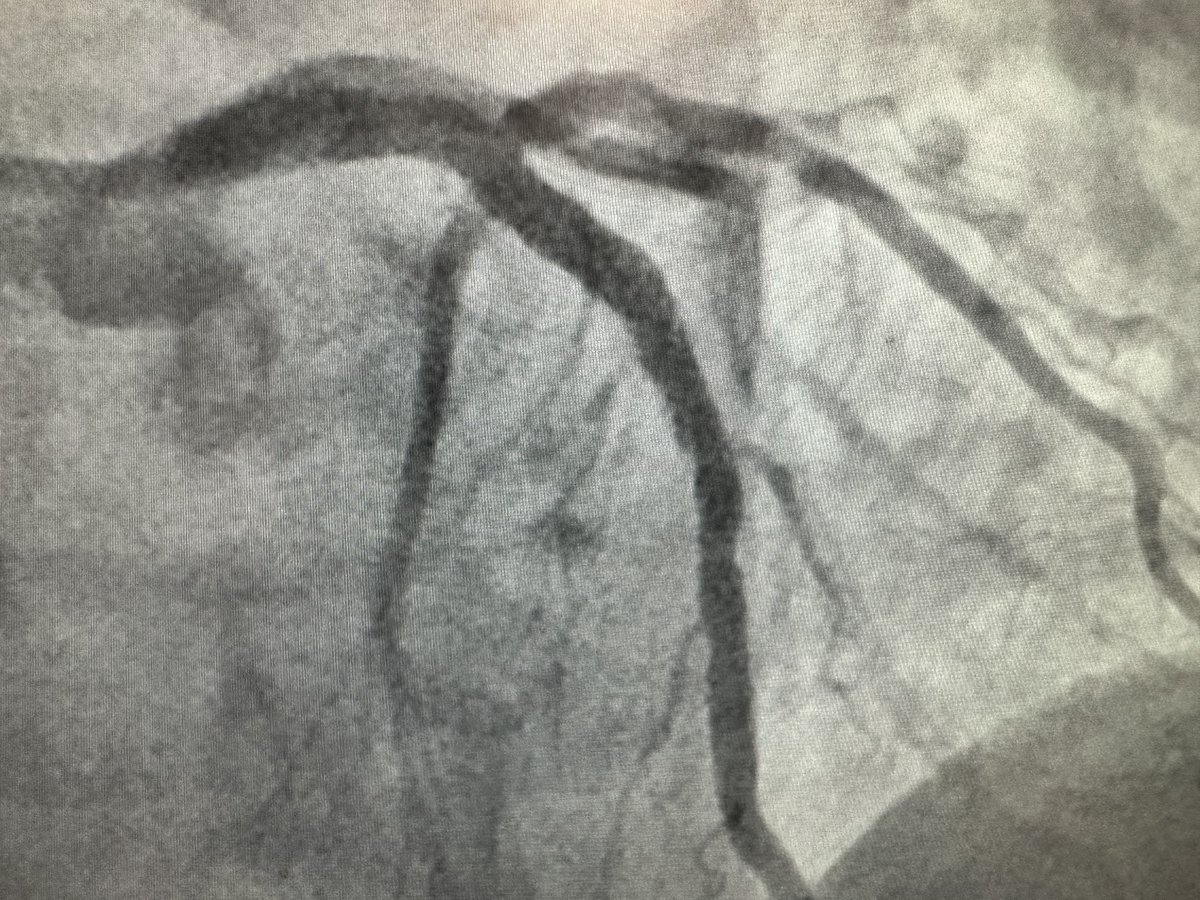
I would say that the KISS trial @JACCJournals not only proved that you do not need to do routine SB intervention (commonly kissing), rather I would say the most significant change is proving the concept of POT-side-POT (done in 57% of SB interventions and seems to be more favorable than kissing).
I have been recently doing POT-side-POT instead of kissing when I need SBI and that study proved it can be better!
Congrats to the authors and @sbrugaletta for an insightful editorial!
https://t.co/H3m2dHoufQ
#cardioX
Some strategies to adopt for a undilatable lesion. It is not uncommon to combine 2 lesion modification techniques (Rotatripsy). Use IV imaging to decide your strategy. My preference is Rota (for non bifurcation) and IVL for bifurcation lesion. You can use scoring/cuttingOPN 🎈
Here is my algorithm:
1) Vasodilator therapy (if hemodynamic allow and pull)
2) Pull Rotawire. This works very effectively, 90% of times. It is frequently overlooked. The 0.014 tip works as a great way to bring back the stuck burr. Make sure wire is free with brake off for maximal efficiency. Pulling the driveshaft is less effective, as it is made of 3 coiled wires which gives some elasticity to the driveshaft.
3) If burr is free beyond lesion, can use short dynaglide runs and then pull. Prinicple is that dynamic friction is lower. Don’t overdo this and also with skipping rope technique, there is risk of driveshaft breakage and burr loss due to torsional forces with a fix s immobile burr!
4) Cut driveshaft and remove teflon sheath
5) Deliver GE over driveshaft to the burr and pull.
6) Intimal/subintimal wire and ballooning to dislodge burr and pull.
7) Re-deliver GE over driveshaft and pull.
8) Obtain second access and adding a ping-pong guide. Remember a ping-pong guide is not required in most cases. Once Teflon sheath is removed, a 6F guide can accommodate: Driveshaft + coronary wire, Driveshaft + Caravel microcatheter, Driveshaft + Corsair/Turnpike LP microcatheters, Driveshaft + 2.5-4mm balloons
9) Combine subintimal ballooning and GE over driveshaft and pull. Only these maneuvers requires ping-pong guides.
10) Call surgeons.
A back table illustration of the technique published by @PCRonline to remove a stuck perclose footplate in the vessel!
Simple and I believe can get us out of trouble!
https://t.co/UOG0sfoOT4
#CardioX peeps, comments welcome
I had the privilege to help to launch the much waited new low profile sheath for impella. These are the main changes:
1. No need to peel away, not tapered and leave in!!
2. 1.5 fr smaller than prior generation
3. Hydrophilic dilator, no need to pre dilate (was already not doing but even easier now)
4. Coiled making it kink resistant
5. Side port is short and with bigger caliber. That might open the possibility for external bypass using the leave in sheath!
6. Easier single access
7. New improved reposition/locking mechanism (similar to the 5.5)
For me the best is getting rid of the reposition sheath! That will make our Cardiogenic shock care in the ICU much better!!
@UICcardfellows@Babar_Basir@evandrofilhobr
Introducing the percutaneous aorto-coronary bypass graft. The VECTOR procedure revascularizes the left main coronary artery using retrograde and antegrade steps: a retrograde wire exits the left main (distal graft), an electrosurgical wire exits the aortic root (proximal graft), a guidewire rail is created, and a stent graft is delivered from the aorta to the left main. What could possibly go wrong?
https://t.co/iNUNbHdGiT
🧵 Starling’s Law: Misunderstood, Misapplied, and Still Misleading
1
🚨 “Starling’s Law explains how the heart increases cardiac output.”
You’ve probably heard this a thousand times.
But it’s wrong.
Or at least - very incomplete.
Let’s fix it.
Because this matters - for heart failure, fluids, vasopressors, inotropes, afterload, and how we think about the whole system.
I have so many questions….
Angio-Seal for Right Ventricle Perforation During Pericardiocentesis for Cardiac Tamponade: A Case Report - Journal of the Society for Cardiovascular Angiography & Interventions https://t.co/oWgSAnu3Oz
A patient with known cardiomyopathy in ICU, had viral prodrome. BP 81/45 mmHg. Sinus rhythm with narrow QRS. Properly aligned CW interrogation across the mitral valve is shown, what are the findings and hemodynamic implications?
MANTA is an effective large-bore VCD in TAVR. Downside: lack of convenient bailout. Conventional bailout (contralateral CFA or radial) may not be fast (major bleeding) or easy (vessel dissection/total closure) enough. What to do? 🧵 1/
@TCT_ME_#TCTMiddleEast@crfheart@MyJSCAI
How I Talk About Left Main PCIs - And You Should Too!* 🧵
(*A suggestion of course!)
This is one of the cases from my talk on MCS for high risk PCI. Case first, then the analysis.
86 year old man, unstable angina, EF 40%, turned down for CABG at OSH, transferred with IABP. The
No IC wants this- but, every one who works in cath lab need to know how to handle this menace !
Mid LAD perforated following pre dilation with 2.5 🎈 at 10 🏧 .
Hwo would u handle this #cardiotwitter#CardioX