Harnessing solar energy to purify water.
Professor Guihua Yu, winner of the Discovery Grand Prize in the 2025 Global Prize for Innovation in Water, developed a hydrogel-based technology that uses solar energy to produce clean water without electricity during operation.
An innovation that translates research into practical applications, opening new possibilities for sustainable water solutions.
#GPIW2026
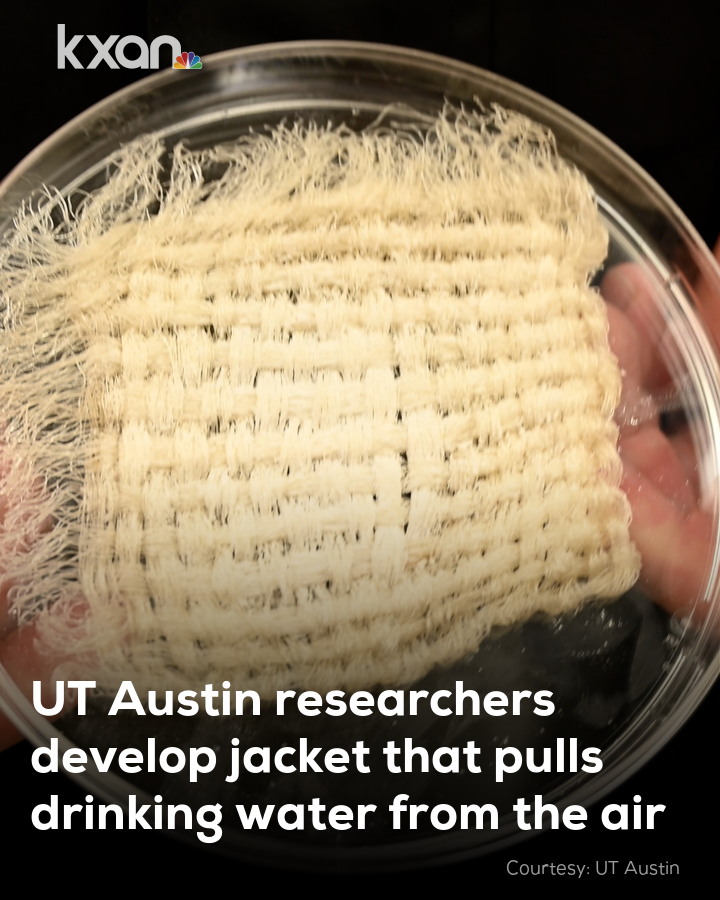
"A jacket that harvests drinking water directly from the air" has been developed by engineers at @UTAustin led by Camille Dreyfus Teacher Guihua Yu.
https://t.co/rTmhPsJSn0
Researchers at UT Austin have developed a wearable textile that pulls moisture from the atmosphere and converts it into drinking water, potentially helping hikers, farmers and emergency responders stay hydrated. https://t.co/SJb8Ba3WB5
A new hierarchical textile fiber harvests atmospheric water even when woven into clothing, creating potable drinking water for portable, on-the-move use.
Learn more in @ScienceAdvances: https://t.co/dYw43r87oZ
@UTAustin just built a real-life Dune stillsuit.
A jacket that pulls drinking water from the air. No batteries. No pump. Just sunlight and hydrogel fabric — up to 30 ounces a day.
Research out of @CockrellSchool led by @UT_YuGroup.
The stillsuit was always the idea. They just got closer than anyone expected.
A new hierarchical textile fiber harvests atmospheric water even when woven into clothing, creating potable drinking water for portable, on-the-move use. @UT_YuGroup@CockrellSchool https://t.co/ZwkxS1O5yJ
Glad to share two recent works on atmospheric water harvesting technologies, from stationary AWH to field-portable, solar-powered, litre-scale gel-fabric system @NatureWaterJnl ; to hierarchical textile fibers based wearable system @ScienceAdvances. @CockrellSchool@utmechengr
What if the solution to water shortages is already in the air?💧
UT Austin researchers with the @CockrellSchool developed a solar-powered device that pulled record amounts of drinking water from the atmosphere in a range of climates, from the dry New Mexico desert to humid Austin.
Read more about the technology here - https://t.co/qOkIlQSuvK
Professor John Goodenough is a legendary scientist, a tremendously kind and supportive mentor with big heart for science and humanity, a very inspiring colleague for many of us. He is well remembered for his lasting impact and legacy on The Forty Acres @CockrellSchool@utmechengr
"We compete against problems, not against people."
John B. Goodenough is the oldest person ever to receive a #NobelPrize. He was 97.
Watch our interview with him. We talked to the extraordinary chemistry laureate about life, science and love: https://t.co/G0YOKZxaYZ
What starts here was never meant to stay here.
Longhorn research and innovation reach far beyond the Forty Acres and are making an impact across Texas and beyond. 🤘
Learn more about the innovations happening across campus: https://t.co/D05GyOFV9U
Thank you @WelchFoundation for featuring this award! Very grateful of continued great support from @WelchFoundation, as Welch grant has played a critical role in enabling our exciting research discoveries related to water sustainability! @UTAustin@CockrellSchool@utmechengr
Congratulations to 2022 #HackermanAwardee Guihua Yu on winning the Grand Discovery Prize in the 2025 Global Prize for Innovation in Water! He’s recognized for pioneering hydrogel systems enabling solar-driven water purification and global water solutions.
The Global Prize for Innovation in Water wraps up its third edition, reinforcing its global presence and championing solutions that will shape the future of water.
Such a great honor to receive the 2025 Grand Global Prize for Innovation in Water @GPIW_Prize award! Also a true recognition to all outstanding students and supportive faculty that I have pleasure to work with over years! Hook’em @UTAustin@CockrellSchool@utmechengr@EnergyU
Weixin Guan and Yaxuan Zhao, @UTAustin materials science and engineering graduate students, won the 2025 Collegiate Inventors Competition graduate category with their invention called AirGel, a solar-powered device that captures moisture in the air and releases it as water. The duo marks UT’s first graduate win since the competition’s inception in 1990, earning $10,000 and a patent acceleration certificate as they aim to combat water scarcity problems worldwide.
https://t.co/NoK6ie13Hs