Symantec Threat Hunter Team reports GodDamn, the latest rebrand of Beast ransomware, itself a rebrand of Monster from the Hyadina developers. Operators used AnyDesk, NirSoft credential tools, & Microsoft-signed PoisonX driver to disable endpoint defences. https://t.co/hxCiUgpf4x
We just dropped a comprehensive engineering guide on PowerShell Defense Evasion, detailing how to systematically dismantle these protections.
Read the full technical breakdown:
https://t.co/dfaBYXihRQ
#DefenseEvasion#RedTeaming#OffensiveSecurity#PowerShell
DynLoader
A modular Windows loader focused on EDR evasion Built with indirect syscall (Tartarus Gate / Hell’s Gate), Manual PE parsing & Section mapping, API hashing & Dynamic resolution, fileless HTTP delivery (AES encrypted option), & more :)
https://t.co/N0wpp3yRMA
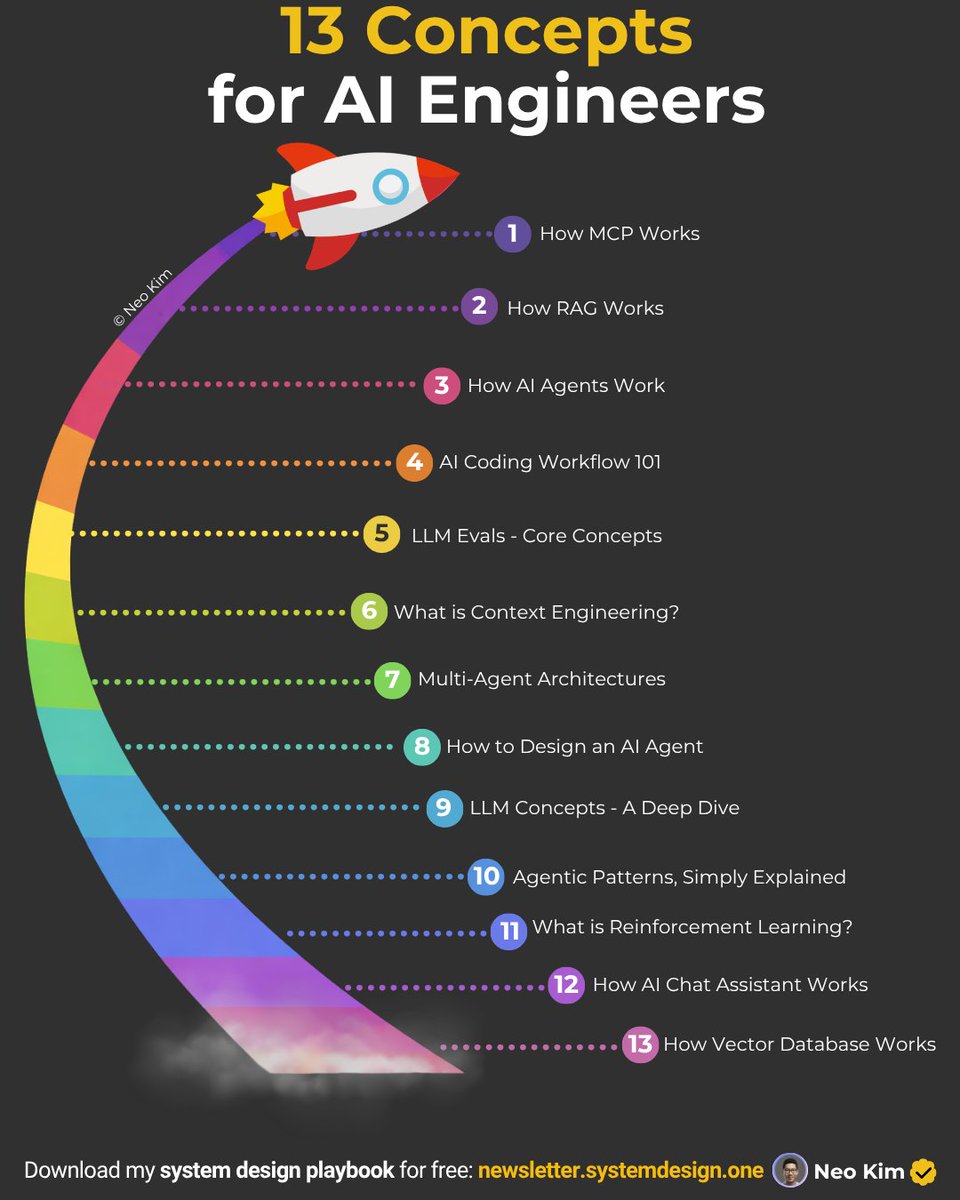
If you're serious about AI engineering (in 2026), then learn these 13 concepts:
1 How Vector Database Works
→ https://t.co/FVxan8xHH3
2 How RAG Works
→ https://t.co/cGmunPTUlb
3 Design Personal Chat Assistant
→ https://t.co/nNWq3onTnW
4 LLM Concepts - A Deep Dive
→ https://t.co/5lCKxq2g4N
5 How to Design an AI Agent
→ https://t.co/JvnPd9773A
6 What is Reinforcement Learning
→ https://t.co/AVpl9j1oit
7 LLM Evals 101
→ https://t.co/nv3Ol8W53p
8 Context Engineering 101
→ https://t.co/OMkiZhkODL
9 AI Coding Workflow 101
→ https://t.co/paIf9ksIU9
10 Agentic Patterns, Simply Explained
→ https://t.co/8YdBBWvTj1
11 How AI Agents Work
→ https://t.co/tk3zkCjRvg
12 Multi-Agent Architectures, Clearly Explained
→ https://t.co/rS5QQS7Jln
13 How MCP Works
→ https://t.co/wgf8gHnnkn
What else should make this list?
===
👋 PS - Want my System Design Playbook (for Free)?
Join my newsletter with 200K+ software engineers now:
→ https://t.co/ByOFTtOihX
===
💾 Save now & repost to help others learn AI engineering.
👤 Follow @systemdesignone + turn on notifications.
[Tool] Rikune: A reverse-engineering MCP server that turns PE triage, Ghidra analysis, runtime evidence, and source-like reconstruction into reusable tools for any LLM
https://t.co/VJ77W1iPag
Incredible work by CrowdStrike Counter Adversary Operations and our broader team on this year’s report.
The trend line is clear: breakout times continue to accelerate. Defenders have less time than ever to detect, respond, and contain before impact.
AI is reshaping the battlefield. Adversaries are operationalizing it to scale social engineering, reconnaissance, and development — while AI adoption across enterprises is simultaneously expanding the attack surface.
Cloud intrusions are rising sharply, with identity compromise remaining the dominant initial access vector. We’re also seeing an unprecedented number of nation-state actors targeting cloud environments.
China-aligned activity remains globally expansive, with increased focus on logistics and critical infrastructure. DPRK operations continue to blend espionage and revenue generation, including crypto theft.
The data is deep. The trends are clear. The implications are urgent.
A must read!
https://t.co/OCQT24ylsB
AI agents don't have a security problem.
They have an identity problem.
Here's what I mean:
You've deployed 47 agent workflows across your infrastructure.
At 3 am, an agent modifies a production database. You check your logs. 47 agents had access. They all used the same service account. You can't tell which one did it.
IBM's 2025 breach report found that 97% of organizations with AI-related breaches lacked proper AI access controls.
This happens because traditional security was built around human behavior: request access, get approved, complete the task, log out.
Agents don't work that way.
They run continuously for hours or days, making independent decisions at machine speed. They don't log out. They don't pause between tasks. They just keep acting.
Microsoft projects 1.3 billion agents in enterprises by 2028. Most will inherit long-lived API tokens and overprivileged service accounts.
The fix isn't better credentials. It's giving every agent its own identity.
Teleport is building an open-source framework for exactly this. I partnered with their team to show you how it works:
↳ Each agent gets its own cryptographic identity. No shared accounts, no static keys.
↳ Access decisions happen in real-time, scoped to what the agent needs right now.
↳ Every action traces back to a specific agent. Rogue behavior is detectable.
↳ Agents connect to databases and tools through the framework, not through scattered credentials.
Deploy agents safely. See exactly what each one does.
The framework is 100% open source. I have shared the link to the GitHub repo in the next tweet.
I’ve been struggling with the OpenClaw setup. Burned over $1,000 on tokens in just 3 days.
Then this guy saved me weeks of time and serious money.
Much respect.
If you’re setting up OpenClaw, this is the only post you need to read. 👇
@crowdstrike is observing opportunistic eCrime actors l pushing Skrawl info stealer via fake OpenClaw skills on GitHub. One-line Terminal commands trick users into running it - steals Keychain, creds, crypto wallets.
See the blog we put out on open claw: https://t.co/0hXF7mXtaM
What is RAG? What is Agentic RAG?
> Retrieval-Augmented Generation (RAG) <
----------------------------------------------
Retrieval-Augmented Generation (RAG) is an architecture that enhances a language model’s outputs by grounding them in external knowledge sources at inference time.
Instead of relying solely on parameters learned during training, RAG systems dynamically retrieve relevant information and inject it into the model’s context before generation.
=> Canonical RAG workflow
> A user submits a query.
> The query is embedded and matched against a pre-indexed corpus (commonly stored in a vector database).
> The top-K most relevant document chunks are retrieved.
> Retrieved context is appended to the original query.
A language model generates a response conditioned on this augmented input.
=> Primary objective
To reduce hallucinations and improve factual accuracy by grounding generation in verifiable, external context.
=> Key limitation
> Traditional RAG is a single-shot pipeline:
> No explicit reasoning or planning
> No validation of retrieved evidence
No iterative refinement if retrieval or generation is suboptimal
The system assumes the first retrieval and generation pass is sufficient, which often breaks down for complex, ambiguous, or multi-hop queries.
> Agentic RAG <
------------------
Agentic RAG extends standard RAG by introducing autonomous decision-making agents that can reason, plan, evaluate, and adapt across multiple steps.
Rather than a static retrieval → generation flow, Agentic RAG operates as a closed-loop, goal-driven system.
=> Core idea
Retrieval and generation are no longer treated as isolated steps, they become actions taken by agents in pursuit of a higher-level objective: producing a correct, complete, and useful answer.
=> Typical Agentic RAG Architecture
1./ Planning Agent
> Interprets the user’s intent
> Decomposes complex queries into sub-tasks
> Determines what information is required and from which sources
2./ Retrieval Agent
> Dynamically reformulates search queries
> Retrieves information from:
- Vector databases
- Structured databases
- APIs
- Tools or live data sources
> Can perform multi-hop retrieval when needed
3./ Generation Agent
> Synthesizes retrieved evidence into a coherent response
> Reasons across multiple sources
> Maintains traceability between claims and evidence
4./ Evaluation (Judge) Agent
> Critically reviews the generated output
> Checks for completeness, correctness, and alignment with the original query
> Decides whether to:
- Accept the answer
- Refine retrieval
- Re-plan and regenerate
This feedback loop can repeat until predefined quality criteria are met.










![secharvesterx's tweet photo. [Tool] Rikune: A reverse-engineering MCP server that turns PE triage, Ghidra analysis, runtime evidence, and source-like reconstruction into reusable tools for any LLM
https://t.co/VJ77W1iPag https://t.co/y3eC5iBpLR](https://pbs.twimg.com/media/HFYawLCXMAAJYkv.jpg)