🇭🇰🇨🇭 For the first time ever, Hong Kong has overtaken Switzerland as the world's top wealth hub.
$2.95 trillion in offshore wealth versus Switzerland's $2.94 trillion, driven by Chinese money and a 2025 IPO boom.
Asian hubs are growing at 9% a year compared to Switzerland's 6%, and the gap is only going to widen.
Source: Reuters
🇺🇸 Scenes from New York City, with roads literally turning into rivers and the infrastructure not ready for it.
It flooded in 2021 after Hurricane Ida. It flooded in 2023. It flooded tonight.
Source: @Arab_Storms, @WhitakerTA_
Behind every AI model there's a data center. Behind every data center there's a full stack of companies most investors never think about.
This is the complete map with every ticker 👇
🔲 Compute Silicon
This is where intelligence gets created. Every AI model, every training run, every inference call starts with a chip doing the math. The GPU narrative is well known by now, but the real evolution is happening in custom silicon.
Hyperscalers are designing their own accelerators because no single vendor can serve every workload optimally. The companies building both general purpose GPUs and custom ASICs are sitting at the center of a market that's still in its early innings. Whoever owns the compute layer owns the foundation.
Tickers: $NVDA $AMD $AVGO $INTC
🔲 Server OEMs & Solutions
Chips are useless without systems to run them. This layer takes raw silicon and turns it into functioning infrastructure. AI server racks today are radically different from anything the industry built five years ago.
Power density per rack has gone from 10kW to over 100kW. That means every aspect of the physical system, from liquid cooling to power distribution to rack architecture, has to be completely rethought. The companies solving these thermal and engineering challenges are extracting enormous value because without them, the chips can't operate at scale.
Tickers: $SMCI $DELL $HPE $VRT $ETN $MOD
🔲 Memory & Storage
AI models are only as good as the data they can access and how fast they can access it. High bandwidth memory has become the most supply constrained component in the entire stack. Training a frontier model requires moving enormous volumes of data in and out of the processor every millisecond, and traditional memory architectures can't handle it.
The companies that locked in HBM production capacity early now have pricing power they haven't seen in decades. Storage matters too. The datasets feeding these models are growing exponentially, and the infrastructure to store, retrieve, and serve that data is a massive market on its own.
Tickers: $SNDK $MU $WDC $P $NTAP
🔲 Networking & Connectivity
The most underappreciated layer in the entire stack. You can fill a data center with the best GPUs on the planet, but if those chips can't talk to each other fast enough, performance collapses. AI training clusters require backend networking that's orders of magnitude faster than traditional cloud setups.
Optical interconnects, high speed switches, and custom networking silicon are becoming the critical path for cluster performance. The spend flowing into this layer is accelerating because hyperscalers have realized that networking is the multiplier that makes their GPU investment actually productive.
Tickers: $ANET $CSCO $MRVL $CRDO $CIEN $NOK
🔲 Neoclouds & Physical Infrastructure
The hyperscalers can't build fast enough. That's created an opening for a new generation of infrastructure companies building GPU dense data centers and cloud platforms from the ground up.
These are the picks and shovels of the next wave. They're signing long term contracts with enterprises that need compute now and can't wait two years for a hyperscaler slot. It's the most speculative layer, but the velocity of capital flowing into physical AI infrastructure is unlike anything the tech industry has seen before.
Tickers: $NBIS $IREN $CRWV $APLD
🔲 Energy
Everything above depends on this. A single frontier AI data center can draw as much power as a mid sized city, and the buildout is just getting started. Grid capacity is already strained in key markets. Nuclear is re entering the conversation as the only scalable, always on, zero carbon source that can meet the load.
Natural gas is filling the gap while renewables scale. The companies providing generation, transmission, and grid solutions are the ultimate bottleneck play. If the energy doesn't scale, nothing else in this stack scales either.
Tickers: $CEG $NEE $EOSE $GEV $EQT $VST
The AI trade is a full stack trade.
The winners of this cycle won't just be the ones making the processors. They'll be the ones cooling them, connecting them, powering them, and housing them. Understanding these six layers is how you build real exposure to the AI infrastructure buildout instead of just chasing the obvious names.
Which layer are you most focused on?
🏦Reserve Bank of Australia dropped their final report on CBDC Project Acacia
Here's the key highlights:
• $HBAR utilized in 4 total payment use cases
• Ripple $XRP used by ZeroCap for govt bond
• Redbelly $RBNT used for bond exchange
• Ripple RLUSD highlighted in stablecoins
The results of Project Acacia will be one to watch with the CBDC space moving forwards
This wasn't just a test of CBDC in payments
It was CBDC in tokenized markets across carbon, fixed incomes & more.
The DLTs selected here were done so for key reasons.
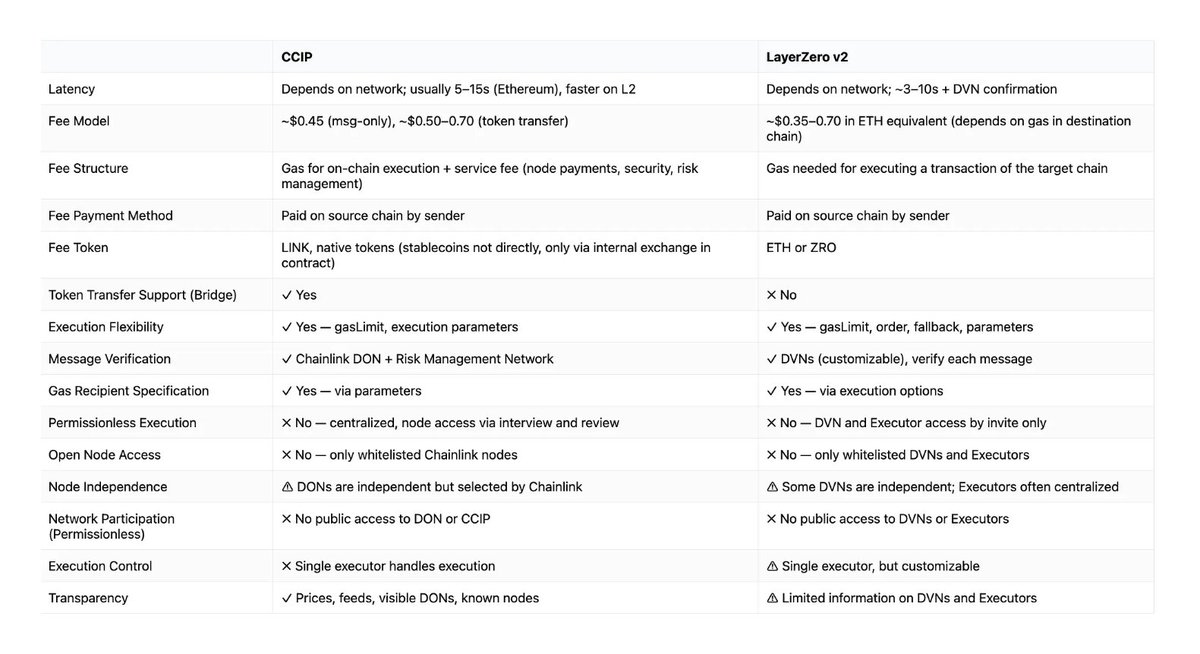
Users are probably wondering why projects are still switching their crosschain infra from LayerZero to Chainlink.
The reason is a philosophical difference in their security model:
→ @LayerZero_Core: developers pick their own validators and thresholds
→ @chainlink CCIP: 16 independent nodes enforced at the protocol level
LayerZero's model is elegant. Each app picks its own validators, so a hack on one app can't bleed into another, but only if each app configures it correctly.
The problem is that LayerZero permitted a 1/1 setup, with one validator and a single point of failure.
At least now, the 1/1 configurations are gone, defaults are moving to 5/5, and Console was shipped with built-in anomaly detection.
But compared to LZ, CCIP is designed to avoid this misconfiguration risk. You can't get it wrong because the protocol doesn't give you the option.
Institutions will often choose less flexibility in exchange for zero misconfiguration risk.
That's why all these protocols are making the switch.
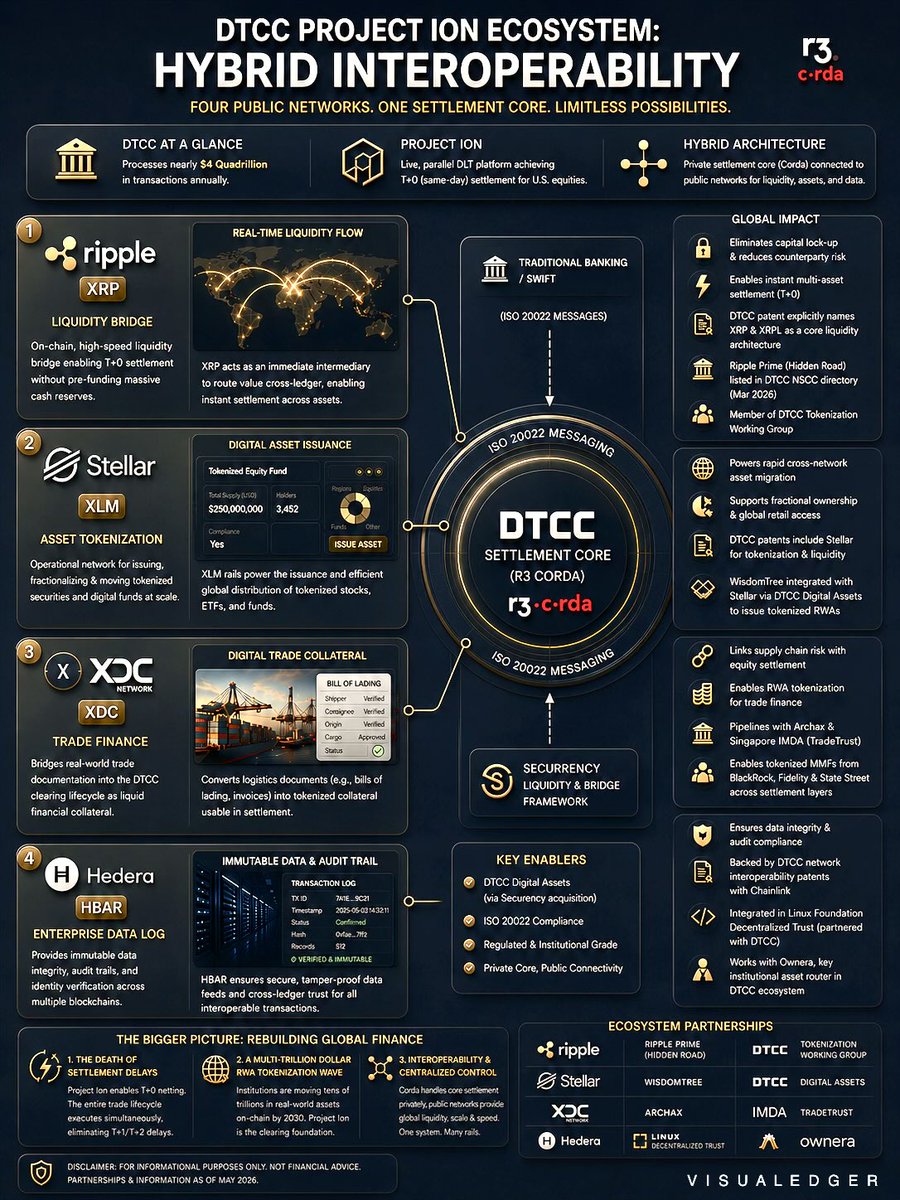
DTCC’s goal of instant settlement could be powered by $XRP, $XLM, $XDC and $HBAR - and here’s why. 🔥📈
$XRP:
A major DTCC patent explains how XRP can be used as a fast “bridge asset” to move value instantly between different financial systems. Instead of banks and institutions holding huge amounts of money as reserves, XRP can temporarily be used to complete transactions immediately. This helps DTCC achieve instant settlement (T+0) without locking up massive amounts of capital.
Ripple acquired institutional prime broker Hidden Road (rebranded as Ripple Prime). As of March 2026, Ripple Prime is officially listed in the DTCC’s NSCC Market Participant Identifiers directory, giving Ripple’s infrastructure active clearing capabilities on Wall Street. Ripple also serves directly on the DTCC Tokenization Working Group.
$XLM:
Through the Securrency framework, Stellar (XLM) helps create and trade digital versions of stocks, ETFs, and other financial assets. This allows these assets to move faster, cheaper, and more efficiently across global markets, including for retail investors.
Through DTCC Digital Assets, asset manager WisdomTree successfully integrated with the Stellar ecosystem to issue and manage compliant, tokenized real-world assets (RWAs) and digital funds.
$XDC:
XDC helps businesses turn real financial documents, such as invoices and trade paperwork, into digital blockchain-based assets. This makes them easier and faster to use within modern financial and settlement systems connected to institutions like DTCC.
XDC Network formed major pipelines with regulated institutional custodians like Archax and Singapore’s IMDA (TradeTrust framework). These networks interface with the DTCC infrastructure to enable tokenized money market funds (MMFs) from BlackRock, Fidelity, and State Street to move smoothly across different settlement layers.
$HBAR:
Hedera (HBAR) provides a secure and reliable way to record and verify data between financial networks. This helps systems like DTCC share information through blockchain technology in a way that is tamper-proof, transparent, and suitable for fast and secure transaction processing.
Hedera is integrated into the Linux Foundation’s Decentralized Trust, an open-source body partnered directly with the DTCC. Furthermore, Hedera operates closely with Ownera, a primary institutional asset router heavily involved in DTCC’s digital ecosystem.
All four assets, XRP, XLM, XDC, and HBAR, are compliant with ISO 20022 standards. This global messaging standard is gradually replacing the legacy SWIFT system. Because these assets align with modern banking and financial messaging requirements, they are well-positioned to integrate with institutional initiatives like DTCC’s Project Ion, enabling faster, more transparent, and more efficient value transfers.
$QNT BOMBSHELL! My biggest video ever! Here comes the 4th Industrial Age(The Tokenization & Blockchain Age! Quant Fusion Launch EXPOSED! Quant Overledger Fusion "Bring Your Own Node" launch is here and it's going to change everything. This is the interoperability operating system that connects all legacy banking systems, blockchains, CBDCs, tokenized assets and enterprises seamlessly - exactly like Windows did for the internet age.
Vietnam has 17 million crypto traders and zero domestic exchanges.
That changes in Q3 2026.
Hanoi is launching a regulated crypto market. Five licensed exchanges.
$400 million minimum capital. A 0.1% transaction tax modeled on stock trading.
The play: stop exporting tax revenue to Binance. Build domestic infrastructure.
Anchor it to a digital economy target of 30% of GDP by 2030.
Vietnam legally recognized crypto as property, licensed exchanges, and set a live date.
The gray market is closing. The regulated one is opening. That's where the money moves.
New podcast on sales - Sell the Truth.
00:00 Be Credible
03:18 “Yes, And”
04:31 Selfish Honesty
05:37 Charisma Is Confidence + Love
07:56 Don’t Manage, Lead
11:16 Hunt Together
14:51 Feed Your (Good) Obsessions
18:57 Sell the Truth
21:07 Good Deal or No Deal
23:39 The Age of Nonlinear Returns
🧨 The Plot Thickens | Final Barrier is Falling
Please share this video before they delete it.
• Phase 2: Swift, DTCC, WB, UN, ECB
• Includes $LINK $AVAX $CC $HBAR $ADA
• Public DLT inevitable. Integrate, don't debate
• @Nomura: 79% Japan institutions buying
• Post Quantum Ready & $XDC Network
• AI on HBAR: backbone of agentic economy
• @Hedera and @nvidia, @intel, @Accenture
• IMF FSAP now covers crypto & cyber risk
• @Ripple + Kyobo Insurance: Korea Bonds
• @thinkingcrypto on Fintech TV @NYSE
• Mastercard + $RLUSD settlement
• ZKP $XRP @boundless_xyz interview
• French research $SOL 270X greener
• Bittensor $TAO institutional research hub
• Algorand x PQC & @RealAllinCrypto
• @DriftProtocol $150M plan on $USDT
The last barrier to adoption was never just regulation. It was risk management.
A Japanese couple quit their jobs, moved to Vietnam with $100K and built a pizza empire 🍕
You probably know Pizza 4P's founded by @Yo_maco if you've been to Vietnam but not the story behind it.
• Started in 2011 in Ho Chi Minh City
• No mozzarella? They built their own cheese factory in Da Lat → in-house cheese now = ~15% of revenue (+ wholesale)
• Grew from 1 store → 40+ locations across Asia (Vietnam, Cambodia, India, Indonesia, Japan)
• Raised $10M from Cool Japan Fund
• $4.6M after-tax profit in 2023 (+38% YoY)
• Next stop: Brooklyn, NYC - opening Summer 2026 🇺🇸
And the food is just as good as the story!
Today I found proof 🇯🇵 Japan’s core payment system, Zengin-Net, is being upgraded with parallel DLT rails.
THIS IS ALL OF JAPAN
Quant $QNT is directly tied via Dentsu Soken, the critical infrastructure partner to Japan’s payment system for tokenizing bank deposits....