Curtis Yarvin is mistaken when he says that Apple can produce iPhones because it's a monarchy. There are millions of firms ("monarchies") in the world that can't produce anything nearly as impressive as iPhones, from the laundromat down the street to Boeing.
Apple is the result of a decades long evolutionary process facilitated by the market which uplifts the very best culture, talent, processes, and ideas in the entire world. And the moment Apple slips, it'll get replaced (the average lifespan of a Fortune 500 is 15 years).
Governments just don't work this way. Xi Jinping isn't competing again a million counterfactual Chinese leaders who didn't do Zero-COVID, avoided deflation, didn't kill the tech industry, and were awake to AGI. He can fuck up as much as he wants.
If a monarch happens to be competent, like Lee Kuan Yew, it's merely by chance, not due to some intrinsic selection mechanism of monarchy that we can replicate. You are just as likely to get brutal dictators like Mao and Stalin by chance - this is not a reasonable gamble to take with the lives of hundreds of millions of citizens.
Apple is indeed a wonderfully competent organization - if we want more of the world to be run competently, we should delegate more functions to the market, which is constantly and ruthlessly sizing down incompetence.
To be clear, ton of incompetent businesses exist, but they loose access to capital, talent, and power rapidly, which is reallocated to those who can deliver. They don't drag down the fortunes of entire countries and kill millions of people, which has happened again and again in authoritarian systems.
Ten months ago, we launched the Vesuvius Challenge to solve the ancient problem of the Herculaneum Papyri, a library of scrolls that were flash-fried by the eruption of Mount Vesuvius in 79 AD.
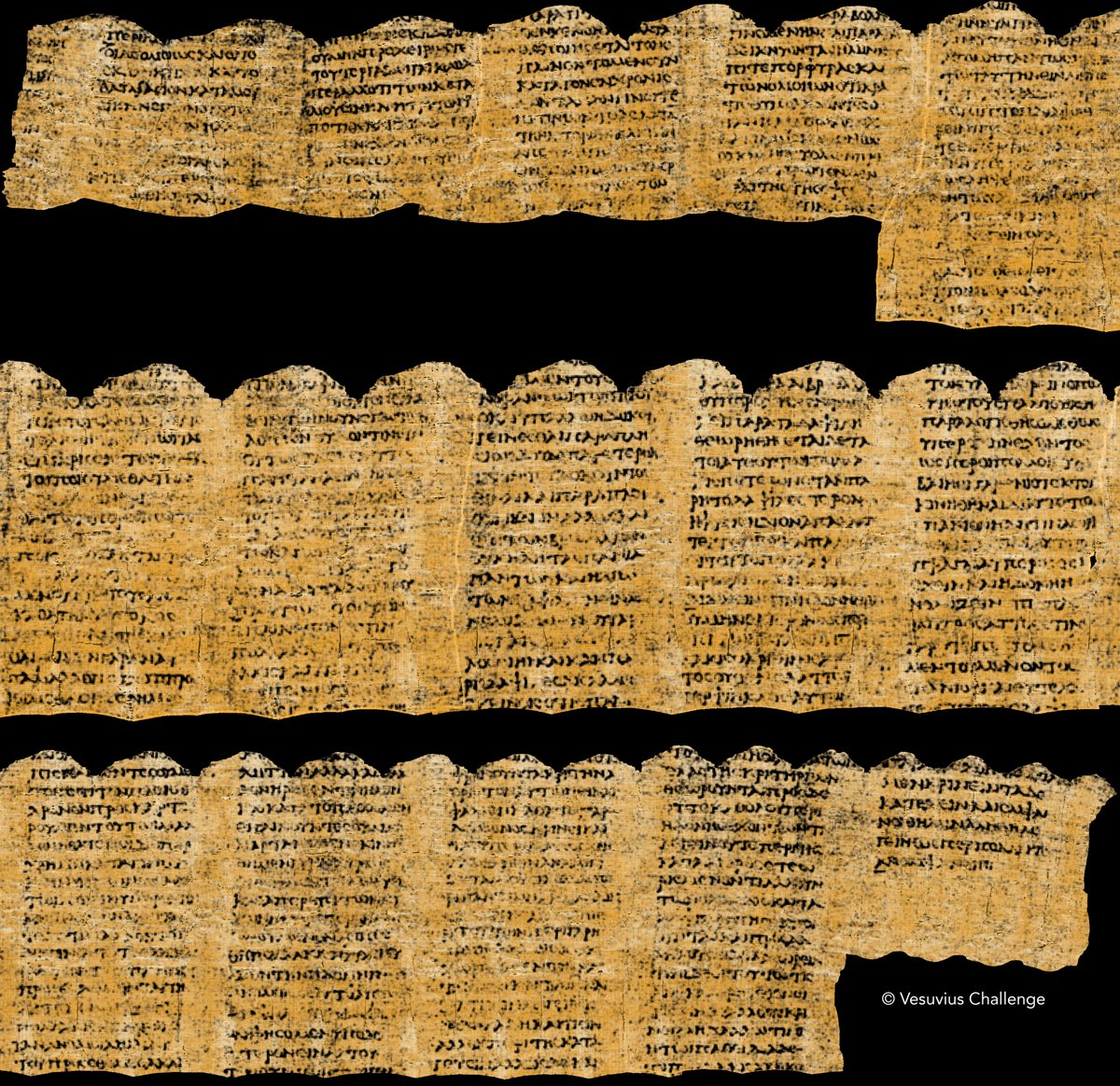
Today we are overjoyed to announce that our crazy project has succeeded. After 2000 years, we can finally read the scrolls:
This image was produced by @Youssef_M_Nader, @LukeFarritor, and @JuliSchillij, who have now won the Vesuvius Challenge Grand Prize of $700,000. Congratulations!!
These fifteen columns come from the very end of the first scroll we have been able to read and contain new text from the ancient world that has never been seen before. The author – probably Epicurean philosopher Philodemus – writes here about music, food, and how to enjoy life's pleasures. In the closing section, he throws shade at unnamed ideological adversaries – perhaps the stoics? – who "have nothing to say about pleasure, either in general or in particular."
This year, the Vesuvius Challenge continues. The text that we revealed so far represents just 5% of one scroll.
In 2024, our goal is to from reading a few passages of text to entire scrolls, and we're announcing a new $100,000 grand prize for the first team that is able to read at least 90% of all four scrolls that we have scanned.
The scrolls stored in Naples that remain to be read represent more than 16 megabytes of ancient text. But the villa where the scrolls were found was only partially excavated, and scholars tell us that there may be thousands more scrolls underground. Our hope is that the success of the Vesuvius Challenge catalyzes the excavation of the villa, that the main library is discovered, and that whatever we find there rewrites history and inspires all of us.
It's been a great joy to work on this strange and amazing project. Thanks to Brent Seales for laying the foundation for this work over so many years, thanks to the friends and Twitter users whose donations powered our effort, and thanks to the many contestants whose contributions have made the Vesuvius Challenge successful!
Read more in our announcement: https://t.co/rUlrdGXBMs
“30 Rock” provides a fascinating window into changes in progressivism over the last decade. When the series ended in 2013, Ta-Nehesi Coates observed, “One thing that I don't think 30 Rock gets enough credit for is how it handles race.” He said no show had “handled race better” 1/