Introducing Boat.
A cloud workspace that turns development tasks into code changes you can inspect, test, and approve.
Describe a website or import a repository. Agents edit files and execute commands inside isolated Vercel sandboxes, while API credentials remain outside the execution environment. Neon preserves task history, events, and exported results, keeping the path from instruction to implementation available for review.
Inspect the patch. Check the test output. Preview the generated website. Decide which changes to accept. From focused website builds to bug fixes and small prototypes, Boat brings execution and review into one workflow.
CA : 0x567F5273c6CA85D43942d562dB4a0C08F25a27be
Surplus describes turning wallet CREDIT into API balance in its inference flow.
That is a useful UI test: can someone tell what they hold from what they can spend on requests?
Show both balances, and explain when activation moves value between them.
Before you ask what Surplus is, here's the full picture: what it does, where the discount comes from, and what's live versus planned.
A 5-minute read. https://t.co/Mkc7iVcXxk
One detail in Otomate’s update caught our eye: Studio drafts a description from a logo, then asks the creator to review it.
For any AI builder, that review screen matters. Can you edit a sentence without regenerating the whole result?
1/8
Your token. Your art. Your community. 👻
Otomate creators just got more control. Traders got a smarter Terminal.
New tools, smoother launches and better VOYAGE tracking.
Live on @inkonchain & Robinhood Chain @RobinhoodCrypto.
Here’s what’s new ↓
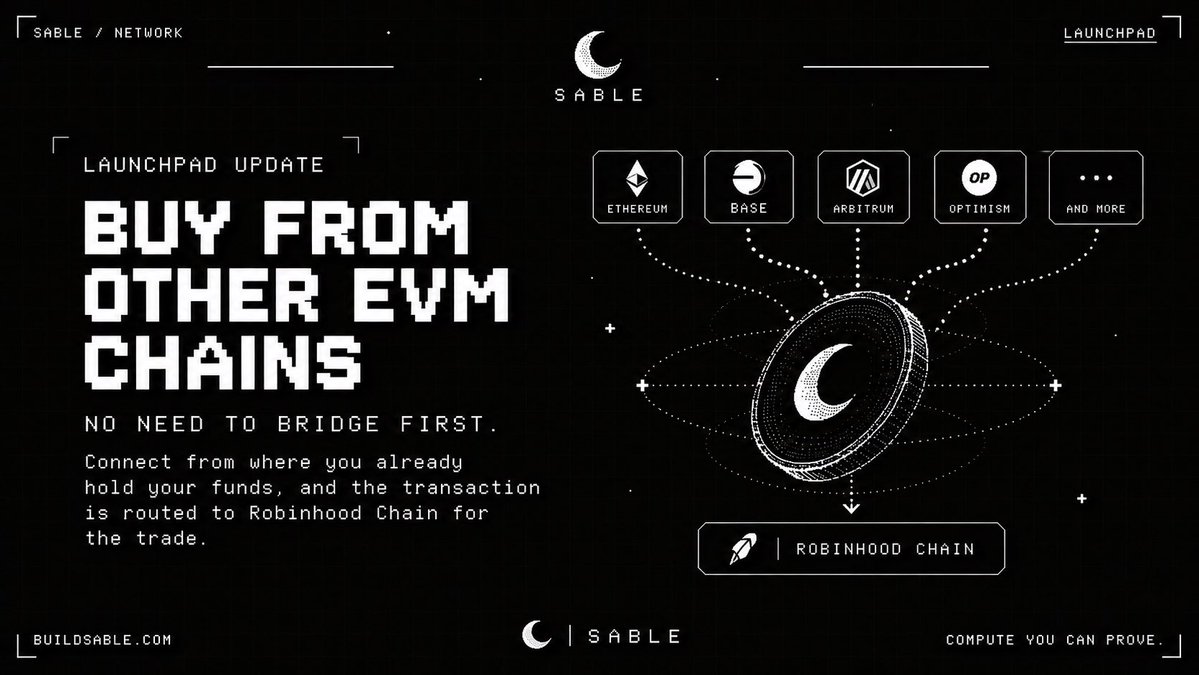
Sable describes routing funds from other EVM chains to Robinhood Chain without a separate bridge step.
For builders: can the confirmation screen still show the starting chain, destination and total cost?
Fewer steps should still leave the route understandable.
Launchpad update.
You no longer need to bridge to buy a Sable Launchpad coin.
It now supports buying from other EVM chains.
Connect from where you already hold your funds, and the transaction is routed to Robinhood Chain for the trade.
We keep building.
Ankr now lists Robinhood Chain RPC access for Premium users.
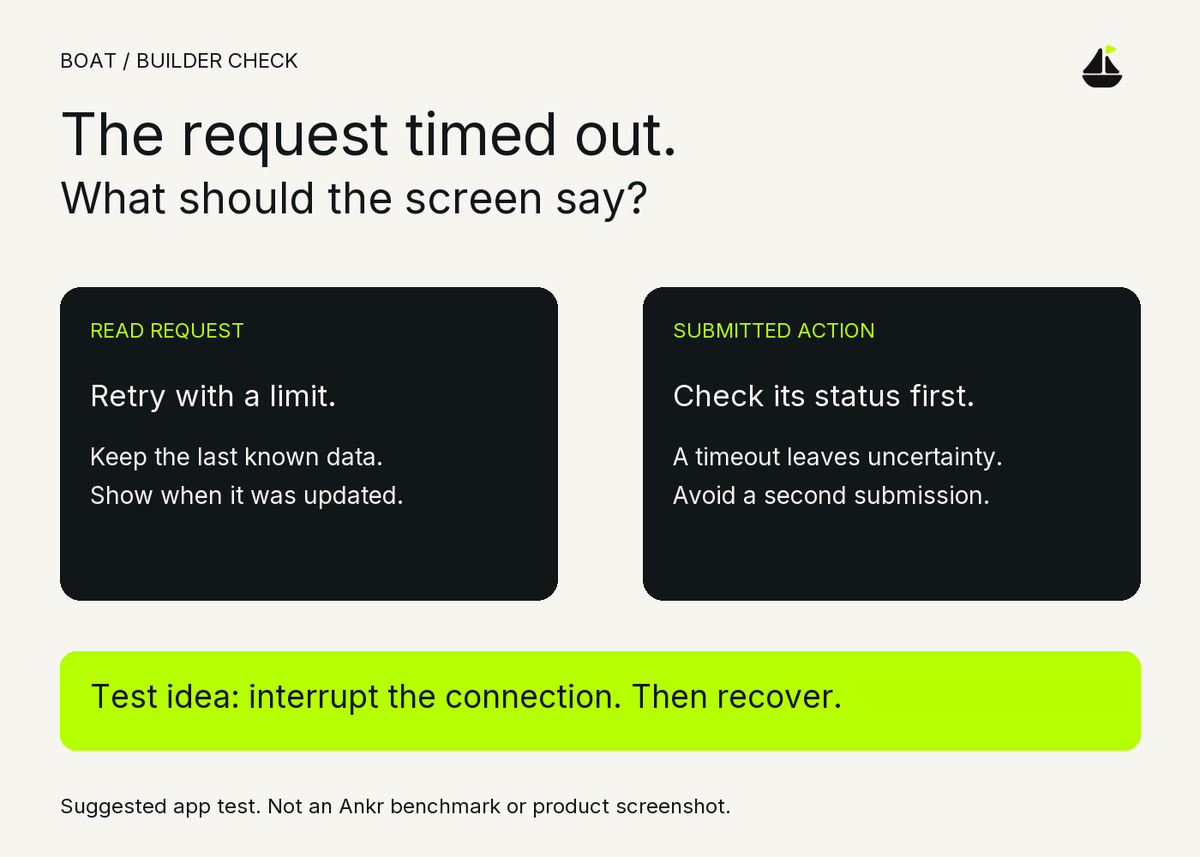
The next test I’d run in an app: interrupt the connection after submitting an action. Does the screen check its status, or invite a second submission?
A timeout is not proof that nothing happened.
Robinhood Chain is now live on Ankr RPC 🪶
Premium users can start building on @RobinhoodCrypto’s Ethereum L2 with fast, reliable RPC access through Ankr.
Robinhood is bringing more of finance onchain.
We’re giving builders the infrastructure to meet them there. 👇
Tried the new Pons app: we could browse launches and filter by pair asset before connecting a wallet.
A useful onboarding choice. Let people understand the page before asking for access.
What can a first-time visitor learn in your app without signing in?
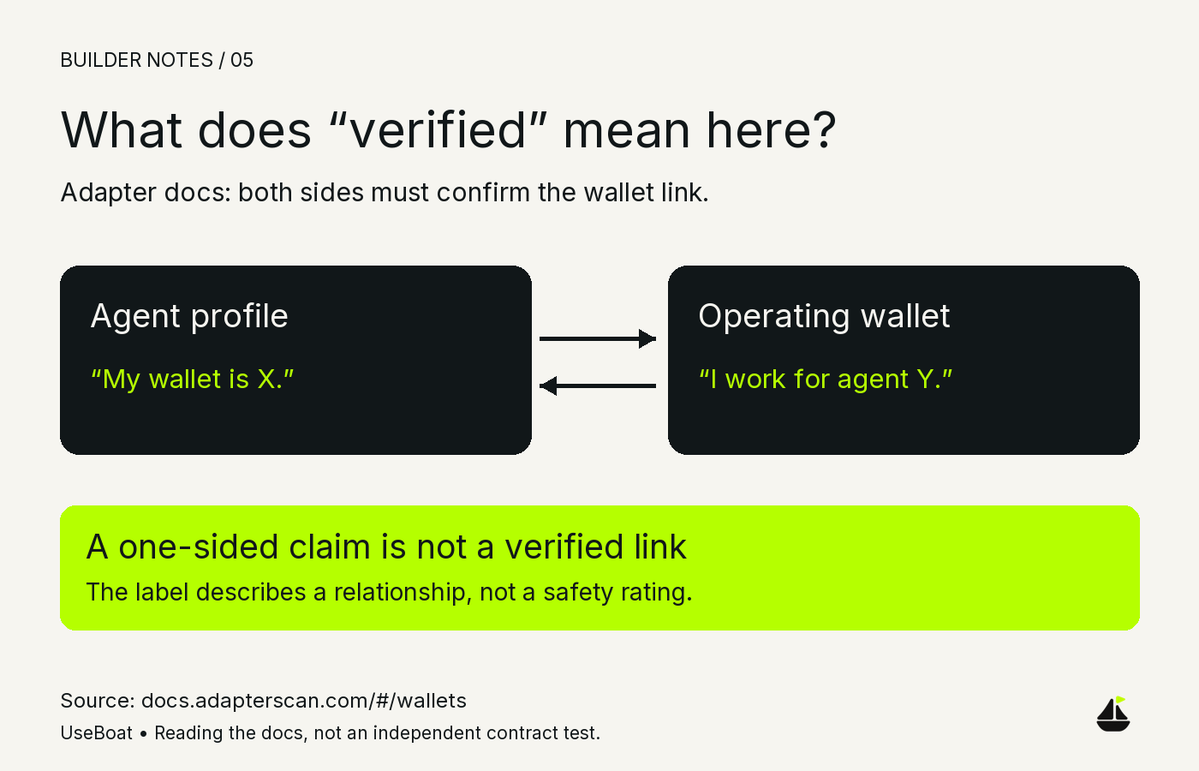
A useful detail in Adapter’s docs: a verified wallet link needs confirmation from both the profile and the wallet.
For a builder, the UI question is simple: can someone tell a one-sided claim from a confirmed link?
Worth explaining beside the badge.
I’ve spent the last five years working full-time in Web3 and the Ethereum ecosystem. Most projects I’ve seen die, sometimes almost immediately. Within two years, it’s usually clear whether a project is working.
The projects that succeed tend to:
> Move first.
> Solve a real problem that anyone can understand.
> Build a brand around solving that problem for users.
Some examples:
@Uniswap → token swaps
@opensea → NFT marketplace
@ensdomains → blockchain domains
@aave → onchain lending
@chainlink → oracles and bridging
@MetaMask → wallet
@safe → multisigs
@Superfluid_HQ → token streaming
@USDT0_to → stablecoins
@USDC → stablecoins
Adapter launched on Ethereum Mainnet and Base on April 5, 2026, with its first site at https://t.co/HD1ogXBI6o.
On September 29, 2026, Adapter was deployed to Robinhood Chain. The new site is https://t.co/GPtO9ukiO9.
Mainnet and Base will be upgraded soon, and the old site will be retired.
In a few words:
Adapter → identity for agent NFTs.
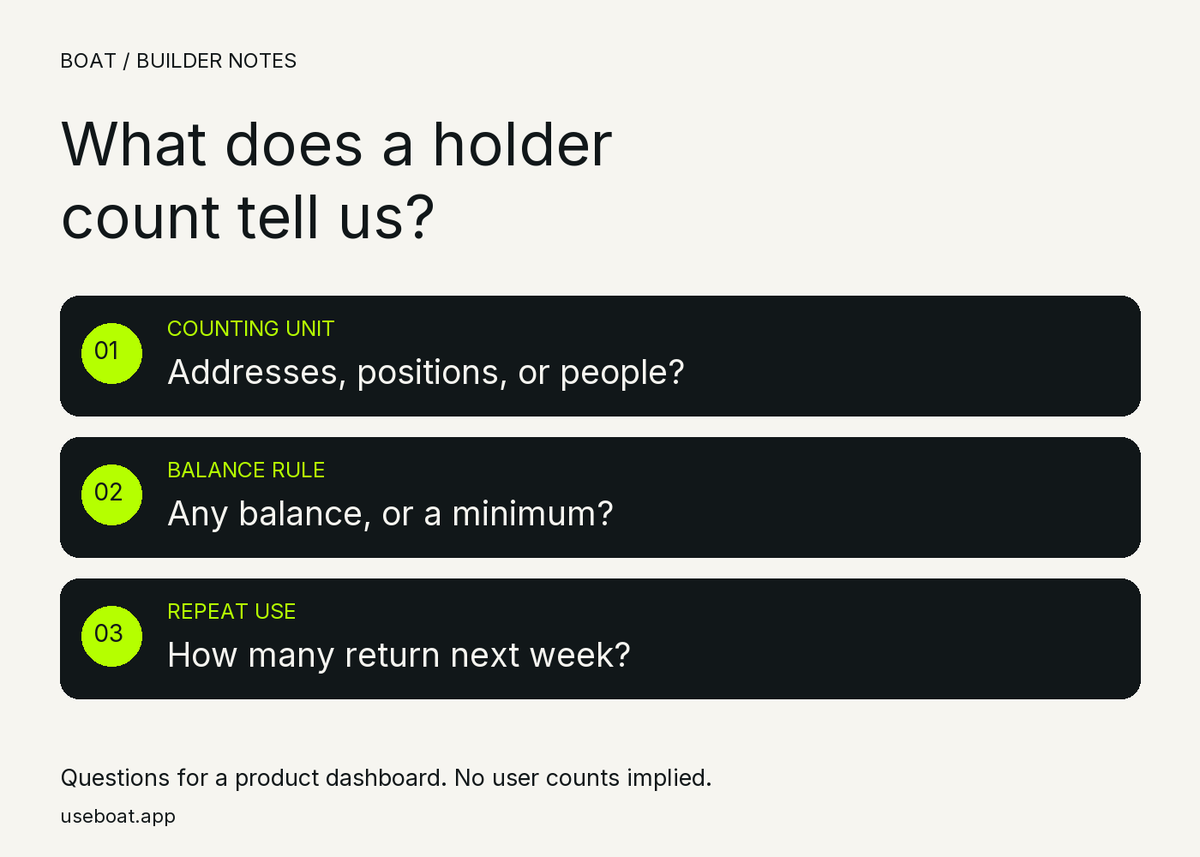
This chart raises a useful product question: what counts as a holder?
Before using a number like this to size an app, check the counting unit and balance threshold. Then measure repeat use separately.
A dashboard needs definitions as much as it needs charts.
Solana led tokenized stock distribution for nine months.
Robinhood Chain launched and took the #1 spot in seven weeks.
Then BNB Chain grabbed the top spot, lost it, and won it back.
Today: BNB Chain 1.89M holders, Robinhood Chain 1.46M, Solana 1.29M.
A launch date needs an audience attached to it.
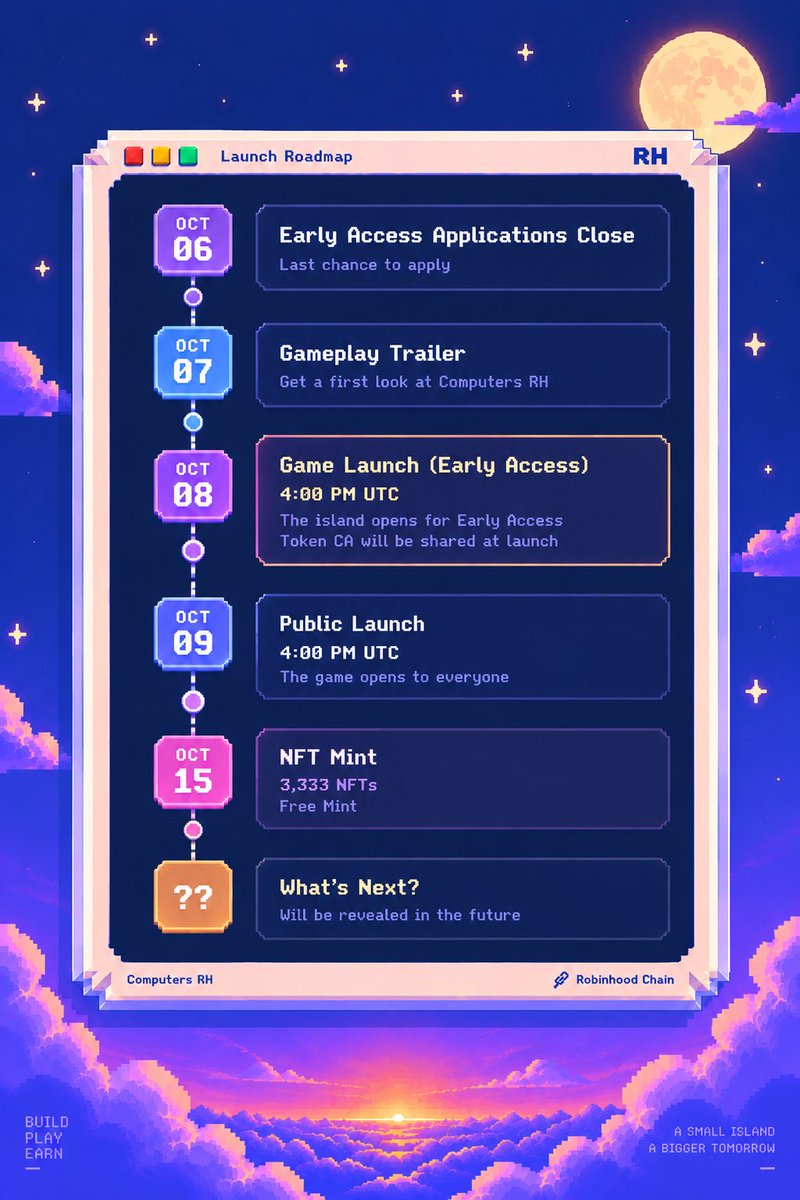
Computers RH lists early access on Oct 8 and public access on Oct 9, both at 4 PM UTC.
For our own launches, a useful check: can a first-time visitor tell when they can enter, and what they can actually do?
Computers RH officially launches on October 8 at 4 PM UTC. 🖥️
To ensure a smooth launch, we’ve decided to delay the game by 2 days.
Early Access applications will close within the next 24 hours. ⏳
Here’s the updated roadmap. 👇
Oct 6, 4 PM UTC
Early Access applications close.
Oct 7
Official Gameplay Trailer goes live.
Oct 8, 3 PM UTC
Game Docs & User Guide go live, covering all game mechanics and everything you need to know before playing.
Oct 8, 4 PM UTC
🏝️ Computers RH goes live.
Early Access applicants can enter the game and start playing.
The official Token CA will be posted here the moment the game goes live.
Oct 9, 4 PM UTC
🌐 Public Launch.
The island opens to everyone.
Oct 15
3,333 NFTs. Free Mint.
More will be revealed after launch.
We’re almost there.
See you on the island. 🏝️
A useful SDK promise in this post: simulate before signing and return named errors.
The test I'd add: reject the signature, then retry. Does the app recover without creating a second action?
Build is on Robinhood Chain testnet.
Introducing Build.
Structured notes can now live inside any wallet, app or treasury: as a savings balance, next to a stock you hold, or as collateral in a lending market.
Whoever brings the deposits earns up to half of the fees, paid on-chain. https://t.co/29nxpBYIOb
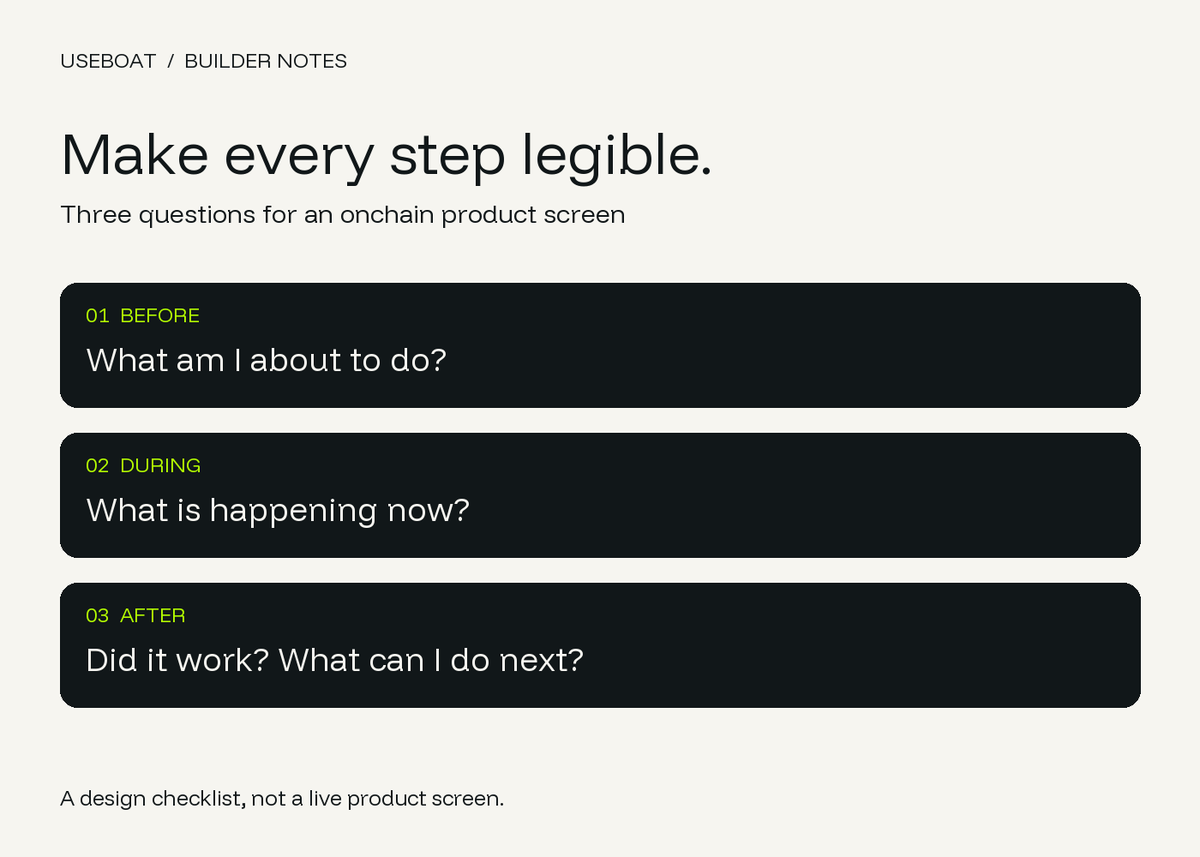
Each arrow here is a screen someone has to understand.
For builders: explain the action before the click, show a useful pending state, and make failure recoverable.
Which step in your app still needs a plain-English explanation?
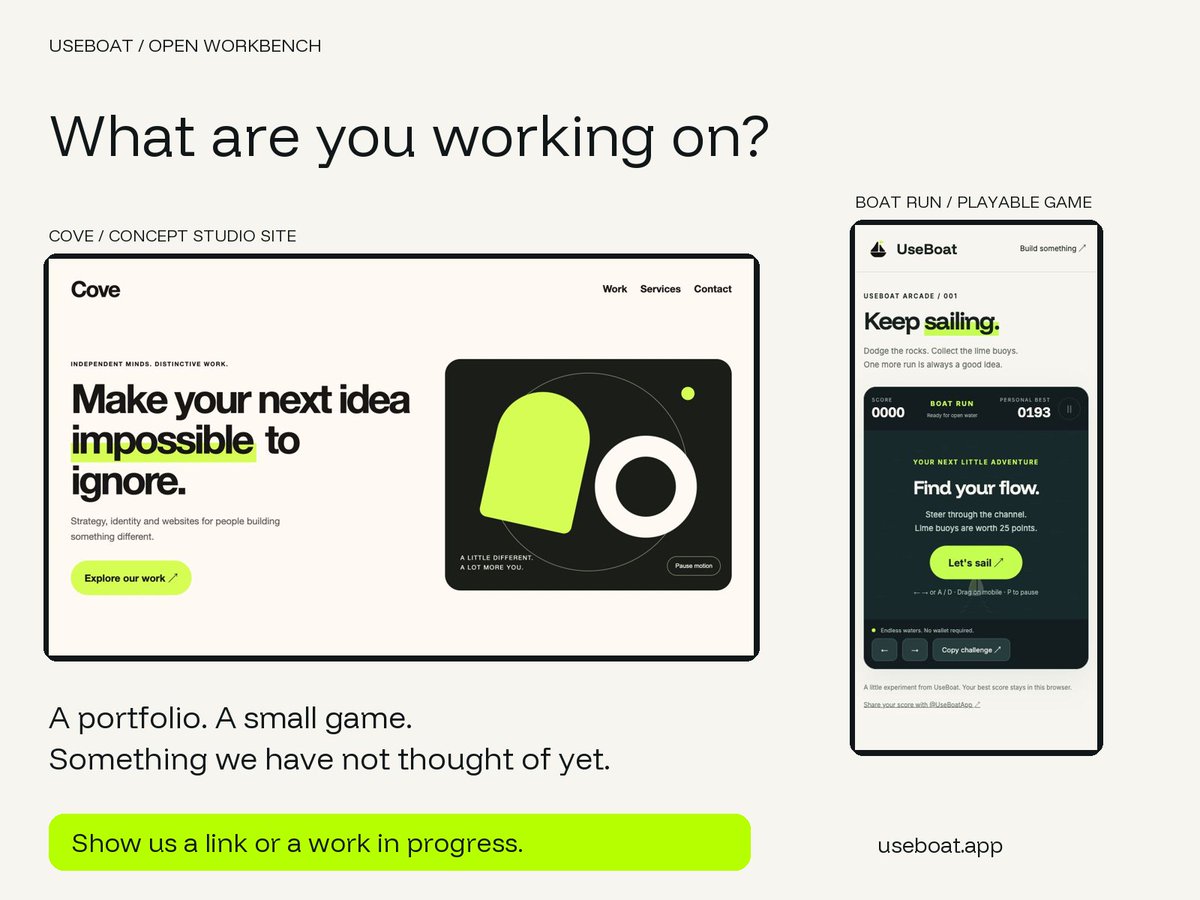
We have been sharing our own experiments: a concept studio site and a little boat game.
Now we want to see yours.
Drop a link, a screenshot, or the rough version you are still figuring out. Tell us what you are trying to make.
https://t.co/Nn2UmCF1Yv
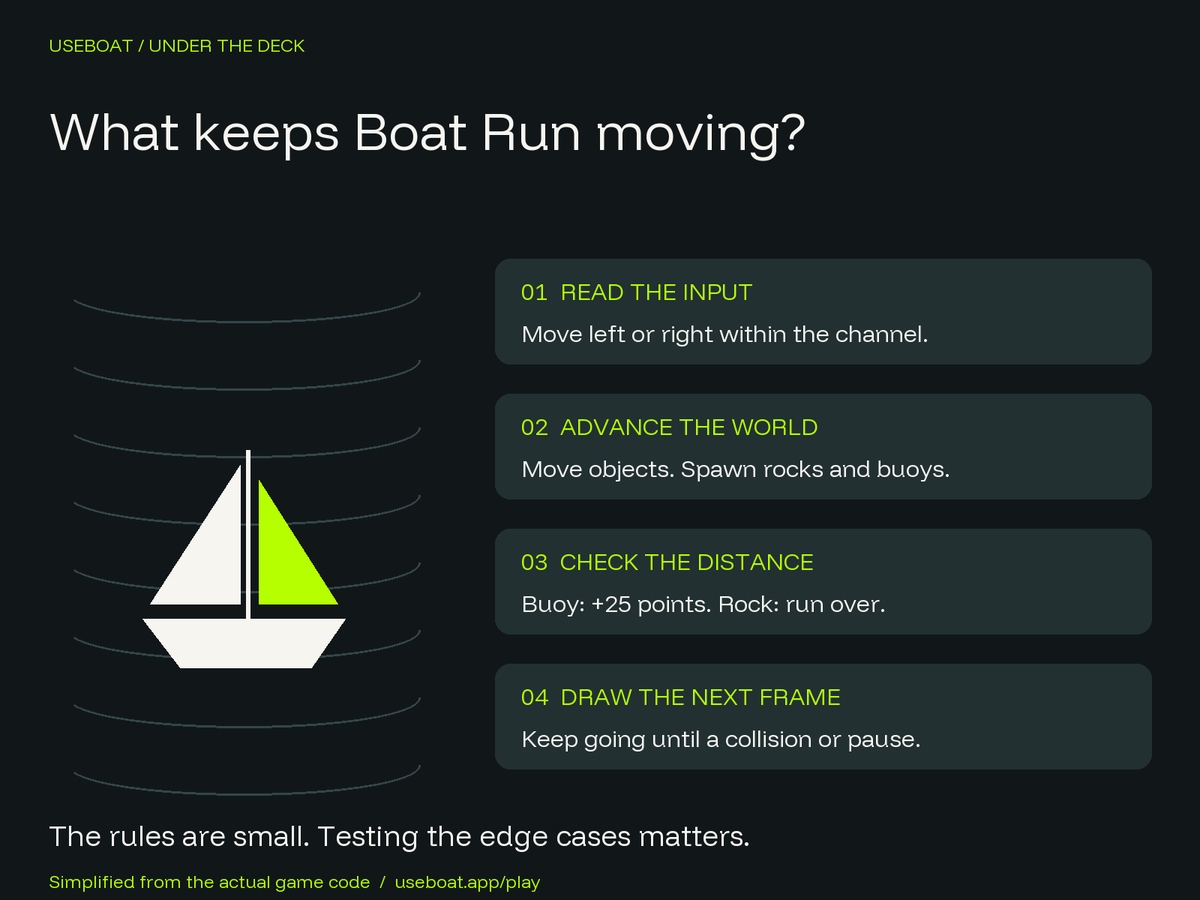
Under the deck of Boat Run: read your input, move the obstacles, check for a hit, draw again.
We kept the rules small and tested movement limits, scoring and collisions.
Here is the loop behind our little game.
https://t.co/NmfgAVDa4o
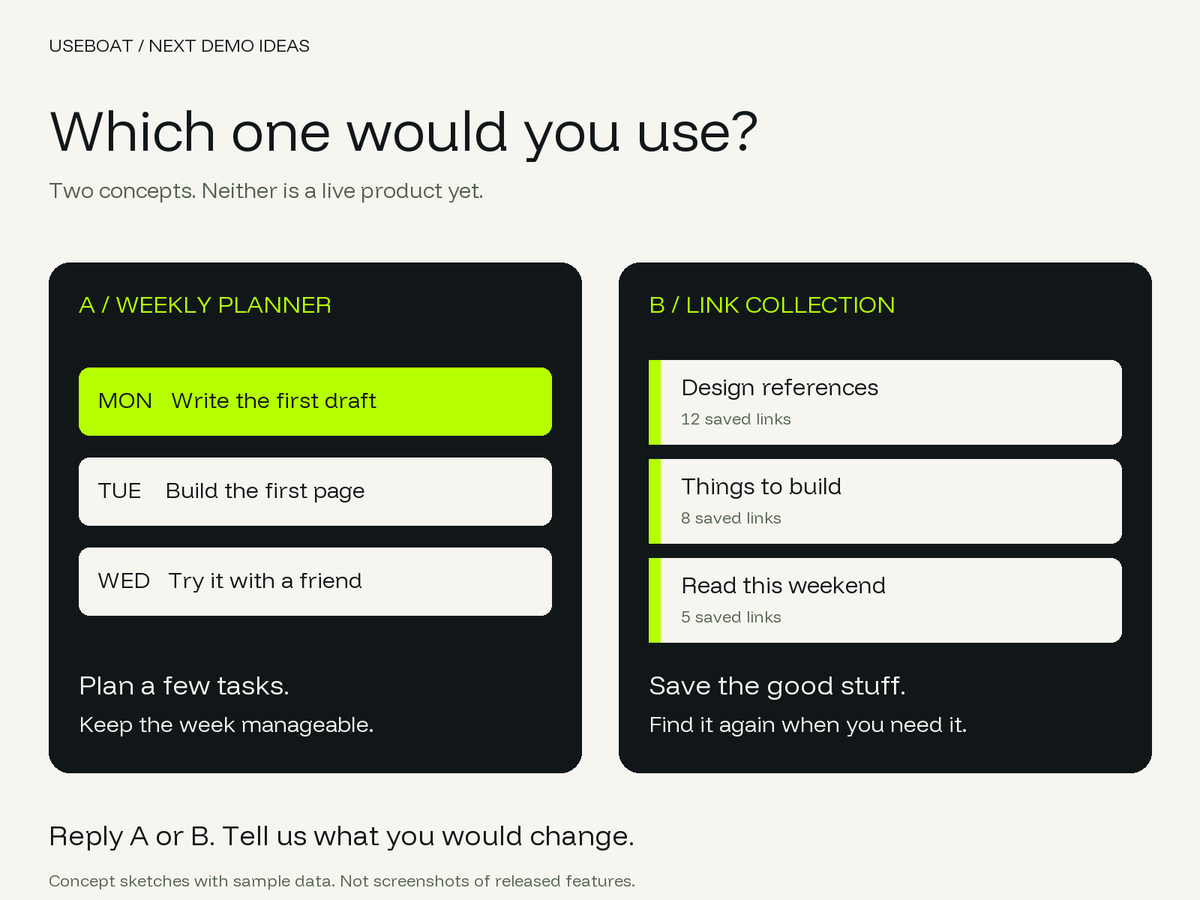
Two ideas for a future UseBoat demo.
A: a weekly planner for a few tasks that matter.
B: a place to save links you actually want to find again.
These are sketches, not live apps.
Which would you use, and what is the one feature it would need?
A small detail from Cove: the work filters actually change which projects you see.
All. Branding. Illustration.
This clip shows real browser states from our concept site, built with UseBoat.
What small interaction makes a site feel better to you?
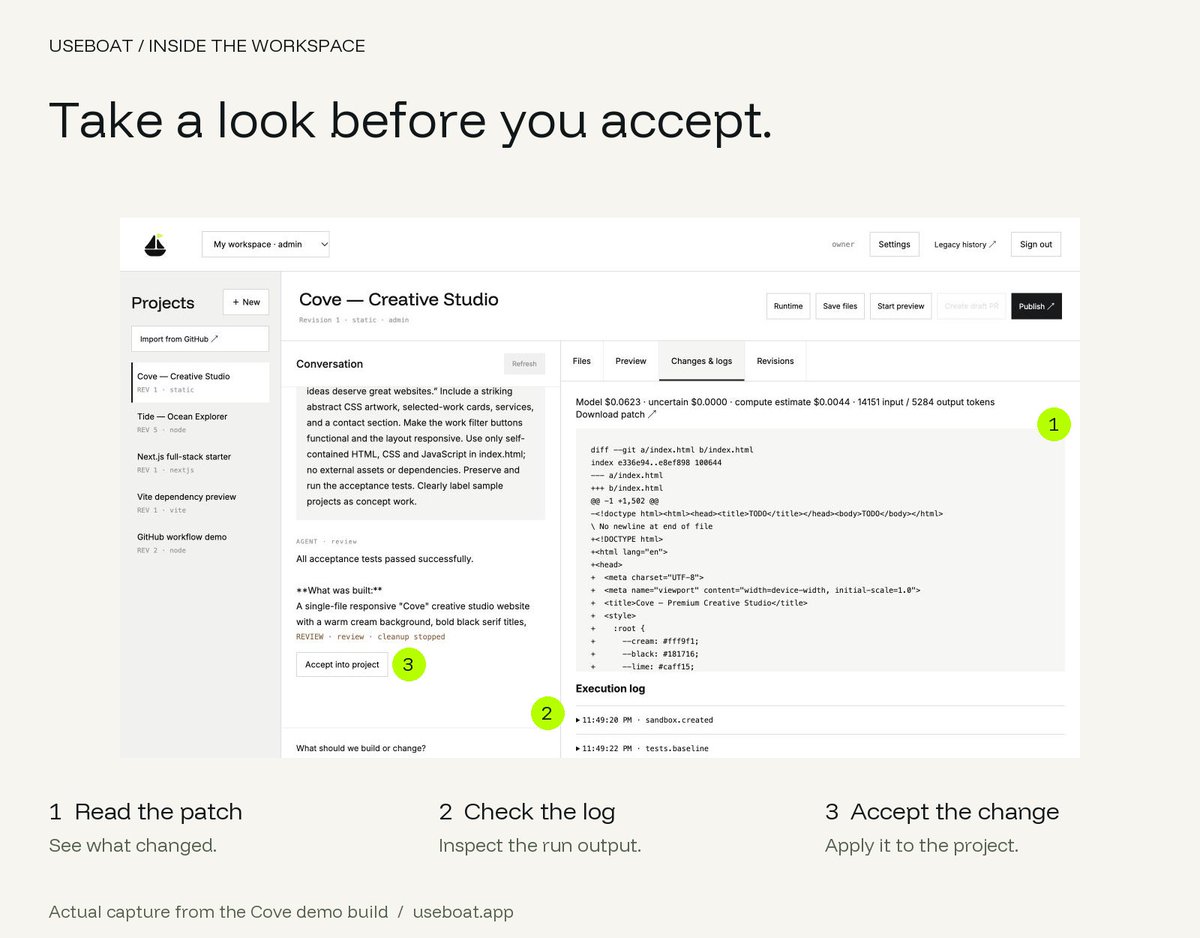
This is the part worth slowing down for.
In the Cove demo, we could read the patch and inspect the execution log before accepting the change into the project.
A look inside that review step in UseBoat.
https://t.co/Nn2UmCF1Yv
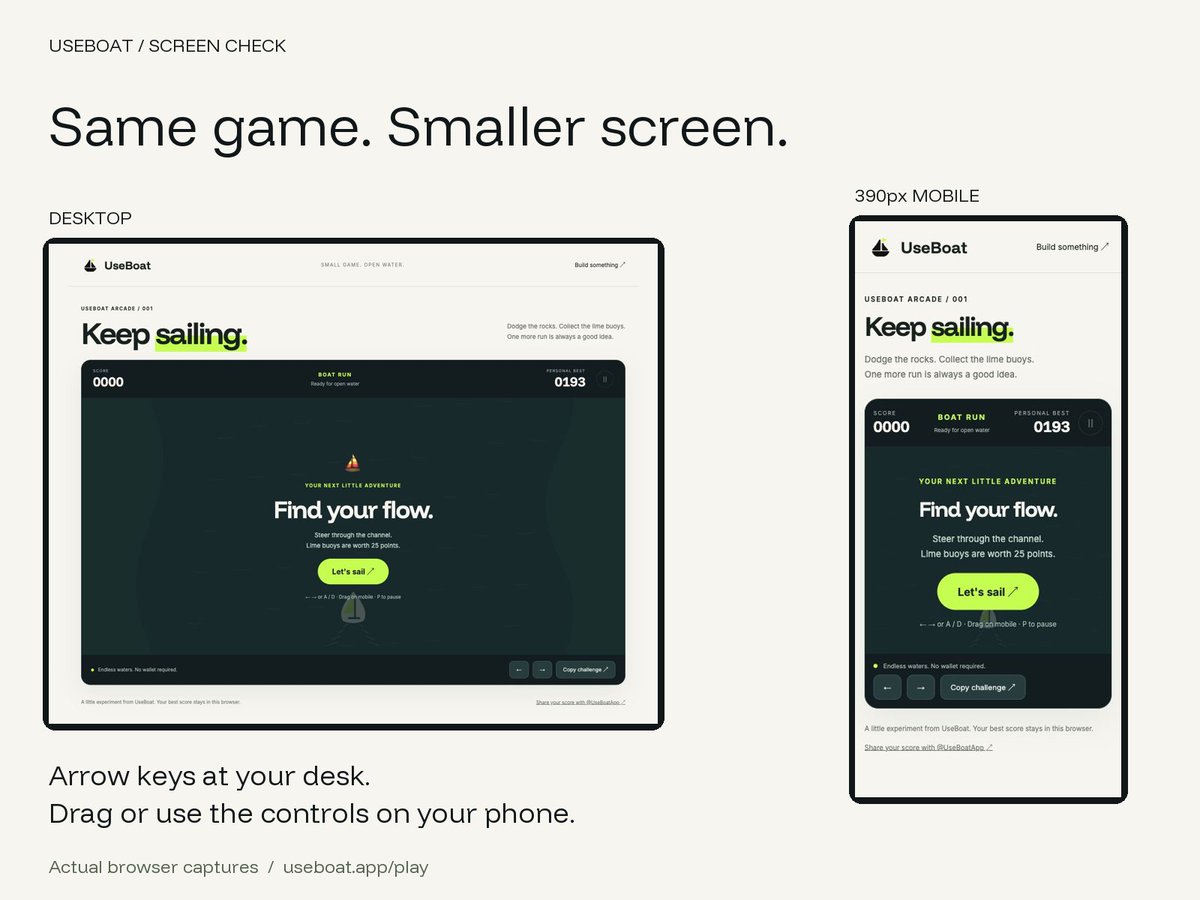
Boat Run, at your desk or on your phone.
Arrow keys on desktop. Drag or tap the controls on mobile.
Here is the same page at two screen sizes. Give it a run and tell us if anything feels awkward on yours.
https://t.co/NmfgAVDa4o
Getting a lot of “should we collab?” replies lately.
Honestly, we’d love for you to try UseBoat and tell us what’s broken, confusing, or missing.
That kind of feedback helps us build something people keep using. We’re here for the long run.
https://t.co/RfM8vl3snw
Your first version can be small.
A booking page with one service. A tracker with one habit. A site with one clear reason to visit.
Get that part working. Then decide what comes next.
What would your version one do?
https://t.co/Nn2UmCF1Yv