Africa is full of surpsises
Ugandan police arrested a man for witchcraft, took him to court, and he responded by inviting bees to the court.
Everyone was attacked by the bees. He didn’t get a single sting.
Interesting to see a man running around with a fire 🔥 extinguisher.
Earth is hard , best such guys are left in peace.
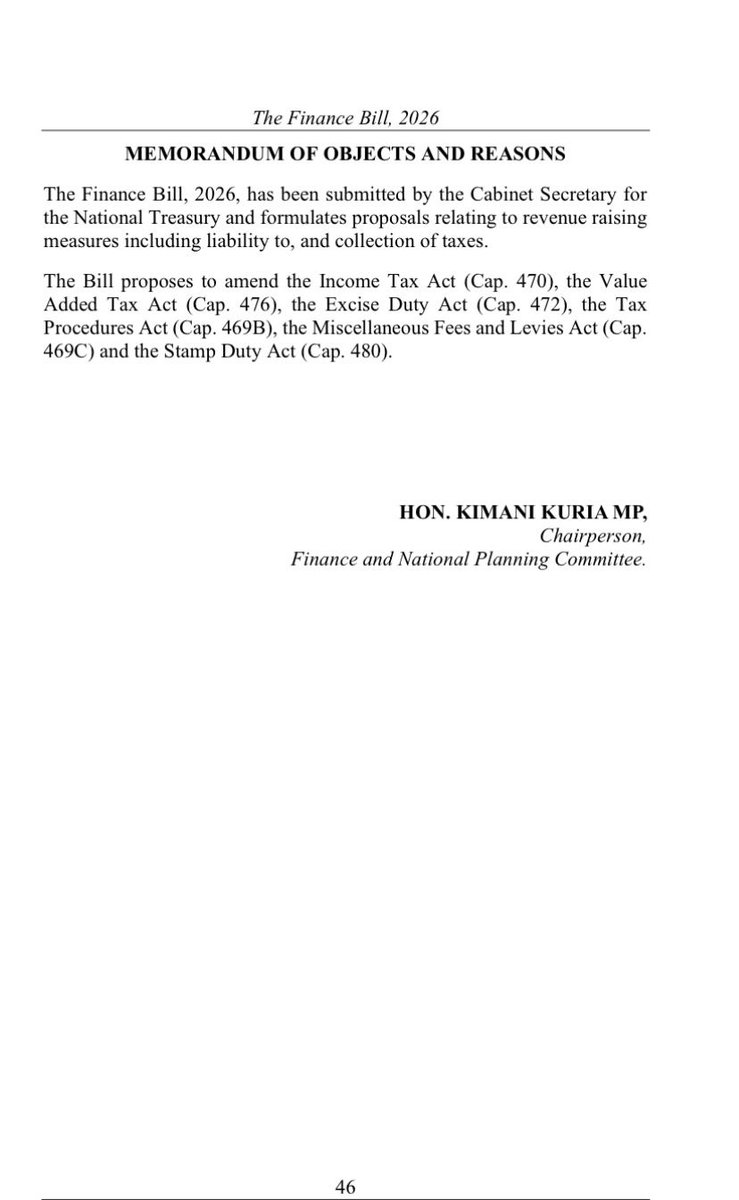
The finance bill 2026 will affect us negatively as follows;
1. Rental income tax has been raised from 7.5% to 10%.(Brace yourself for increased rent)
2. Mitumba traders, brace yourselves.
Import a bale at Ksh1M → Pay Ksh50K tax upfront.
3. They’re removing VAT exemptions on mobile money and digital payments.This will increase the cost of sending money.
4. KRA can now decide 60% of your company’s retained earnings are “dividends” and tax you anyway.
5. An introduction 25% excise duty on phones.
6. Banks won’t absorb new compliance costs. Let’s be serious.
You will.
7. They’ve moved tax return deadlines from June to APRIL.
Tough times ahead.
Incoming Finance Bill;does Parliament/Executive have moral authority to increase taxes on the already over-taxed Kenyans without first returning money stolen/looted in;E-Citizen;SHA;G-2-G Fuel imports;Construction kickbacks,budgeted corruption eg
Education Min.etc?BOYCOTT?
I saw someone ask, “What exactly has Edwin Sifuna done in the Senate?”
Fair question.
Because in Kenyan politics, too many leaders are loud on TV and silent in Parliament.
So I checked the record.
So far, Sifuna has tabled 3 Bills and pushed 3 major people-centred motions:
1. Sports (Amendment) Bill
To reform sports governance, improve accountability in sports bodies, and protect athletes from mismanagement.
2. Energy (Amendment) Bill
To address high electricity costs, strengthen regulation in the energy sector, and push for fairer pricing for consumers.
3. Office of the County Printer Bill
To institutionalize county publication of laws and notices, making county governments more transparent and accountable.
And his motions?
1. Abolishing parking fees in hospitals, malls and airports
Because access to hospitals and essential services should not come with punitive charges.
2. Inquiry into deputy governors’ welfare and protection
To address the growing trend of political frustration, humiliation and sidelining of deputy governors.
3. Electricity cost reduction reforms
To push government and regulators to lower the cost of power for households and businesses.
On top of that, he has been active in Senate oversight committees, questioning governors, including Johnson Sakaja, on accountability. He has also submitted several statements in the Senate. And much more is on the way.
This is why some of us support Sifuna.
Not because we are blind.
Not because of party loyalty.
But because we checked the receipts.
Before dismissing him, show us your MP or Senator’s record first.
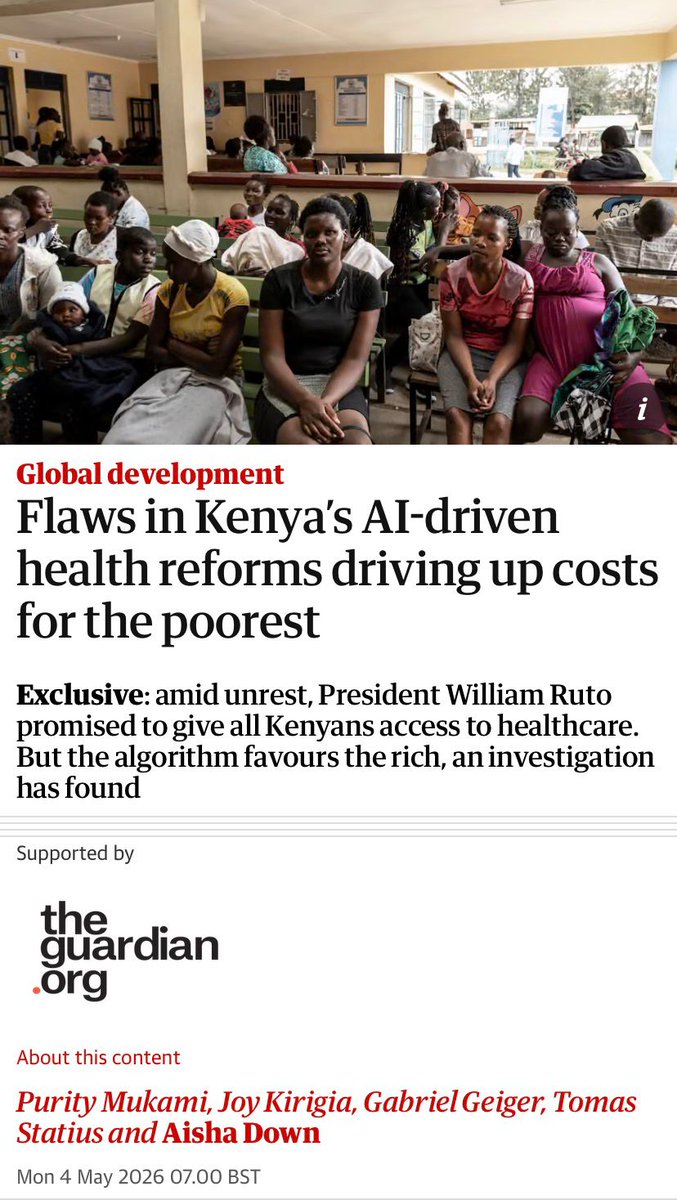
AI-driven Social Health Authority (SHA) was sold to us as a revolution in healthcare financing. However, the algorithm overcharges the poorest Kenyans while undercharging the wealthy. A single mother earning Ksh 3,500/month is now billed Ksh 1,030 for health cover. That is digital poverty extraction.
At the same time, yesterday’s Daily Nation cover story on the politics of motherhood reminds us that women, especially poor and working-class mothers, already carry the invisible burden of sustaining families, communities and the economy through unpaid care work, sacrifice and survival. Yet instead of easing that burden, the system is now digitising it. A mother struggling to put food on the table is reduced to an affordability score by an opaque algorithm that cannot measure exhaustion, caregiving, vulnerability or survival.
Many reports flagged this system as flawed and inequitable before it was even launched. The Government chose to proceed anyway. Today, only 5 million of 22 million registered members pay regularly and Kenyans are dying because they cannot afford to walk into a facility.
Technology should serve human dignity. This one entrenches inequality and calls it algorithmic neutrality. The poor are not data points. They are Kenyans who deserve better healthcare.
Harry Truman once said: “The only thing new in the world is the history you do not know.”
Fellow Kenyans, our crisis did not begin yesterday.
The looting. The illegal debt. The betrayal of the Constitution. The collapse of public services. The silence of career politicians. These are old scripts repeated by leaders who believe Kenyans forget quickly.
They believe another scandal will trend. Another distraction will come. Another funeral, another handshake, another coalition, another slogan.
Meanwhile, you pay more taxes for debts you never approved and never benefited from.
Between 2014 and 2024, Kenya borrowed Sh9.11 trillion. Only Sh2.57 trillion received proper parliamentary approval. The remaining Sh6.54 trillion is odious debt, unconstitutional borrowing forced onto the backs of struggling citizens.
This is why food prices rise while wages stagnate. This is why hospitals lack medicine while billions disappear. This is why schools decline while politicians grow richer. This is why young people graduate into hopelessness.
And while Kenya bleeds, legacy politicians remain silent. Many are not fighting to fix the system. They are fighting to inherit it.
They criminalize protesters. They weaponize police. They reward political loyalists with advisory jobs funded by taxpayers. They protect corruption networks while ordinary Kenyans suffer.
We go to court because the Constitution is the last line of defense between the people and organized state plunder.
From the struggle for independence in 1963, to Saba Saba, to the 2010 Constitution, every generation of Kenyans has been called to defend freedom against greed and impunity. History is watching us now.
If we remain silent while our country is looted, future generations will remember us as the people who watched Kenya collapse and did nothing.
Read history. Defend the Constitution. Reject fear. Reject silence. Reject thieves disguised as leaders.
We must be a nation that reads, remembers, and refuses to be misled by the same old tricks. Know your history, defend your rights, and let us not be "newly" surprised by what we should have already learned.
Kenya istahili heshima
#OdiousDebt
#ReKe
#Constitutionalism
The Finance Bill, 2026 was published on 30th April and is now before Parliament and every Kenyan deserves to know what is in it.
The government targets Ksh3.63 trillion in revenue for 2026/27 and a wider budget deficit of 5.3% of GDP in the 2026/27 fiscal year (July-June) up from 4.7% in 2025/26. These are not unreasonable fiscal objectives but the manner in which the burden of achieving them is distributed is a cause for serious concern.
On tax filing timelines, the Bill moves the income tax return deadline to April 30th which is two months earlier than the current June 30th and compresses nil return filing to January 31st. This reduces the time available for audit completion, cash flow planning and compliance. For small businesses and individual traders, this is not administrative reform. It is an additional compliance cost they can ill afford.
On mitumba, the Bill inserts a new Section 12H into the Income Tax Act which deems profit at 5% of customs value payable upfront before goods are released by KRA as a final tax. A trader importing a bale worth Ksh1 million pays Ksh50,000 regardless of whether they make a profit or a loss. I cannot in good conscience describe this as equitable.
The Bill increases residential rental income tax from 7.5% to 10%. Absent a serious enforcement framework, this will drive non-compliance rather than revenue. The government must fix the enforcement gap before it increases the rate. One without the other is burden-shifting.
On digital financial services, the Bill removes existing VAT exemptions on money transfers and payment processing. These are the tools of financial inclusion that millions of Kenyans including the very people this government says it wants to reach rely on daily. Making them more expensive will not serve the objective of a broader tax base.
By including interchange and merchant service fees within the definition of management or professional fees for withholding tax purposes, the Bill introduces a compliance burden into automated banking processes. That burden will be passed on to businesses and ultimately to consumers.
The amendment to Section 24 of the Income Tax Act empowers KRA to deem at least 60% of a company's undistributed income as dividends for tax purposes. This fails to account for legitimate decisions on reinvestment, working capital and business growth. It is a retrogressive measure that sends the wrong signal to the investors Kenya needs.
A 25% excise duty on telephones for cellular and wireless networks is proposed. A phone is not a luxury. It is how Kenyans bank, communicate, conduct business and access government services. Parliament must interrogate this carefully.
On PAYE, Kenyans were led to expect relief and a restructuring of the tax bands to ease the burden on salaried workers. That proposal does not appear in this Bill. That is not a minor omission. An explanation is owed to every employed Kenyan who was waiting for it.
To be fair, the Bill is not without merit. The reduction of corporate tax for non-resident companies from 37.5% to 30% improves our investment climate. The extension of the tax amnesty to cover liabilities up to 31st December 2025 provides a genuine and welcome pathway to compliance. VAT exemptions on electric buses, bicycles, dialysers, animal feed raw materials and PPP infrastructure are sensible measures. The clarity introduced on trust taxation ensuring beneficiaries are not taxed on income already taxed at the trust level and the recognition of gratuity contributions as exempt income are also steps in the right direction.
Be that as it may, we cannot afford a repeat of June 2024. Parliament must discharge its oversight role with the seriousness this moment demands. They should not merely rubber-stamp what the Treasury has placed before it. Every clause must be scrutinised. Every punitive or ambiguous provision must be rejected or amended.
#FinanceBill2026 #PublicParticipation
The truth will always be told as it is!
You can deny some the mic and chase others away, but from the crowd/congregation, another will rise and say what must be said.
Rt. Rev. Charles Ochieng’ Ong’injo, the Bishop of the Anglican Diocese of Maseno South did not mince his words today.
The High Court yesterday made a very important decision. When you take a loan from any lending institution, the amount of interest accrued cannot exceed the amount you received from the institution (principal). Meaning if you borrow kshs. 100,000, you cannot pay more than kshs.200,000 in total. This is good news to many Kenyans. Tag that one lending institution wajionee habari kamili.
OUR APRIL CHALLENGES and GOALS:
This is the month for structure, discipline, and proof.
HEALTHSET:
• Train 3 days a week.
• Every session must include push, pull, hinge, and core.
• Walk 8,000–12,000 steps daily, especially after meals.
• No sugar, no refined carbs and your first meal at 2 PM.
• Daily OMAD/2MAD and AUTOPHAGY weekly: Wednesday to Friday
SKILLSET:
• Pick one skill that can make you money.
• Skills could be sales, copywriting, coding, AI, or a hand skill.
• Commit 60–90 minutes daily. No distractions before you complete it.
• Leave April with proof of growth.
WEALTHSET:
• Track every coin for 30 days.
• Cut unnecessary spending.
• Save 20–30% of your income.
• Start or grow one income stream.
Control your money, or it will control you.
SOULSET:
• 10–15 minutes of silence daily.
• No phone and no noise.
• Read at least 10 pages a day.
• Reduce talking like a parrot.
• Reduce validation seeking.
Build inner order and masculine calm.
Think. Reflect. Reset.
April will expose weak men, but it will build disciplined men.
#BetterTogether
VIEWER DISCRETION!
As promiscuous women continue to insult me, here is a video by Raphael Tuju.
It is called THE SILENT EPIDEMIC,
It was a popular IEC (Information, Education and Communication) tool in the 90s and 00s promoting behaviour change and sensitising the public about Sexually Transmitted Infections.
Just like the 90s, a lot of young men today have become reckless and indiscriminate in the sex market.
Promotional sexual health messages have since been erased in our public institutions (Schools, colleges and hospitals), leaving an awareness gap that is silently predisposing young people to HIV/AIDS and STDs.
Young men engage in risky sexual behaviours, oblivious to the consequences of their choices.
This video is just 18 minutes, and it will save your life.
CHANGE or PERISH