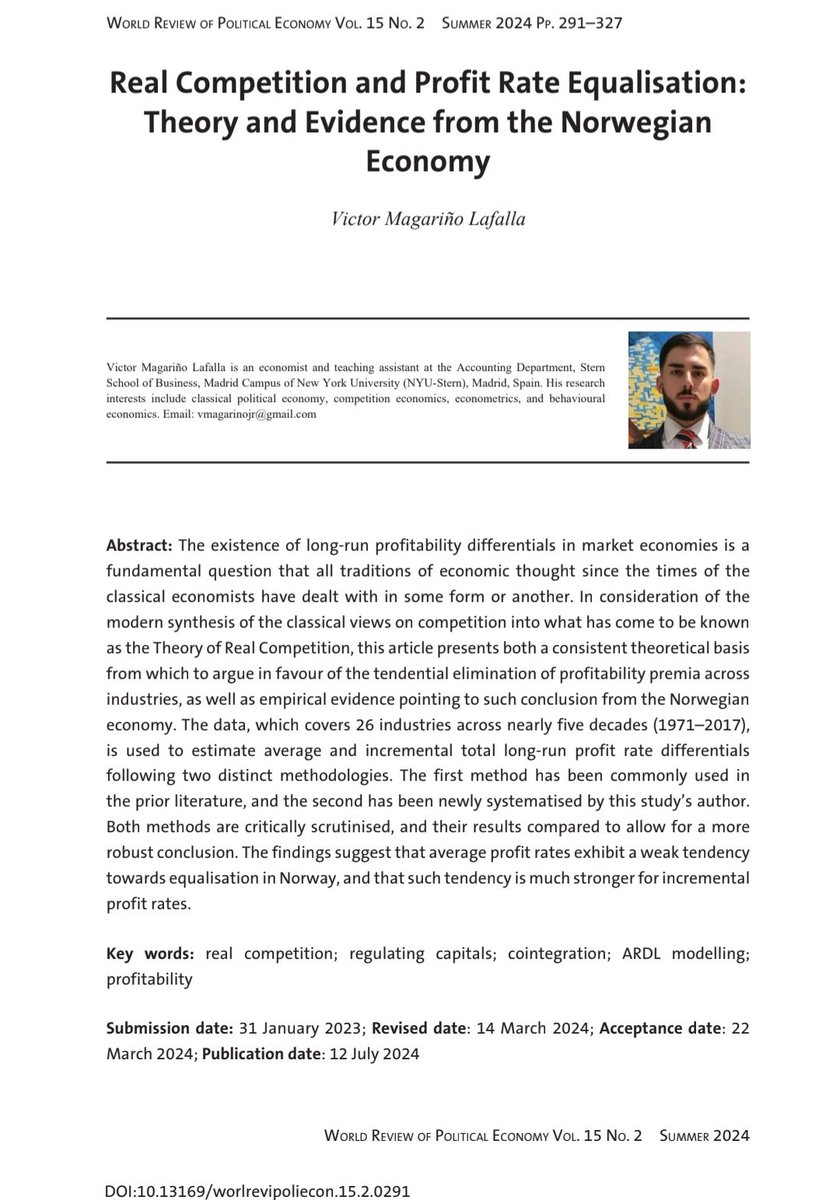
My paper on the issue of profit rate equalisation has been published in the peer-reviewed journal "World Review of Political Economy"
https://t.co/CnuEG9jVrO
“bro so busy trying to not die he forgot how to live”
I’m told hundreds of times a day that I need to live a little. That I’m so busy trying to not die that I’ve forgotten to live.
The psychology powering this sentiment is the most interesting phenomenon happening on earth right now.
Every individual constructs a persona, a character to present to the world. It’s a compromise between what they are and what society demands of them. In current culture, its characteristics are the appearance of living fully, productivity, busyness, enjoying life, pleasure, spontaneity, and being unafraid.
It’s carefully constructed to shield the wearer from the terror of their inevitable death. To make this irreconcilable pain invisible to themselves, they dissolve themselves into the group and enact its rituals.
Sleep under your desk, have a drink, pull the vape, grab a fast food meal, gamble a little, stay up late to watch your favorite show, splurge some, chill out…live a little.
They are living.
At the cellular level, metabolic debt accumulates and repair mechanisms are traded for short term dopamine spikes.
But it’s done together, so it’s normal, and even desirable. No one will die alone if everyone is dying together and all agree to call it living.
The group moves in unison, comforted by the rhythmic movement. When someone declines to participate in their shared rituals, they experience it as an insult and a threat that must be attacked, discredited and mocked.
Subconsciously, they know their rituals are performative and masking something that must be suppressed. But it’s been buried so deep that it’s only a faint whisper, easily silenced by a swipe at the offender.
But then the whisper becomes a quiet voice and asks if they’re afraid. They attack the mirror because they cannot bear the reflection.
In pre-modern societies, death rituals were explicit and honest. They held a funeral, kept a mourning period, washed the body, prayed for the dead and observed burial customs. They faced death and created community rituals to metabolize the grief, fear and loss.
We no longer have death rituals. As explicit customs eroded, consumer culture monetized the void, driving our existential anxieties underground. Thanksgiving debauchery, New Year drunkenness, Halloween indulgence, the wedding open bar, the treat, splurge and cheat day. They are commercialized, camouflaged celebrations staged as group rituals to dull the shared death anxiety.
We previously faced the fear and now we gluttonize on it. Group rituals that name and face death can metabolize it. Rituals that hide from it accumulate the debt and are owned by their creditors.
When I abstain from societal death rituals, I break the spell. The anesthesia only works if everyone does it together. One abstainer reveals to the room that they are drunk.
This is the source of the anger. It’s not my decisions. It’s their reflection in the mirror.
Predictably, the collective seeks to pathologize my non-conformity. They will claim that systematic discipline is just another defense mechanism; a frantic obsession with control to escape the same existential dread. They will argue that preserving the biological vessel is a sterile exercise, a perpetual preparation for a game I refuse to play.
They misunderstand the objective.
Control is maintaining the status quo. I seek an evolutionary jailbreak. Natural selection stops maintaining us once reproduction is done. Accepting that automated slide into decrepitude isn't ‘living’, it’s passive submission to a blind algorithmic process.
I am not opposed to pleasure. I am opposed to the counterfeit. I say no to the dying ritual so that I can say yes to the full offering of consciousness: a vibrant physiological state, cognitive clarity, and deep emotional coloring. Vitality is mastery, not abuse dressed up as freedom.
The reward is a clearer lens, the ability to see what is currently invisible. High resolution consciousness allows for depths of thought, creativity, and experiential variance that are far harder to reach when the brain and body are chronically inflamed, degraded, and sedated. I want to expand the boundaries of the human experience.
On offer in this new future are things that no human has ever tasted before. I’m not deprived by the lack of participating in the rituals, I’m pointing to a joy that the human mind has not yet imagined.
I don’t intend to live a little. I intend to live more than any human who has yet lived and invite you to join me.
NUEVO VIDEO. CRÍTICAS A MARX DESDE LA IZQUIERDA
Entre las pocas cosas que Marx dijo sobre la transición hacia una sociedad comunista aparece la idea de una dictadura del proletariado. Según Marx, la lucha de clases culminaría necesariamente en un período transitorio donde el proletariado tomaría el control del Estado para abolir las relaciones de explotación y crear las condiciones de una sociedad sin clases.
Cuando se escucha hoy la palabra dictadura, se piensa en censura, persecución política, presos ideológicos, desaparición de opositores, falta de pluralismo, culto al líder. Y muchos marxistas responden rápidamente: no, no, Marx no hablaba de eso, hablaba del gobierno de una clase sobre otra.
Hasta ahí, concedamos el punto parcialmente. Es verdad que Marx no estaba usando necesariamente el término con el mismo significado contemporáneo. Pero también es cierto que el lenguaje importa, y más todavía cuando se trata de ideas políticas destinadas a orientar la acción histórica. En la Roma antigua, un dictador era un funcionario nombrado temporalmente para enfrentar una crisis. Con el tiempo, la palabra designó la concentración de un gran poder político. Después de la Revolución Francesa, fue utilizada para describir gobiernos revolucionarios de transición. Marx la adoptó para referirse al dominio político de una clase social sobre otra. Decía que en su época se vivía bajo una "dictadura de la burguesía", porque el Estado tendía a proteger los intereses de los dueños del capital. La "dictadura del proletariado" sería una etapa transitoria en la que la clase trabajadora pasaría a controlar el Estado. Recién en el siglo XX, la palabra dictadura quedó asociada principalmente a regímenes autoritarios sin respeto por derechos humanos básicos.
Acá suele aparecer un argumento bastante común dentro de ciertos sectores de izquierda. Cuando alguien cuestiona los autoritarismos de los socialismos realmente existentes, rápidamente responden: bueno, el capitalismo también tuvo dictaduras.
Y sí, claro que las tuvo. América Latina conoce bastante bien esa historia. Pero este es un ejemplo clásico de falacia tu quoque: vos también. El hecho de que existieran dictaduras capitalistas no vuelve menos problemáticas las dictaduras impulsadas en nombre del socialismo. Criticar una cosa no obliga a justificar la otra.
Una dictadura supone concentración extrema de poder, restricciones severas al pluralismo y dificultad real para cuestionar a quienes gobiernan.
Algunas personas de izquierda responden que quienes criticamos la dictadura del proletariado somos ingenuos, porque las élites económicas jamás cederían voluntariamente sus privilegios. Y algo de razón hay en esto. La historia muestra que grupos poderosos suelen resistirse ferozmente a perder privilegios. Basta mirar ciertos golpes de Estado, sabotajes económicos o persecuciones políticas.
Pero de ahí no se sigue necesariamente que la única salida sea una dictadura política. No todos los cambios históricos relevantes ocurrieron mediante regímenes autoritarios. Existen transformaciones profundas logradas a través de instituciones democráticas, luchas sindicales, presión social y reformas graduales. Cada contexto histórico requiere un diagnóstico concreto, no un libreto fijo escrito en el siglo XIX.
El video “MARX en PROBLEMAS: las críticas más duras vienen de su propio bando” está en https://t.co/SVSfbY1dFa
❌Los políticos en España no son ideológicos: son “buscadores de cargos”
Evidencia causal con 190.000 candidatos (2003-2019) muestra que al perder las elecciones aumenta ~15% probabilidad de que cambien de partido. Y se van a los partidos que ganan.
https://t.co/oj4zYToi9J
Many people probably don't realize how high the bar is to complete a PhD in economics. But let me explain for their benefits.
A proper PhD program makes you work about 50 to 60 hours every week for a year before your start focusing almost all your time on research. If you clear all your classes, you get to take qualifying exams: 4 hours long exams on micro theory and macro theory, each covering the entirety of 3 graduate level courses. If you fail those exams, you're out.
And the exams are extremely hard to pass. The problems are not broken down, so you do not have any hints along the way and a mistake can rapidly snowball into cost you 20%. And you basically do not have any time to hesitate. It's so demanding that smart people who prepare for it routinely fail.
Have you ever seen the face of students who failed those exams? Because I have. These people were smart. I was around them for a year. Some of them studied physics and mathematics before falling in love with economics. And they really wanted to do an economics PhD. They showed up every weekend to study. But it wasn't enough -- and that's not Chicago or Harvard where it would be even harder.
So, I am going to say something many people will dislike: most people would fail to complete a PhD in economics even if they gave it their best shot. It's just that hard.
Paul Krugman and Joe Stiglitz ran circles around people who did this for years... I know it's tempting to call them names if you dislike their politics, but there is no question these are unusually smart people.
Years after I first shared the draft of my NYU undergraduate thesis, the published version is finally out. The theory part is now more concise, and the evidence from Spain points in the same direction: support for classical relative-price theory. https://t.co/6OUgQWKLZF
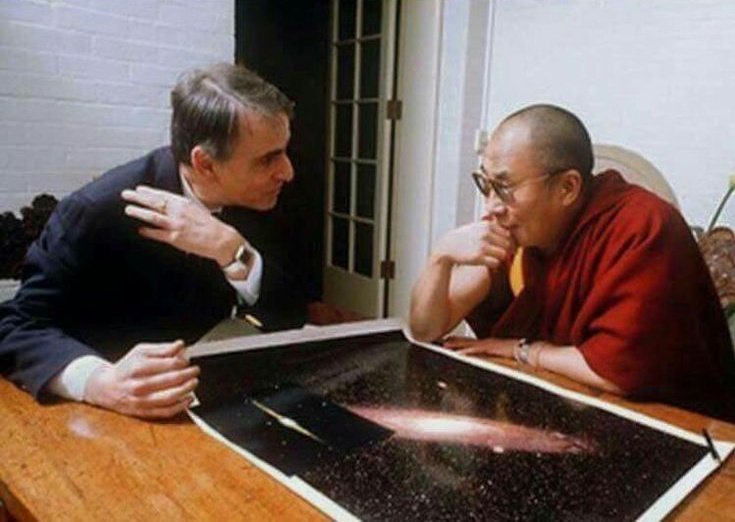
Carl Sagan once asked the Dalai Lama what he would do if a central tenet of Buddhism was definitively disproven by science. The Dalai Lama's response was that they would have to give up the belief, stating, "If through thorough investigation things become clear, only then is it time to accept and believe". He later clarified that Buddhists should accept careful scientific findings over scriptural accounts if they conflict, citing how he stopped believing in the traditional Buddhist flat-world cosmology after learning about modern astronomy.
( 📷 Carl Sagan and the Dalai Lama, who met in 1991 at Cornell University.)
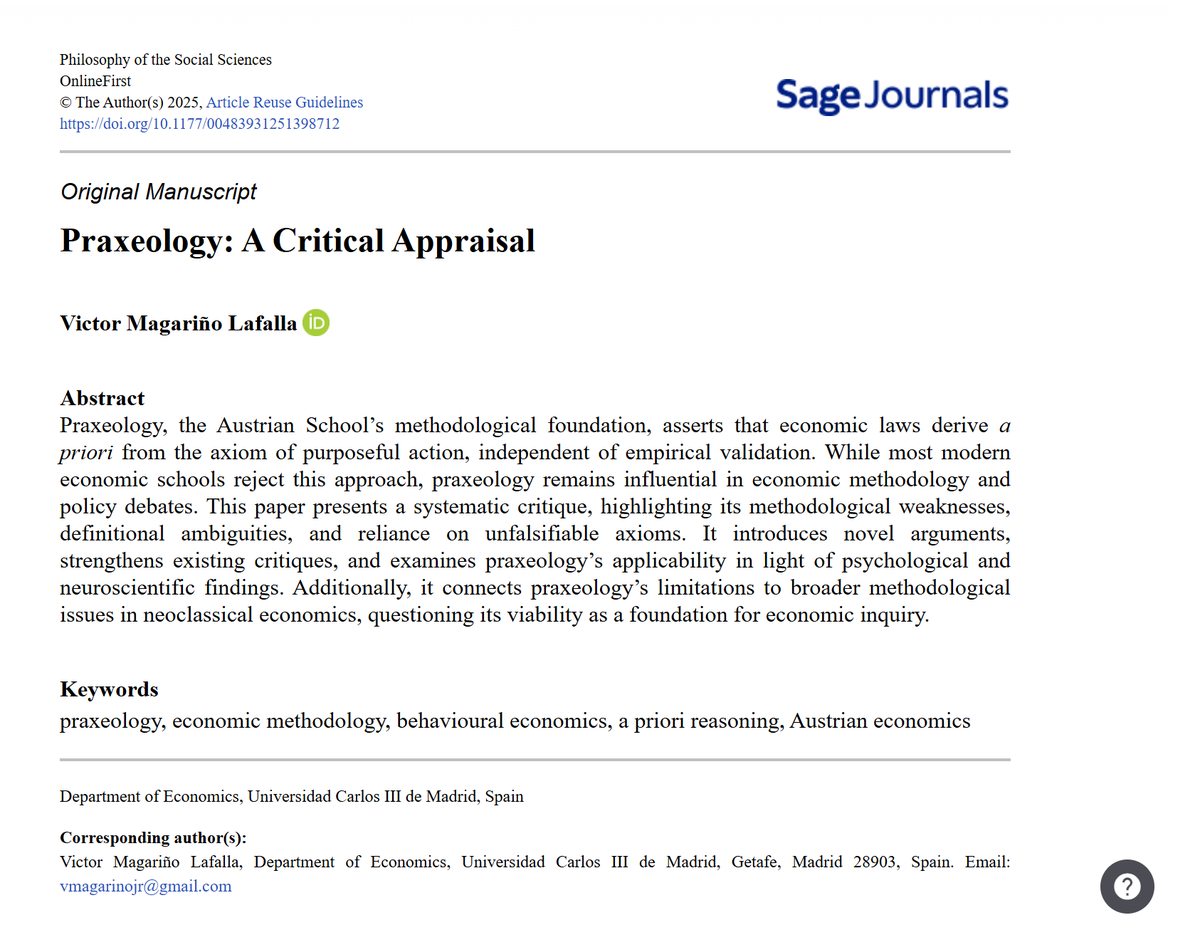
My paper “Praxeology: A Critical Appraisal” has just been published in Philosophy of the Social Sciences.
This paper takes a deep, rigorous and critical look at the dominant methodology of the Austrian School of Economics.
https://t.co/cmfjChvRmi
¿Cuán fiables son los datos que maneja el feminismo mainstream? Este acalorado debate que mantuvimos en vivo en Youtube con la socióloga feminista Giulia Constanzo, es un ejemplo de cómo la mayoría de los datos sobre economía y biología del feminismo hegemónico funcionan como “estadística zombie”, información que, pese a no estar basada en ninguna fuente reconocible, o a pesar de haber sido refutada en numerosos estudios publicados en revistas académicas con revisión de pares, es repetida incorrectamente hasta el cansancio.
El debate tuvo lugar en un canal español de economía, y su moderador fue el economista Eduardo Garzón. Los temas preestablecidos para el debate fueron 1) brecha salarial, 2) techo de cristal, las mujeres en los cargos jerárquicos, 3) la dicotomía biología/cultura, 4) Propuestas sobre políticas de género.
Este video también ofrece un ejemplo de los recursos argumentativos que resultan deseables en un debate racional, al contrastarlos con otros que, aunque frecuentes, desvían la atención del análisis crítico hacia aspectos más emocionales o personales.
https://t.co/T1wqLZApFD
1/11 Recientemente se ha presentado el programa económico de VOX con distintas medias. ¿Es coherente con la situación de España 🇪🇸 o es puro populismo?
Le he pasado a una IA su programa y aquí tenéis el resultado.
Abro hilo 👇
The debate I did with @boredkanack on socialism and central planning is just up on my YouTube channel. You should also check out his channel for more debates on interesting subjects. https://t.co/NJ65sDIVPW
I couldn't wait. So here's a work-in-progress video on "Price-value dynamics with heterogeneous labor" that showcases (simple aspects) of my new simulation model (for the book). Should Marx have proposed that "complex" labor is reduced to "simple" labor? https://t.co/mzi5cfL2A0
Quienes se dirigen a las mujeres transgénero como hombres, además de ignorantes, son unos desalmados con título honorífico. Alcanzaron la maestría en ceguera moral, y la ejercen sin vergüenza.
Episode 151 - Long Form Existential Dread (Ft.
@ProlekultFilms) is now LIVE EVERYWHERE: https://t.co/aUkXqfDVLB
Also, Episode 152 - Real Economy Hour (Ft. Victor Magariño @Victormagajr ) is now up early for Patrons - https://t.co/Q0SfwvjokA
@TwiceBlind@liquid2ulu@PresidentSunday I agree. They seem to focus more on having the word "Subjective" be the main theme of their case rather than on the logic behind Value formation in competitive economies.