Today Instagram had this massive exploit where hackers were just stealing rare handles left and right. Hundreds of accounts gone.
People losing handles they’ve owned since 2010, some worth hundreds of thousands.
I own a few rare ones so I was actually stressed watching this happen in real time, which I haven’t been in years.
Obama White House account got hit.
These aren’t some random new accounts, these are verified, locked down accounts and they still got compromised.
The thing is the exploit is so simple it’s almost funny. Attacker goes to Forgot Password, says their account is hacked, turns on a VPN to match the target’s location (which now you can find on the about section of the page).
Instagram’s AI support flow asks them to verify with a selfie.
They grab a photo from the target’s profile, run it through an AI video generator to make an animation of the person’s face moving around, upload that to Meta’s AI as proof.
And Meta’s AI just accepts it because it can’t tell the difference between a real selfie and an AI-generated video of someone’s face
.
Once verified they change the email to theirs. Password reset link goes to their email. They own it now. 2FA gets bypassed somehow in the process but honestly I don’t know exactly how, just that it did.
Point is even locked down accounts went down.
Then you try to recover your account and you’re talking to a chatbot that has zero ability to help.
You can’t escalate to a human. You’re just stuck. Your asset is gone and there’s no one to call.
The whole thing just highlighted how stupid it is to automate account security without any human in the loop.
One AI fooling another AI while there’s literally no person anywhere to catch it.
Meta took hours to even acknowledge it while accounts were getting stolen every minute.
Now thankfully it’s patched but I don’t think it will be the last one. Stay safe!
@HackingLZ Probably just as long as you don't bring an actual bear, like if it's 90 lbs maybe they can't tell.
Bringfido[.]com has a filter for over 50 lbs allowed that helps narrow it down
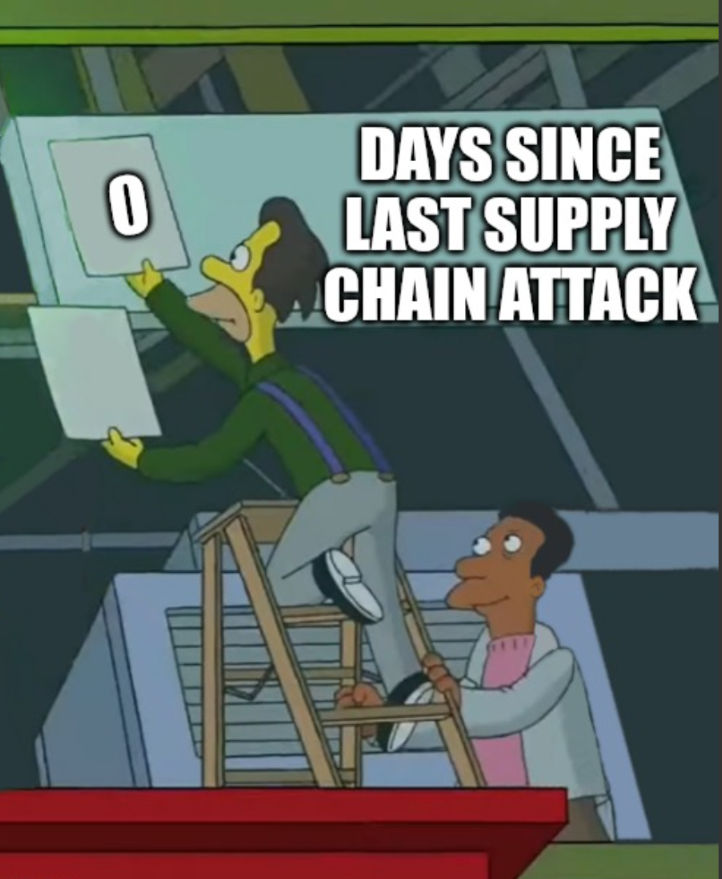
🚨 Bitwarden CLI 2026.4.0 was compromised as part of the ongoing Checkmarx supply chain campaign after attackers abused a GitHub Action in Bitwarden’s CI/CD pipeline.
We’ll continue updating our coverage as more details are confirmed.
https://t.co/G0aakn8swq
Christ is risen from the dead, and with him, we too rise to new life! This Easter proclamation embraces the mystery of our lives and the destiny of history, reaching us even in the depths of death. #Easter
🚨 CRITICAL: Active supply chain attack on axios -- one of npm's most depended-on packages.
The latest [email protected] now pulls in [email protected], a package that did not exist before today. This is a live compromise.
This is textbook supply chain installer malware. axios has 100M+ weekly downloads. Every npm install pulling the latest version is potentially compromised right now.
Socket AI analysis confirms this is malware. plain-crypto-js is an obfuscated dropper/loader that:
• Deobfuscates embedded payloads and operational strings at runtime
• Dynamically loads fs, os, and execSync to evade static analysis
• Executes decoded shell commands
• Stages and copies payload files into OS temp and Windows ProgramData directories
• Deletes and renames artifacts post-execution to destroy forensic evidence
If you use axios, pin your version immediately and audit your lockfiles. Do not upgrade.
@medusa_0xf Not fully replace it. Part of the toolkit but not a replacement.
If anything it might become it's own streamline, how a Vulnerability Assessment is.
There's also the risk of it hallucinating and going outside the the ROE scope. And if it causes an outage, clients will be pissed.