Overnight, I used GPT-6 Astra (high reasoning effort) to analyze raw data from my old DNA test, performed on an Illumina chip covering ~660,000 genetic variants.
Then, in 40 minutes, I built an interactive body atlas to explore selected associations involving taste, eye pigmentation, lactose digestion, muscle proteins, and metabolism.
The app brings together 25 selected markers from my file, with recorded genotypes, supporting evidence, and explicit uncertainty. DNA imports are processed locally in the browser.
My most personal data project with Astra. 🧬
Next, I plan to get fresh tests from several labs, compare the results, and learn more about my biology using Frontier AI.
@DeryaTR_@gdb@thekaransinghal
GPT-6 Astra is now the best-performing frontier model for antibody developability prediction in our benchmark. 🧬
Finding an antibody that binds is only the beginning. Will it aggregate? Will it stay stable? Can it actually behave like a drug?
GPT-6 Astra predicts these developability properties better than the other frontier models we tested. 🤯
And yes, the interactive visualization showing how an antibody actually works was also built with Astra in about 1 hour.
This model looks seriously powerful.
Congrats @gbt@sama
#insilicoSOTAFM
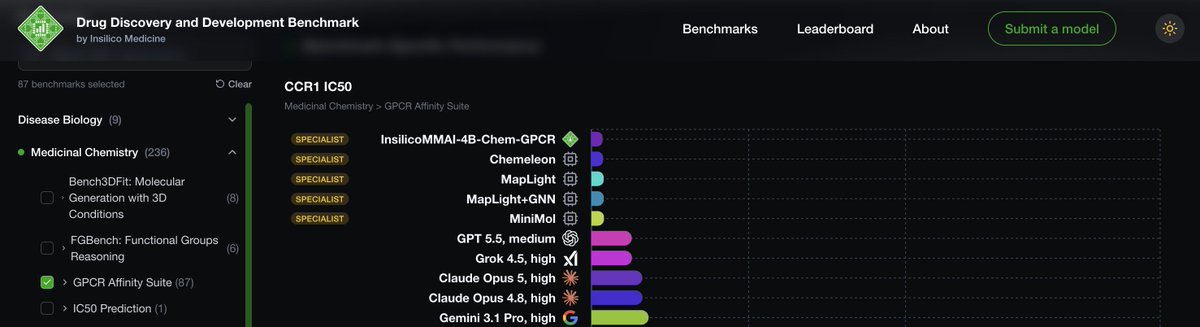
InsilicoMMAI-4B-Chem-GPCR — one more specialist from MMAI Gym.
4B model, trained as a GPCR potency specialist. Lower MAE than Chemeleon, MapLight, MapLight+GNN, and MiniMol on 11 IC50 targets.
Same data, same split.
GPCRs are a different selectivity problem than kinases: same idea, different protein family.
Results across the receptors: https://t.co/rMfJybqOfm
#insilicoSOTAFM
Dopamine. 🧠 Serotonin. 🙂 Glucagon. 🍬
Very different biology, but all of these signals can run through GPCRs.
Predicting how strongly a molecule interacts with them is a classic molecular modeling problem.
Now, a 4B specialist language model is winning 11 of those tasks. 🤯
#insilicoSOTAFM
Yesterday I found out I have an SNP in CYP1A2 that might change how I metabolize caffeine.
Today I realized our ADMET model is SOTA on CYP1A2 inhibition. Same enzyme: one question is how fast you clear a substrate, the other is whether a compound blocks the enzyme for everyone else. That second one is what shows up in a DDI profile.
#insilicoSOTAFM
Overnight, I used GPT-6 Astra (high reasoning effort) to analyze raw data from my old DNA test, performed on an Illumina chip covering ~660,000 genetic variants.
Then, in 40 minutes, I built an interactive body atlas to explore selected associations involving taste, eye pigmentation, lactose digestion, muscle proteins, and metabolism.
The app brings together 25 selected markers from my file, with recorded genotypes, supporting evidence, and explicit uncertainty. DNA imports are processed locally in the browser.
My most personal data project with Astra. 🧬
Next, I plan to get fresh tests from several labs, compare the results, and learn more about my biology using Frontier AI.
@DeryaTR_@gdb@thekaransinghal
Here we go... Two months ago I wouldn't have believed this result.
What makes it interesting is the test set: structures annotated with synthetic routes that have never been published. We update those sets periodically to reduce the chance of contamination.
That is why Astra’s jump over GPT-5.6 matters, and why beating specialist models on this benchmark is a bigger deal than it looks.
@gd @thekaransinghal
GPT-6 Astra⭐️outperformed 2 specialist models (LocalRetro and RetroKNN) in single-step retrosynthesis prediction. Unbelievable result just a month ago! It is the very first general-purpose model outperforming these stong specialists in our benchmark. Kudos to @gdb@joyjiao12 👏
In the #DDDBenchmark, the model ranks 3rd🥉overall, behind only 2 other specialist models including our model and MHNReact by @gklambauer@phseidl , while significantly outperforming all other frontier models (see in thread⬇️).
Btw, this synthesis visualization itself was also generated by GPT-6 Astra in just 15 minutes. We will see an explosion of 3D simulations of reactions thanks to models like Astra! 🧵1/2
#insilicoSOTAFM
For those of you who don't know 🙂->
#InsilicoMedicine's MMAI Gym also hosts a catalogue of state-of-the-art specialist and generalist AI models for drug discovery.
ADMET
retrosynthesis
binding affinity
multi-property design
TargetID
📩 Get access & find out more: email [email protected], subject "MORE PLS" or "🩷" this post!
🧬 More SOTA models coming soon..
#AIDrugDiscovery #TechBio #GPT-6 Astra
@InSilicoMeds
Overnight, I used GPT-6 Astra (high reasoning effort) to analyze raw data from my old DNA test, performed on an Illumina chip covering ~660,000 genetic variants.
Then, in 40 minutes, I built an interactive body atlas to explore selected associations involving taste, eye pigmentation, lactose digestion, muscle proteins, and metabolism.
The app brings together 25 selected markers from my file, with recorded genotypes, supporting evidence, and explicit uncertainty. DNA imports are processed locally in the browser.
My most personal data project with Astra. 🧬
Next, I plan to get fresh tests from several labs, compare the results, and learn more about my biology using Frontier AI.
@DeryaTR_@gdb@thekaransinghal
Nonequilibrium morph in 20 minutes is the demo. Alchemistry is the engine: RBFE and ABFE via NEQS, sitting next to the generative models on Chemistry42. https://t.co/wmI7yQ3vXM
You’re using Astra the wrong way. Watch till the end :)
In our drug discovery projects, we use #insilicoSOTAFM and Alchemistry to prioritize compounds for both ADME and binding. I put GPT-6 Astra to work on the visuals.
With the right prompt: a nonequilibrium FEP-like transformation between two ligands from the new OpenBind dataset. Animated in Blender in 20 minutes.
Job done, so I quickly moved to further analyses of transformations for distant pockets
@andrewaiginin@rand_longevity Found out I have a CYP1A2 variant that may slow caffeine metabolism. Switching from a double to a single-shot espresso as of tomorrow ☕️