🚨 YAHOO FINANCE HAS PICKED UP THE INVESTIGATION WE DROPPED THIS MORNING
1. No Hims House mention :(
2. They said $HIMS is the only publicly traded telehealth platform selling GLP-1s. Not quite -- $LFMD is public and sells GLP-1s. So does $WW.
3. The most interesting tidbit comes directly from our special report this morning.
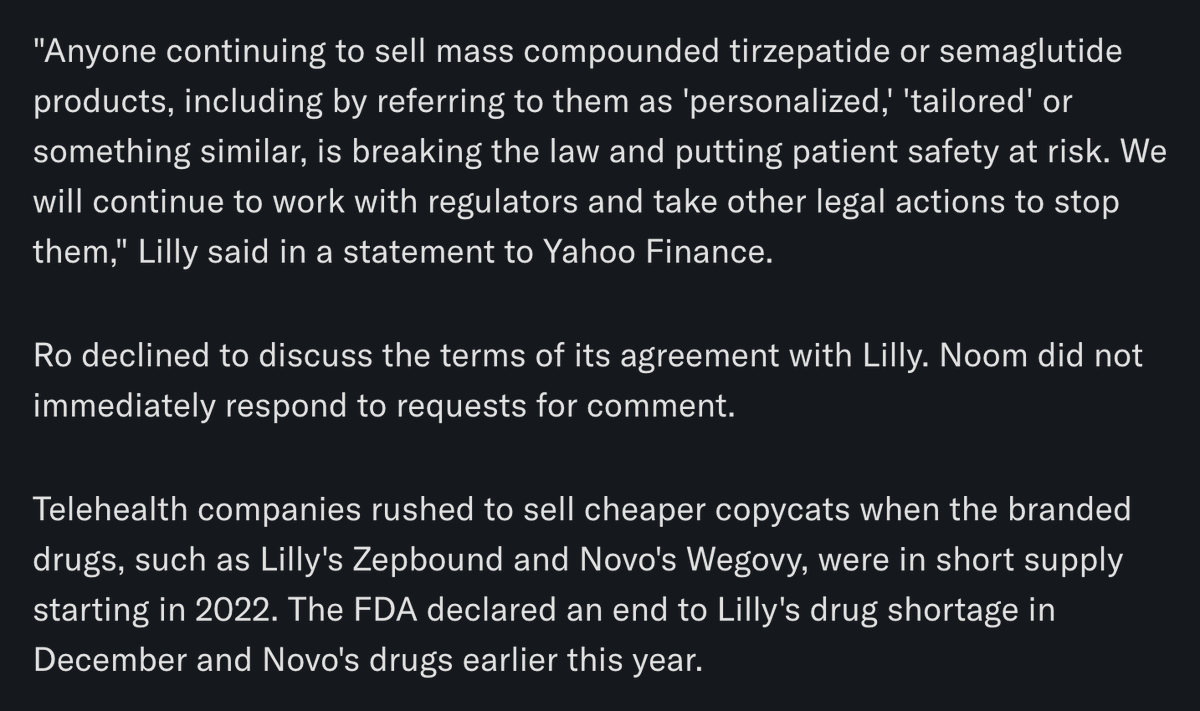
"Companies like Ro and Noom, which announced partnerships with $LLY in the past six months, are both still offering compounded versions of GLP-1 drugs. That includes competitor $NVO's semaglutide, which is also part of Lilly's agreement."
4. "Ro declined to discuss the terms of its agreement with Lilly. Noom did not immediately respond to requests for comment." 👀
(link below)
h/t @tungstenpilot for spotting this news first
Healthcare might be the application of AI I’m most excited about:
1. The industry is so complex.
2. That complexity and the incentives involved have created a huge administrative burden on clinicians and providers.
3. AI’s really well-suited to solve that problem.
But to understand the solution we have to understand the problem.
So I wrote (as simply as I can) a primer on the US healthcare system, why it’s so complex, the incentives involved, and why I think the healthcare software/AI market is set to massively expand.
My conversation with @naval. Enjoy!
(0:00) - The Theory of Everything
(4:48) - How do you know what’s true?
(7:51) - Groups search for consensus, individuals search for truth
(13:07) - We have never run out of a single resource
(15:25) - Are we destroying the Earth?
(17:48) - Marxism denies wealth creation
(21:28) - Regulation kills innovation
(27:05) - Degrowth and the fall of Western universities
(33:31) - Why the West is best
(35:47) - Federalism
(38:10) - Everyone wants to live forever
(41:44) - Humans are universal explainers
(43:25) - Collectivism vs. individualism
(50:44) - You cannot explain the universe without explaining humans
(55:02) - How @DavidDeutschOxf’s ideas have changed Naval’s life
(1:02:31) - The scientific method isn’t possible
(1:05:07) - The low-hanging fruit theory is a bad explanation
(1:08:19) - The biggest threats to Western civilization
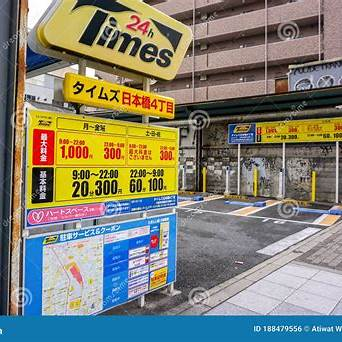
Tokyo has a shortage of parking lots, partly because of regulatory changes a decade or so back that allowed buildings to have fewer parking spaces, forcing dwellers and commuters to park outside. The largest operator of these spaces is Park 24 $4666.T (trading @ 15x fwd PE). You'll probably see at least one "Times" parking space if you visit Japan. They're also the largest car-sharing operator with 3mn registered users sharing 70k cars; Park 24 is also working with Uber Japan to bring ride-sharing into Japan. This segment is still small (30% of overall sales) but expected to accelerate in growth (18.4% y/y rev growth guidance this FY): https://t.co/HMGbKwFGWU
Sharing a list of 15 market outlook reports for 2025 from some of the largest investment banks and financial organizations.👇
1) Goldman Sachs https://t.co/QXVlxouEB9
2) J.P Morgan https://t.co/SQt8x7aDjj
3) HSBC https://t.co/XPtCGJIEoH
4) Wells Fargo https://t.co/fyP6SrqQq2
5) Barclays https://t.co/Lves8J59kP
6) BNP Paribas
https://t.co/o04Ua7pVy4
7) ING https://t.co/CjzGqqG2gO
8) Invesco
https://t.co/OpDrM3BTfw
9) LaSsalle
https://t.co/OpDrM3BTfw
10) T. RowePrice https://t.co/RmouJ1WqiJ
11) Allianz https://t.co/F7NaXFJDvr
12) BlackRock lobal https://t.co/Vj9NwYUlgU
13) BlackRock
https://t.co/q9WskVBQMm
14) Deloitte https://t.co/eFCnev3gYl
15) National Intelligence Council of The US https://t.co/YJn1j6Xu1H
$HIMS crashed by over 30% following $AMZN's announcement of expanding its telehealth services to subscription-based options.
Was this justified, or an overreaction?
Will Amazon kill Hims & Hers?
Here’s a thread with some of the key topics to consider when answering this: 👇🏻🧵
Amazon $AMZN announced an expansion of their telehealth program, causing $HIMS to drop over 25%.
Here’s the thing, Amazon has a history of moving into new markets, but this doesn't spell doom for strong competitors.
Here’s a quick look:
~ Car Sales: When Amazon hinted at moving into car sales, Carvana $CVNA took a temporary hit, but fast-forward, and it’s up over 300% YTD.
~ Music & Audio: Amazon Music and Audible entered the audio space, but Spotify’s $SPOT subscriber base continues to grow despite other major players like Apple Music.
~ Streaming: Amazon Prime Video is a giant, yet $NFLX still dominates entertainment streaming. Amazon’s presence didn’t stop Netflix’s success.
~ Pet Supplies: Yes, you can buy pet supplies on Amazon, but Chewy $CHWY remains a strong player, up 44% YTD.
$HIMS is no different.
They’re positioned strongly in their niche, and Amazon’s entry doesn’t change the fundamentals.
In the last few weeks, here’s what’s happened with $HIMS:
- Bank of America $BAC upgraded it to $23, then to $25, and after strong earnings, to $30.
- Now, recycled news about Amazon’s telehealth push (news first shared in June) coincides with BofA downgrading $HIMS to $16.
This type of back-and-forth signals why retail investors often don’t trust the banks and Wall Street. The game of recycled news and downgrades feels like a manipulation of power.
For me? This looks like a buy signal. Don’t let the noise shake you.
This is excellent.
I’ve been talking about Florida real estate being in serious trouble based on a lack of affordability/availability of home insurance but they actually have the exact numbers and it’s worse than I thought.
Nvidia $NVDA reported after the close – very strong and I expect the stock to trade up tomorrow. Also bullish for other AI / data center beneficiaries like Vertiv $VRT (which I expect investors to buy at the open tomorrow).
Numbers beat across the board but I’d argue the qualitative commentary from the press release / conference call was more encouraging. A few thoughts:
“Accelerated computing and generative AI have hit the tipping point…”
“Demand is surging worldwide across companies, industries and nations.”
“We believe these two trends (accelerated compute and generative AI) will drive a doubling of the world's data center infrastructure installed-base in the next five years and will represent an annual market opportunity in the hundreds of billions.”
“Overall, supply is increasing very nicely, but overall demand will continue to exceed supply through year”
Already called for the Blackwell chips (next generation) to be supply constrained
“Fundamental conditions are excellent for continued growth”
“Inference workloads accounted for ~40% of data center revenue”
Large CSPs (hyper scalers) accounted for over half of data center revenue and continue to increase capex.
$GOOGL $META $MSFT $ORCL $AMZN
Interestingly, DGX Cloud (Nvidia’s cloud supercomputer) is now available in AWS, which was the last CSP to adopt – Google, Microsoft, Oracle currently have DGX
Nvidia software and services now at >$1bn run rate
Also called out several other data center end markets:
Large CSPs continuing to build out but entire new category of GPU specialized CSPs (like CoreWeave)
Enterprise software platforms
Service Now, Adobe, SAP, etc.
$NOW $ADBE $SAP
Consumer internet services like social media companies (Meta, TikTok, etc.)
Industry specific generative AI
Auto, health, financial services – each of these is >$1bn run rate
Healthcare: drug discovery, surgery, medical imaging, wearable devices
Finance: trading and risk management to customer service and fraud detection
Auto: data ingestion, curation, labelling and training
Sovereign AI
Countries want to protect and transform data themselves
“Japan, Canada, France, and so many other regions”
What’s being experienced in the west will surely happen around the world
AI factories will be in every company, every industry and every region
The number that everyone was looking at…data center revenue guidance
Guided to $24bn in sales vs. consensus of $21bn. I think buyside was looking for $22-24, so this is better than buyside which is likely why the shares are looking up in the aftermarket.
Gross margins ~77% benefited from data center mix shift and lower component costs
Will move back toward mid 70s after Q1
China accounted for MSD of data center revenue vs. >20% prior to export restrictions
Management mentioned this quarter will be weak in China again but then hope to ship afterward
China coming back means upside to current numbers – I estimate this could add $1-2bn to quarterly data center revenue
Sales to one customer represented ~13% of sales in FY 2024 – no customer accounted for >10% in FY 2023
My guess is this customer is Microsoft given commentary like this:
“Microsoft recently noted that more than 50,000 organizations use GitHub copilot business to supercharge the productivity of the developers. Contributing to GitHub revenue growth accelerating to 40% year-on-year. Copilot for Microsoft 365 adoption grew faster in its first, two months, then the two previous major Microsoft-365 enterprise suite releases”
This is obviously a very challenging name to model given the magnitude of growth and velocity of data points, but right now I can get to ~$27 EPS in CY 2025 (street ~$25) – at the after hours price of $726 (+8%...I wouldn’t be surprised to see the stock up less than 8% tomorrow – while the report was strong, it was largely in line with buyside expectations that I’ve been paying attention to), the stock is trading ~27x CY 2025 EPS. I think this is a reasonable valuation for a business that’s moat seems to be expanding, not shrinking. Continue to own the stock.
$AMD $INTC $MRVL $AVGO $ASML $TSM
I own Vertiv $VRT (leader in power / cooling solutions for several end markets, but most importantly, data centers) and will continue to own. I’d imagine the stock continues to run into earnings on 2/21 after strong data center capex commentary from the hyper scalers and robust trends from other AI / data center beneficiaries like Super Micro $SMCI (there is a very linear correlation between cloud capex and Vertiv demand).
Vertiv came public in February 2020 via SPAC. The sponsor was Dave Cote, the legendary CEO that turned around Honeywell $HON. This is like Satya Nadella forming a SPAC and buying an enterprise software company. These guys have domain expertise and domain dominance.
This is a good (not great) company benefiting from a massively rising tide. Its also the biggest pure play available to ride that tide. My thesis is based on a few key points: market for data center power / precision cooling is exploding, gaining market share, and upside to numbers (at a reasonable valuation). I say good (not great) because while their solutions are certainly not commoditized, they are replicable (more similar to Super Micro than Nvidia $NVDA in terms of proprietary technology / margin profile) and they also had some execution hiccups around the pandemic (although under a different management team). I will further discuss these points below:
The first point to mention is the durability of data center / AI capex, because everything else is downstream. Everyone from Microsoft $MSFT and Google $GOOGL to Super Micro and TSMC $TSM and Eaton $ETN / Trane $TT continues to be extremely optimistic about this trend continuing. Importantly, Microsoft spoke on their earnings call about inference use cases taking shape, showing the economic benefits of these outsized AI investments. This should put to bed the belief that there could be an “air pocket” in demand on the horizon. The transition from traditional CPU-focused servers to GPU-powered AI servers will take a long time and drive growth for the foreseeable future. My belief in this multi year wave is also underscored by record order pipelines and backlog – I expect orders to grow in excess of backlog again in 2024. Comments from management suggest current demand could take 3-4 years to work through.
The data centers running those AI servers generate 5x more heat / power than traditional CPU servers and require 10x more cooling per square foot. ~75% of Vertiv’s business is power and cooling related infrastructure, with the balance largely being services like maintenance, installation, remote monitoring, etc.
Vertiv has announced plans to double its production capacity for electrical switchgear and busway over the 2023-2025 period. This comes on top of a >100% increase in capacity over 2021-2023. And they recently opened a new manufacturing facility in India for thermal management products for domestic and international markets. This follows the opening of a thermal manufacturing facility in Mexico early in 2023. And at its recent investor day, management raised medium-term capex guidance to 2.0-2.5% of revenue, from an average of 1.6% over 2019-2022 period. This capacity expansion is obviously rooted in the belief that demand is durable and sustainable (similar to Super Micro’s comments of taking capacity to ~$30bn from low teens today). A general rule of thumb is that if volume of data goes up 10%, we generally will see 3-5% increase in the volume of gear to ensure adequate power supply.
Many of these AI benefits are yet to flow through to Vertiv, particularly around liquid cooling. There are several reasons for this:
The market for cooling infrastructure is gradually transitioning from air cooling (where Vertiv is currently the leader) to liquid cooling (which is Vertiv’s to lose). Super Micro’s CEO said on the last earnings call: “You are right. In these current 600 watt / 700 watt modules, people can still do well with air conditioning. And that's why people still are comfortable with our traditional air cooler. But when that system grows to 1,000 or even 1,000 watt per module, yes. I mean -- I think cooling becomes even much more critical.” Basically as power / compute demands increase, there is a need for more heavy duty cooling direct to the chip / rack. Super Micro CEO then said: “I anticipate that up to 20% or more of global data centers will transition to liquid-cooled solutions in just a few years.” So we are early days. Important to note that liquid cooling will largely be additive to Vertiv’s business – down the road ~1/3 of thermal cooling will still be from air cooling – liquid cooling does a great job taking heat away from the chip and rack but it still needs to be moved and expelled from the building. For example, traditional compute requires 6 computer room air conditioners vs. 10 for high density compute. As we move toward Nvidia’s next chip (B100), more cooling capability will be required. The industry was growing high single digits prior to liquid cooling – so growth with liquid cooling is obviously higher.
Additionally, new AI data centers take time to permit, build, etc. and even existing data centers are only turned on with half – 2/3 capacity, which illustrates why the demand curve could be longer and more durable than the market appreciates.
A few comments from management on the last earnings call: “still very early in AI opportunity – its barely started.” “AI will show up in more pronounced manner in 2024.” “More demand than capacity in industry.” Longevity of current order inflection: “Believe this is a long term trend – multi year cycle – this is just the beginning”
As I mentioned, Vertiv is the largest pure play, with other competitors like Schneider $SCHN, Eaton and Stulz $STULZZ, as well as a long tail of independents (still ~50% of market). As hyper scalers continue to drive AI data center demand, there are only a few players that can service this demand.
Scale and service excellence matter when dealing with hyper scalers (they want someone to hold their hand). Ecolab $ECL has a similar competitive advantage. Vertiv’s product offering is good, not great, but their ability to service customers and be a one stop shop / systems integrator for power, precision cooling and other infrastructure management systems is what sets them apart. For example, you don’t want several different teams in your data center, you want one team doing power, air cooling, liquid cooling, etc. This is why Vertiv has the prime position and this is why it is theirs to lose.
There are also several startups working on liquid cooling technologies – these starts up could never service the needs of a hyper scale data center – so the natural move is for Vertiv to buy them. At ~2x net leverage and a cash generative business model, they are positioned to make this happen.
We also cant overlook the fact that Vertiv has partnerships with Nvidia, Intel $INTC (bought Habana AI in 2019) and others. Jensen (Nvidia CEO) called out Vertiv as the world leader, saying their collaboration is growing in leaps and bounds and that their partnership is more important than ever.
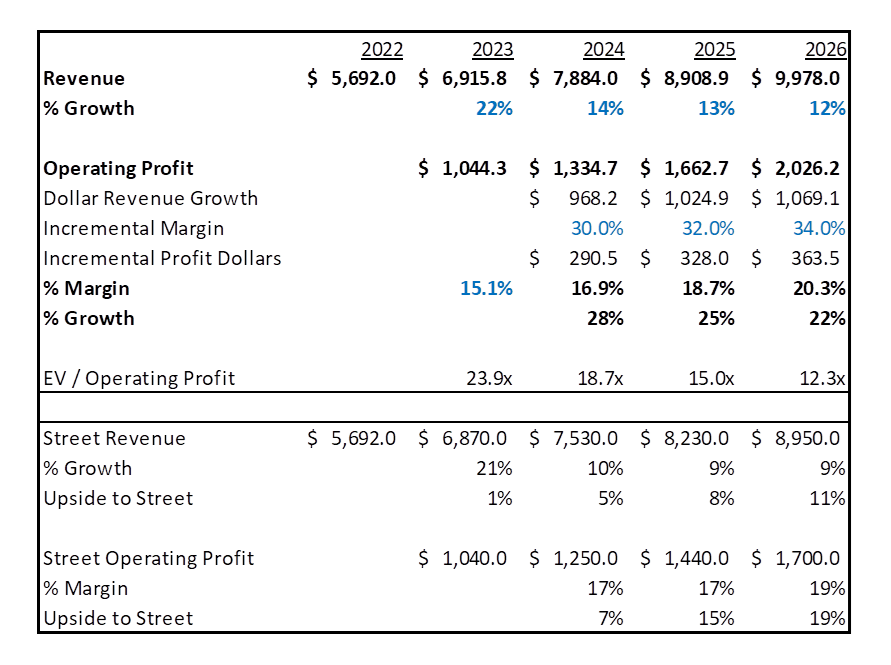
Numbers / estimates higher at a reasonable valuation = stock higher. Simple model summary and valuation snapshot below. These are base case estimates and I don’t expect them to guide to what I am expecting right away on the Q4 call. I also reserve the right to revise my estimates as the data suggests - likely higher.
Starting with Q4 – management said to expect a similar growth rate in Q4 as in Q3. We saw 18% growth in Q3 and the street is at ~14% growth for Q4. Either people aren’t paying attention, or they don’t trust management. I trust that this management team will continue to be conservative with the hopes of creating a consistent beat / raise story.
At the investor day in November 2023, management gave “very preliminary” 2024 guidance of 8-11% sales growth and operating margins 16.5-16.9%, with 83-87% FCF conversion. Given the “very preliminary” comment its clear that this is more a floor than a ceiling. The street is at ~10% growth for 2024 and has it slowing to HSD in 2025 and 2026.
Important to note that Vertiv’s growth has largely been US driven (grew >40% in 2023). And while this is where most of the AI investment is taking place, international markets will eventually pick up – this is another advantage of Vertiv’s global footprint. Vertiv grew >20% in 2023, despite APAC down ~5% (macro weakness in China) and EMEA only up high single digits.
Additionally, management has said incremental margins (margins on incremental revenue that flows through) are currently ~30%, but will move toward ~35% as the liquid cooling investments start to bear fruit. As you can see in my model summary, I can get to >20% operating margins in 2026 (managements long term guidance is 20%+ operating margins sometime in 2026-2028 period).
Backlog is also at record levels ~$5bn, which tells you >3/4 of the year is already accounted for. And again, I expect orders to grow faster than sales through 2024, leading to another record backlog number on the horizon. Importantly, management spoke to taking ~5% pricing in their backlog, which tells me pricing could be up mid single digits again this year. Historically this has been a flat to down ~1% annually pricing business, but the demand environment has changed this and I expect it to last for several years before mean reverting. Management has said they expect to be price / cost positive on a go forward basis.
Balance sheet is healthy, which will allow them to paydown debt, buyback stock and make bolt on technology acquisitions. Current debt structure is $850mm fixed rate bond 4.125% due October 2028 and a $2.1bn term loan due March 2027. The term loan is split between $1.1bn at variable rate currently ~8% (focus is to pay this down over next two years, which should allow them to accelerate capital deployment) and $1bn fixed ~4%. Vertiv also has authorization to buyback $3bn worth of stock over the next 4 years (~15% of market cap).
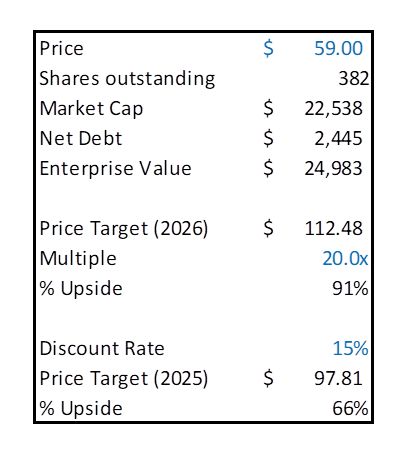
The stock currently trades ~20x EV / operating profit (I’m using this metric because this is what they guide to). I’m assuming this multiple holds, which it will as long as numbers / estimates go higher. There is no pure play comp, but Eaton trades ~23x and Amphenol trades ~22x (also a low double-digit growth with >30% incremental margins). As I look out a few years, I can still get to meaningful upside, despite the recent run in the stock (see below).
The key risk is that AI investment / capex slows. Additionally, Vertiv could lose market share if they don’t continue to innovate / buy the innovators. They could also make execution errors, which they did early in Covid under a different management team.
Vertiv also serves certain telecom end markets, which have slowed post heavy 5G investments. However, this is a small part of the overall business (and getting smaller given data center growth).
in 2016, Morgan Stanley published a paper titled "The Equity Compounders".
"These compounders have generated superior risk-adjusted returns across the economic cycle".
🧵 Our 6 favourite highlights from the paper:
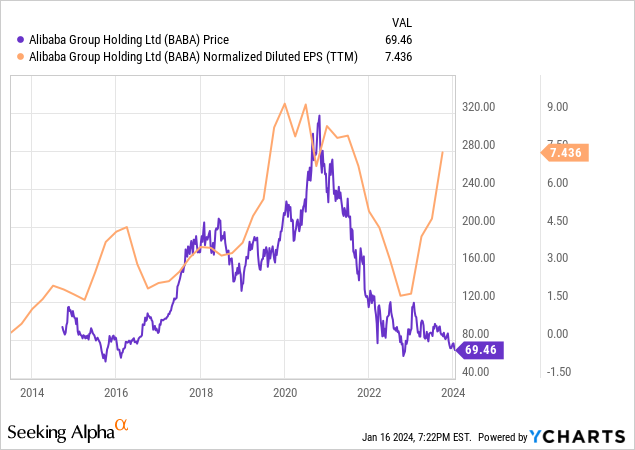
If you've been watching Alibaba stock over the last 2 years, you might have noticed something odd:
The stock going down despite the earnings and FCF going up.
Why is this happening?
A big part of it is management's refusal to do large buybacks.
$BABA has enough cash on its balance sheet--~$78B-- to buy back more than 1/3rd of the shares.
Further, the company does $27B in annual free cash flow. Combine the balance sheet cash and four years' free cash flow, and the company has enough to buy back ~ALL~ of its stock! **
Unfortunately, they aren't doing that:
In 2023, the company bought back only $9.5 billion worth of stock. That's barely a third what it can afford to with just annual FCF alone, not even factoring in the balance sheet cash horde.
It's been disappointing, to put it mildly. But I have faith that with China's new push to invigorate the economy, management will increase the pace of buybacks with time.
** = ignoring the tendency of buybacks to move stock prices of course.
Office building prices in the US are down ~40% from their peak just over 2 years ago.
Over the last year, office building prices are down a massive ~30%.
Currently, 1 in 5 office buildings in the US are vacant.
The worst part?
Most of these office buildings hold large debt balances.
With high interest rates and falling cashflows, delinquency rates are rising.
Commercial real estate bankruptcies are coming.
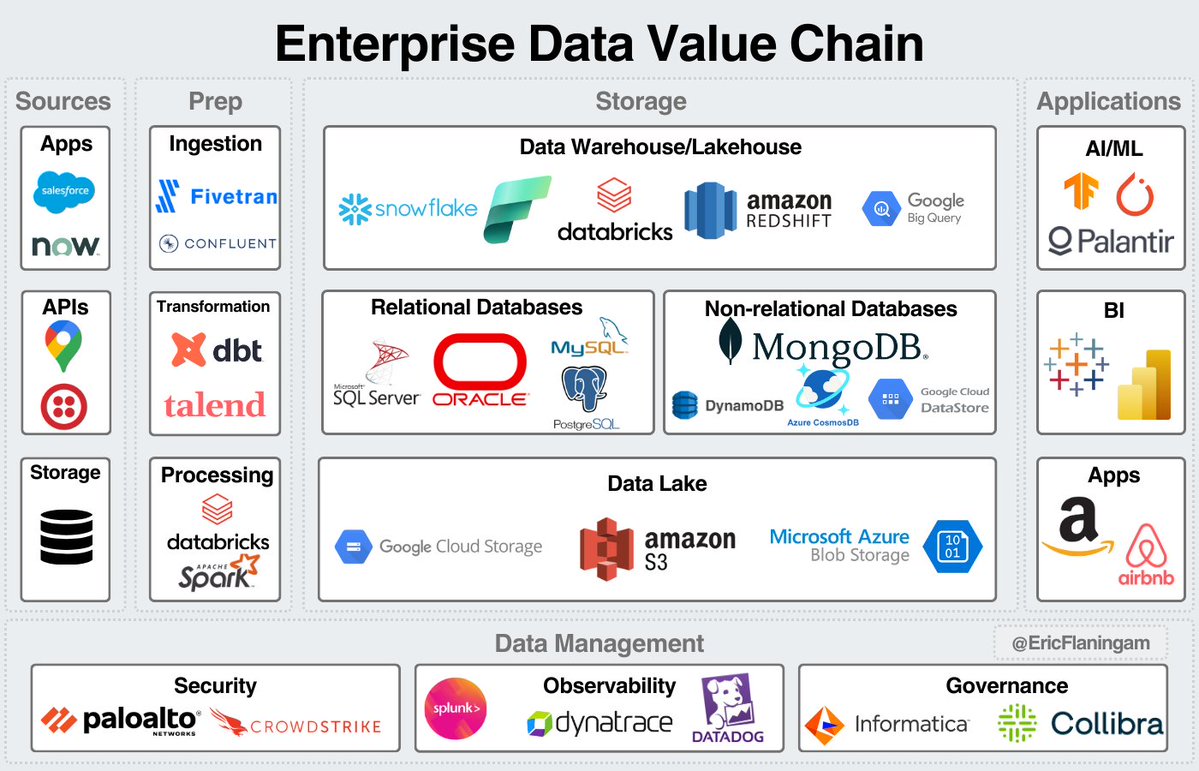
Sharing how I view the enterprise data ecosystem:
The data industry is one of the most fragmented industries in tech with thousands of products.
The general flow of data is this:
1. Ingest and transform data from various sources.
2. Store the data in a data lake & organize it in databases or data warehouses.
3. Build applications that interact with that data.
4. Protect that data with security and governance.
There are thousands of combinations of architectures to accomplish these primary tasks.
This image is meant to be a mental model for thinking about the structure of the industry, not an all-encompassing list of companies and niches.
The other important note is that companies offer products across numerous categories, so platforms like $SNOW $PLTR $DDOG aren’t necessarily confined to one category.
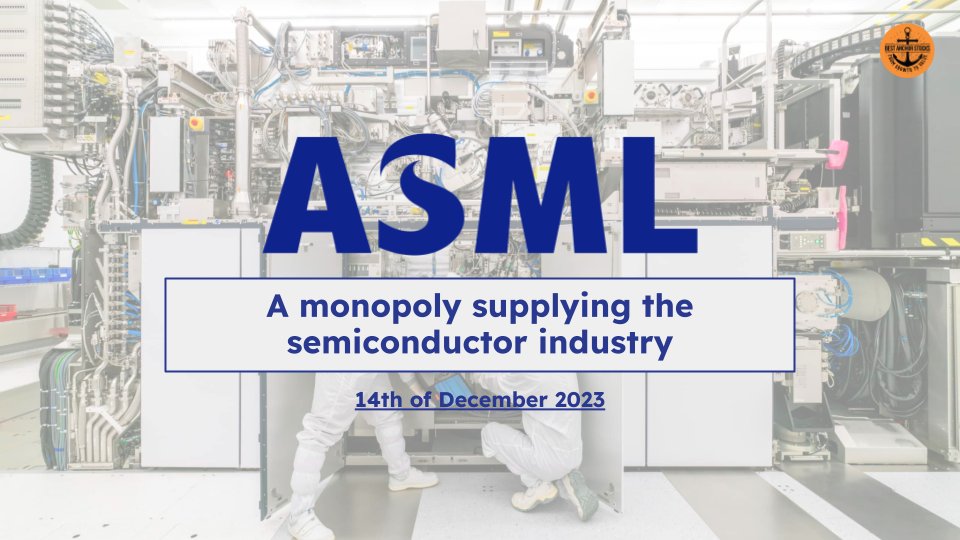
1/ A couple of weeks ago I gave a presentation on $ASML to some investors.
The goal of the presentation was to give an overview on the company, touching all the relevant topics (I cover $ASML more in detail at Best Anchor Stocks, together with other high quality companies)
👇
$IBM is an interesting example of the Innovator's Dilemma.
IBM released their first cloud services in 2002, estimating 20-50% cost savings for customers.
However, enterprise customers had spent millions on expensive IBM software and hardware; it would be a wasted cost if they moved to a new service with less functionality.
Additionally, IBM sales teams weren't incentivized to sell the service.
When $AMZN AWS was launched, it provided a new cost structure for smaller companies that couldn't build expensive data centers.
$IBM peaked in 2011 in both revenue and market cap, 5 years after AWS was founded.
AWS revenue didn't surpass IBM in revenue until 2021.
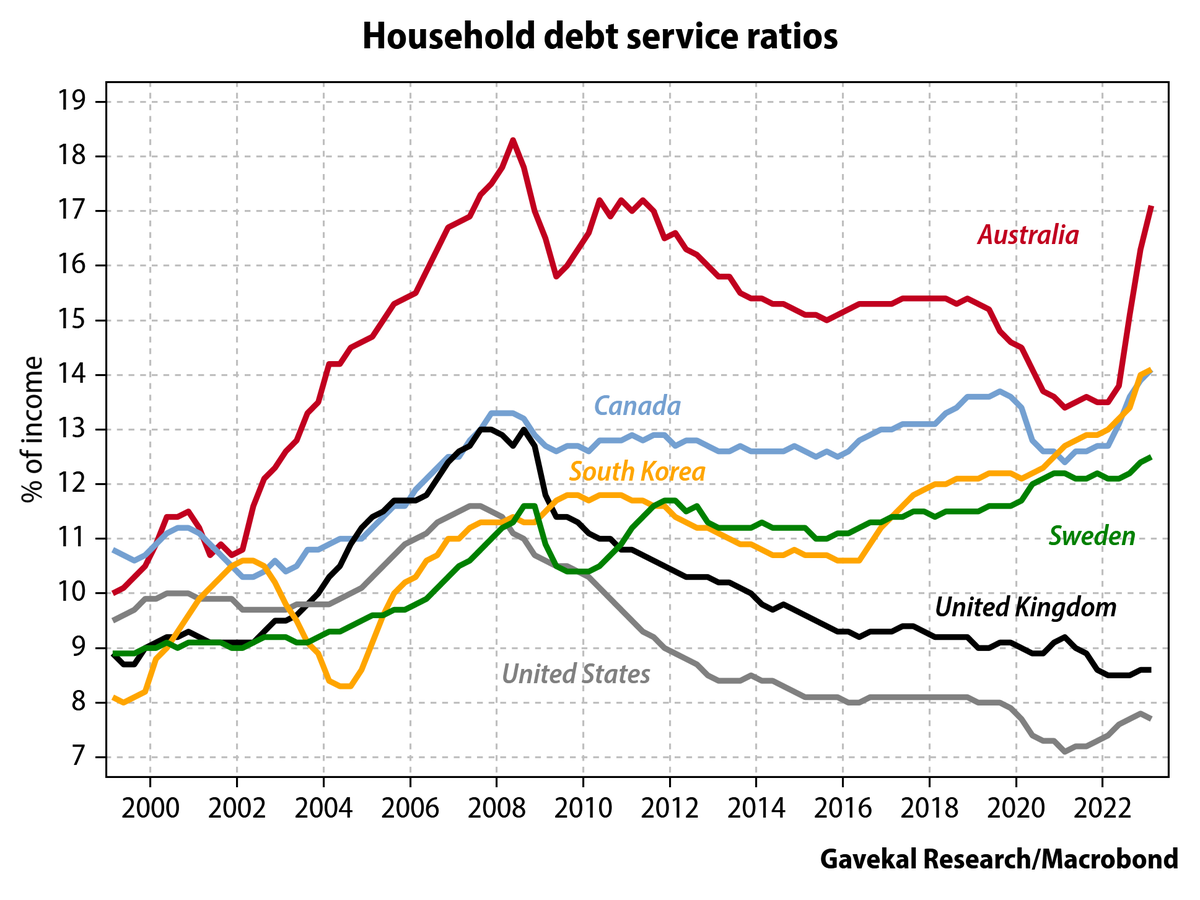
Amid the sharpest interest rate rises in a generation, can households in developed economies withstand the shock? The concern is particularly acute in Australia where households' debt service ratio—mostly through variable-rate mortgages—has risen to 17% of income.