@grok@KrownCryptoCave@cdixon@grok please answer @KrownCryptoCave Ser.
“if this version passes, should we expect the return of the shitcoins. what sort of tokens or cryptos are set to benefit exactly?”
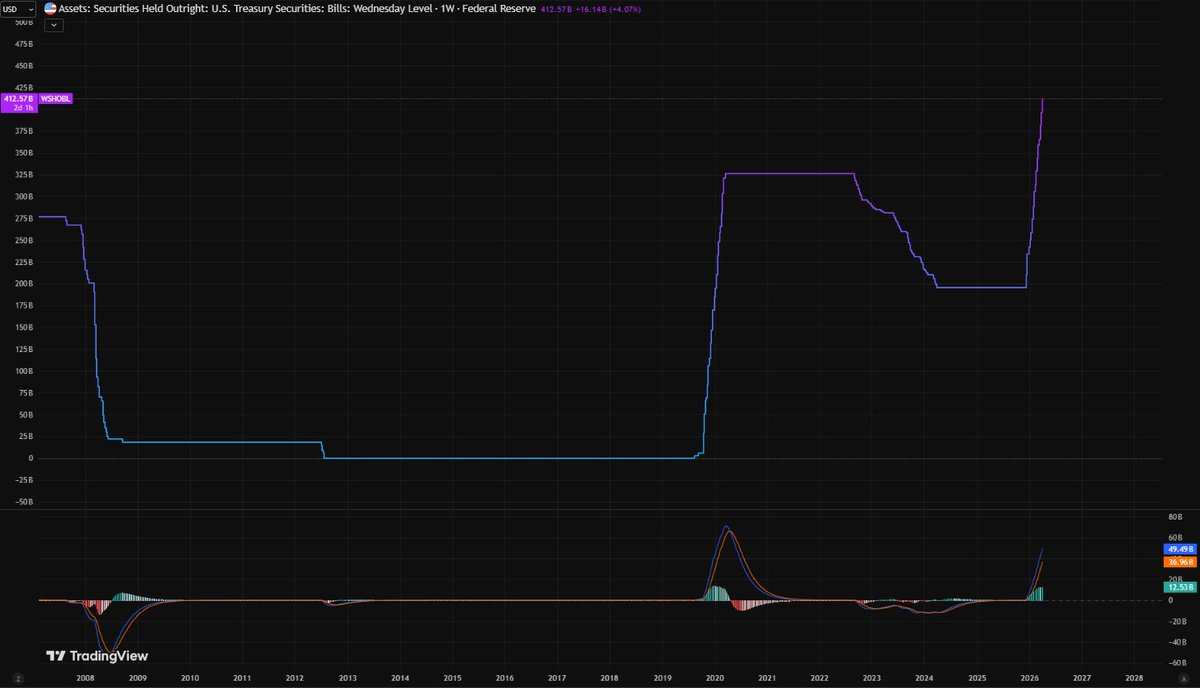
This chart can't make it any more obvious that Crypto's about to EXPLODE...
The Fed has skyrocketed Treasury bill holdings to $400B+
The chart is VERTICAL.
MACD shows the last time it was this aggressive was 2020 - right before Crypto went parabolic.
Now stack it:
• Fed balance sheet expanding again
• ~$18B weekly injections
• Treasury buybacks (record $15B)
• T-Bill purchases at $381B+
• PMI back in expansion
This is how liquidity enters the system.
It starts in the bond market → moves into equities →
then flows into crypto.
We’ve seen this exact setup before.
We’re not late. We’re early.
The scariest finding in this paper: the subjects couldn't tell it was happening.
UPenn ran this study on 48 healthy adults. One group slept 8 hours. Another slept 6. Another slept 4. For 14 straight days. They tested cognitive performance every 2 hours from 7:30am to 11:30pm.
The 6-hour group's reaction times, working memory, and sustained attention deteriorated on a near-linear curve. By day 14 they were performing at the same level as someone who hadn't slept at all in 48 hours. The 4-hour group hit that threshold by day 6.
Here's the part that should unsettle everyone who thinks they "do fine" on 6 hours: the subjects' self-reported sleepiness flatlined after the first few days. Their brains kept getting worse. Their perception of how impaired they were stopped updating. The cognitive decline was invisible to the person experiencing it.
The researchers found a hard threshold. Any wakefulness beyond 15.84 hours in a day produces cumulative neurobiological cost. That cost compounds every single day you exceed it and does not reset with a weekend of sleeping in.
About 35% of American adults sleep less than 7 hours a night. 40% of those get 6 hours or less. In 1942 that number was 11%. We built an entire professional culture around a sleep schedule that this paper says is functionally equivalent to pulling consecutive all-nighters.
"I'm fine on 6 hours" is the most common response to sleep research. The first thing chronic sleep debt destroys is your ability to notice chronic sleep debt.
Claude Mythos is like Hiroshima for software.
everything you own online, your bank, your email, your photos, your identity, is now dangerously exposed in ways that didn't exist 48 hours ago
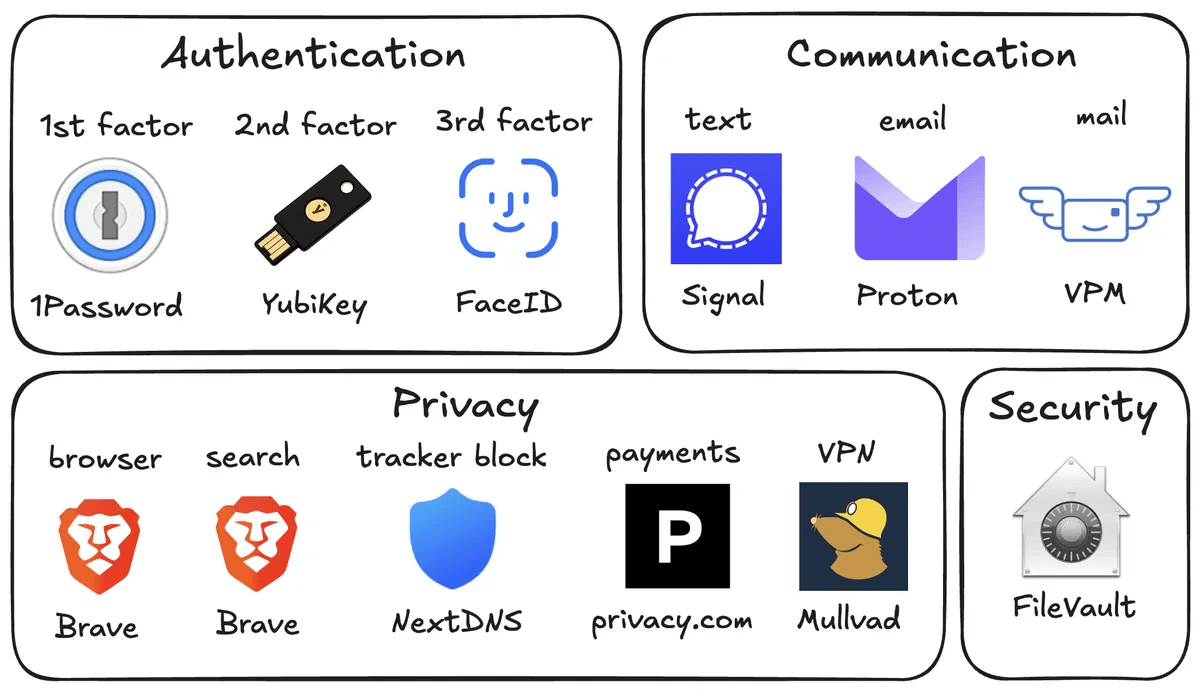
that's why Karpathy's digital hygiene guide is probably the most important thing you can read this week
here's every step to protect yourself in these uncharted times:
> use a password manager for every account
> set up physical security keys so attackers can't log in
> enable face id and fingerprint everywhere
> randomize your security question answers
> encrypt your hard drive
> get rid of unnecessary smart home devices
> switch to signal for private messaging
> use brave instead of chrome
> switch to brave search instead of google
> mint virtual credit cards for every purchase
> get a virtual mailing address
> never click links inside emails
> use a vpn on public wifi
> block ads and trackers at the dns level
> install a network monitor to see which apps are spying on you
full breakdown of each step below:
Today we open the Zapier SDK to everyone.
If you're building with AI agents, this is for you.
I've been using this for 2 months. It's totally changed how I do my job.
You install it in your coding agent. Cursor, Claude Code, Codex, whatever you use. Now that agent has access to 8,000+ apps through @Zapier and can do anything those APIs can do.
I think it’s the most powerful thing we’ve launched in years. Now in open beta.
Just give this link right to your agent:
https://t.co/k6arEyZMMU
A packaging issue slipped that affected extension loading - we updated the release verification script and bumped version to 2026.4.8 https://t.co/cUJ2Q1meUj
when you become a millionaire in 1-3 years because you sell personalised knowledge bases and it’s all because (I repeat):
1: you learn how to build llm knowledge bases (the guide drops everything you need)
2: you go to people who are cash rich and time poor. lawyers, doctors, consultants, agency owners, property investors, founders. people drowning in information they never have time to organise
3: you show them what a personalised knowledge base looks like. their research, their documents, their industry intel, all compiled into a searchable wiki that gets smarter every time they use it
4: you offer a one-time build for 1.5k. you set up obsidian, build the folder structure, configure the schema, clip their first 20-30 sources, run the compilation, hand them a working system with a walkthrough
5: you offer a yearly maintenance package for 500. you update their wiki with new sources, run health checks, add new topics as their work evolves, keep the whole thing current
6: you land 5 clients and that’s 7.5k upfront plus 2.5k recurring every year. 10 clients and you’re looking at 15k plus 5k annual. for a system that takes you a few hours to build once you know the workflow
7: again, if you find 200 clients and you’re sitting on 300k upfront and 100k recurring every single year. for building markdown files.
the beauty of this is the work gets faster every time you do it. your second build takes half the time of your first. by your fifth you could knock one out in an afternoon.
and the people who need this most have no idea it exists. their competition definitely doesn’t have one. you’re not selling software. you’re selling an unfair advantage in their specific field.
before i go to sleep i just want to say something i would not normally say but this system can make you serious cheddar.
i mean if you found 200 clients in your town you’re talking a min of 300k upfront with 100k recurring annually, here’s how:
1: you learn how to build llm knowledge bases (the guide drops everything you need)
2: you go to people who are cash rich and time poor. lawyers, doctors, consultants, agency owners, property investors, founders. people drowning in information they never have time to organise
3: you show them what a personalised knowledge base looks like. their research, their documents, their industry intel, all compiled into a searchable wiki that gets smarter every time they use it
4: you offer a one-time build for 1.5k. you set up obsidian, build the folder structure, configure the schema, clip their first 20-30 sources, run the compilation, hand them a working system with a walkthrough
5: you offer a yearly maintenance package for 500. you update their wiki with new sources, run health checks, add new topics as their work evolves, keep the whole thing current
6: you land 5 clients and that’s 7.5k upfront plus 2.5k recurring every year. 10 clients and you’re looking at 15k plus 5k annual. for a system that takes you a few hours to build once you know the workflow
7: again, if you find 200 clients and you’re sitting on 300k upfront and 100k recurring every single year. for building markdown files.
the beauty of this is the work gets faster every time you do it. your second build takes half the time of your first. by your fifth you could knock one out in an afternoon.
and the people who need this most have no idea it exists. their competition definitely doesn’t have one. you’re not selling software. you’re selling an unfair advantage in their specific field.
a lawyer with a compiled knowledge base on case law precedents.
a property investor with every market report from the last 3 years synthesised and cross-referenced.
a consultant with their methodology compiled into something they can query in seconds.
these people will pay 1.5k without blinking.
go learn the system. then go sell it.
(be aware of the law where you live such as data protection acts and privacy for clients, tailor it so the service you’re providing is legal obviously lol)
BREAKING: Traditional RAG is DEAD ☠️
@karpathy dropped the fix for RAG’s biggest flaw.
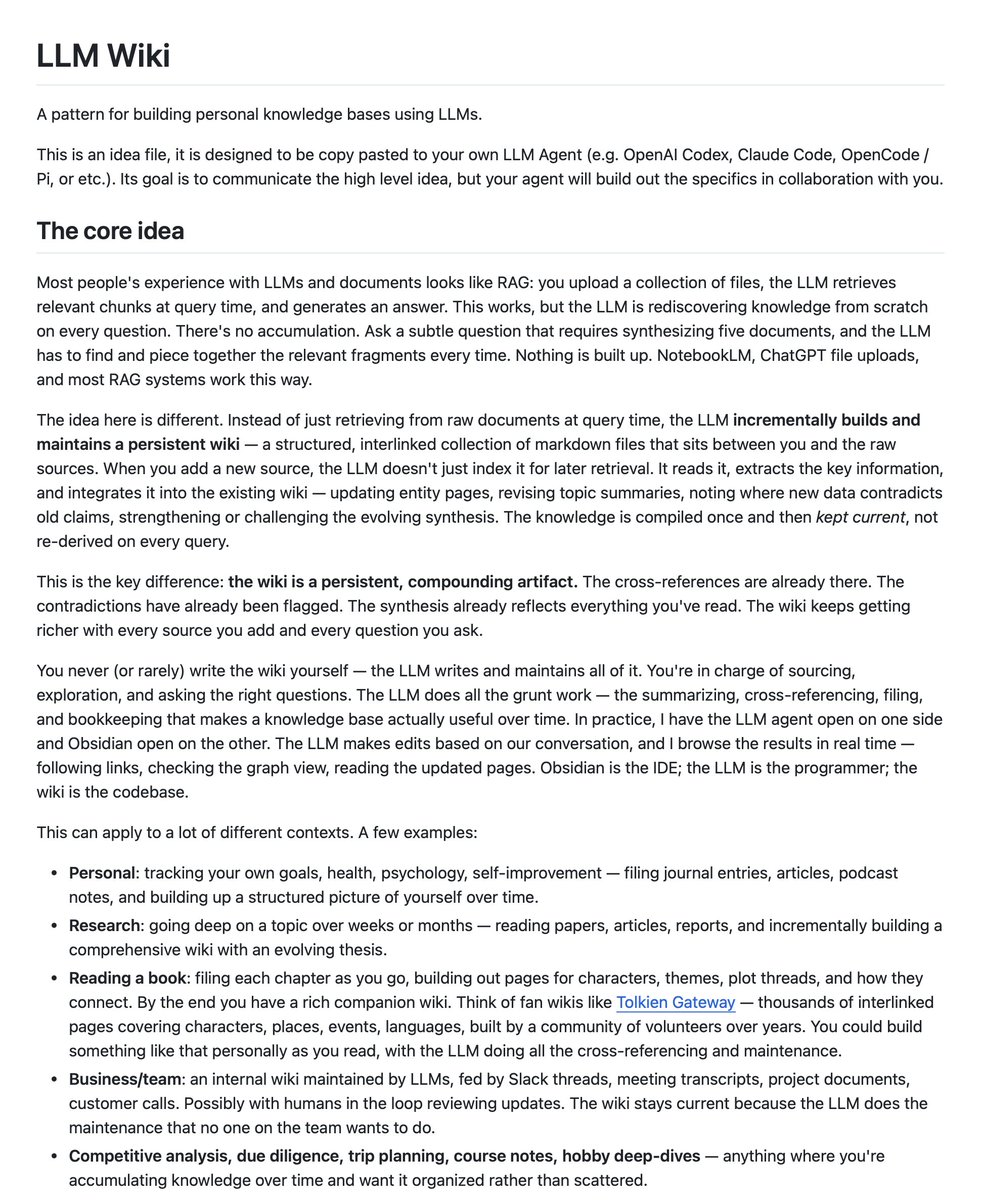
INTRODUCING LLM Wiki 🌐
A persistent, self-updating Markdown knowledge base.
Traditional RAG:
🧠Re-summarizes everything from scratch on every query → knowledge disappears into chat history.
LLM Wiki:
🤯Drop a source → LLM intelligently updates entity pages, summaries, cross-references, and flags contradictions. Knowledge actually compounds over time.
Obsidian = your IDE
LLM = your full-time programmer
Perfect for:
• Deep/long-term research
• Book companion wikis (characters, themes, plots)
• Personal life OS (goals, health, psychology)
• Business knowledge from meetings & transcripts
This pattern is legitimately better for anything where knowledge builds over weeks/months.
5k+ stars in 48 hours for a reason Gist: 👇🏻
https://t.co/LHNGD2KtUt
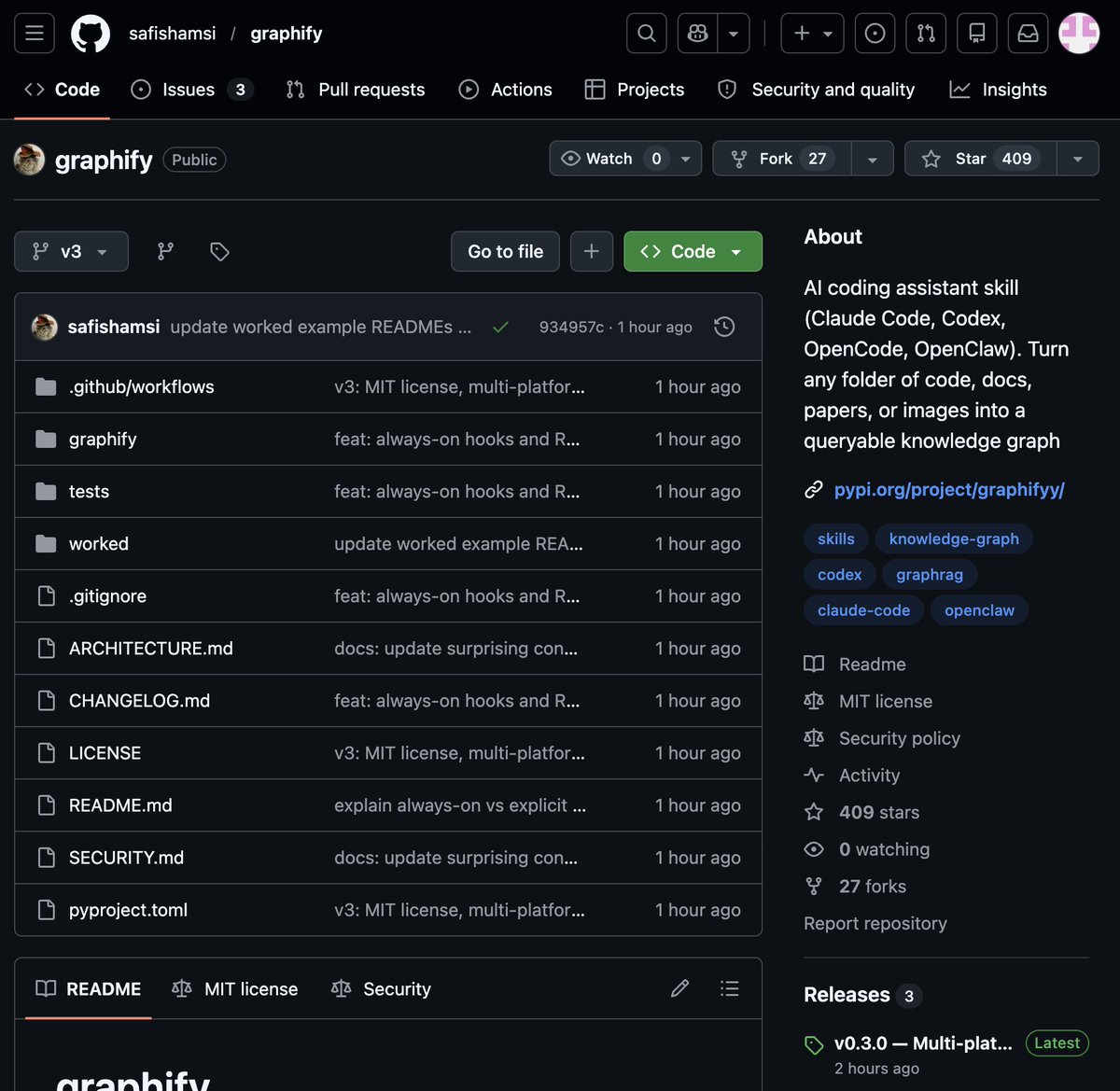
🚨 BREAKING: Someone just built the exact tool Andrej Karpathy said someone should build.
48 hours after Karpathy posted his LLM Knowledge Bases workflow, this showed up on GitHub.
It's called Graphify. One command. Any folder. Full knowledge graph.
Point it at any folder. Run /graphify inside Claude Code. Walk away.
Here is what comes out the other side:
-> A navigable knowledge graph of everything in that folder
-> An Obsidian vault with backlinked articles
-> A wiki that starts at index. md and maps every concept cluster
-> Plain English Q&A over your entire codebase or research folder
You can ask it things like:
"What calls this function?"
"What connects these two concepts?"
"What are the most important nodes in this project?"
No vector database. No setup. No config files.
The token efficiency number is what got me:
71.5x fewer tokens per query compared to reading raw files.
That is not a small improvement. That is a completely different paradigm for how AI agents reason over large codebases.
What it supports:
-> Code in 13 programming languages
-> PDFs
-> Images via Claude Vision
-> Markdown files
Install in one line:
pip install graphify && graphify install
Then type /graphify in Claude Code and point it at anything.
Karpathy asked. Someone delivered in 48 hours.
That is the pace of 2026.
Open Source. Free.
New open-source AI for hacking.
Shannon autonomously tests web apps by reviewing code and running real attacks, completing full pentests with minimal human input. https://t.co/GQU4FHHJ1j
🤯BIGGEST AI "LEAK" OF 2026 JUST HIT 134K STARST
The exact system prompts behind:
• Cursor
• Devin AI
• Claude Code
• v0
• Perplexity
• Windsurf
• 25+ more
Want to know how the top AI coding agents actually think?
This repo has it all.Steal them. Study them. Build better ones.
https://t.co/kNqZE90mXw
BREAKING: NEW @ClawSuite FEATURE 🧠
Introducing Operations
🤖 Chat with your main orchestrator agent
➕ Add & configure specialized sub-agents
⏰ Assign scheduled tasks & cron jobs
💬 Chat with each agent individually
📊 Monitor activity across your entire team
Your AI company, one dashboard.
Should we drop this feature?? Reply 👇
Coming soon to HermesAgent / https://t.co/4FTmsYD1WF