4/ By abolishing term limits, Xi Jinping has solidified his position as China’s de facto modern emperor. Through endless "anti-corruption" purges, he has dismantled political rivals and choked out any remaining civil dissent. Power is concentrating back into a single point, just as it has for 2,000 years. This is the true face of Chinese Imperialism. Unlike Western or European imperialism, China’s imperialism does not expand outward—China is already massive. Instead, it projects inward, plundering its own citizens.
There have never been true communists or laissez-faire capitalists in China’s ruling class. There are only two classes: the Tax-Eating Class (the Imperial rulers) and the Tax-Paying Class (the disenfranchised subjects). I cannot predict the exact future, but if the regime continues to suppress freedom while the economy spirals down, this massive empire will collapse. And as a Chinese, I dread to imagine the sheer catastrophe my compatriots will have to endure when the wheel turns once again.
3/ To understand the contemporary governance logic of the CCP, one must look at China's 2,000-year imperial inertia. The Daoist concept of Wu Wei (無爲) originates from the Dao De Jing(approx. 4th century BC), a time when China was divided into competing states. However, ever since the First Emperor unified China in 221 BC, the ruling ideology shifted permanently to a highly centralized, extractive institution.
Power concentrated solely in the Emperor. The bureaucracy became a tool to fund grandiose, vanity projects and cover the astronomical costs of maintaining social control. As early as 119 BC, the empire nationalized the salt and iron industries (a state-monopoly model derived from Guanzi approx. 4th century BC). Living essentials were monopolized by the state to generate up to half of the national revenue. The populace was heavily taxed and locked into agricultural labor. When peasants couldn't pay, they sold their lands to the tax-exempt gentry, becoming generational serfs. Whenever life became utterly unlivable, massive peasant uprisings would erupt, paving the way for ambitious warlords or foreign invaders to overthrow the dynasty. Yet, the new dynasty would simply reboot the same extractive system. It is a wheel that has turned for millennia.
When the CCP seized power, communism simply replaced Confucianism to provide a new veneer of ideological legitimacy. The governance model remained purely extractive. Mao Zedong became, in effect, a new emperor. His totalitarian ideological and economic controls—such as the Great Leap Forward and the Cultural Revolution—pushed Chinese society to the brink of collapse, resulting in tens of millions of unnatural deaths during peacetime.
Following Mao’s death, the Party initiated the "Reform and Opening-up" in 1978 as a self-preservation mechanism. They loosened economic grips and allowed private enterprise to breathe. The source of their legitimacy shifted to a transactional promise: "We will lead you to economic prosperity."
While China saw immense GDP growth over the decades, a vast portion of those who got rich in traditional industries (like real estate) were merely "white gloves" (frontmen) for corrupt officials engaging in rent-seeking. Even in the booming tech sector, private entrepreneurs must navigate a fragile web of political-business relationships, helping local officials hit political KPIs to secure promotions.
Furthermore, this wealth is highly polarized. Beyond the glittering skylines of Beijing and Shanghai lies a stark reality: over 600 million Chinese citizens still survive on a monthly income of less than 1,000 RMB (roughly $145 USD). In today’s economic downturn, resources are retreating back into the hands of monopolistic SOEs or a select few state-backed private giants. To compensate for lost tax revenue, the government has aggressively tightened tax collection on small entities, forcing mass bankruptcies and skyrocketing unemployment. This is all compounded by a ticking time-bomb of massive local government hidden debt.
2/ We must distinguish between the two types of large entities in China:
* State-Owned Enterprises (SOEs): They monopolize critical sectors like energy, mining, infrastructure, telecom, and finance. The state regulates them heavily, but primarily through political loyalty (today, SOE executives must be strictly vetted Party members). Operationally, they only need a veneer of compliance.
* Private Owned Enterprises (POEs): Large private tech giants or conglomerates must constantly worry about not stepping on the state’s toes or encroaching on state-monopolized turf. For instance, Alibaba’s Ant Group had its massive IPO abruptly halted because it dared to challenge the monopoly of traditional state-owned banks. In China, the state owns large companies, and national capitalism is strictly top-down.
Here are my thoughts on your observation. As someone who was born and raised in China and identifies politically as a libertarian, this topic hits very close to home.
1/ The Chinese government’s legislation and regulations have always been extremely rigid and pervasive. What looked like "laissez-faire" in the 1990s and 2000s was actually a byproduct of high enforcement costs, leading the state to default to selective enforcement. Moreover, the state deliberately creates regulatory ambiguity. There is an ancient Chinese legal maxim: "When the law is inscrutable, its authority is absolute and unpredictable" (法不可知,则威不可测). The regime uses this deliberate vagueness to rule the private economy through fear—no one knows when the axe will fall. Today, regulation on small entities has become suffocatingly strict, which is a major driver of China’s current economic stagnation.
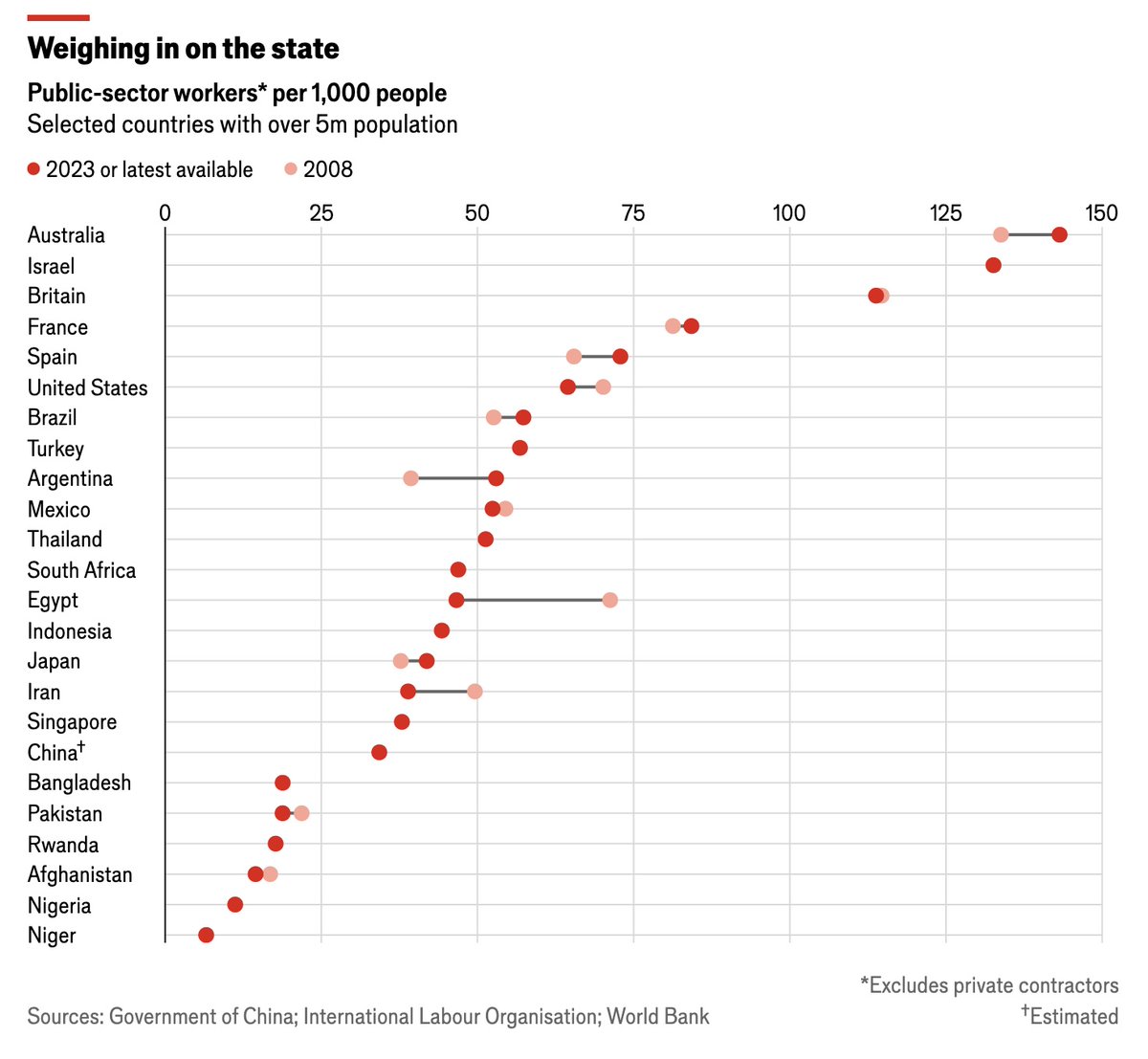
This sort of worries the hell out of me! No wonder productivity is low. Not blaming those employed in the public sector because the govt creates these jobs but this stat is not sustainable.
We shouldn’t criticise govt workers from this stat but we should critically examine how elected officials have built this moat around themselves.
I am sure many govt workers would take a job in the private sector if offered . They just want a purpose and be appreciated for what they do like everyone else. We are not heading in the right direction as a nation. When we have such a large portion on the government payroll it means that taxes have to be high to pay for those jobs , including the hidden taxes all of us pay to make this experiment work.
Let’s be the most innovative, creative, hard working and productive nation on the planet and pay less tax on the way so that we can have a standard of living that grows year after year! Instead of going backwards.
And let’s be the happiest and healthiest nation in the world and measure that yearly as well!
Read more about this graph here: https://t.co/0ZRFUwz3pu
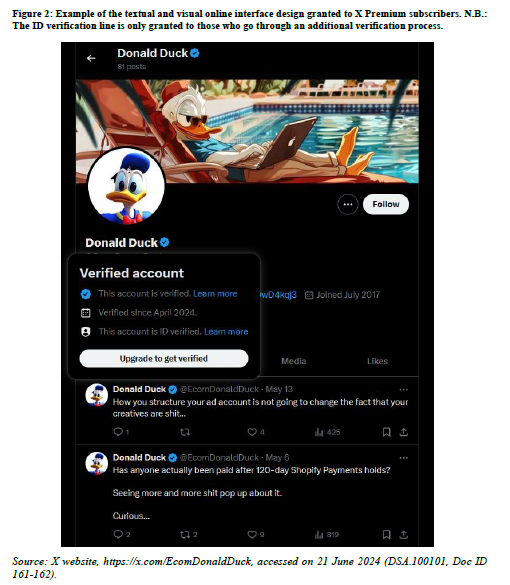
The Commission even gave an example of what it found so objectionable: a blue checkmark on a Donald Duck parody account.
It called the practice “deceptive.”
That’s right—the Commission fined X €45 million because its practices might lead users to believe that 1) this fictional duck had come to life, and 2) was a real X user.
1/
We visualized NDIS's entire Sep '25 budget.
The result: 44% of all funding now flows to just two diagnostic categories.
Explore the interactive breakdown below:
Media Shame File:
Sky News Australia goes totally woke and betrays its audience by cancelling Freya Leach's "free speech" show because guest @koreanscot made comments about Muslims that no-one watching would have been offended by.
https://t.co/POdyamCu14
So shocked to wake up and see the news that the brilliant young man Charlie Kirk has been shot dead. Rest in peace.
The lunatic left couldn’t debate him, so they shot him.
Yes @realmarklatham is correct - journo is a moron.
1. You can sell a property for any price to anyone … but purchaser still has to pay stamp duty on what a certified valuer says its market value is.
2. In divorce matters, same applies (but no stamp duty).
0% scandal here.
Shi Yongxin, head of the famous Shaolin Temple, was arrested yesterday. Authorities claim he has fathered 174 children out of wedlock. Who would’ve thought China’s biggest dad is a monk?!