Profiling of pneumococcal population structure during infection reveals an unappreciated role of bacteriocins in driving the development of pneumonia by facilitating the release of inflammatory mediators
https://t.co/RnHSLwAugP
Excited to share our latest work studying pneumococcal pneumonia. We found that pneumococcal population structures undergo massive changes within the lung. This bacteriocin-mediated turnover of the population "promotes" pneumococcal pneumonia
https://t.co/eAOhtMJ7Hv
🚨Excited to share our new study below!🚨
1/7: Childhood mortality from bacterial respiratory & enteric pathogens remains a global concern. But what compromises infants' ability to fight infections? Our study delves into the immune deficiencies intrinsic to early age.
Why are infants susceptible to invasive pneumococcal diseases? Excited to share our latest work led by @LokkenToyli which explores this question and elucidates the age-dependent mechanisms that drive pneumococcal spread from the mucosa. @PLOSPathogens
https://t.co/98o6PyLWsf
Is phenotypic variation functional? Stoked about our latest preprint spearheaded by the amazing Anne-Stephanie @DMF_UNIL@unil in collaboration with a fantastic team of people @vrrenske @suryad26@santosmoreno_j @LalouxLab @YSchaerli@WeiserLabNYU https://t.co/blwNxbQ3xg
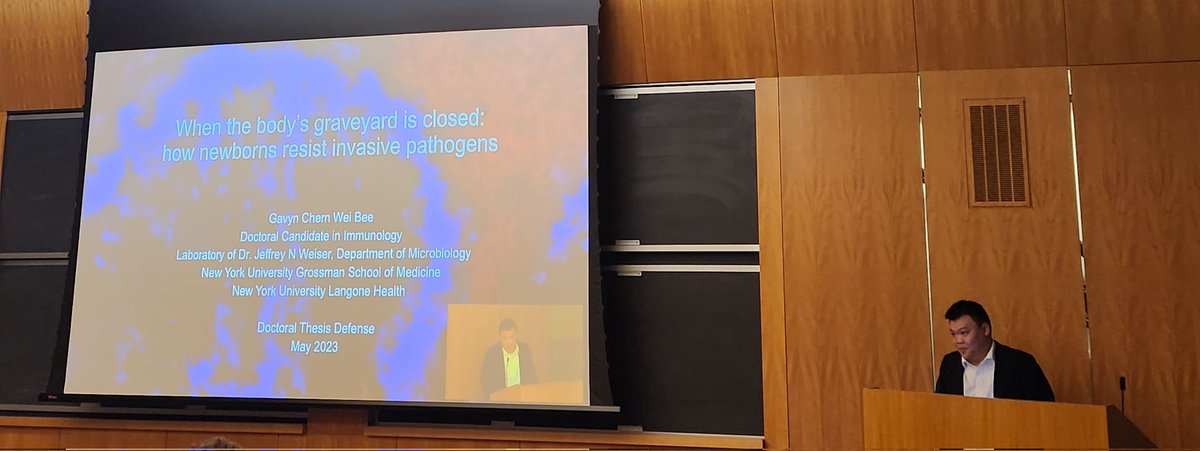
Congratulations to our newly minted PhD - Dr. Bee (@cwb315) did a fantastic job showcasing his research in the lab over the past 6 years! Well done 🎉🎊🍾
Excited to see Gavyn @cwb315 from @WeiserLabNYU@nyulangone defend his thesis defense. starting now! Brilliant and touching intro from Jeff! here we go!
Happy to share our latest work from @cwb315 that was published in @ImmunityCP earlier today!! Here is a tweetorial summarizing the major findings from this work.
Feels surreal but here it goes! Elated to share that my primary research from @WeiserLabNYU@nyugrossman@nyulangone is now out at @ImmunityCP! Tweetorial ahead! 1/n 🧵
https://t.co/Bg6SosK5iN
A selfish bacteriocin dictates pneumococcal domination:Trappetti/Paton discuss @suryad26@WeiserLabNYU work on population dynamics of S.pneumoniae colonization. Bacteriocin promotes survival of lineages, providing population bottleneck & limiting diversity https://t.co/URlqS3oxJG
A selfish program reduces S. pneumoniae diversity. Intra-strain competition upon #Spneumoniae colonization causes loss of clonal diversity. Bacteriocins induced by BlpC led to predation of kin & tightening of population bottlenecks @suryad26@WeiserLabNYU https://t.co/SRB9EPSFpL
Excited to share our latest from @suryad26, now on @biorxiv! We describe the unexpected role of BlpC in driving intra-strain competitive success, with physiological consequences on ecology of the colonizing strain and importantly, transmission to new hosts! Tweetorial below.
Pleased to share some of our latest work available online now in @cellhostmicrobe. In this work, we discovered that quorum sensing induced bacteriocins mediate intra-strain competition in pneumococcus during colonization and transmission.
https://t.co/wA8l9ZTMNz
Congratulations to graduate student Sheya @ma_sheya for passing her qualifying examination and becoming a PhD candidate. Looking forward to all the discoveries she’ll make in the lab.
Excited to share our latest from @suryad26, now on @biorxiv! We describe the unexpected role of BlpC in driving intra-strain competitive success, with physiological consequences on ecology of the colonizing strain and importantly, transmission to new hosts! Tweetorial below.
Happy to share this manuscript where we study the population dynamics of pneumococcus during colonization and transmission. We used chromosomal barcoding to examine how the population structure of pneumococcus changes following infection. (1/n)