I would have expected the market to start discerning between SaaS that is impacted by AI, SaaS that needs to evolve, and SaaS that benefits from AI. Analytical SaaS, Creative SaaS is in category 1, System or Record, Human workflow and Engagement and Productivity are in category 2 and Infrastructure SaaS and Cybersecurity are in 3. This constant paranoid reaction of the market will continue to create buying opportunities for the discerning.
Where this is actually leading
For the longest time consulting was seen as the dirtiest of dirty revenue source in software. Yuck. Who wants it. Push it down to other orgs if ppl really need it. Do the bare min, at lowest cost.
I think it's about time a lot of software companies re-thought this approach.
@atelicinvest Software used to be all custom developed in the 80's and 90's and then it went to packaged then SaaS and perhaps we are back to custom? Different DNA than software. Engineering focused IT services may have a play here.
The best of being @satyanadella is that he is rethinking the whole MS stack in AI agent age himself — the CEO who is visionary CTO.
Not leaving someone else to reinvent Excel or Dynamics. I am sure he doesn’t want smartphone issue that MS faced.
@atelicinvest What do you make of Ben Thompson's point that because development is cheap now, every SaaS Co will be in every other SaaS co's business and you will be constantly defending? Affects pricing, expand rates etc.
The Fed has destroyed the financial system by explicitly monetizing the government, implicitly stepping in to monetize fiscal impropriety via an unlimited repo backstop, and generating extreme and capricious redistributions of wealth to favour asset owners. They’ve engineered a position of fiscal dominance and can’t tighten rates effectively, either. Since they blew out the balance sheet rate hikes on that balance sheet just lead to more monetization. And the 3% of GDP fiscal blowout on rate hikes in 2023 shows that. At that time, the Fed had printed so much money (in excess of both a 15yr fiscal blowout and even the demands of a euphoric bubble in 2021-22), there was a latent $2.5tr in RRP. They did nothing to neutralize or absorb that liquidity and then it automatically seeped out as repo markets tightened, reflating the bubble from 2023 to now. The financial markets now rest on an unprecedented amount of repo lending to NBFIs bc the Fed accommodated both the fiscal supply, and the repo market, and bailed out the sovereign at par with the BTFP.
The Fed doesn’t understand the second order consequences of what they do, how the balance sheet works, or the socially disastrous impacts of their policy. They’ve brought the currency to the brink of a monetized dish wars spiral and seem to have no awareness of this if Powell’s comments on gold are anything to go by.
They care not practitioners - all the academics there use single-stage models (when the economy is a dynamic non-equalizing cycle), unsullied by contact with reality. And they don’t ever learn from the systematic errors their models produce.
To answer your question the FOMC should be replaced by a systematic macro algorithm based on projected potential real GDP growth. Nothing more. No inflation bias, no sovereign or financial backstop. Easy to build. The emotional human involvement here is not necessary and extremely corrosive.
FY 2025 Letter is up
It has been more than 4 years since we began!
In this letter, we talk about our top holdings and how the portfolio is positioned going forward.
https://t.co/j9gngyAn3S
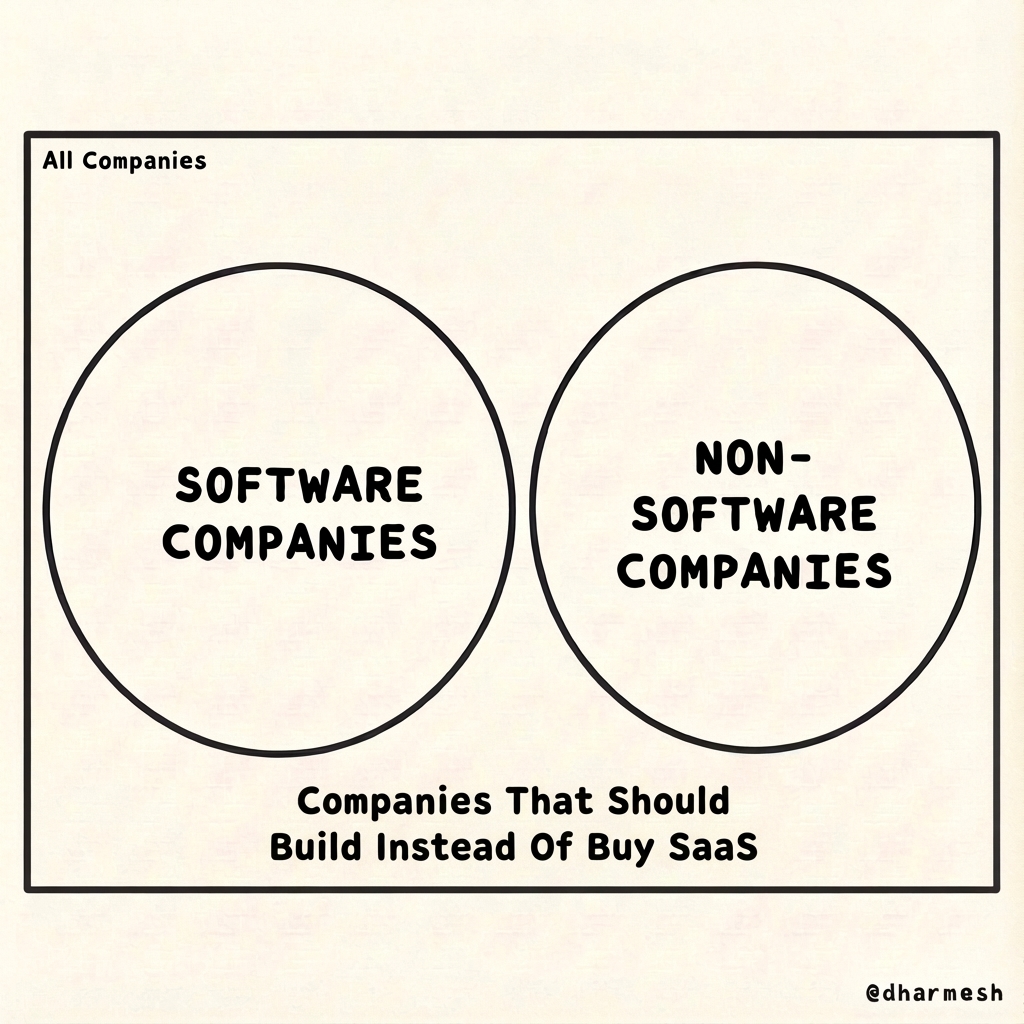
"Why should companies pay for SaaS (HR/CRM/ERP/etc.) when they could just vibe code them?"
I get variations of this question or comment with some regularity (granted, it's sometimes just me talking to myself).
Here are some biased (but hopefully, well-considered) thoughts:
1) I am a big proponent and user of vibe coding (what I call "agentic coding"). I do it every day, 7 days a week, including Sundays. It's amazing.
2) My company, HubSpot is a software company. We have hundreds of professional engineers -- just about all of them use AI for product development too. They are brilliant and know how to build production-grade products.
3) Even with this powerful army of talent, the number of internal, core SaaS applications that we have replaced with a vibe-coded variant is exactly ZERO. The number of applications we plan to replace is also exactly ZERO.
4) It's not the absence of talent that keeps us from rolling our own SaaS apps, it's the presence of focus. It would be silly to try and replace our HR, team collaboration, expense tracking and 100+ other SaaS apps we use when we can just buy them. Just doesn't make sense.
5) That's us -- as a software company at some scale. If you're a non-software company it makes even less sense for you. Doesn't matter how good the AI coding tools get. Let's say you *could* vibe code a replacement for that SaaS app you're using, who's going to maintain it? Who's going to keep up with industry trends? What are you going to do when the 20-something genius that vibe coded it over a weekend leaves the company? Who do you call when there's a major bug?
6) If you're a Fortune 500 company at some scale, perhaps you could pull this off for some discrete use cases and the tradeoffs are worth it. You have an IT/Engineering department that is larger than the population of some countries. You can take on the pain in return for the positives.
For the millions of others, my advice is:
Spend every calorie possible on creating value for your customers.
@eh_jon Difficult to say. Not something I would have expected of this board. Is the issue in project accounting, or is something else wrong? Does it affect all of Brazil or a few projects? Brazil is ~15% of revenues and the market reaction has been much more than that.
@ashish2902 Epam doing much better. Others like Cognizant and Genpact also doing much better. This is a very specific Dava issue due to their scale, vertical concentration and client concentration.
@atelicinvest That's what you thought 20% ago!
On Friday, $20 bn in crypto was liquidated in 1.6 mn accounts. These degens had $12.5 mn per account! So, there is obv money to be made being a degen.
Okay let me clear this debate (longer post but needed).
As someone who’s worked at market-neutral L/S pods and at a 40-ticker LO fund - I can safely say both are retarded ways to invest and both sides can stfu. The only true (and correct) way to invest is one that champions flexibility and adaptability whereby the PM is free to make directional bets with varying levels of concentration, turnover, net exposure, and leverage. This set up has increasingly become rare, but is the only path for the best investors.
Pods and LOs are alike are constructed in a way to obscure the mediocrity and downright incompetence of the vast majority of institutional active managers. What do you do when 90% of people in an industry are shit at their jobs? You create these institutional constraints to convince LPs they need you and excuse underperformance. It’s no surprise passive has taken majority share.
L/S pods are retarded because stock prices don’t move on fundamentals over the short term, yet pods are comped on daily P&L and have no ability to have 1-2 year duration for when the fundamentals do matter. Hence a big disconnect between theory and application. You want market neutral? Stick with FX, commodities, or quant. But stop pretending your “deep fundamental research” will consistently work in a portfolio that is a hodgepodge of beta and factor hedges with very high turnover and strict volatility limits. In other words the pod style is literally fugazi and everyone is just praying each day random price movements don’t zero them out.
LO mutual funds are equally as retarded on the other end of the spectrum. Pure beta exposure with performance that is consistently below their index. Most of these managers can’t pick winning stocks because they think emulating fundamental analysis 101 gives them the right to generate alpha. You want to outperform via quality? Yeah, get in line next to the other thousand managers. What’s worse - if you want to outperform via quality then you need much higher degree of portfolio concentration and much higher time horizon. Living by annual performance with 40 tickers that seldom change simply won’t cut it.