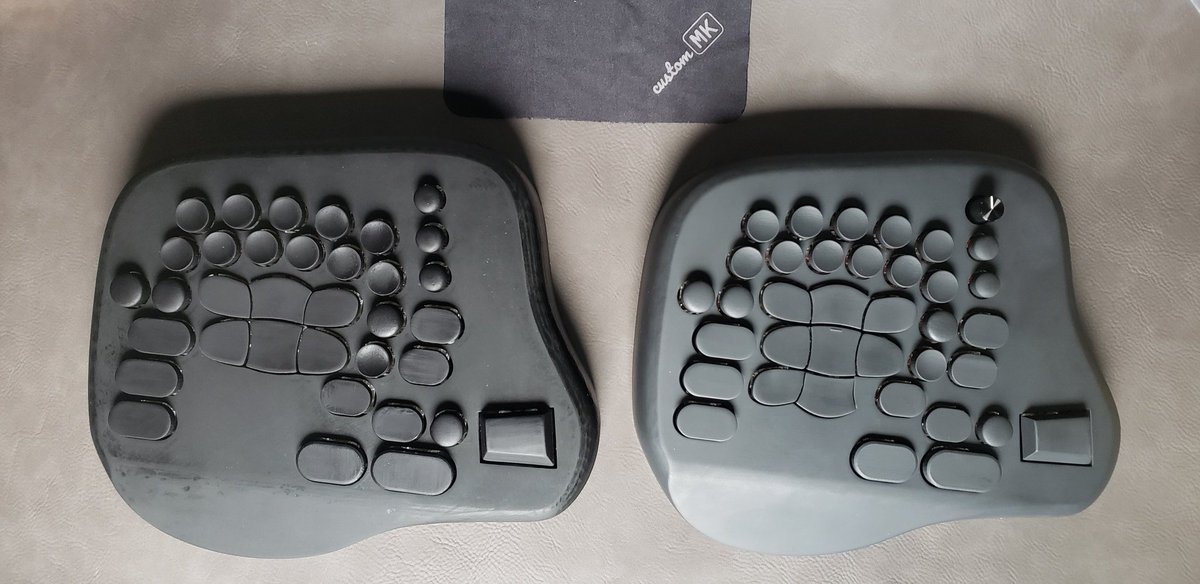
@arturo182 If they're unidirectional digital signals, then add a tiny WLCSP FPGA between them and just buffer the signals through, let the silicon sort it out. Might feel a bit like https://t.co/HTV9EiMNSx though...
@arturo182 They just didn't take it far enough to be interesting. Make it "Blink an LED with Etherium blockchain smart contracts" and I'd at least be intrigued.
@glarses1 "I suppose the clicky sounds can be considered somewhat musical..." (submits dissertation as a "Stomp Out Loud"-style music video using only mechanical keyboard clicking sounds)
@kristopherbl1 @arturo182@digikey Logically, yes. But practically... "do I want to pay for shipping and have nothing to show it, or use this a convenient opportunity to buy some more stuff I wanted anyway"
@_MG_@colinoflynn@arturo182 I think what Paul Graham said about coding applies to schematics: write code primarily for people to read, and only incidentally for the computer to understand. While I allow myself to make a mess in the creation process, if I don't clean up later, it comes back to haunt me.
@arturo182@theavalkyrie Perhaps fear of commitment? I mean, if someone paid you good money for it, you'd feel obligated to respond to customer questions, maintain inventory, do bookkeeping, pay taxes on sales, etc. when all you wanted to do was make a good, useful thing and share it with the world...
Today’s the day! Come to our launch day party at the #asugsvsummit to find out how you can be a part of improving the #edtech industry 🚀💪🏽
https://t.co/FrWPLFrSMk
@tedyapo Strongbad's version of the book "Everyone is Different" taught me that some people are squirrel-handed. Perhaps we are merely witnessing their handiwork.
@nturley47 I like to compare FPGAs to factories. In a factory, different people and equipment have different jobs and everyone does their separate jobs simultaneously, to collectively make a car or something like that. FPGAs are just factories for bits, where calculations happen in parallel
@tedyapo I have trust issues with footprints that I didn't generate. Until I've proven to myself that the measurements match the datasheet dimensions, I can't bring myself to use even the simplest footprint from a public component library
@helenleigh @brianmoreau @samaaron Yes, something like that. The Firmata protocol is based on the MIDI protocol, and Firmata on microbit exists (https://t.co/QcQHCGowRN) so in theory, you should be able to do MIDI directly over the USB port
Today, we kicked off the 6th cohort of the #ATTAspireAccelerator! Eight different companies working across some of the most pressing issues in Education. Excited to get started working with each of them to boost equitable outcomes for all! #edtech
Excited to have educators from 30 states and 5 countries registered to attend #edcampQ. Please reach out if you are an ed tech vendor interested in sponsoring prizes or discount codes for our "virtual" swag bags! Register today at https://t.co/lbyD4K5p8G.
@Marty_Rice@hugs@Chris_Gammell@esden@pdp7 No. Silkscreen is usually about 0.0005" thick, whereas a solderpaste stencil (and resulting solder) is typically 10x thicker at 0.005" thick. Soldermask is about 0.0008", so even the combined thickness of soldermask + silkscreen is not enough to affect solder paste deposition.